
Shoulder Rehab Pulley & Arms System is a manual physiotherapy exercise equipment designed to support controlled shoulder and arm movement during rehabilitation. The pulley-based system allows one arm to assist the movement of the other, making it useful for selected range-of-motion, mobility, flexibility, and strengthening exercises.
The system can be used in physiotherapy clinics, rehabilitation centres, hospitals, sports rehabilitation facilities, and suitable home exercise programs after professional instruction. A typical shoulder pulley system consists of pulleys, a durable cord or rope, mounting hardware, and handles that allow the user to perform controlled arm movements.
The National Health Systems Resource Centre (NHSRC) describes shoulder pulleys as physiotherapy equipment used to stretch the shoulder in different directions to improve shoulder mobility and function. Its technical specification includes a wall-mountable construction, two nylon pulleys, two grip handles, and a durable nylon cord.
PHYSIOMODALITIES™ provides practical physiotherapy and rehabilitation equipment designed for professional clinical environments. The Shoulder Rehab Pulley & Arms System can be incorporated into an exercise therapy area alongside shoulder wheels, wall ladders, parallel bars, treatment couches, and other rehabilitation equipment.
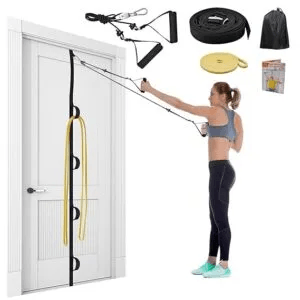
What Is a Shoulder Rehab Pulley & Arms System?
A Shoulder Rehab Pulley & Arms System is a manual exercise and rehabilitation apparatus that uses a pulley mechanism to facilitate controlled shoulder and arm movements.
The pulley is generally mounted at an appropriate height, with a rope or cord passing through the pulley and handles positioned at both ends. The user holds the handles and uses one arm to assist the movement of the opposite arm.
This assisted movement can be useful when active movement of the affected shoulder is limited. The exact exercise, range, repetitions, and resistance should be selected according to the individual’s rehabilitation requirements.
Shoulder pulley systems are commonly used for active-assisted range-of-motion exercises, including movements in different directions of the shoulder.
Key Features of Shoulder Rehab Pulley & Arms System
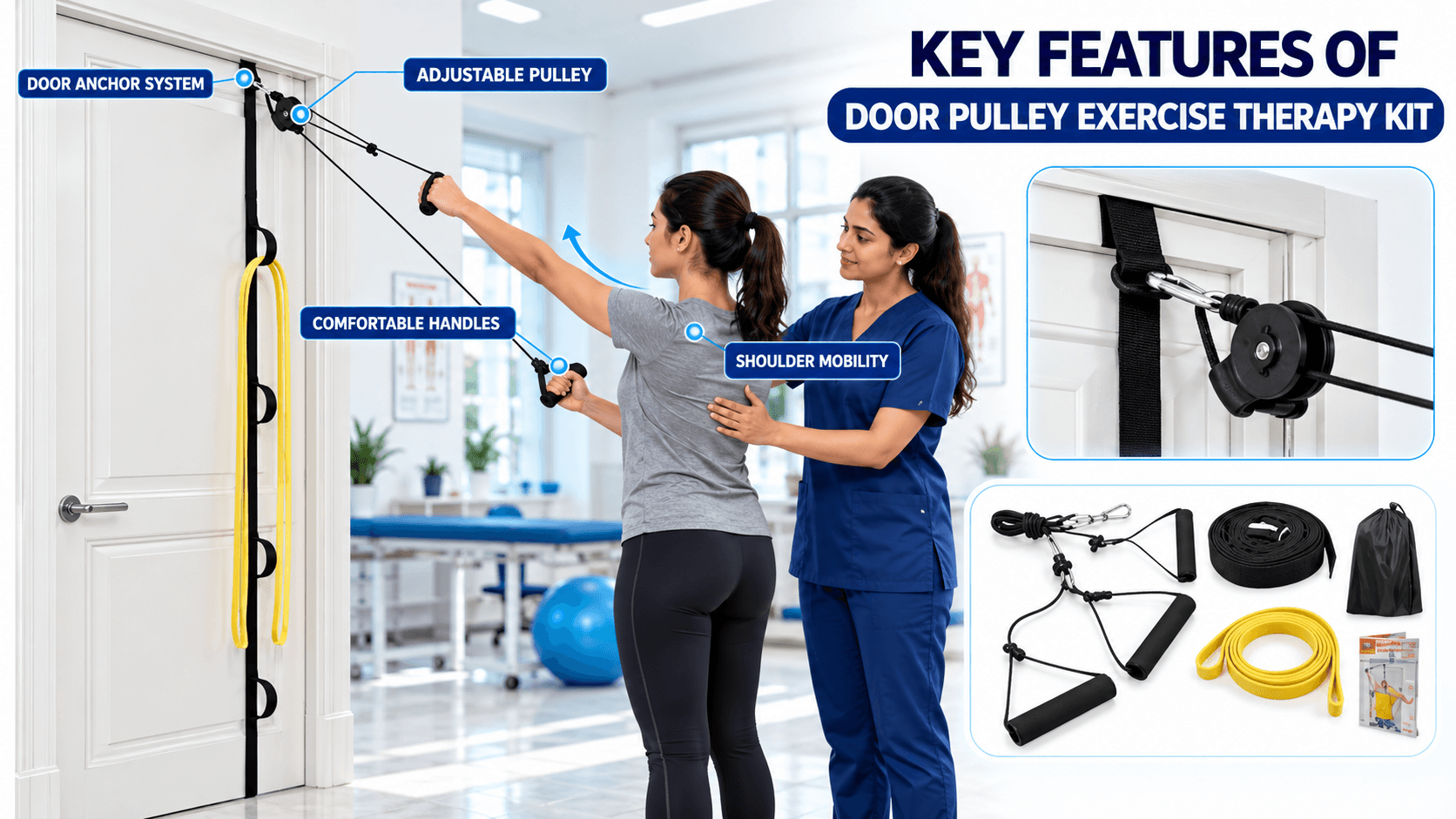
Dual Pulley Mechanism
The system can incorporate two pulley points to provide a smooth rope-guided movement for shoulder and arm exercises.
Durable Cord or Rope
A strong cord provides the connection between the handles and pulley mechanism. The exact rope material and length depend on the selected configuration.
Comfortable Grip Handles
Handles allow the user to maintain a secure grip while performing controlled rehabilitation movements.
Wall-Mounted Design
Wall-mounted systems can be installed in a suitable location within the physiotherapy exercise area. NHSRC specifications describe a wall-mountable shoulder pulley with mounting hardware.
Manual Operation
The system does not require electrical power and is operated through controlled patient movement.
Adjustable Exercise Movement
Depending on the system configuration and rope arrangement, the user can perform different shoulder and arm movement patterns.
Compact Rehabilitation Equipment
A wall-mounted pulley system requires relatively little floor space, making it practical for physiotherapy clinics with dedicated exercise areas.
How Does the Shoulder Pulley System Work?
The Shoulder Rehab Pulley & Arms System works through an assisted movement principle.
The user holds one handle in each hand. When one arm pulls downward, the pulley mechanism allows the opposite arm to move upward with assistance.
This arrangement can allow the stronger or less affected arm to assist the movement of the opposite shoulder. This is particularly useful when the affected arm cannot comfortably complete the desired movement independently.
The movement should remain controlled rather than forceful. The physiotherapist determines the appropriate range and exercise technique based on the patient’s condition.
Applications of Shoulder Rehab Pulley & Arms System
The system can be incorporated into several physiotherapy and rehabilitation programs.
Shoulder Range-of-Motion Exercises
A pulley system can support controlled shoulder movement in different directions, helping therapists introduce assisted mobility exercises.
Frozen Shoulder Rehabilitation
Shoulder pulleys are commonly used as part of exercise programs for restricted shoulder mobility, including frozen shoulder rehabilitation. Government physiotherapy training material describes shoulder pulley exercises for improving range of motion and lists frozen shoulder among their uses.
Post-Surgical Rehabilitation
After appropriate clinical assessment, pulley exercises may be incorporated into selected shoulder rehabilitation programs following surgery.
The timing and permitted movement range must be determined by the treating healthcare professional.
Shoulder Stiffness
Controlled assisted movement may be incorporated into rehabilitation programs for patients experiencing shoulder stiffness.
Arm Mobility Training
The system can also be used for selected elbow and upper-limb mobility exercises. Some commercially available shoulder pulley kits are specifically designed for reciprocal, assistive, and resistive shoulder and elbow exercises.
Sports Rehabilitation
Sports rehabilitation professionals can incorporate pulley exercises into appropriate shoulder mobility and movement-control programs.
Benefits of Shoulder Rehab Pulley & Arms System
When used appropriately as part of a professionally designed rehabilitation program, a Shoulder Rehab Pulley & Arms System can provide several practical benefits:
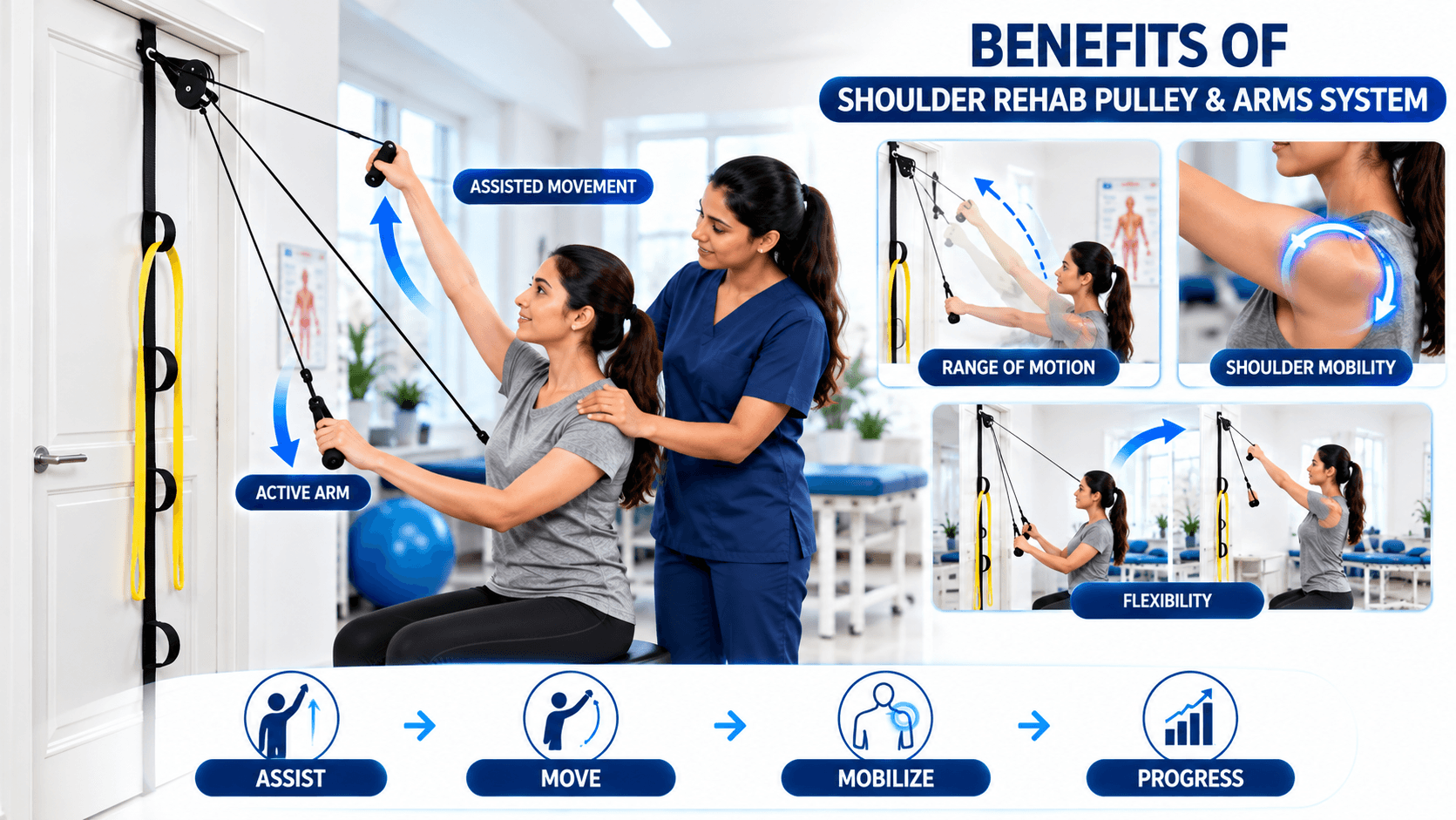
- Supports assisted shoulder movement
- Helps practice controlled range-of-motion exercises
- Allows one arm to assist the other
- Supports shoulder mobility training
- Can be incorporated into flexibility exercises
- Useful for selected arm rehabilitation programs
- Provides a simple manual exercise mechanism
- Requires no electrical power
- Compact for physiotherapy treatment areas
- Can be used in clinical rehabilitation settings
- Suitable for progressive exercise under professional supervision
The system does not independently treat a medical condition. Its usefulness depends on correct exercise selection, patient condition, technique, and professional supervision.
Shoulder Rehab Pulley for Physiotherapy Clinics
A shoulder pulley is a simple but useful addition to a physiotherapy exercise area.
During rehabilitation, the physiotherapist may need to work on controlled shoulder movement while avoiding unnecessary loading. A pulley system provides an assisted movement mechanism that can be incorporated into an individualized exercise program.
The therapist can monitor posture, movement quality, range of motion, and patient tolerance while the exercise is performed.
Because the equipment is manually operated, it can also be used alongside other exercise therapy equipment without requiring a separate power supply.
Shoulder Mobility Training
Normal shoulder movement requires coordinated motion across the shoulder complex.
When movement becomes restricted, rehabilitation may include carefully selected mobility exercises. A pulley system can provide assistance during these exercises, allowing the user to gradually practice movement within an appropriate range.
The NHSRC specifically identifies shoulder pulleys as equipment intended to stretch the shoulder in different directions to improve mobility and function.
The therapist should determine the appropriate movement direction and range rather than forcing the shoulder beyond a comfortable or clinically permitted range.
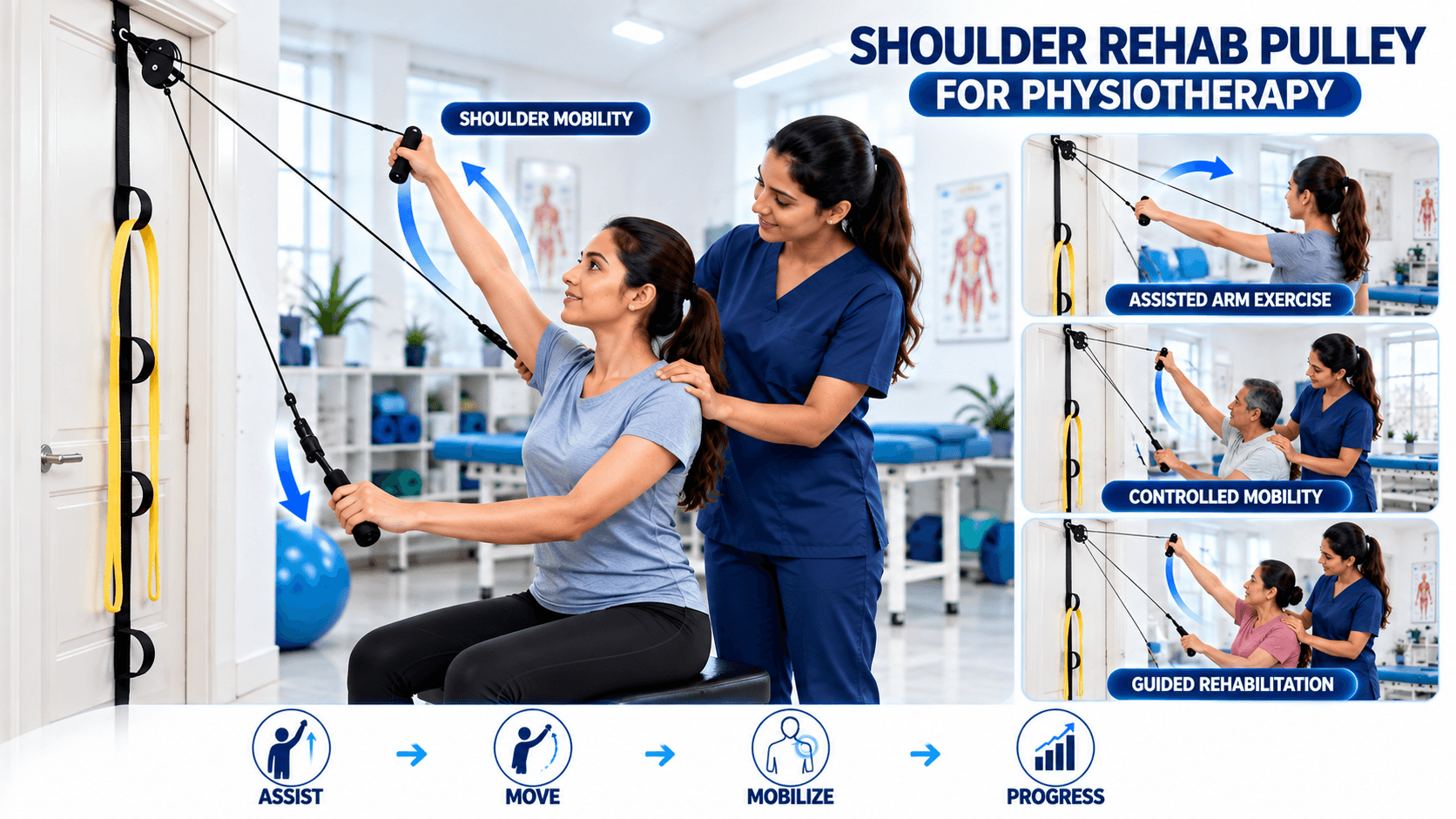
Shoulder Rehab Pulley for Arm Exercises
The pulley mechanism can also be incorporated into selected arm exercises.
Depending on the setup, exercises may involve:
- Assisted arm elevation
- Shoulder flexion
- Shoulder abduction
- Controlled shoulder mobility
- Elbow movement
- Upper-limb stretching
- Reciprocal arm movement
- Selected strengthening exercises
The specific exercises should be chosen according to the patient’s rehabilitation program.
Shoulder Pulley for Frozen Shoulder
Frozen shoulder, also known as adhesive capsulitis, can involve significant restriction in shoulder movement.
Shoulder pulley exercises may be incorporated into a rehabilitation program to provide controlled, assisted movement. Government physiotherapy training material specifically describes shoulder pulley exercises for different shoulder movements and lists frozen shoulder among the conditions in which they may be used.
However, the appropriate range and intensity vary from person to person. Exercises should therefore be performed according to professional guidance.
Shoulder Pulley After Surgery
Post-operative shoulder rehabilitation requires careful progression.
A pulley system may be introduced when the treating clinician considers assisted movement appropriate. The exercise range, timing, repetitions, and movement restrictions depend on the type of surgery and the individual’s recovery.
Patients should not begin pulley exercises after surgery without following the rehabilitation instructions provided by their healthcare professional.
How to Use Shoulder Rehab Pulley & Arms System
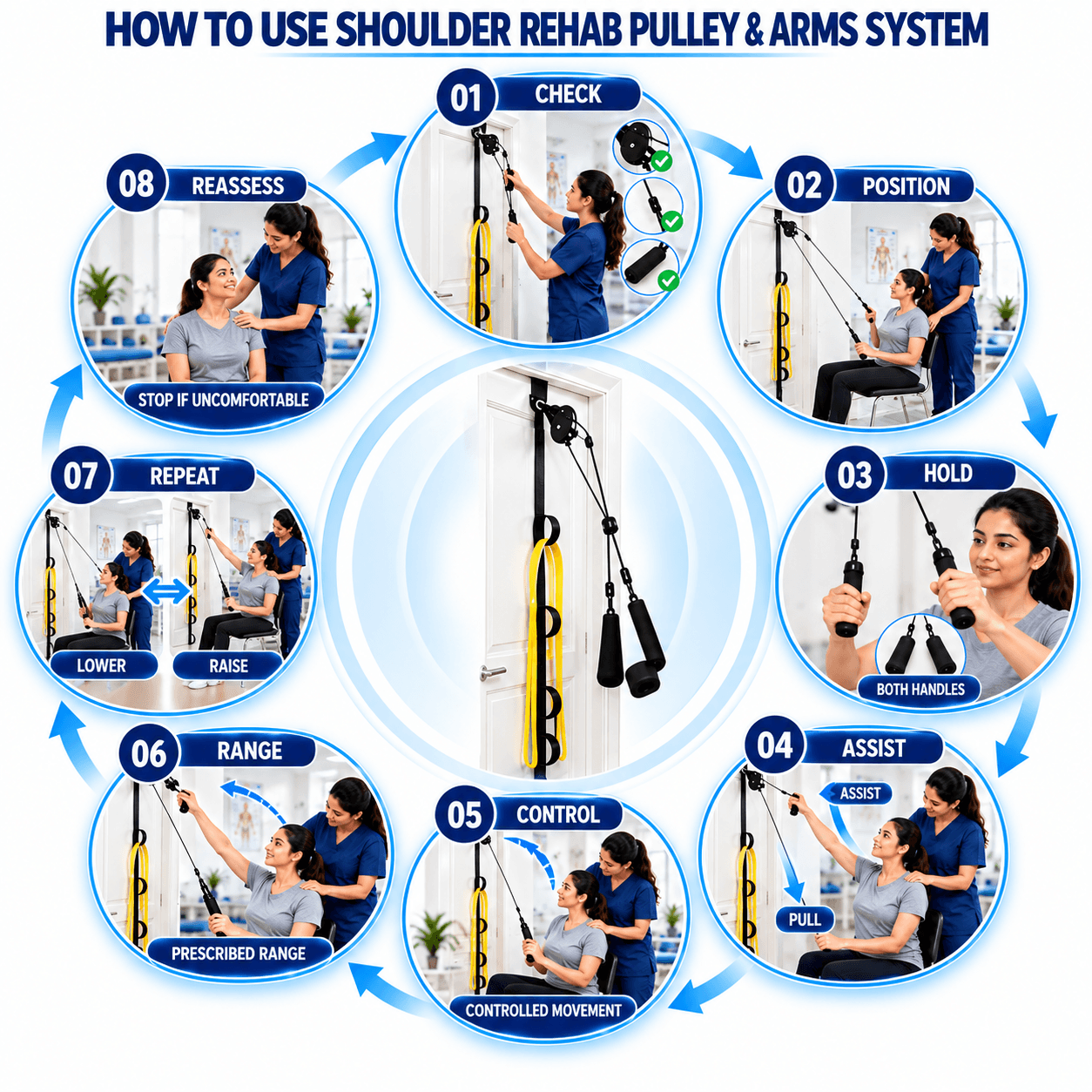
Step 1: Check the Equipment
Inspect the pulley, mounting points, rope, handles, and other components before beginning the exercise.
Step 2: Sit or Stand Correctly
Position the patient according to the prescribed exercise. Good posture is important during shoulder movement.
Step 3: Hold Both Handles
Hold one handle with each hand using a comfortable grip.
Step 4: Begin Assisted Movement
Use the stronger or less affected arm to gently assist the movement of the opposite arm through the pulley.
Step 5: Maintain Controlled Movement
Perform the movement slowly and avoid sudden pulling or jerking.
Step 6: Stay Within the Prescribed Range
Do not force the shoulder beyond the range recommended by the physiotherapist.
Step 7: Repeat as Prescribed
Complete the required repetitions and sets according to the rehabilitation program.
Step 8: Stop and Reassess if Necessary
If unusual pain, dizziness, or significant discomfort occurs, stop the exercise and seek professional guidance.
Safety Precautions
- Inspect the pulley and mounting system before use.
- Ensure wall mounting or other attachment points are secure.
- Check the rope or cord for signs of wear.
- Check that handles are firmly attached.
- Use controlled movements rather than sudden pulling.
- Do not force the shoulder into painful positions.
- Follow post-operative movement restrictions where applicable.
- Do not exceed the manufacturer’s specifications for any component.
- Maintain correct posture during exercises.
- Use the system under professional guidance when beginning rehabilitation.
- Stop the exercise if unusual pain or other concerning symptoms occur.
Maintenance of Shoulder Rehab Pulley & Arms System
Regular inspection can help maintain the functionality of the system.
The pulley mechanism should be checked for smooth movement. The rope or cord should be inspected for fraying, stretching, or other visible damage.
Wall brackets, hooks, mounting hardware, and handles should also be checked periodically to ensure that they remain secure.
The equipment should be cleaned according to the manufacturer’s recommendations, particularly when shared by multiple patients in a clinical environment.
Who Can Use the Shoulder Rehab Pulley?
The Shoulder Rehab Pulley & Arms System is intended for use in physiotherapy and rehabilitation environments.
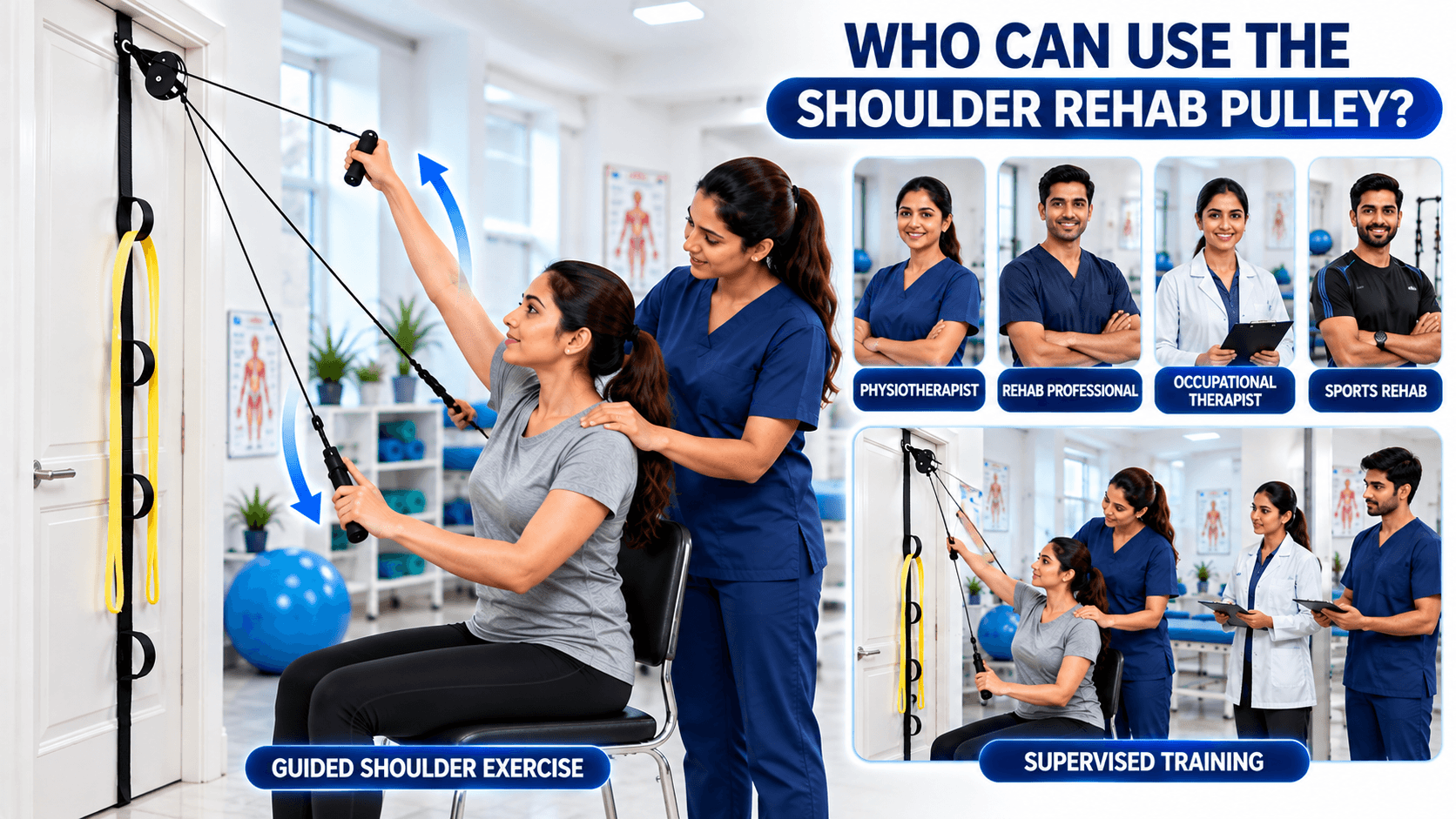
Potential users include:
- Physiotherapists
- Rehabilitation professionals
- Occupational therapists, where appropriate
- Sports rehabilitation professionals
- Physiotherapy students under supervision
- Patients following professional instruction
The appropriate exercise should be selected according to the individual’s condition and rehabilitation goals.
Shoulder Rehab Pulley for Clinic Setup
A shoulder pulley can be combined with other upper-limb and exercise therapy equipment to create a dedicated rehabilitation area.
A physiotherapy clinic may include:
- Shoulder pulley
- Shoulder wheel
- Finger ladder
- Wall ladder
- Exercise bars
- Parallel bars
- Suspension frame
- Treatment couch
- Resistance bands
- Exercise balls
- Hand and wrist exercisers
The combination allows therapists to select different exercises according to individual rehabilitation requirements.
Things to Consider Before Buying
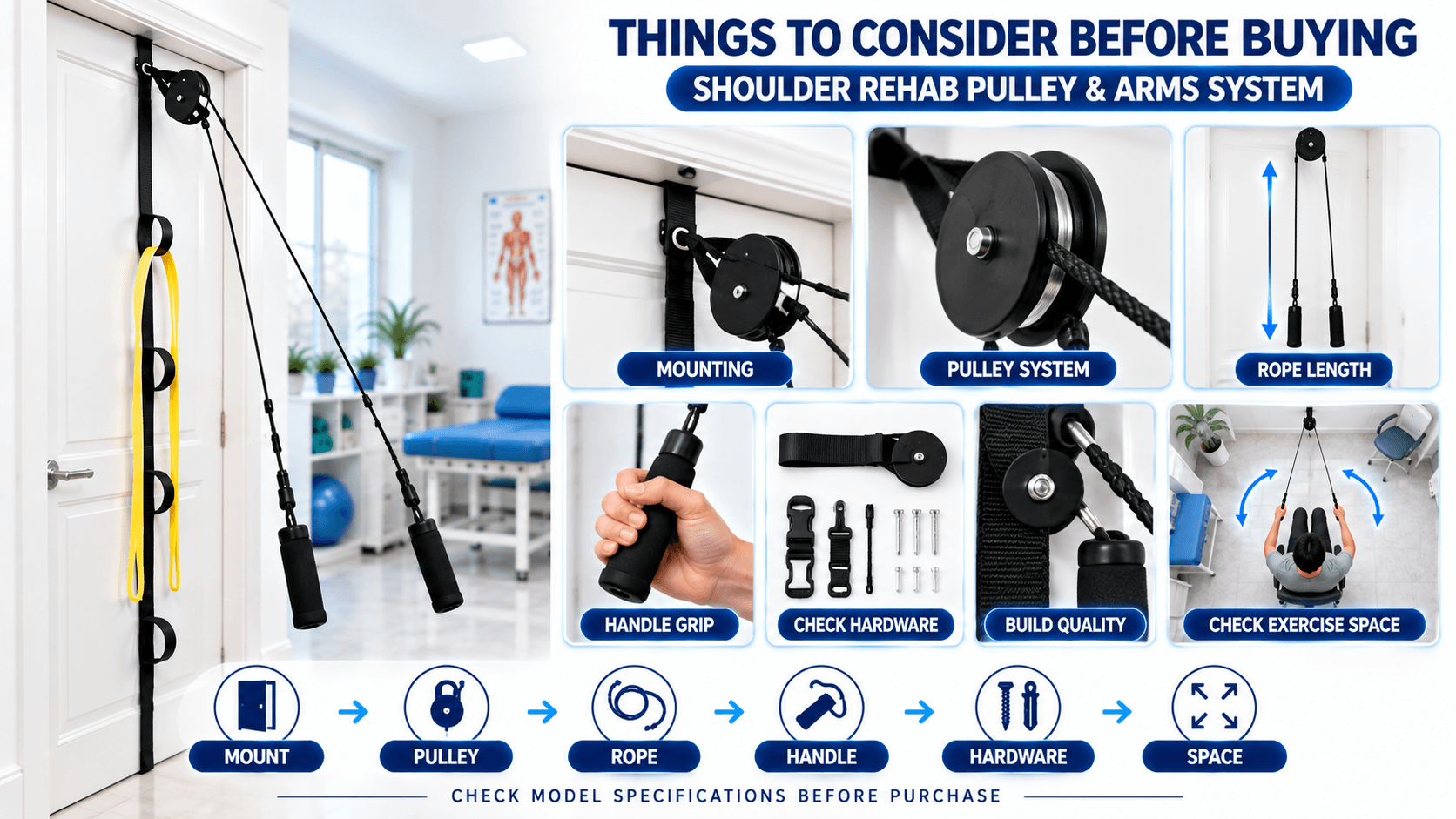
Mounting Type
Check whether the system is designed for wall mounting, door mounting, or another installation method.
Pulley Configuration
Confirm the number of pulleys and the type of pulley mechanism included.
Rope Length
Choose a suitable rope length according to the installation height and intended exercise area.
Handle Design
Look for comfortable and secure handles suitable for repeated clinical use.
Mounting Hardware
Confirm whether brackets, hooks, screws, and other installation hardware are included.
Construction Quality
Check the material and overall build quality of the pulley, rope, handles, and mounting components.
Clinic Space
Measure the available wall and exercise area before installation.
Technical Specifications
| Specification | Details |
|---|---|
| Product Name | Shoulder Rehab Pulley & Arms System |
| Product Type | Shoulder & Upper-Limb Rehabilitation Equipment |
| Primary Application | Shoulder Mobility & Arm Exercise |
| Operation | Manual |
| Mounting | Wall Mounted / Configuration Dependent |
| Pulley System | Dual Pulley / Model Dependent |
| Rope/Cord | Durable Cord, Configuration Dependent |
| Handles | Two Grip Handles |
| Mounting Hardware | Model Dependent |
| Power Requirement | None |
| Exercise Type | Active-Assisted & Controlled Shoulder Movement |
| Applications | Physiotherapy, Rehabilitation & Exercise Therapy |
| Suitable Environment | Clinics, Hospitals & Rehabilitation Centres |
| Brand | PHYSIOMODALITIES™ |
Specifications may vary according to the selected model. Confirm pulley type, mounting system, rope length, handle design, and included accessories before purchase.
Why Choose PHYSIOMODALITIES™?
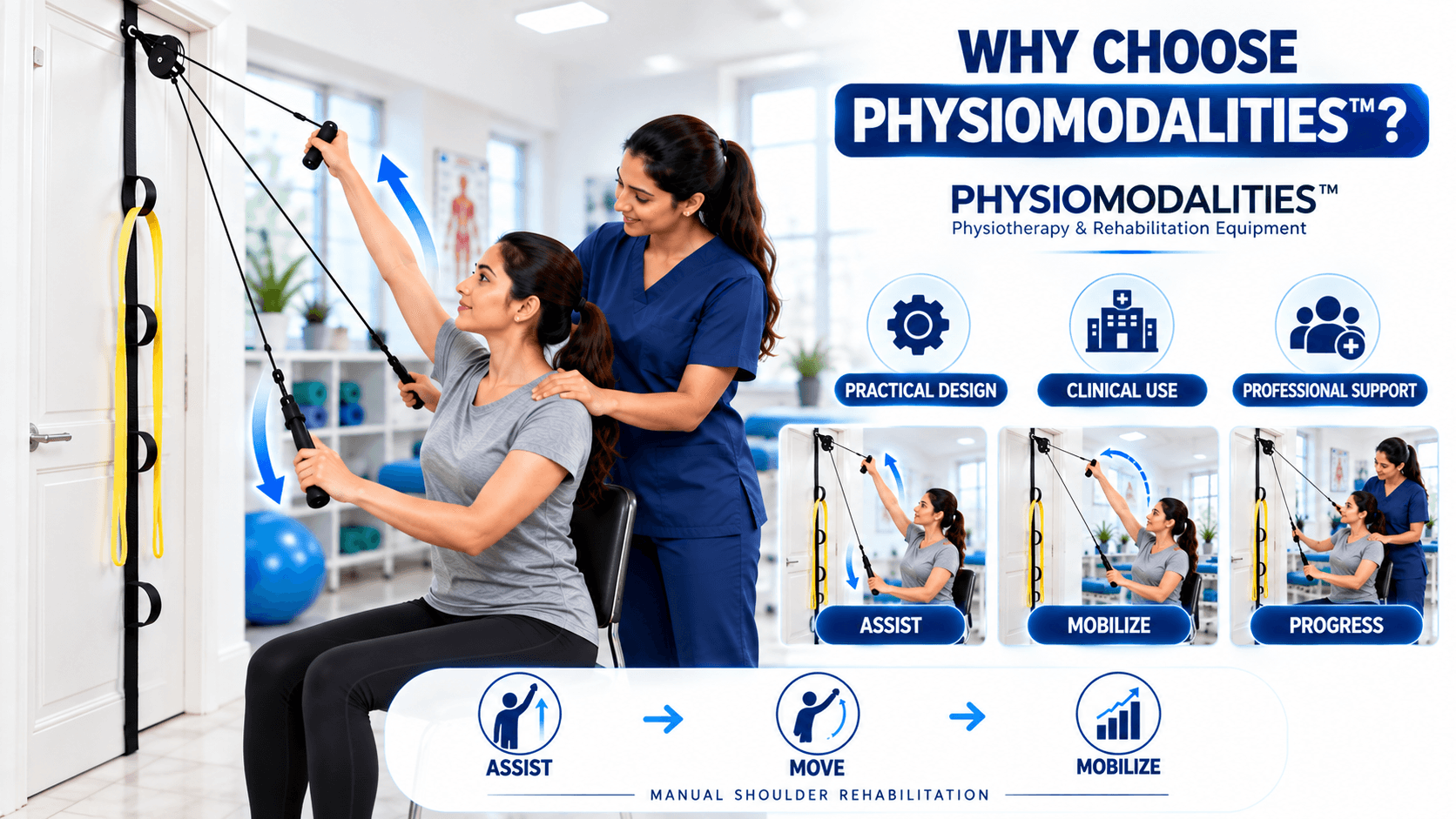
PHYSIOMODALITIES™ focuses on practical physiotherapy and rehabilitation equipment for professional healthcare environments.
A Shoulder Rehab Pulley & Arms System provides a straightforward mechanical solution for assisted shoulder and upper-limb exercises. Its compact design can make it suitable for dedicated exercise areas where therapists need an accessible shoulder mobility system.
When selecting a shoulder pulley, clinics should consider construction quality, mounting method, pulley mechanism, rope length, handle comfort, available space, and the accessories included with the system.
Conclusion
A Shoulder Rehab Pulley & Arms System is a practical manual physiotherapy device designed to support controlled shoulder and arm rehabilitation exercises. Its pulley mechanism allows one arm to assist the other, making it useful for selected mobility and active-assisted range-of-motion exercises.
The system can be incorporated into rehabilitation programs for shoulder stiffness, restricted mobility, post-operative recovery, frozen shoulder, sports rehabilitation, and other clinically appropriate upper-limb exercise programs.
With a compact design, manual operation, and simple pulley mechanism, it can be a useful addition to physiotherapy clinics, rehabilitation centres, hospitals, and exercise therapy areas.
PHYSIOMODALITIES™ provides practical rehabilitation equipment designed to support organized and functional physiotherapy environments.
Frequently Asked Questions
1. What is a Shoulder Rehab Pulley & Arms System?
It is a manual physiotherapy exercise system that uses pulleys, rope or cord, and handles to support controlled shoulder and arm movements.
2. What is a shoulder pulley used for?
A shoulder pulley is used for selected assisted range-of-motion, mobility, flexibility, and rehabilitation exercises for the shoulder and upper limb.
3. Can it be used for frozen shoulder?
Yes. Shoulder pulley exercises may be incorporated into professionally supervised rehabilitation programs for restricted shoulder movement, including frozen shoulder.
4. Does the system require electricity?
No. A standard manual shoulder pulley system operates through the pulley, rope, and handles and does not require electrical power.
5. Can the shoulder pulley be used after surgery?
It may be used during appropriate stages of post-operative rehabilitation, but the timing and permitted movements should be determined by the treating healthcare professional.