
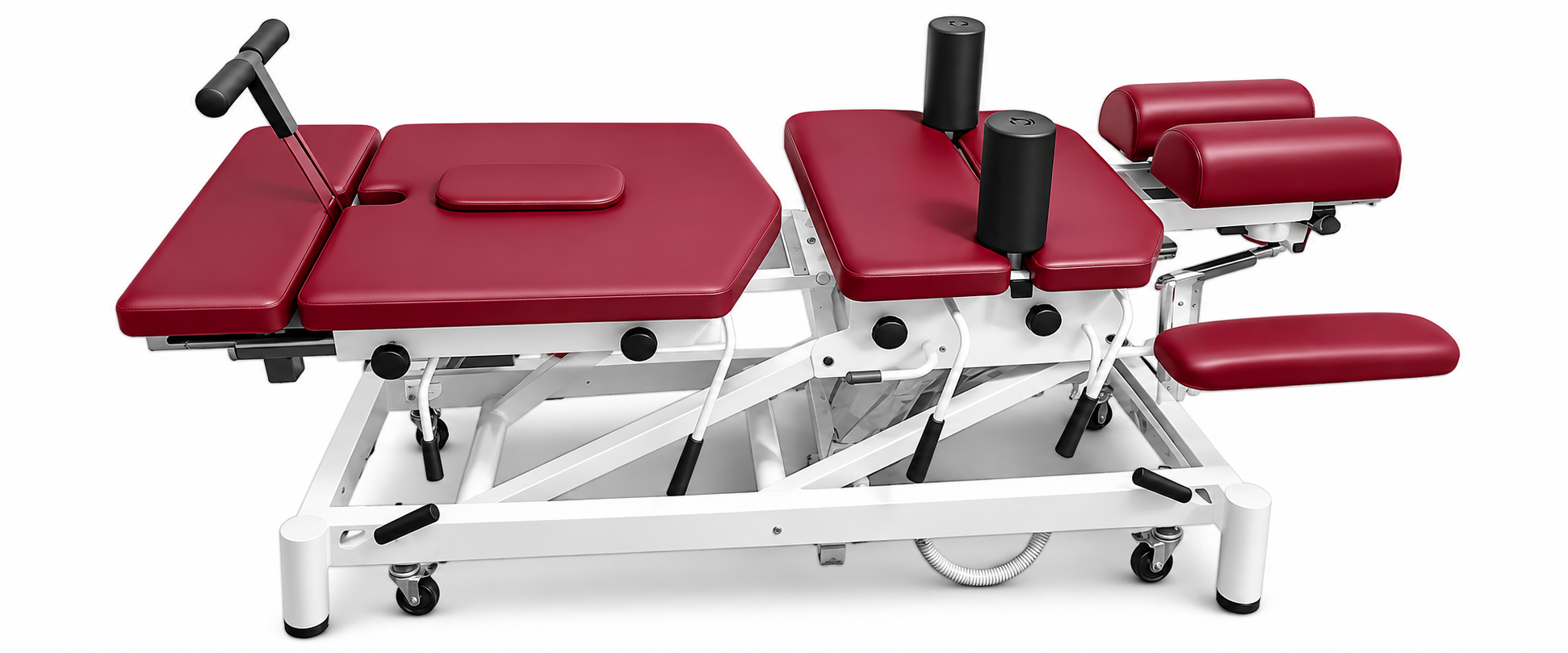
Spinal Decompression Chiropractic Treatment Table – Professional Spinal Therapy Equipment
Introduction to Spinal Decompression Chiropractic Treatment Table
The Spinal Decompression Chiropractic Treatment Table is specialized equipment designed for professional chiropractic and spinal rehabilitation environments. It is intended to support controlled patient positioning and selected spinal decompression or traction-based treatment procedures, depending on its mechanical design.
The spine plays an essential role in supporting the body, maintaining posture, protecting the spinal cord, and allowing movement. It consists of cervical, thoracic, and lumbar regions, along with vertebrae, intervertebral discs, ligaments, muscles, and nerves. Musculoskeletal problems, injuries, degenerative changes, and physical strain can affect spinal function and everyday mobility.
A Spinal Decompression Chiropractic Treatment Table provides a dedicated treatment platform that may allow practitioners to position patients and perform selected decompression procedures using the table’s available mechanical or adjustment systems.
Depending on the model, the table may include a divided treatment surface, adjustable sections, manual or motorized controls, patient support arrangements, and other specialized features. Not every table includes all these functions, so the actual product specifications should always be verified.
For chiropractic clinics, physiotherapy centres, orthopedic hospitals, and spinal rehabilitation facilities, selecting an appropriate treatment table requires consideration of its operating mechanism, patient positioning, adjustment options, safety features, and intended clinical applications.
PHYSIOMODALITIES ENTERPRISES provides professional physiotherapy, rehabilitation, orthopedic, and healthcare equipment for clinical environments.
What Is a Spinal Decompression Chiropractic Treatment Table?
A Spinal Decompression Chiropractic Treatment Table is a specialized treatment table designed to support selected spinal traction, decompression, and chiropractic procedures.
Spinal decompression refers to treatment approaches intended to modify compressive loading on spinal structures through controlled positioning or traction. Different equipment designs use different operating methods.
Some tables provide practitioner-controlled manual adjustment, while other systems may use powered mechanisms to apply controlled traction according to selected settings.
The table provides a stable and supportive treatment surface while allowing the practitioner to position the patient according to the selected procedure.
The exact working principle, adjustment range, traction capability, and supported treatment areas depend on the particular model.
Importance of Spinal Decompression in Chiropractic Treatment
Spinal decompression is considered in selected clinical situations where a practitioner believes that controlled traction or unloading may be appropriate.
The spine experiences mechanical loading during everyday activities such as standing, walking, sitting, bending, and lifting. Certain musculoskeletal conditions may be associated with pain, stiffness, and reduced mobility.
A suitable decompression table may provide a structured platform for selected treatment procedures under professional supervision.
1. Controlled Spinal Traction
Depending on its design, the table may support controlled traction procedures intended to apply a selected pulling force to the spinal region.
2. Patient Positioning
The treatment table helps practitioners position patients appropriately for the intended spinal procedure.
3. Support for Chiropractic Procedures
A specialized chiropractic table can support selected manual or mechanical treatment techniques.
4. Professional Treatment Setup
The equipment provides a dedicated treatment surface for spinal rehabilitation and chiropractic services.
5. Complementary Rehabilitation Approach
Decompression-based procedures may be considered alongside therapeutic exercises, mobility training, and other interventions when clinically appropriate.
Working Principle of a Spinal Decompression Chiropractic Treatment Table
The working principle depends on the table’s mechanical configuration. A decompression table may use controlled traction, manual adjustments, movable sections, or powered mechanisms.
A general treatment process may include the following stages:
1. Patient Assessment
The healthcare professional evaluates the patient’s symptoms, medical history, spinal condition, and suitability for the intended treatment.
2. Patient Positioning
The patient is positioned on the treatment table according to the selected procedure and manufacturer instructions.
3. Patient Support and Stabilization
The practitioner ensures that the patient is appropriately supported. If the model includes specific support or restraint arrangements, these are used according to the operating instructions.
4. Treatment Parameter Selection
For systems with adjustable traction controls, the professional selects suitable settings within the device’s operating limits and the prescribed treatment protocol.
Manual systems are adjusted according to their design and the practitioner’s technique.
5. Controlled Decompression or Traction
The table performs its intended function through the available manual or mechanical mechanism. Treatment should remain within the prescribed limits and the patient’s tolerance.
6. Patient Monitoring
The practitioner monitors the patient’s comfort, symptoms, and response during the procedure.
7. Post-Treatment Assessment
The patient’s response is reviewed, and further treatment is decided according to clinical findings.
Important: Traction force, treatment duration, adjustment range, motor functions, and programmable settings must not be assumed without the specific model’s technical documentation.
Common Applications of Spinal Decompression Chiropractic Treatment Table
A Spinal Decompression Chiropractic Treatment Table may be considered in professional settings for selected spinal therapy and rehabilitation procedures.
1. Lower Back Pain Management
Lower back discomfort can be associated with muscular strain, disc-related conditions, joint problems, and other musculoskeletal factors.
Selected patients may be considered for traction-based treatment when clinically appropriate. The treatment should be selected after proper assessment rather than based only on symptoms.
2. Lumbar Spinal Rehabilitation
The lumbar spine supports a significant portion of the body’s weight and is involved in bending, lifting, and everyday movement.
A suitable decompression table may support selected lumbar traction procedures as part of a broader rehabilitation programme.
3. Cervical Spine Treatment
Some specialized systems may support selected cervical traction or positioning procedures.
Cervical treatment requires particular care, patient screening, and professional training. Not every decompression table is designed for cervical applications.
4. Selected Disc-Related Conditions
Certain patients with disc-related symptoms may be assessed for traction-based treatment. However, suitability depends on the specific diagnosis and clinical findings.
Decompression should not be presented as a guaranteed treatment for disc bulges, herniated discs, or degenerative disc disease.
5. Spinal Mobility Rehabilitation
Selected spinal treatment approaches may be combined with mobility exercises and strengthening programmes when appropriate.
6. Chiropractic and Manual Therapy Practice
The table may provide a treatment platform for qualified practitioners performing selected chiropractic and spinal therapy procedures.
Spinal Decompression for Lumbar Spine Treatment
The lumbar spine is the lower section of the spinal column and consists of five vertebrae. It supports body weight and contributes to bending, lifting, and other movements.
Some patients experience lower back pain due to muscular strain, disc-related problems, degenerative changes, or other conditions.
A spinal decompression table designed for lumbar applications may support selected traction procedures under professional supervision.
Treatment selection should consider:
- Patient Diagnosis
- Symptom Severity
- Spinal Stability
- Medical History
- Neurological Findings
- Contraindications
- Equipment Specifications
- Treatment Objectives
A decompression table is not a replacement for a complete lumbar rehabilitation programme.
Spinal Decompression for Cervical Spine Treatment
The cervical spine is the upper section of the spinal column and consists of seven vertebrae. It supports head movement and protects important neurological structures.
Selected cervical traction approaches may be used for certain neck-related conditions after appropriate assessment.
A treatment table should only be used for cervical applications if its design and manufacturer instructions specifically support them.
The practitioner must carefully assess the patient and avoid inappropriate traction or positioning.
Features to Look for in a Spinal Decompression Chiropractic Treatment Table
The available features depend on the manufacturer and model. Important equipment-selection factors include:
1. Strong Frame Construction
A stable frame is important for supporting the patient and maintaining safe operation during clinical procedures.
2. Adjustable Treatment Sections
Some tables include divided or movable sections that support specific patient positions or treatment techniques.
3. Traction Mechanism
For decompression systems, review whether the device uses manual or powered traction and how the mechanism is controlled.
4. Patient Positioning Supports
Check the available head, torso, pelvic, and lower-limb support arrangements.
5. Control System
Motorized models may include electronic controls or treatment settings. Manual systems may use mechanical adjustment controls.
6. Patient Weight Capacity
Confirm the manufacturer’s stated maximum supported patient weight.
7. Safety Mechanisms
Review the available safety controls, operating limits, emergency procedures, and manufacturer recommendations.
8. Upholstery and Treatment Surface
The treatment surface should provide appropriate patient support and be suitable for routine clinical cleaning.
9. Maintenance Requirements
Check the inspection and maintenance procedures for the frame, moving components, adjustment mechanisms, and other parts.
Benefits of a Spinal Decompression Chiropractic Treatment Table
A suitable treatment table can provide practical advantages for healthcare facilities offering spinal rehabilitation and chiropractic services.
Dedicated Spinal Treatment Setup
It provides a specialized platform for selected spinal decompression and traction-based procedures.
Supports Controlled Treatment Procedures
Depending on the model, the table may allow manual or mechanical adjustment within defined operating limits.
Patient Positioning Support
The treatment surface and available supports help practitioners position patients according to the intended procedure.
Professional Chiropractic Equipment
It can form part of a dedicated treatment setup for chiropractic and spinal rehabilitation services.
Complements Rehabilitation Programmes
When clinically appropriate, decompression-based treatment may be combined with therapeutic exercises and other rehabilitation interventions.
Suitable for Specialized Facilities
Depending on its intended use, the table may be considered for chiropractic clinics, physiotherapy centres, and rehabilitation hospitals.
These are potential equipment-related advantages, not guaranteed clinical outcomes.
Spinal Decompression Chiropractic Treatment Table vs Regular Chiropractic Bed
| Feature | Spinal Decompression Treatment Table | Regular Chiropractic Bed |
|---|---|---|
| Main purpose | Designed for decompression or traction procedures | Supports chiropractic positioning and manual therapy |
| Operating mechanism | Manual or powered, depending on model | Usually manual adjustment or positioning |
| Traction function | May include a dedicated traction mechanism | Not necessarily available |
| Treatment controls | May include traction adjustments or programmed controls | Depends on table construction |
| Main application | Selected spinal decompression procedures | General chiropractic and manual therapy |
A regular chiropractic bed should not be described as a decompression table unless its design supports the required traction or decompression function.
Spinal Decompression Table vs Motorized Traction Machine
Although these terms are sometimes used together, different products may have different operating mechanisms.
| Comparison | Spinal Decompression Table | Motorized Traction Machine |
|---|---|---|
| Design | Specialized treatment table | Powered traction equipment |
| Patient support | Table-based positioning | Depends on traction system |
| Operation | Manual or powered, depending on model | Motor-driven |
| Adjustment | Depends on mechanical configuration | Electronic or mechanical controls |
| Application | Selected spinal decompression procedures | Controlled cervical or lumbar traction, depending on model |
Always check the specific equipment’s intended use before comparing products.
Who Can Use a Spinal Decompression Chiropractic Treatment Table?
This equipment is intended for appropriate professional healthcare environments where trained practitioners provide spinal and musculoskeletal treatment.
Potential facilities include:
- Chiropractic Clinics
- Physiotherapy Clinics
- Orthopedic Hospitals
- Spinal Rehabilitation Centres
- Multispecialty Hospitals
- Sports Rehabilitation Centres
- Manual Therapy Clinics
- Medical Colleges
- Healthcare Training Institutions
- Professional Rehabilitation Facilities
The table should be used only by appropriately trained professionals and according to its intended application.
Safety Guidelines for Spinal Decompression Treatment
Patient screening is essential before using any spinal decompression or traction equipment.
Important Safety Precautions
- Review the patient’s medical history.
- Confirm the diagnosis and suitability of traction.
- Follow the manufacturer’s operating instructions.
- Check the table and patient support arrangements before treatment.
- Use only the available and verified adjustment settings.
- Avoid excessive traction or uncomfortable positioning.
- Monitor the patient’s symptoms throughout the procedure.
- Stop treatment if symptoms worsen or new neurological symptoms occur.
- Inspect mechanical and electrical components as recommended.
- Maintain appropriate cleaning and servicing procedures.
Conditions Requiring Special Assessment
Particular caution or specialist clearance may be necessary in patients with:
- Suspected spinal fractures
- Severe osteoporosis
- Spinal instability
- Recent spinal surgery
- Spinal infection
- Spinal malignancy
- Severe or progressive neurological symptoms
- Certain vascular conditions
- Acute traumatic spinal injuries
- Unexplained severe spinal pain
This is not a complete contraindication list. Cervical and lumbar traction have different risk profiles, and the treating professional must assess each patient individually.
How to Choose the Right Spinal Decompression Chiropractic Treatment Table
Before purchasing a Spinal Decompression Chiropractic Treatment Table, healthcare facilities should evaluate its technical specifications and suitability for their intended procedures.
1. Identify the Treatment Requirements
Determine whether the table is required for lumbar decompression, cervical applications, general spinal positioning, or another specific procedure.
2. Confirm the Operating Mechanism
Check whether the equipment uses manual adjustment, powered traction, or another mechanical approach.
3. Review Traction Specifications
For a traction-capable system, verify the supported force range, adjustment method, and operating limits from the manufacturer’s documentation.
4. Check Patient Positioning
Review the available supports, table sections, positioning arrangements, and ease of patient access.
5. Evaluate Frame Quality
Check the frame material, structural stability, construction, and suitability for regular clinical use.
6. Review Control and Safety Features
Understand how the equipment is operated and what safety mechanisms are provided.
7. Check Dimensions and Weight Capacity
Confirm the table’s dimensions, installation requirements, and maximum supported patient weight.
8. Confirm Warranty and Technical Support
Review the warranty, installation support, training, servicing, and availability of spare parts.
Why Choose PHYSIOMODALITIES ENTERPRISES?
PHYSIOMODALITIES ENTERPRISES provides physiotherapy, rehabilitation, electrotherapy, orthopedic, and healthcare equipment for professional clinical environments.
Healthcare facilities exploring a Spinal Decompression Chiropractic Treatment Table should consider the actual operating mechanism, supported treatment applications, construction quality, safety features, and technical support.
PHYSIOMODALITIES ENTERPRISES supports clinics, hospitals, rehabilitation centres, and healthcare professionals in exploring equipment options for their clinical requirements.
Buyers should confirm the specifications, available configurations, intended applications, warranty, and service arrangements for the particular model before purchasing.
Conclusion
The Spinal Decompression Chiropractic Treatment Table is specialized equipment designed to support selected spinal decompression, traction-based, and chiropractic treatment procedures, depending on its construction and operating mechanism.
It may be considered by chiropractic clinics, physiotherapy centres, orthopedic hospitals, and spinal rehabilitation facilities that provide professional spinal therapy services.
The table’s traction mechanism, patient positioning arrangements, adjustment options, and technical specifications vary by model. Therefore, healthcare professionals should review the manufacturer’s documentation before selecting equipment.
Patient assessment, appropriate treatment protocols, and professional supervision are essential when using spinal decompression equipment. It should be considered as one possible component of an individualized rehabilitation programme rather than a guaranteed solution for spinal pain or disc-related conditions.
PHYSIOMODALITIES ENTERPRISES offers professional physiotherapy and rehabilitation equipment options for healthcare facilities looking to develop their clinical equipment setup.
Frequently Asked Questions (FAQs)
1. What is a Spinal Decompression Chiropractic Treatment Table?
It is specialized treatment equipment designed to support patient positioning and selected spinal decompression or traction-based procedures in chiropractic and rehabilitation settings.
2. What is the purpose of a Spinal Decompression Table?
Its purpose is to provide a suitable platform for controlled spinal traction or decompression procedures, depending on the table’s design.
3. How does a Spinal Decompression Chiropractic Treatment Table work?
The mechanism varies by model. It may use manual adjustments, movable table sections, or powered traction to support selected treatment procedures.
4. Can a Spinal Decompression Table be used for lower back treatment?
Some models are designed to support lumbar traction or decompression applications. The patient’s suitability must be determined by a qualified professional.
5. Can it be used for cervical spine treatment?
Only if the specific model is designed for cervical applications. Cervical treatment requires careful assessment and appropriate professional training.
6. What is the difference between a chiropractic bed and a spinal decompression table?
A chiropractic bed primarily supports patient positioning and manual therapy, while a spinal decompression table is specifically designed to provide a decompression or traction mechanism.
7. Is a Spinal Decompression Table manual or motorized?
It can be either, depending on the model. Some systems use manual adjustments, while others use powered mechanical controls.
8. Who can operate a Spinal Decompression Chiropractic Treatment Table?
Appropriately trained chiropractors, physiotherapists, and other qualified healthcare professionals may operate the equipment within their professional scope.
9. Is spinal decompression suitable for every patient?
No. Suitability depends on the patient’s diagnosis, medical history, symptoms, spinal stability, and relevant contraindications.
10. Can a Spinal Decompression Table cure a herniated disc?
No. It should not be marketed as a guaranteed cure. Treatment outcomes vary, and management should be based on clinical assessment and appropriate evidence.
11. What should I check before buying a Spinal Decompression Table?
Check its operating mechanism, traction specifications, patient supports, adjustment range, frame quality, safety controls, weight capacity, warranty, and technical support.
12. Does a Spinal Decompression Chiropractic Treatment Table require electricity?
Manual models may not require electricity, whereas powered systems generally do. Confirm the specifications of the selected model.
13. Can spinal decompression replace conventional physiotherapy?
No. It does not automatically replace exercise therapy, strengthening, mobility training, or other recommended rehabilitation interventions.
14. Where can a Spinal Decompression Chiropractic Treatment Table be used?
Depending on the model, it may be suitable for chiropractic clinics, physiotherapy centres, orthopedic hospitals, and specialized spinal rehabilitation facilities.
15. Where can I explore a Spinal Decompression Chiropractic Treatment Table?
Healthcare facilities can explore professional physiotherapy and rehabilitation equipment options through PHYSIOMODALITIES ENTERPRISES. Confirm the particular model’s specifications and intended applications before purchase.


Reviews
There are no reviews yet.