
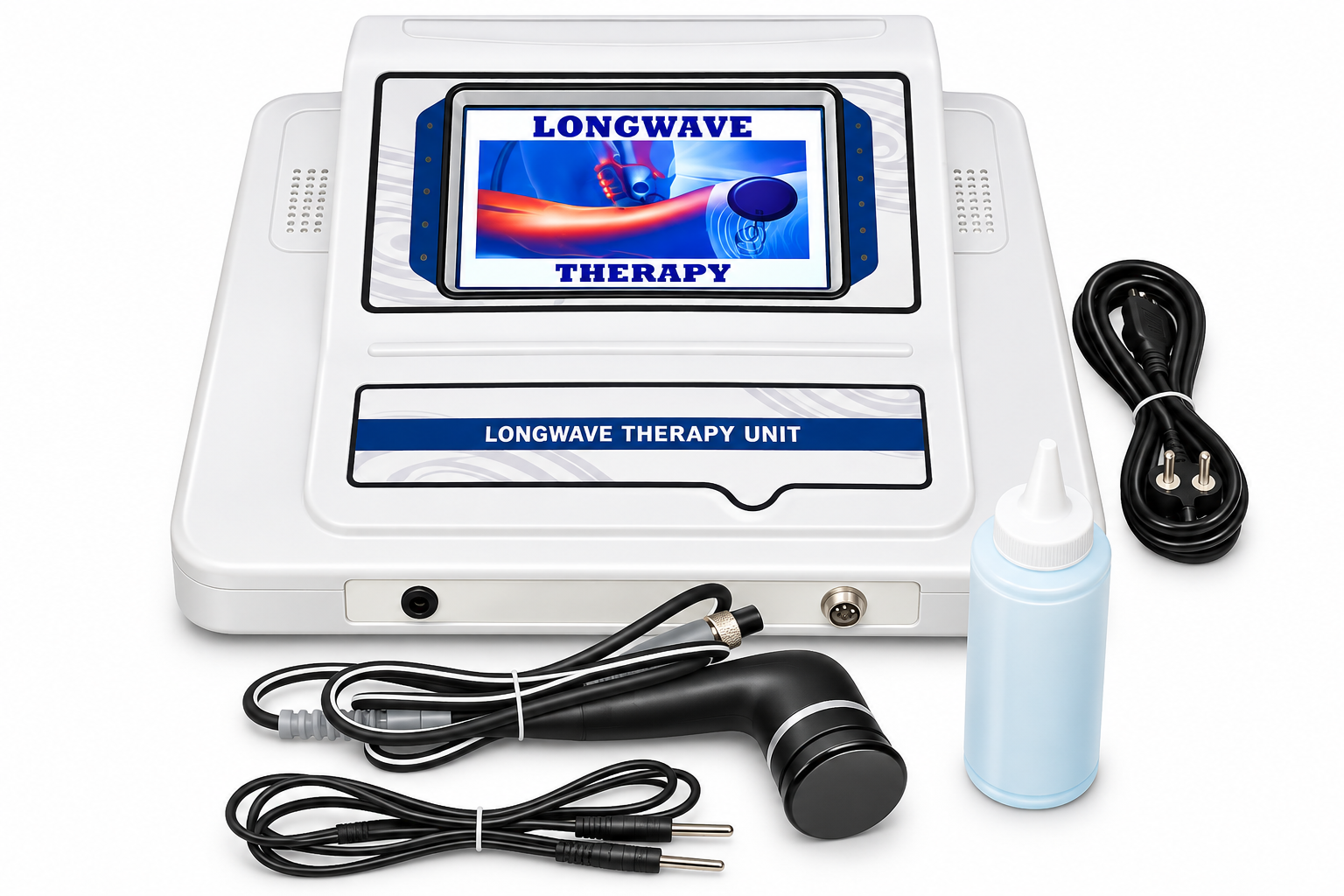
The Touch Longwave Therapy Unit is specialised physiotherapy equipment designed for professional healthcare environments. It uses longwave electromagnetic energy for selected therapeutic applications and features a touch-based control interface to manage available treatment settings. The device is intended for physiotherapy clinics, hospitals, rehabilitation centres, and specialist healthcare facilities.
Modern physiotherapy practices use different technologies to support patient rehabilitation and treatment programs. Electromagnetic therapy equipment is one category of devices used in selected clinical applications. A Touch Longwave Therapy Unit provides a dedicated system for managing longwave energy delivery through its model-specific applicators and electronic controls.
The touchscreen interface may allow healthcare professionals to select treatment parameters, manage session duration, and operate available programs. Depending on the configuration, the equipment may include adjustable output settings, treatment timers, applicator connections, and safety controls.
PHYSIOMODALITIES™ provides professional physiotherapy and rehabilitation equipment for clinics, hospitals, and healthcare professionals looking for equipment suitable for their clinical requirements.
What Is a Touch Longwave Therapy Unit?
A Touch Longwave Therapy Unit is a physiotherapy device designed to generate and deliver longwave electromagnetic energy through a specified treatment arrangement. It is intended for professional use as part of selected physiotherapy and rehabilitation procedures.
The unit generally consists of an electronic control system, energy-generation components, a display interface, and compatible treatment applicators. Its touchscreen interface helps the operator access available settings and manage treatment sessions.
Depending on the manufacturer’s design, the machine may provide different operating options and treatment configurations. Healthcare professionals should check the exact specifications and approved applications before selecting a device.
Main Components of a Touch Longwave Therapy Unit
A typical configuration may include:
- Main electronic control unit
- Touchscreen display
- Longwave energy-generation system
- Treatment applicator or applicators
- Applicator connection ports
- Treatment parameter controls
- Session timer
- Power supply system
- Model-dependent safety controls
The number and type of components depend on the specific product model.
How Does a Touch Longwave Therapy Unit Work?
The Touch Longwave Therapy Unit works through an electronic system that generates electromagnetic energy within its specified operating frequency range. The energy is delivered through the compatible applicator or treatment arrangement.
1. Electromagnetic Energy Generation
The internal electronic system generates longwave electromagnetic energy according to the machine’s technical configuration. The operating frequency and output characteristics depend on the manufacturer.
2. Energy Transmission
The generated energy is transferred through the designated applicator. The applicator design determines how the energy is delivered during the treatment procedure.
3. Treatment Parameter Selection
The operator selects available settings through the touchscreen interface. Depending on the model, these may include output intensity, treatment duration, and operating modes.
4. Controlled Treatment Session
The machine operates according to the selected settings and prescribed clinical protocol. A trained professional supervises the session and monitors the patient’s response.
5. Session Completion
After the prescribed treatment duration, the operator stops the energy output and safely removes or repositions the applicator according to the manufacturer’s instructions.
Key Features of Touch Longwave Therapy Unit
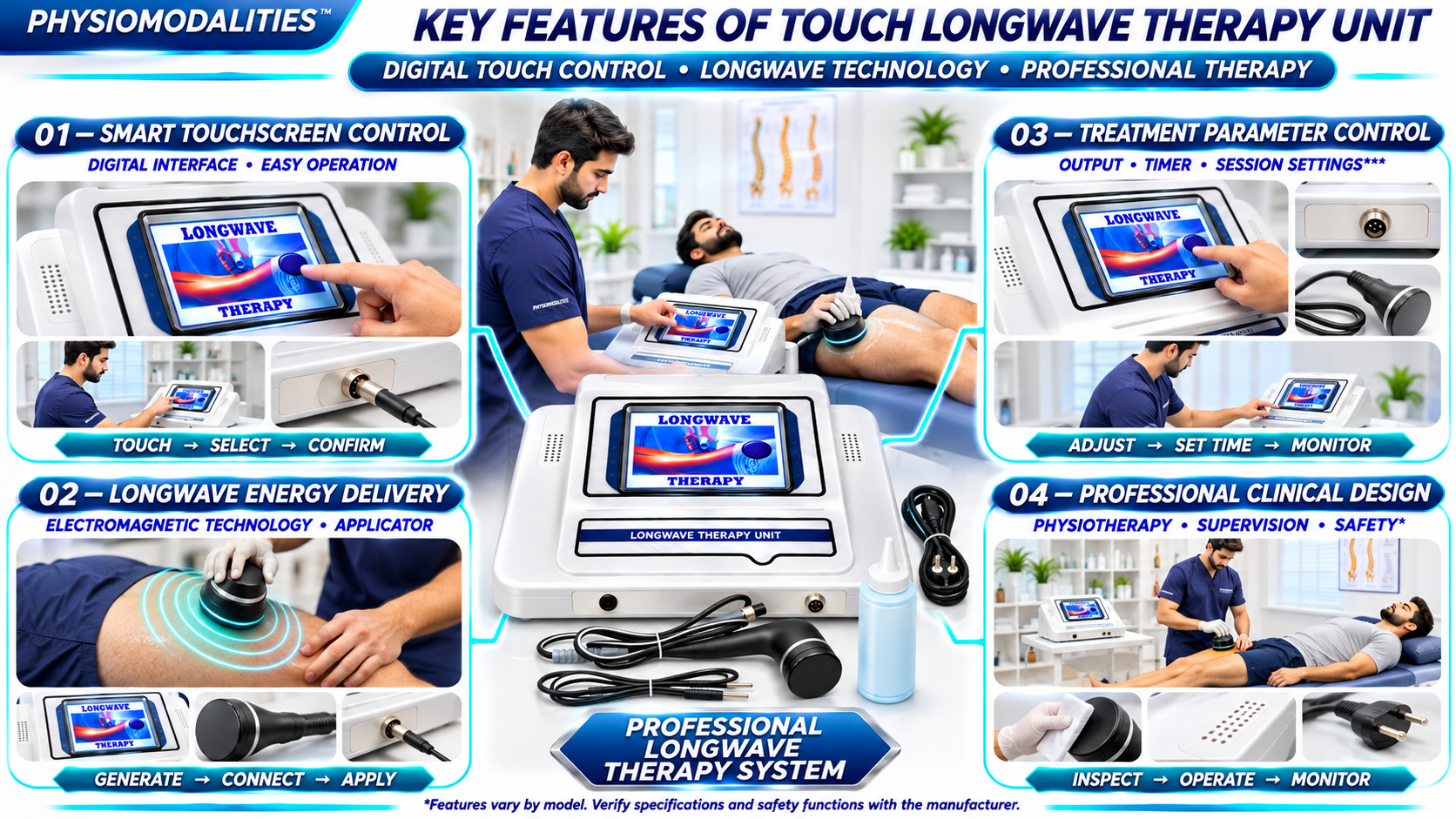
The Touch Longwave Therapy Unit may include several features designed to support professional operation. Actual features must be verified against the supplied model.
Touchscreen Control Interface
A touchscreen interface can provide access to the available machine settings. It may help the operator select treatment parameters and manage the operating process.
Longwave Electromagnetic Technology
The equipment is designed around longwave electromagnetic energy generation and delivery. The exact frequency range should be confirmed from the manufacturer’s documentation.
Digital Parameter Selection
Supported models may allow the operator to adjust available treatment settings through a digital control panel.
Treatment Timer
A session timer may help the operator manage the prescribed treatment duration.
Applicator-Based Energy Delivery
The machine may use dedicated applicators for transferring electromagnetic energy during treatment. Applicator type and compatibility vary by model.
User-Friendly Operation
The touchscreen design may provide a structured interface for accessing treatment functions and operating controls.
Professional Clinical Design
The equipment is intended for professional physiotherapy environments where trained healthcare personnel manage treatment procedures.
Model-Dependent Safety Functions
Safety features may include output controls, alerts, monitoring functions, or emergency interruption mechanisms. These should be verified before purchase.
Applications of Touch Longwave Therapy Unit
A Touch Longwave Therapy Unit may be considered for selected physiotherapy applications depending on its technical specifications, regulatory status, and approved intended use.
1. Musculoskeletal Physiotherapy
Musculoskeletal physiotherapy involves the assessment and rehabilitation of muscles, joints, and related structures. Electromagnetic therapy equipment may be considered as part of selected treatment programs when appropriate.
The practitioner should evaluate the patient’s condition and confirm whether the device’s intended application is suitable.
2. Pain Management Programs
Pain management may involve a combination of physiotherapy techniques, exercise programs, education, and other clinically appropriate interventions.
A longwave therapy system may be considered as one component of a treatment plan if its approved indications support that application.
3. Sports Rehabilitation
Sports rehabilitation facilities use different physiotherapy technologies as part of athlete assessment and recovery programs.
A Touch Longwave Therapy Unit may be evaluated for inclusion in a professional sports rehabilitation setup, subject to the device’s intended use and clinical suitability.
4. Joint Rehabilitation
Joint rehabilitation programs may involve mobility exercises, strengthening, manual therapy, and other selected interventions.
Electromagnetic therapy equipment may be incorporated only where appropriate for the patient’s condition and the device’s approved applications.
5. Rehabilitation Centre Applications
Rehabilitation centres may consider longwave therapy equipment as part of their available treatment technology. The machine should be selected according to the centre’s clinical services, equipment requirements, and operator training.
6. Physiotherapy Clinic Applications
Physiotherapy clinics may evaluate this equipment when planning their treatment facilities. The touchscreen interface and available operating controls may support the management of treatment sessions.
Important: These are possible clinical contexts, not a statement that every Touch Longwave Therapy Unit is approved for all the applications listed. Confirm the specific model’s intended use and regulatory documentation.
Potential Benefits of Touch Longwave Therapy Technology
A professional Touch Longwave Therapy Unit may offer practical equipment capabilities for clinical environments.
- Touchscreen-based operation
- Digital selection of available treatment settings
- Longwave electromagnetic energy delivery
- Treatment duration management on supported models
- Dedicated applicator-based treatment arrangement
- Integration into selected physiotherapy workflows
- Professional equipment for rehabilitation facilities
- Model-dependent treatment controls and safety functions
These points describe equipment features and workflow capabilities. They do not guarantee pain relief, faster recovery, or any specific patient outcome.

Touch Longwave Therapy Unit for Physiotherapy Clinics
Physiotherapy clinics require equipment that matches their treatment services, patient requirements, and professional operating procedures.
The Touch Longwave Therapy Unit may be considered by facilities that provide selected electromagnetic therapy applications. Before adding it to a clinic, practitioners should review its technical details and confirm that the device is appropriate for their intended services.
Suitable Professional Environments
- Physiotherapy clinics
- Multispecialty hospitals
- Rehabilitation centres
- Orthopaedic departments
- Sports rehabilitation facilities
- Specialist healthcare centres
- Professional physiotherapy training facilities
Why Clinics Evaluate Touch-Based Equipment
A touchscreen interface may help operators access the available controls through a single display. The usefulness of the interface depends on its design, readability, available functions, and ease of operation.
Clinics should also evaluate applicator handling, equipment dimensions, servicing requirements, and technical support before purchasing.
Touch Longwave Therapy Unit vs Conventional Physiotherapy Equipment
Physiotherapy devices use different energy sources and operating mechanisms. It is important to understand these differences before selecting equipment.
| Feature | Touch Longwave Therapy Unit | TENS Machine | IFT Machine |
|---|---|---|---|
| Technology | Longwave electromagnetic energy | Electrical stimulation | Interferential electrical stimulation |
| Energy Delivery | Model-specific applicator | Electrodes | Electrodes |
| Control Interface | Touchscreen, model-dependent | Digital or manual | Digital or manual |
| Main Function | Device-specific electromagnetic therapy | Electrical nerve stimulation | Interferential stimulation |
| Treatment Settings | Model-dependent | Adjustable on supported models | Adjustable on supported models |
| Clinical Use | Based on approved indications | Selected electrotherapy applications | Selected electrotherapy applications |
These devices use different technologies and should not be treated as interchangeable. Selection depends on the clinical requirement and device documentation.
How to Use a Touch Longwave Therapy Unit
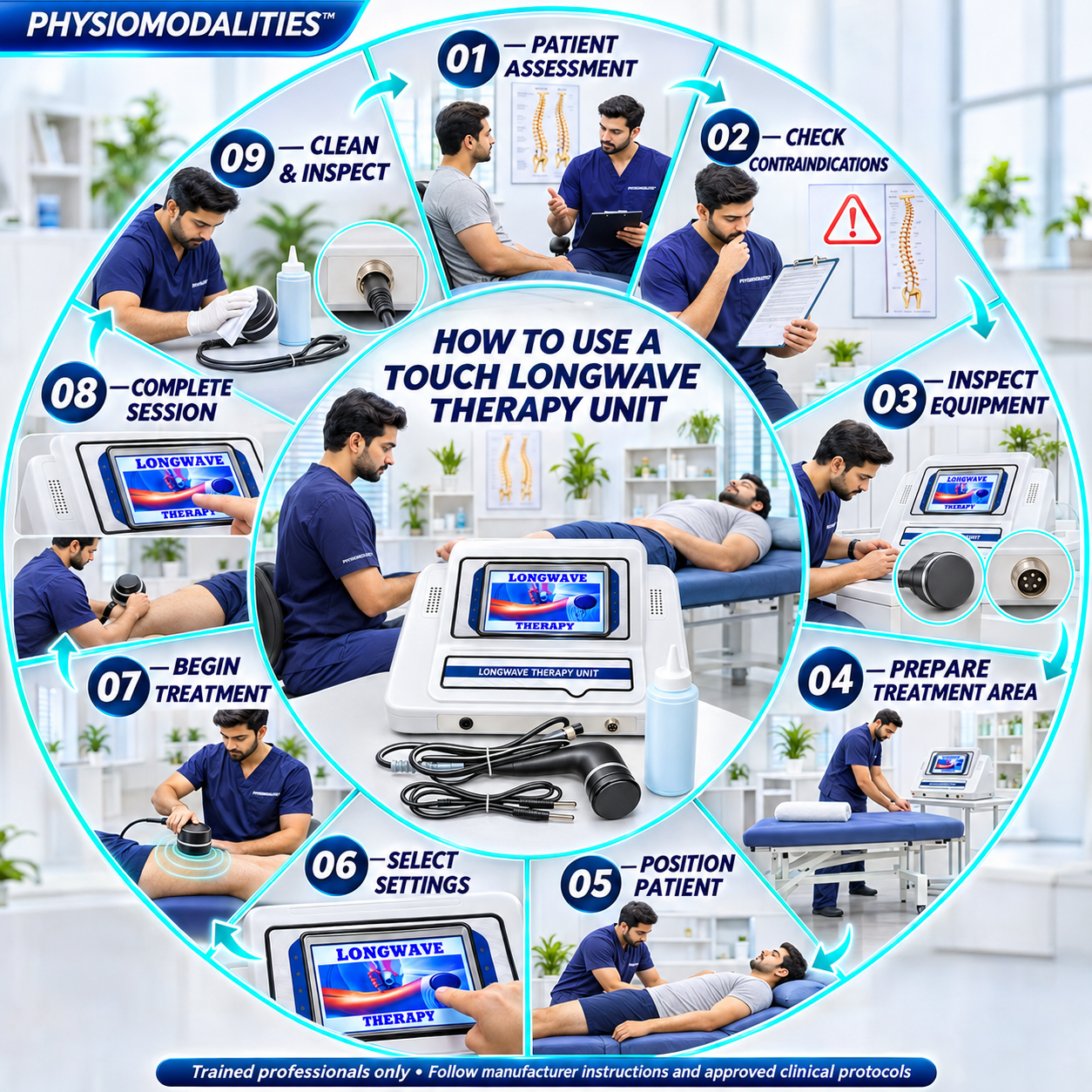
The equipment should only be operated by trained physiotherapists or qualified healthcare professionals. The exact operating procedure must follow the manufacturer’s instructions.
Step 1: Patient Assessment
Review the patient’s medical history, current condition, symptoms, treatment objectives, and suitability for the intended procedure.
Step 2: Review Contraindications
Check the manufacturer’s safety documentation and applicable clinical guidelines. Identify any patient-related contraindications before treatment.
Step 3: Inspect the Machine
Examine the main unit, touchscreen, power cable, applicators, connectors, and other supplied accessories. Do not use damaged components.
Step 4: Prepare the Treatment Environment
Place the unit in a suitable location and ensure that the treatment area meets the manufacturer’s environmental and electrical requirements.
Step 5: Position the Patient
Assist the patient into the recommended treatment position according to the clinical protocol and device instructions.
Step 6: Connect the Applicator
Connect the compatible applicator using the designated port and procedure. Check that the connection is secure.
Step 7: Select Treatment Settings
Use the touchscreen interface to select the available settings prescribed by the qualified professional. Do not use arbitrary output values.
Step 8: Begin the Treatment Session
Start the machine according to the manufacturer’s operating procedure. The healthcare professional should remain present and monitor the patient.
Step 9: Monitor Patient Response
Observe the patient throughout the session. Stop treatment if unexpected discomfort or an adverse response occurs.
Step 10: Complete the Session
Stop the energy output before removing or repositioning the applicator. Return the machine to its safe resting condition.
Step 11: Clean and Maintain
Clean patient-contact components according to the manufacturer’s instructions. Inspect the unit and accessories after treatment.
Safety Precautions for Touch Longwave Therapy Unit
Correct operation and patient screening are essential when using electromagnetic therapy equipment.
- Use the machine only under qualified professional supervision.
- Read the manufacturer’s operating instructions before use.
- Screen patients for relevant contraindications.
- Check the power cable, connectors, and applicators before every session.
- Use only manufacturer-approved accessories.
- Follow the recommended applicator placement and treatment procedure.
- Do not exceed the specified output limits.
- Follow manufacturer-specific precautions for implanted electronic devices and metallic implants.
- Maintain the required distance from other equipment where specified.
- Keep the unit away from water and unsuitable environments.
- Stop treatment if the patient experiences an unexpected adverse response.
- Do not attempt unauthorised internal repairs.
- Arrange regular inspection and servicing.
The exact contraindications and precautions must be taken from the device’s instructions for use. Do not assume that precautions for one electromagnetic therapy device apply identically to another.
Technical Specifications of Touch Longwave Therapy Unit
The following table provides a specification checklist. Actual values must be obtained from the manufacturer’s datasheet.
| Specification | Details |
|---|---|
| Product Name | Touch Longwave Therapy Unit |
| Equipment Category | Physiotherapy Equipment |
| Therapy Technology | Longwave Electromagnetic Energy |
| Control Interface | Touchscreen, Model-Dependent |
| Operating Frequency | Confirm with Manufacturer |
| Output Power | Confirm with Manufacturer |
| Output Intensity | Model-Dependent |
| Treatment Timer | Model-Dependent |
| Treatment Modes | Confirm with Manufacturer |
| Applicator Type | Confirm with Manufacturer |
| Applicator Quantity | Confirm with Manufacturer |
| Display Type | Touch Display, Model-Dependent |
| Safety Features | Confirm with Manufacturer |
| Power Supply | Confirm with Manufacturer |
| Dimensions | Confirm with Manufacturer |
| Weight | Confirm with Manufacturer |
| Warranty | Confirm with Supplier |
| Intended Application | Professional Physiotherapy Use |
| Intended Operator | Trained Healthcare Professional |
Technical verification: Before publishing final specifications, confirm operating frequency, output power, waveform, applicator type, treatment modes, electrical requirements, certifications, and included accessories from the actual product datasheet.
Things to Consider Before Buying a Touch Longwave Therapy Unit
Choosing professional physiotherapy equipment requires checking more than the product name and appearance.
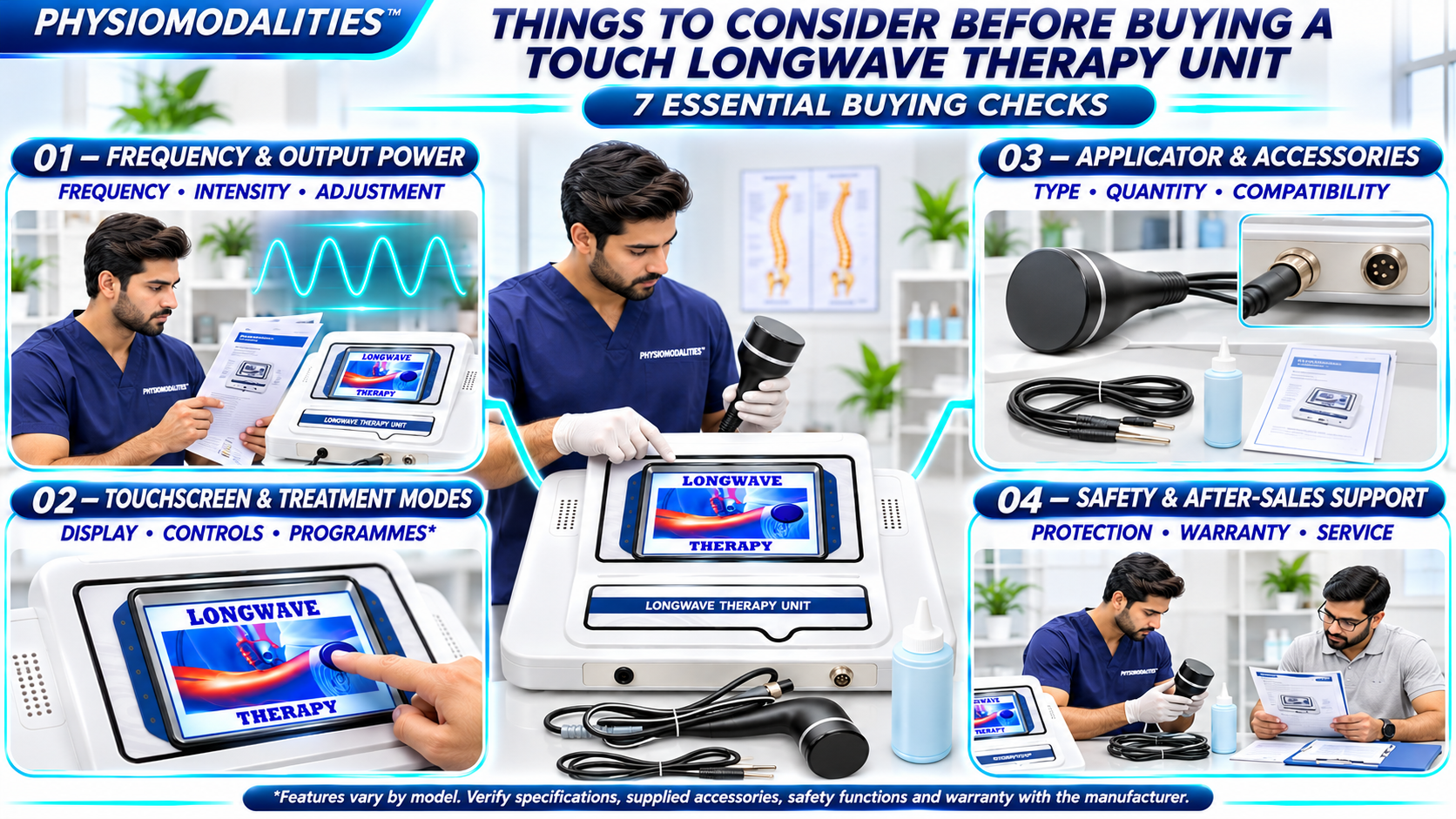
1. Operating Frequency
Verify the exact operating frequency and confirm that it matches the intended application. Do not assume a frequency based only on the term longwave.
2. Output Power
Check the available output power and intensity range. These values should be supported by manufacturer documentation.
3. Touchscreen Quality
Review the display size, visibility, control layout, and ease of operation. The interface should be suitable for regular professional use.
4. Applicator Configuration
Check the type and number of applicators included with the machine. Confirm compatibility and replacement availability.
5. Treatment Modes
Review the available operating modes and adjustable parameters. Ask for a demonstration if the interface or treatment functions are unclear.
6. Safety Features
Check emergency controls, output protection, monitoring functions, and other safety mechanisms.
7. Build Quality
Consider the machine’s overall construction, component quality, stability, and suitability for regular clinic use.
8. Electrical Requirements
Confirm the power supply, electrical ratings, and installation requirements before purchasing.
9. Warranty and Technical Support
Check the warranty period, servicing arrangements, spare parts, and availability of technical assistance.
10. Regulatory Documentation
Verify the relevant medical-device documentation, certifications, and approved intended use for the market where the machine will be operated.
Who Should Operate a Touch Longwave Therapy Unit?
The Touch Longwave Therapy Unit should be operated by trained physiotherapists or qualified healthcare professionals who understand electromagnetic therapy principles, patient assessment, treatment precautions, and equipment operation.
The operator should understand:
- Basic electromagnetic therapy principles
- Device-specific treatment procedures
- Patient screening and contraindications
- Applicator handling and placement
- Available treatment parameters
- Equipment inspection
- Safety procedures
- Adverse-response monitoring
- Cleaning and maintenance instructions
Appropriate training helps ensure that the machine is used according to its intended purpose.
Maintenance and Care of Touch Longwave Therapy Unit
Regular inspection and proper maintenance help keep physiotherapy equipment in suitable working condition.
Daily Inspection
Check the display, controls, power cable, connectors, and applicators before clinical use.
Cleaning
Clean the external surfaces and patient-contact accessories according to the manufacturer’s recommended procedure.
Applicator Care
Handle applicators carefully. Avoid pulling cables or exposing connectors to moisture.
Electrical Safety
Check cables and plugs for visible damage. Do not operate the unit if electrical components appear damaged.
Scheduled Servicing
Follow the manufacturer’s service schedule and use authorised technical support for repairs.
Safe Storage
Keep the machine in a clean, dry environment and protect its accessories from unnecessary damage.
Why Choose PHYSIOMODALITIES™?
PHYSIOMODALITIES™ provides physiotherapy and rehabilitation equipment for professional healthcare environments.
When evaluating a Touch Longwave Therapy Unit, clinics should consider its actual operating frequency, output specifications, applicator configuration, touchscreen interface, safety functions, warranty, and technical support.
PHYSIOMODALITIES ENTERPRISES aims to support physiotherapy clinics, hospitals, rehabilitation centres, and healthcare professionals with equipment for their clinical and operational requirements.
Conclusion
The Touch Longwave Therapy Unit is specialised physiotherapy equipment designed to deliver longwave electromagnetic energy through a model-specific treatment arrangement. Its touchscreen interface, electronic controls, and available treatment settings may support professional operation in selected physiotherapy and rehabilitation environments.
The suitability of the machine depends on its actual technical configuration, approved intended use, and the requirements of the healthcare facility. Before purchasing, verify the operating frequency, output power, applicator configuration, treatment modes, safety features, certifications, warranty, and technical support.
Proper patient assessment, professional training, and adherence to the manufacturer’s instructions are essential for responsible clinical use.
Frequently Asked Questions
1. What is a Touch Longwave Therapy Unit?
It is a physiotherapy device designed to deliver longwave electromagnetic energy for selected therapeutic applications.
2. Does the machine have a touchscreen?
The product is described as a touch unit; exact display functions depend on the model.
3. Where is this machine used?
It may be considered for professional physiotherapy clinics, hospitals, and rehabilitation facilities.
4. Who can operate a Touch Longwave Therapy Unit?
Trained physiotherapists and qualified healthcare professionals should operate the equipment.
5. Are treatment settings adjustable?
Available treatment settings depend on the specific model and its technical configuration.