
The TDCS Brain Stimulation Device – Transcranial Direct Current Stimulation Machine is a non-invasive neuromodulation system designed to deliver controlled, low-intensity direct electrical current through electrodes positioned on the scalp. Also known as a tDCS machine, it is used in selected neurological rehabilitation, clinical research, neuroscience, and specialist brain-stimulation environments.
The device works by delivering a controlled electrical current through a designated electrode arrangement. Depending on the model, it may provide anodal and cathodal stimulation, adjustable current intensity, session timing, digital controls, and electrode-contact monitoring.
The TDCS Brain Stimulation Device is intended for professional environments where trained healthcare practitioners or qualified researchers follow established stimulation protocols. It may be considered as an additional tool in selected rehabilitation and research programs, rather than a replacement for conventional medical care.
PHYSIOMODALITIES™ provides physiotherapy and rehabilitation equipment for professional clinical and specialist treatment environments.
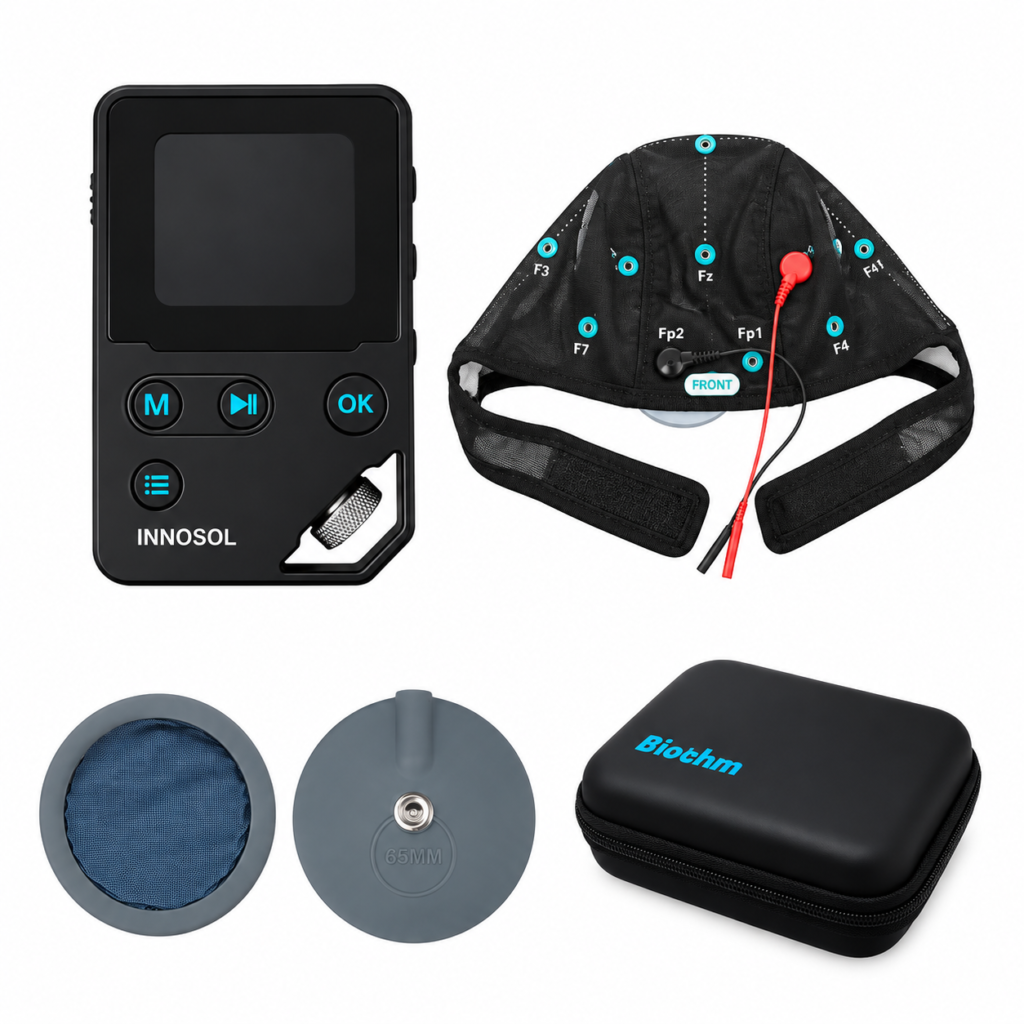
What Is a TDCS Brain Stimulation Device?
TDCS stands for Transcranial Direct Current Stimulation. It is a non-invasive brain-stimulation technique that delivers a low-intensity direct electrical current through electrodes placed at selected positions on the scalp.
The current passes between the stimulation electrodes and produces changes in the electrical environment of targeted brain regions. Depending on the electrode arrangement and stimulation parameters, tDCS may influence cortical excitability.
Unlike TENS and IFT machines, which are generally used for peripheral electrical stimulation, a tDCS system is specifically designed for transcranial stimulation.
A typical tDCS system may include:
- Main stimulation unit
- Anodal and cathodal electrode connections
- Scalp electrodes
- Conductive sponge or electrode accessories
- Electrode positioning straps or supports
- Connecting leads
- Digital controls
- Power supply or rechargeable battery, depending on model
The exact components and functions depend on the supplied configuration.
How Does Transcranial Direct Current Stimulation Work?
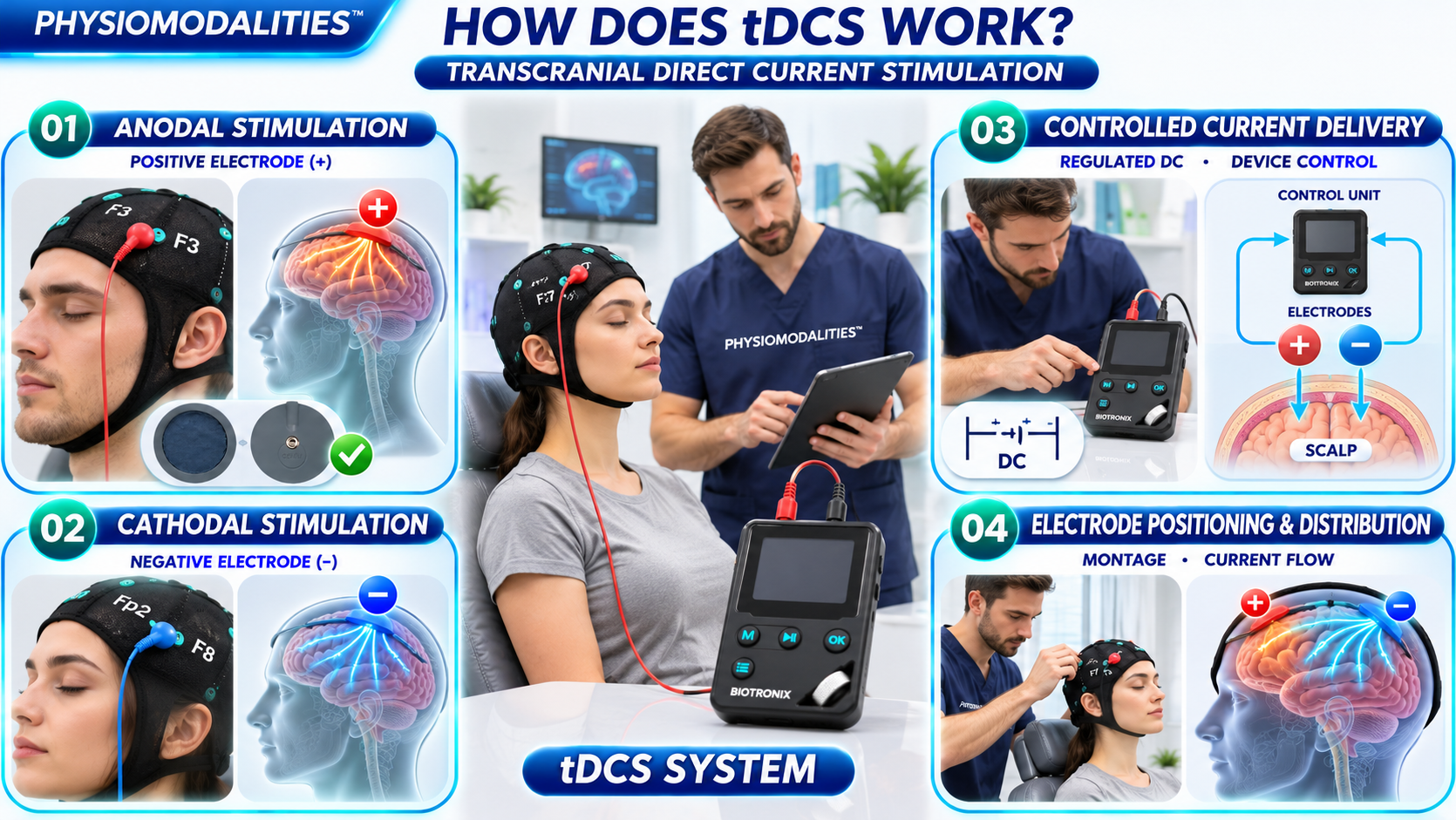
A tDCS machine delivers a controlled direct current through electrodes placed at specific scalp locations. The electrode arrangement determines the direction and distribution of current through the head.
Anodal Stimulation
Anodal stimulation uses a positively charged electrode. Depending on the stimulation arrangement and protocol, it may influence the excitability of the targeted cortical region.
Cathodal Stimulation
Cathodal stimulation uses a negatively charged electrode. Its effects also depend on electrode placement, current intensity, duration, and individual characteristics.
Controlled Current Delivery
The device regulates the stimulation current according to the selected parameters. Professional systems may include current monitoring and impedance-related safety features to help identify unsuitable electrode contact.
Electrode Positioning
Electrode placement is a critical part of tDCS administration. The correct positions must be selected according to an established clinical or research protocol.
Key Features of TDCS Brain Stimulation Device
Features vary according to the manufacturer and model. Professional tDCS devices may include:
- Low-intensity direct-current stimulation
- Anodal and cathodal stimulation options
- Adjustable current intensity
- Adjustable stimulation duration
- Digital control interface
- Dedicated scalp electrode connections
- Conductive electrode accessories
- Current-output monitoring
- Electrode-contact or impedance monitoring on supported models
- Rechargeable or battery-operated design on applicable models
- Portable configuration on selected models
- Sham stimulation mode on selected research systems
- Controlled stimulation-session management
Note: These are possible features of tDCS equipment, not a confirmed specification list for every model. Verify the exact features before publishing product claims.

Applications of TDCS Brain Stimulation Device
The TDCS Brain Stimulation Device is used in specialist clinical and research environments involving non-invasive brain stimulation.
Neurological Rehabilitation Research
tDCS has been investigated as an additional intervention in neurological rehabilitation research. Studies have explored its use alongside structured rehabilitation activities.
Stroke Rehabilitation Research
tDCS has been studied in selected stroke-rehabilitation protocols involving motor recovery, language-related functions, and other rehabilitation outcomes. It should only be considered according to appropriate professional assessment and established protocols.
Motor Function and Motor Learning Research
Researchers have investigated how tDCS may influence cortical excitability and motor-learning processes. It may be studied alongside structured motor-training activities.
Cognitive Research
tDCS has been investigated in research involving attention, memory, learning, and other cognitive functions. Findings vary according to the research design and stimulation protocol.
Neurorehabilitation
Specialist rehabilitation teams may consider tDCS as an additional intervention in selected neurological rehabilitation programs where appropriate.
Clinical and Academic Research
Universities, neuroscience laboratories, hospitals, and research institutions may use tDCS equipment for controlled studies involving brain stimulation and neurophysiology.
Clinical note: Research is ongoing, and results vary across conditions and protocols. tDCS should not be promoted as a guaranteed treatment or cure for neurological or psychiatric disorders.
Potential Benefits of a TDCS Brain Stimulation Device
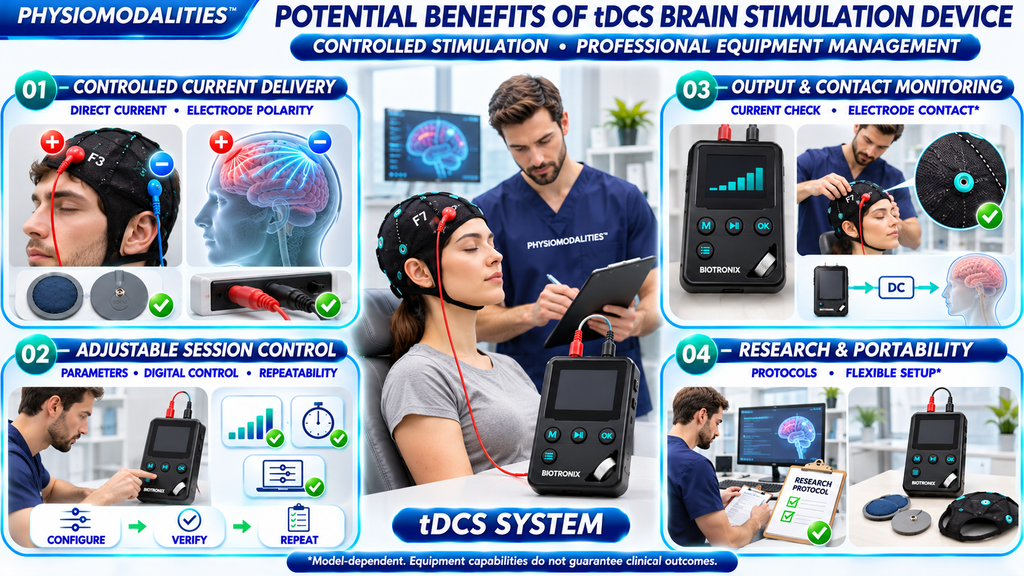
A professional tDCS system can provide equipment-related capabilities such as:
- Controlled direct-current delivery
- Selectable electrode polarity
- Adjustable stimulation parameters on supported models
- Repeatable stimulation-session settings
- Dedicated scalp electrode accessories
- Digital parameter control
- Current monitoring on applicable models
- Electrode-contact monitoring on supported systems
- Integration with selected research protocols
- Portable operation on applicable configurations
These are operational features of the equipment. They do not guarantee a particular clinical outcome.
TDCS Brain Stimulation Device for Hospitals and Research Centres
A TDCS Brain Stimulation Device may be incorporated into specialist clinical and research environments where non-invasive brain stimulation is part of an approved protocol.
Potential settings include:
- Neurology departments
- Neurorehabilitation centres
- Physiotherapy departments
- Neuroscience laboratories
- Academic research institutions
- Specialist rehabilitation hospitals
- Clinical research facilities
The device may be used alongside conventional rehabilitation activities when permitted by the relevant protocol. It should not replace neurological assessment, prescribed medical treatment, or established rehabilitation interventions.
TDCS vs TENS and IFT
Although tDCS, TENS, and IFT involve electrical current, they are different treatment technologies with different purposes.
| Feature | TDCS | TENS | IFT |
|---|---|---|---|
| Full Form | Transcranial Direct Current Stimulation | Transcutaneous Electrical Nerve Stimulation | Interferential Therapy |
| Main Application | Non-invasive brain stimulation | Peripheral electrical stimulation | Interferential electrical stimulation |
| Electrode Placement | Selected scalp positions | Selected body areas | Selected body areas |
| Current Type | Low-intensity direct current | Pulsed electrical current | Interferential currents |
| Primary Focus | Neuromodulation | Commonly used in pain-management programs | Selected physiotherapy applications |
| Equipment Category | Brain stimulation | Electrotherapy | Electrotherapy |
These machines are not interchangeable. Each requires its own operating knowledge, electrode placement approach, and safety procedures.
How to Use a TDCS Brain Stimulation Device
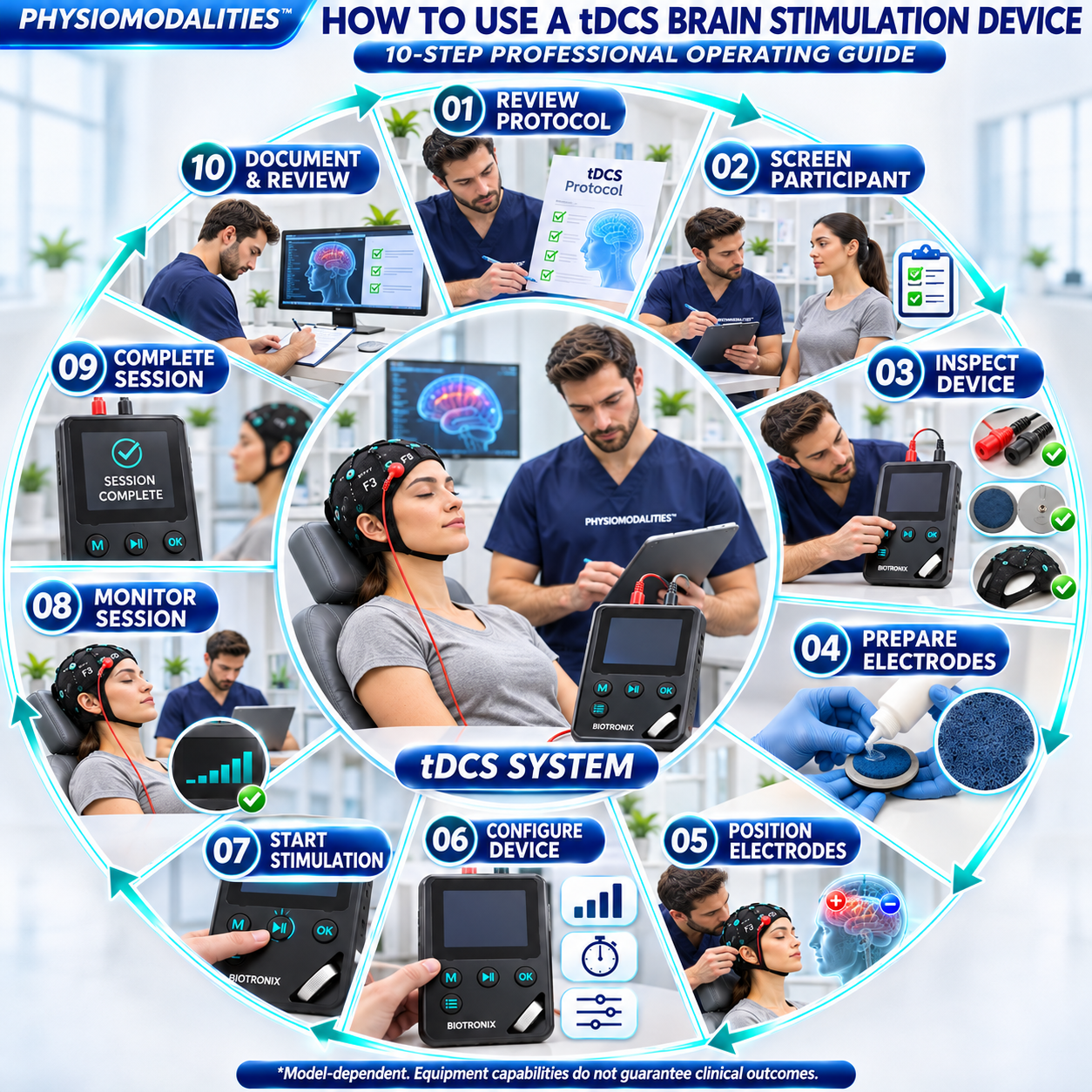
The device should only be administered by appropriately trained professionals following the manufacturer’s instructions and an established clinical or research protocol.
Step 1: Review the Stimulation Protocol
Confirm the intended application, stimulation target, electrode arrangement, current intensity, and session duration according to the approved protocol.
Step 2: Screen the Participant
Review relevant medical history, contraindications, implanted devices, scalp condition, and other factors identified in the applicable safety guidance.
Step 3: Inspect the Equipment
Check the main unit, connecting leads, electrodes, electrode covers, and accessories for visible damage or wear.
Step 4: Prepare the Electrodes
Prepare electrodes using the manufacturer’s recommended conductive interface. Use only compatible electrode accessories designed for the device and intended stimulation application.
Step 5: Position the Electrodes
Place the electrodes at the designated scalp locations according to the approved protocol. Accurate positioning and suitable electrode contact are essential.
Step 6: Configure the Device
Set the current intensity, polarity, and session duration according to the approved protocol and device instructions.
Step 7: Begin Supervised Stimulation
Start the stimulation using the manufacturer’s recommended procedure. Monitor the participant throughout the session.
Step 8: Monitor the Response
Observe participant comfort and check for unexpected sensations, headache, dizziness, skin irritation, or other adverse effects.
Step 9: Complete the Session
End stimulation according to the device instructions and remove the electrode arrangement safely.
Step 10: Inspect and Document
Check the electrode-contact areas for skin irritation and document the session details and any reported adverse effects.
Safety Precautions
TDCS is a specialist brain-stimulation technique. Appropriate screening, training, equipment, and supervision are essential.
- Use equipment intended and verified for the relevant human stimulation application.
- Follow the manufacturer’s operating instructions.
- Use established clinical or research protocols.
- Ensure the operator has appropriate training.
- Screen participants before stimulation.
- Inspect the scalp before and after each session.
- Use compatible, manufacturer-approved electrodes.
- Ensure suitable electrode preparation and contact.
- Never use damaged cables, electrodes, or connectors.
- Do not exceed the device’s specified output limits.
- Monitor the participant throughout stimulation.
- Stop the session if significant discomfort or an unexpected reaction occurs.
- Record relevant adverse effects.
- Follow applicable precautions for implanted electronic devices and other medical considerations.
- Do not use the device for unsupervised experimentation or self-treatment.
Possible side effects can include temporary tingling, itching, skin redness, headache, fatigue, or a burning sensation. Incorrect electrode preparation or poor contact can increase the risk of skin irritation or injury.
Technical Specifications
The exact specifications depend on the manufacturer and model. Confirm the product datasheet before publishing fixed technical values.
| Specification | Details |
|---|---|
| Product Name | TDCS Brain Stimulation Device |
| Full Form | Transcranial Direct Current Stimulation |
| Equipment Type | Non-Invasive Brain Stimulation System |
| Stimulation Type | Low-Intensity Direct Current |
| Stimulation Modes | Anodal / Cathodal, Model-Dependent |
| Current Intensity | Adjustable, Model-Dependent |
| Stimulation Duration | Adjustable, Model-Dependent |
| Display | Digital Display, Model-Dependent |
| Electrode System | Compatible Scalp Electrodes |
| Electrode Accessories | Model-Dependent |
| Current Monitoring | Model-Dependent |
| Impedance Monitoring | Model-Dependent |
| Sham Stimulation | Selected Research Models |
| Power Supply | Battery / Rechargeable / Adapter, Model-Dependent |
| Intended Application | Clinical and Research Use |
| Intended Operator | Trained Healthcare Professional or Qualified Researcher |
Important: Confirm current output, maximum intensity, session duration, electrode dimensions, impedance limits, operating modes, certification, battery specifications, and included accessories from the exact product datasheet.
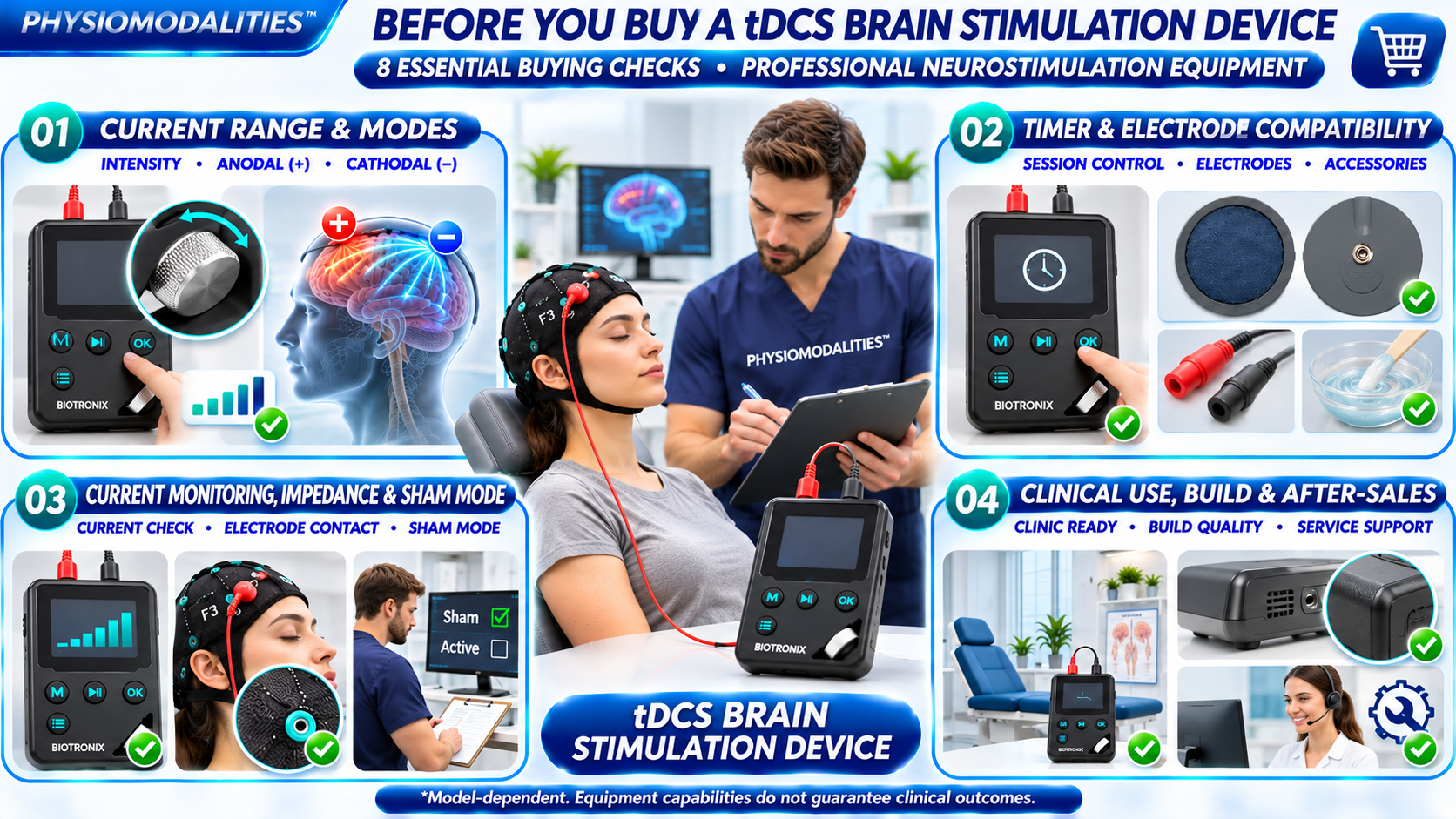
Things to Consider Before Buying
Current Intensity Range
Check the adjustable current range and confirm that it meets the intended clinical or research requirements.
Stimulation Modes
Confirm whether the device supports anodal and cathodal stimulation and whether additional modes are available.
Session Duration
Review the available timer and maximum stimulation duration.
Electrode Compatibility
Check the electrode type, dimensions, conductive accessories, and availability of replacement components.
Current and Impedance Monitoring
For professional use, check whether the device monitors current delivery and electrode contact or impedance.
Sham Stimulation
Research institutions may require a sham stimulation mode for controlled studies. Confirm this feature if it is needed.
Safety Certification
Verify applicable medical-device certification, electrical safety documentation, and regulatory status for the intended market.
Warranty and Technical Support
Confirm warranty coverage, operator training, service availability, and access to replacement accessories.
Who Should Operate a TDCS Brain Stimulation Device?
A TDCS Brain Stimulation Device should be operated by appropriately trained healthcare professionals or qualified researchers with knowledge of brain stimulation, electrode positioning, participant screening, stimulation parameters, and safety procedures.
The operator should understand:
- tDCS principles
- Anodal and cathodal stimulation
- Electrode positioning
- Current intensity and duration
- Participant screening
- Contraindications and precautions
- Electrode-contact monitoring
- Adverse-effect monitoring
- Manufacturer-specific operating instructions
Why Choose PHYSIOMODALITIES™?
PHYSIOMODALITIES™ provides physiotherapy and rehabilitation equipment for professional clinical environments.
When selecting a TDCS Brain Stimulation Device, hospitals, rehabilitation centres, and research institutions should evaluate the exact device configuration, current-control capabilities, electrode accessories, safety features, certification, warranty, and technical support.
PHYSIOMODALITIES ENTERPRISES aims to support professional healthcare environments with equipment selected according to clinical and operational requirements.
Conclusion
The TDCS Brain Stimulation Device – Transcranial Direct Current Stimulation Machine is a non-invasive neuromodulation system designed to deliver controlled, low-intensity direct current through electrodes positioned on selected areas of the scalp. It is used in specialist clinical and research environments for protocols involving brain stimulation and neurological rehabilitation research.
Features such as adjustable current, anodal and cathodal stimulation, digital controls, electrode accessories, and monitoring functions depend on the exact model. Before purchasing, confirm the technical datasheet, safety certification, included accessories, operating modes, warranty, and service support.
Appropriate participant screening, trained operation, and adherence to established protocols are essential for responsible use.
Frequently Asked Questions
1. What is a TDCS Brain Stimulation Device?
It is a non-invasive brain-stimulation device that delivers low-intensity direct current through electrodes placed at selected positions on the scalp.
2. What does TDCS stand for?
TDCS stands for Transcranial Direct Current Stimulation.
3. What are anodal and cathodal stimulation?
They refer to the two electrode polarities used in tDCS. Their effects depend on electrode placement, stimulation parameters, and the individual protocol.
4. Where is a TDCS device used?
It may be used in specialist hospitals, neurorehabilitation departments, neuroscience laboratories, academic institutions, and clinical research centres.
5. Is TDCS the same as TENS or IFT?
No. tDCS is a brain-stimulation technique involving scalp electrodes, while TENS and IFT are electrotherapy modalities generally applied to selected areas of the body.