The RTMS Brain Stimulation Therapy Machine – Repetitive Transcranial Magnetic Stimulation is a non-invasive neuromodulation system designed to deliver repeated magnetic pulses to selected regions of the brain. Also known as an rTMS Machine, it uses electromagnetic stimulation to influence neuronal activity in targeted cortical areas.
The system generally consists of a main control unit, stimulation coil, coil positioning arrangement, and software or control interface. During treatment, the coil is positioned near the patient’s head and delivers repeated magnetic pulses according to a selected clinical protocol.
The RTMS Brain Stimulation Therapy Machine is designed for specialist healthcare environments, including neurology departments, psychiatric facilities, hospitals, neurorehabilitation centres, and clinical research institutions. Its use requires trained professionals, appropriate patient screening, and adherence to the manufacturer’s instructions.
PHYSIOMODALITIES™ provides professional physiotherapy and rehabilitation equipment for clinical and specialist healthcare environments.

What Is an RTMS Brain Stimulation Therapy Machine?
RTMS stands for Repetitive Transcranial Magnetic Stimulation. It is a non-invasive brain-stimulation technique that uses rapidly changing magnetic fields to induce electrical activity in selected regions of the cerebral cortex.
Unlike tDCS, which delivers low-intensity direct electrical current through electrodes placed on the scalp, rTMS uses an electromagnetic coil to generate magnetic pulses.
The main components of a typical rTMS system may include:
- Main stimulation unit
- Electromagnetic stimulation coil
- Coil positioning system
- Patient positioning arrangement
- Digital control interface
- Treatment management software
- Cooling system, depending on model
- Safety and monitoring features
The exact configuration depends on the manufacturer and device model.
How Does Repetitive Transcranial Magnetic Stimulation Work?
The RTMS Brain Stimulation Therapy Machine uses electromagnetic induction to generate magnetic pulses.
When electrical current passes through the stimulation coil, it creates a magnetic field. Rapid changes in this magnetic field induce electrical currents in the targeted cortical tissue, influencing neuronal activity.
Electromagnetic Stimulation
The stimulation coil produces brief magnetic pulses that pass through the scalp and skull without requiring electrodes to deliver direct electrical current to the brain.
Repetitive Magnetic Pulses
The machine delivers repeated pulses according to the selected stimulation frequency and treatment protocol.
Targeted Brain Stimulation
The coil is positioned near a selected region of the head. Accurate positioning is important for delivering stimulation consistently to the intended brain area.
Controlled Stimulation Parameters
Depending on the model, the operator may configure parameters such as stimulation intensity, frequency, pulse duration, number of pulses, and intervals between stimulation trains.

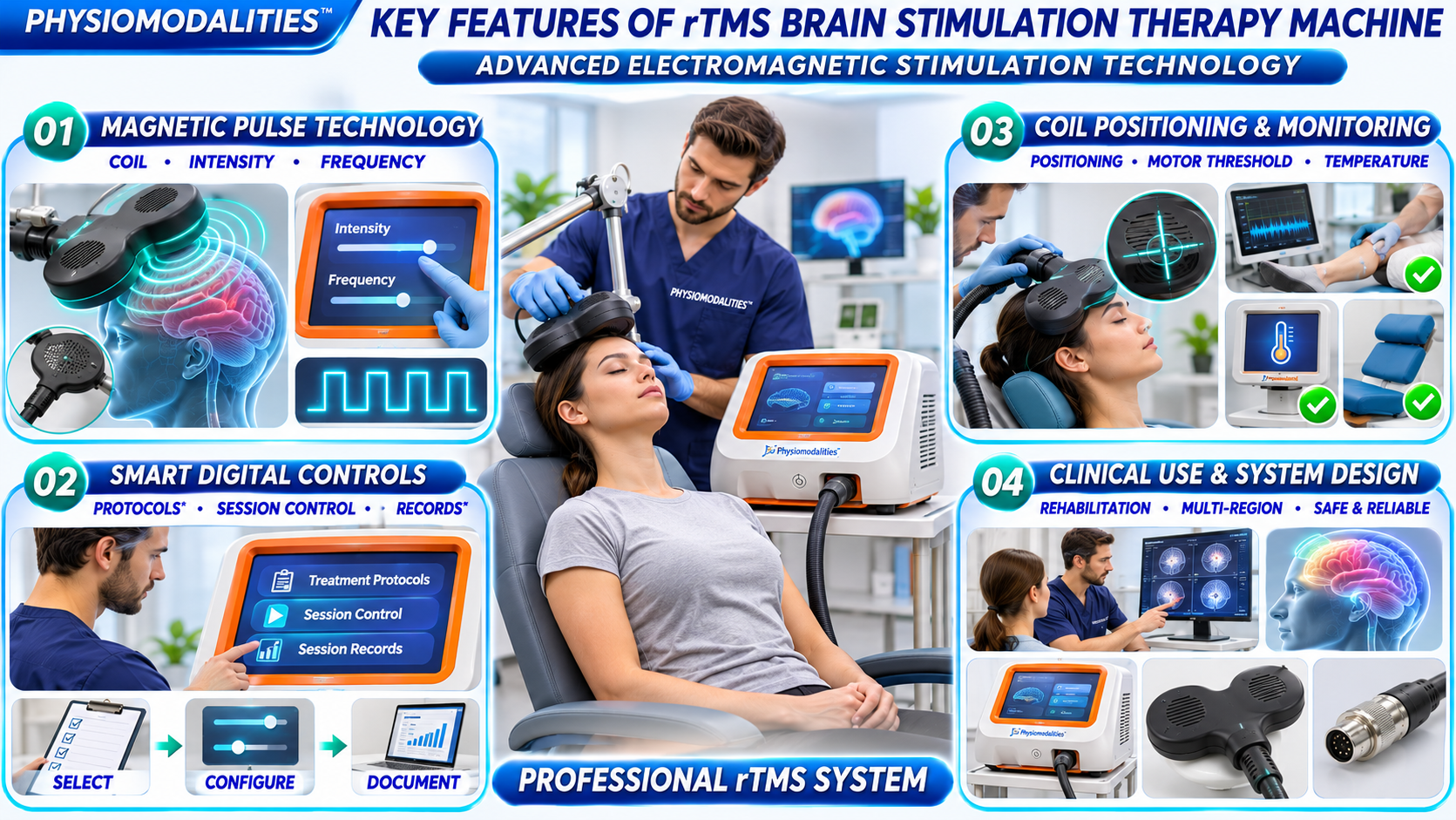
Key Features of RTMS Brain Stimulation Therapy Machine
Features vary according to the manufacturer and model. Professional rTMS systems may include:
- Repetitive magnetic pulse generation
- Electromagnetic stimulation coil
- Adjustable stimulation intensity
- Adjustable pulse frequency
- Programmable treatment protocols
- Digital control interface
- Coil positioning arrangement
- Treatment-session management software
- Motor threshold assessment support on applicable models
- Coil temperature monitoring on supported models
- Emergency stop or pulse interruption controls
- Treatment history and session records
- Cooling system on applicable configurations
- Patient positioning accessories
Note: These are common features of professional rTMS systems. Confirm the actual features of the supplied machine before publishing them as product specifications.
Applications of RTMS Brain Stimulation Therapy Machine
The RTMS Brain Stimulation Therapy Machine is used in specialist clinical settings for selected brain-stimulation applications.
Major Depressive Disorder
Certain rTMS systems have regulatory clearance for specific major depressive disorder indications. Treatment suitability depends on the device’s approved indication, patient eligibility, and clinical assessment.
Neurological Rehabilitation Research
rTMS is studied in selected neurological rehabilitation settings, including research involving motor function, cortical excitability, and recovery after neurological injury.
Motor Function Research
The technique can be used in research protocols investigating motor pathways, motor learning, and cortical activity.
Cognitive Neuroscience Research
Researchers use TMS techniques to investigate brain function, including selected processes involving attention, memory, and cognitive control.
Specialist Psychiatric Applications
Some rTMS systems have specific regulatory clearances for additional psychiatric indications. These vary by device, country, and approved protocol.
Clinical and Academic Research
Hospitals, universities, neuroscience laboratories, and research centres may use rTMS systems for controlled studies involving brain stimulation and neurophysiology.
Important: Do not assume that every rTMS machine is approved for every condition. Clinical indications must be checked against the exact model’s regulatory documentation.

Potential Benefits of RTMS Brain Stimulation Technology
A professional rTMS system provides equipment capabilities that may support specialist clinical and research workflows:
- Non-invasive magnetic stimulation
- Targeted cortical stimulation
- Repetitive pulse delivery
- Adjustable stimulation parameters on supported models
- Programmable stimulation protocols
- Dedicated electromagnetic coil
- Digital treatment controls
- Coil positioning support
- Session management features
- Integration into selected clinical and research programs
These are equipment capabilities, not guaranteed clinical outcomes. The response to rTMS depends on the condition, treatment protocol, device configuration, and individual patient factors.
RTMS Brain Stimulation Therapy Machine for Hospitals and Clinical Centres
An RTMS Brain Stimulation Therapy Machine can be considered for specialist facilities that provide brain-stimulation services or conduct neurological and psychiatric research.
Potential professional settings include:
- Neurology departments
- Psychiatric hospitals
- Neurorehabilitation centres
- Specialist mental healthcare facilities
- Neuroscience laboratories
- Academic research institutions
- Clinical research departments
- Multidisciplinary rehabilitation centres
The device should be integrated into a properly equipped clinical environment with trained operators and appropriate patient-monitoring procedures.
RTMS vs TDCS Brain Stimulation
RTMS and TDCS are both non-invasive brain-stimulation techniques, but they use different technologies.
| Feature | RTMS | TDCS |
|---|---|---|
| Full Form | Repetitive Transcranial Magnetic Stimulation | Transcranial Direct Current Stimulation |
| Stimulation Method | Magnetic pulses | Low-intensity direct current |
| Main Component | Electromagnetic coil | Scalp electrodes |
| Energy Delivery | Changing magnetic field | Direct electrical current |
| Electrode Requirement | No scalp stimulation electrodes required | Scalp electrodes required |
| Stimulation Pattern | Repetitive magnetic pulses | Controlled direct-current stimulation |
| Parameter Examples | Frequency, intensity, pulse count, train duration | Current intensity, polarity, session duration |
| Equipment Type | Magnetic brain-stimulation system | Electrical neuromodulation system |
Although both techniques involve brain stimulation, they are not interchangeable. Each requires its own equipment, training, safety procedures, and clinical protocols.
How to Use an RTMS Brain Stimulation Therapy Machine
An rTMS machine should only be operated by appropriately trained healthcare professionals according to the manufacturer’s instructions and approved clinical protocols.
Step 1: Clinical Assessment
Review the patient’s medical history, clinical condition, treatment objective, and suitability for rTMS.
Step 2: Safety Screening
Screen for relevant contraindications and risk factors, particularly implanted metallic or electronic devices, seizure history, and other conditions identified in the manufacturer’s documentation.
Step 3: Prepare the Treatment Environment
Ensure that the treatment area is suitable for rTMS operation and that emergency procedures and required safety equipment are available.
Step 4: Position the Patient
Seat or position the patient according to the system’s instructions. Provide appropriate hearing protection.
Step 5: Position the Stimulation Coil
Place the coil at the designated treatment location using the manufacturer’s positioning method and the approved clinical protocol.
Step 6: Determine Stimulation Parameters
Determine the required stimulation intensity and other parameters according to the clinical protocol. Motor threshold assessment may be required for certain treatment protocols.
Step 7: Configure the Treatment
Select the prescribed stimulation frequency, intensity, pulse count, train duration, and inter-train interval as supported by the device.
Step 8: Begin Supervised Stimulation
Start treatment according to the manufacturer’s operating procedure. The operator should remain present and monitor the patient.
Step 9: Monitor Patient Response
Observe the patient for discomfort, headache, unusual symptoms, or other adverse responses throughout the session.
Step 10: Complete the Session
Stop stimulation, remove or reposition the coil safely, and document the treatment settings and patient response.

Safety Precautions
rTMS requires specialist screening and safety procedures. Important precautions include:
- Use the machine only under qualified professional supervision.
- Follow the manufacturer’s operating instructions.
- Screen patients for contraindications before treatment.
- Assess the history of seizures or epilepsy and other seizure-risk factors.
- Check for metallic or magnetic-sensitive implants near the head and treatment coil.
- Evaluate implanted electronic devices according to the device-specific safety instructions.
- Provide appropriate hearing protection to the patient and operator.
- Position the coil correctly according to the approved protocol.
- Monitor coil temperature and equipment condition where applicable.
- Do not use damaged coils, cables, or connectors.
- Keep flammable materials away from the equipment.
- Ensure that emergency procedures are available.
- Stop stimulation if a significant adverse reaction occurs.
- Follow manufacturer-specific requirements for seizure management and emergency response.
Seizure is a recognised potential risk of rTMS. Patients with relevant neurological history or other risk factors require careful assessment and monitoring. Hearing protection is important because the magnetic coil produces loud clicking sounds during stimulation.
Technical Specifications
The following table provides specification categories to verify for the exact RTMS model. Values should not be assumed without manufacturer documentation.
| Specification | Details |
|---|---|
| Product Name | RTMS Brain Stimulation Therapy Machine |
| Full Form | Repetitive Transcranial Magnetic Stimulation |
| Equipment Type | Non-Invasive Brain Stimulation System |
| Stimulation Technology | Electromagnetic Induction |
| Pulse Type | Repetitive Magnetic Pulses |
| Stimulation Coil | Model-Dependent |
| Stimulation Intensity | Adjustable, Model-Dependent |
| Frequency Range | Model-Dependent |
| Pulse Duration | Model-Dependent |
| Pulse Count | Model-Dependent |
| Train Duration | Model-Dependent |
| Inter-Train Interval | Model-Dependent |
| Coil Positioning | Manual / Assisted, Model-Dependent |
| Control Interface | Digital / Software-Based, Model-Dependent |
| Motor Threshold Assessment | Model-Dependent |
| Cooling System | Model-Dependent |
| Safety Features | Model-Dependent |
| Power Supply | Confirm with Manufacturer |
| Intended Application | Specialist Clinical and Research Use |
| Intended Operator | Trained Healthcare Professional |
Important: Confirm the exact stimulation frequency, intensity range, waveform, pulse width, maximum pulse count, coil type, cooling system, electrical requirements, safety features, certifications, and included accessories from the manufacturer’s datasheet.
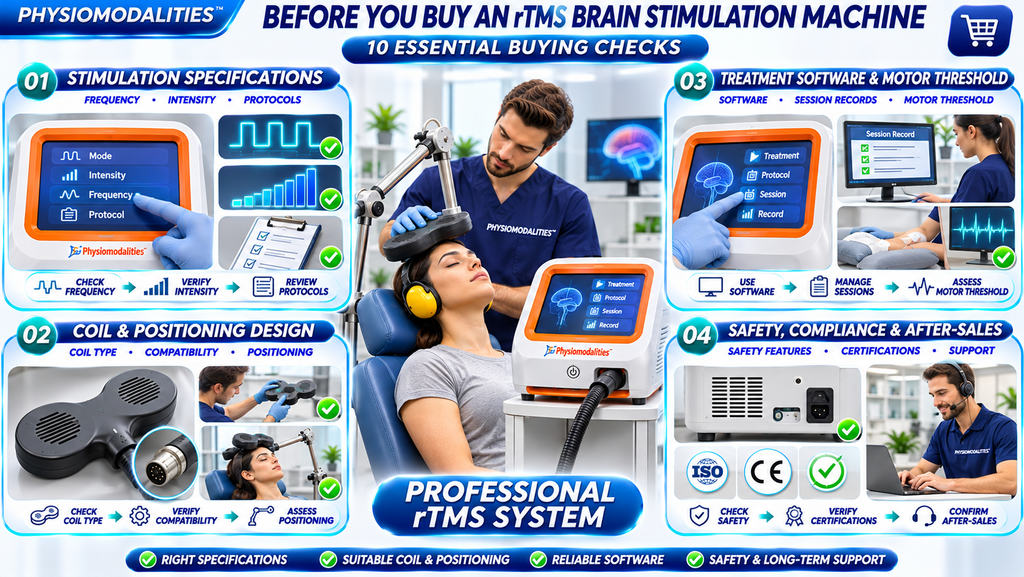
Things to Consider Before Buying
Stimulation Frequency
Check the supported frequency range and available stimulation protocols.
Stimulation Intensity
Confirm the output intensity range and how the device measures or displays stimulation levels.
Coil Type
Review the coil design, compatibility, replacement availability, and intended treatment applications.
Coil Positioning System
Check whether the machine provides manual, assisted, or software-supported positioning.
Treatment Software
A suitable interface can help operators configure protocols and maintain treatment records.
Motor Threshold Assessment
Confirm whether the device supports motor threshold assessment and the method used to determine stimulation intensity.
Cooling and Temperature Monitoring
For repeated clinical use, review the coil cooling arrangement and overheating protection.
Safety Features
Check emergency-stop functions, pulse interruption, alarms, and other protective mechanisms.
Regulatory Documentation
Verify applicable medical-device approvals, certifications, and approved indications for the intended market.
Warranty and Technical Support
Confirm warranty coverage, coil servicing, replacement parts, software support, and operator training.
Who Should Operate an RTMS Brain Stimulation Therapy Machine?
An RTMS Brain Stimulation Therapy Machine should be operated by appropriately trained healthcare professionals with specialist knowledge of transcranial magnetic stimulation.
The operator should understand:
- rTMS principles
- Electromagnetic stimulation
- Coil positioning
- Motor threshold assessment where applicable
- Stimulation intensity and frequency
- Treatment protocols
- Patient screening
- Contraindications and precautions
- Hearing protection
- Adverse-event monitoring
- Emergency procedures
- Manufacturer-specific operating instructions
Why Choose PHYSIOMODALITIES™?
PHYSIOMODALITIES™ provides physiotherapy and rehabilitation equipment for professional clinical environments.
When selecting an RTMS Brain Stimulation Therapy Machine, healthcare facilities should evaluate the device’s stimulation technology, coil configuration, treatment controls, safety systems, regulatory documentation, warranty, and technical support.
PHYSIOMODALITIES ENTERPRISES aims to support clinics, hospitals, and specialist healthcare facilities with equipment selected according to their clinical and operational requirements.
Conclusion
The RTMS Brain Stimulation Therapy Machine – Repetitive Transcranial Magnetic Stimulation is a non-invasive neuromodulation system that uses repeated magnetic pulses to stimulate selected regions of the cerebral cortex.
Its electromagnetic coil, controlled pulse delivery, adjustable stimulation parameters, and positioning system make it a specialist device for selected clinical and research applications. The exact treatment capabilities and approved indications depend on the specific model and its regulatory documentation.
Before purchasing, confirm the stimulation frequency, intensity, coil type, pulse parameters, cooling system, safety features, certifications, warranty, and technical support. Appropriate patient screening, hearing protection, trained operation, and emergency procedures are essential for responsible clinical use.
Frequently Asked Questions
1. What is an RTMS Brain Stimulation Therapy Machine?
It is a non-invasive brain-stimulation system that uses repeated magnetic pulses to influence neuronal activity in selected regions of the brain.
2. What does RTMS stand for?
RTMS stands for Repetitive Transcranial Magnetic Stimulation.
3. How does an rTMS machine work?
It uses an electromagnetic coil to generate magnetic pulses that induce electrical currents in targeted cortical tissue.
4. What is the difference between RTMS and TDCS?
rTMS uses magnetic pulses generated by a coil, while tDCS delivers low-intensity direct electrical current through electrodes placed on the scalp.
5. Is rTMS suitable for every patient?
No. Suitability depends on the patient’s medical history, contraindications, device-approved indications, and assessment by a qualified healthcare professional.