
The Rehabilitation Foot Stepper is a compact physiotherapy and rehabilitation exercise device designed for controlled lower-limb movement, foot and ankle exercise, stepping practice and functional mobility training. It provides a repetitive stepping motion through foot-operated pedals, allowing patients to perform controlled exercises according to their rehabilitation program.
Foot steppers can be used for lower-limb exercise because the feet remain on the pedals while performing a reciprocating movement. Depending on the design, rehabilitation foot steppers may include adjustable resistance, non-slip foot platforms, pedal straps or other features intended to provide controlled exercise.
The Rehabilitation Foot Stepper can be incorporated into physiotherapy clinics, rehabilitation centres, occupational therapy departments, sports rehabilitation facilities and selected home-rehabilitation programs under professional guidance.
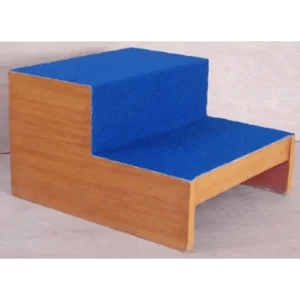
What Is a Rehabilitation Foot Stepper?
A Rehabilitation Foot Stepper is a manual or mechanically resisted exercise device that allows the user to perform repeated stepping movements using the feet.
The device generally consists of a stable base with two foot pedals. The pedals move through a controlled reciprocating pattern, allowing the user to exercise the lower limbs without needing to lift the feet completely away from the platforms.
Unlike a conventional staircase, the foot stepper provides a compact and controlled exercise environment. Depending on the model, resistance can be adjusted to make the movement easier or more challenging.
This makes the equipment useful as part of progressive foot, ankle and lower-limb rehabilitation programs.
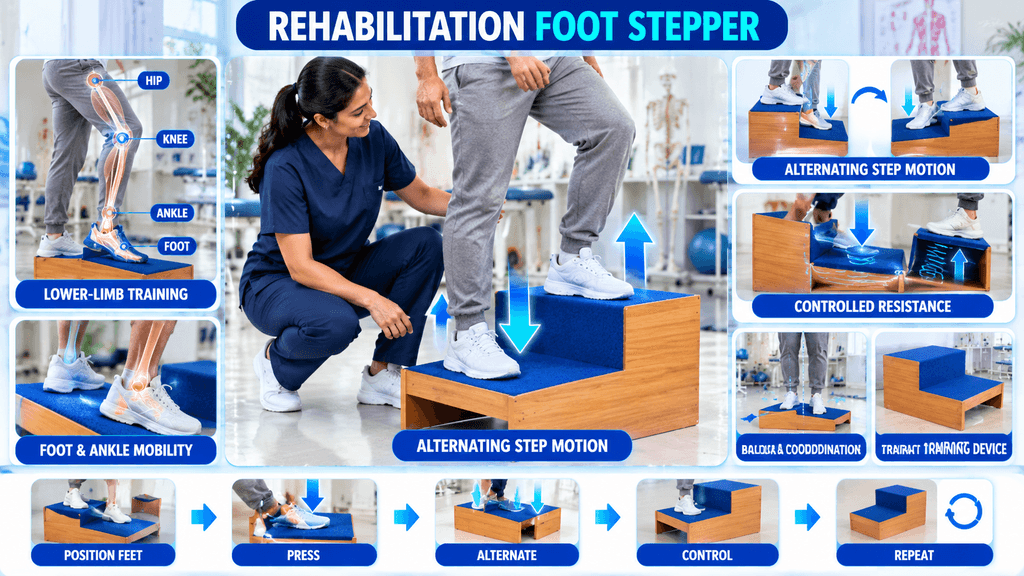
How Does a Rehabilitation Foot Stepper Work?
The user places both feet securely on the designated foot platforms and performs alternating or coordinated stepping movements.
Depending on the mechanism, the pedals may provide mechanical resistance as the user presses downward. Some rehabilitation designs allow the resistance or movement range to be adjusted.
The therapist can select an appropriate exercise intensity based on the patient’s:
- Lower-limb strength
- Foot and ankle mobility
- Balance
- Coordination
- Exercise tolerance
- Rehabilitation stage
- Functional goals
The movement should remain controlled and comfortable rather than being performed with excessive force or speed.
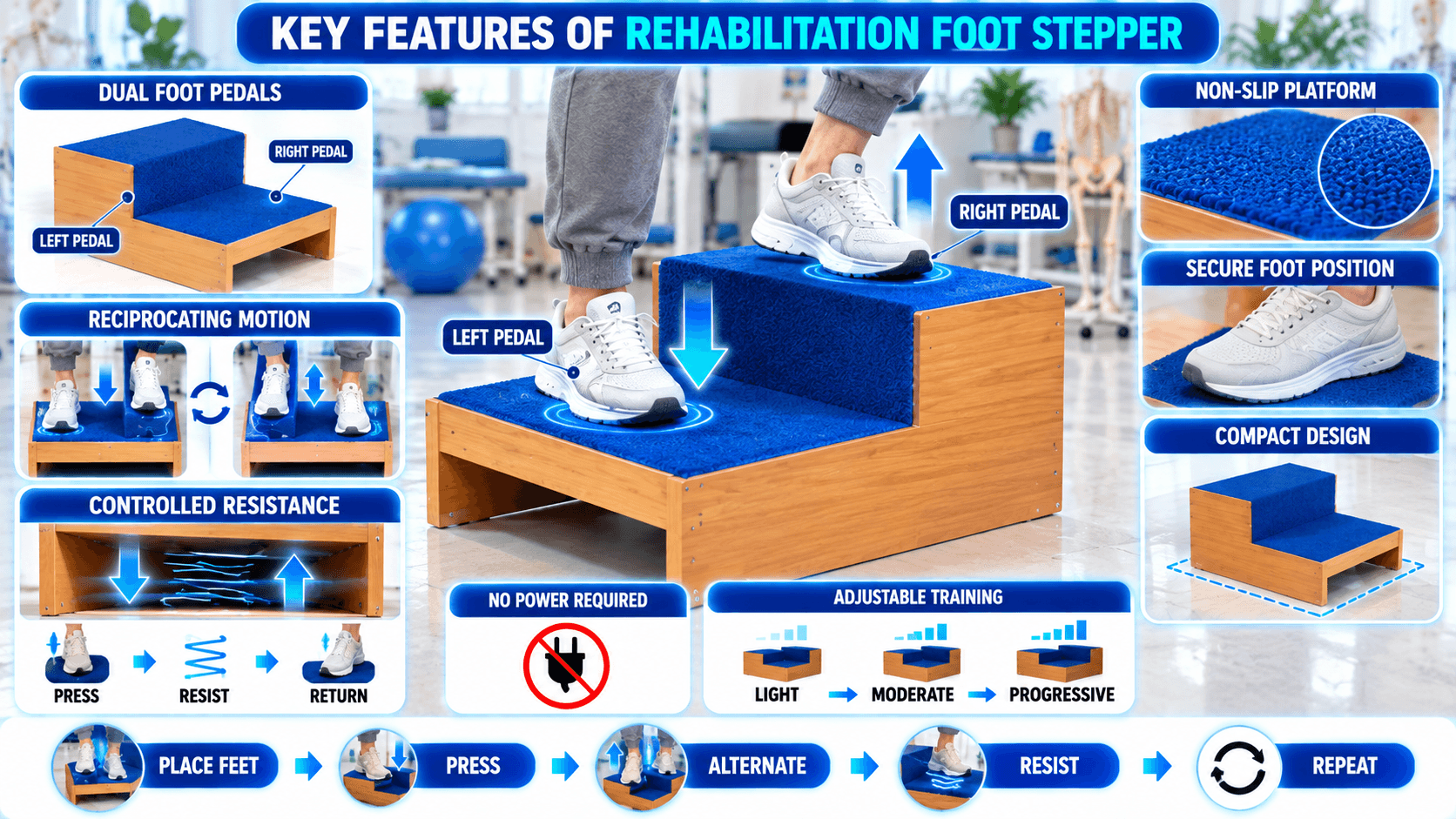
Key Features
Dual Foot Pedals
The Rehabilitation Foot Stepper generally includes separate platforms for the right and left foot, allowing alternating lower-limb movement.
Reciprocating Movement
The foot platforms can move in an alternating stepping pattern. This type of movement is characteristic of stationary stepper equipment.
Controlled Resistance
Depending on the model, mechanical or hydraulic resistance may be available to control exercise intensity.
Non-Slip Foot Platforms
Non-slip pedal surfaces help provide better foot contact during exercise.
Foot Straps
Some models may include adjustable straps to help maintain appropriate foot positioning during exercise.
Compact Design
A compact foot-stepper format can be convenient for physiotherapy rooms with limited floor space.
Manual Operation
Many rehabilitation foot steppers operate without external electrical power, making them straightforward to use.
Progressive Exercise
Resistance or movement difficulty can be adjusted on suitable models to support gradual progression.
Applications of Rehabilitation Foot Stepper
The Rehabilitation Foot Stepper can be incorporated into a variety of lower-limb rehabilitation programs.
Foot and Ankle Exercise
Controlled stepping can provide repetitive movement for the lower limbs, including the foot and ankle region.
Lower-Limb Rehabilitation
The device can be used as part of exercise programs focused on controlled leg movement and functional strengthening.
Mobility Training
Repeated stepping movements can complement broader functional mobility exercises.
Coordination Training
Alternating pedal movement requires coordination between the lower limbs.
Muscle Activation
Stepping exercises can engage muscles involved in lower-limb movement. The exact muscles and exercise intensity depend on the movement pattern and resistance setting.
Post-Injury Rehabilitation
A foot stepper may be incorporated into rehabilitation following selected lower-limb injuries when exercise has been cleared by the treating professional.
Sports Rehabilitation
Sports rehabilitation programs may use controlled stepping exercises as one component of progressive lower-limb conditioning.
Geriatric Exercise
For suitable users, a compact foot stepper can provide a controlled lower-limb exercise option. Exercise selection and supervision should be based on the individual’s mobility and balance.
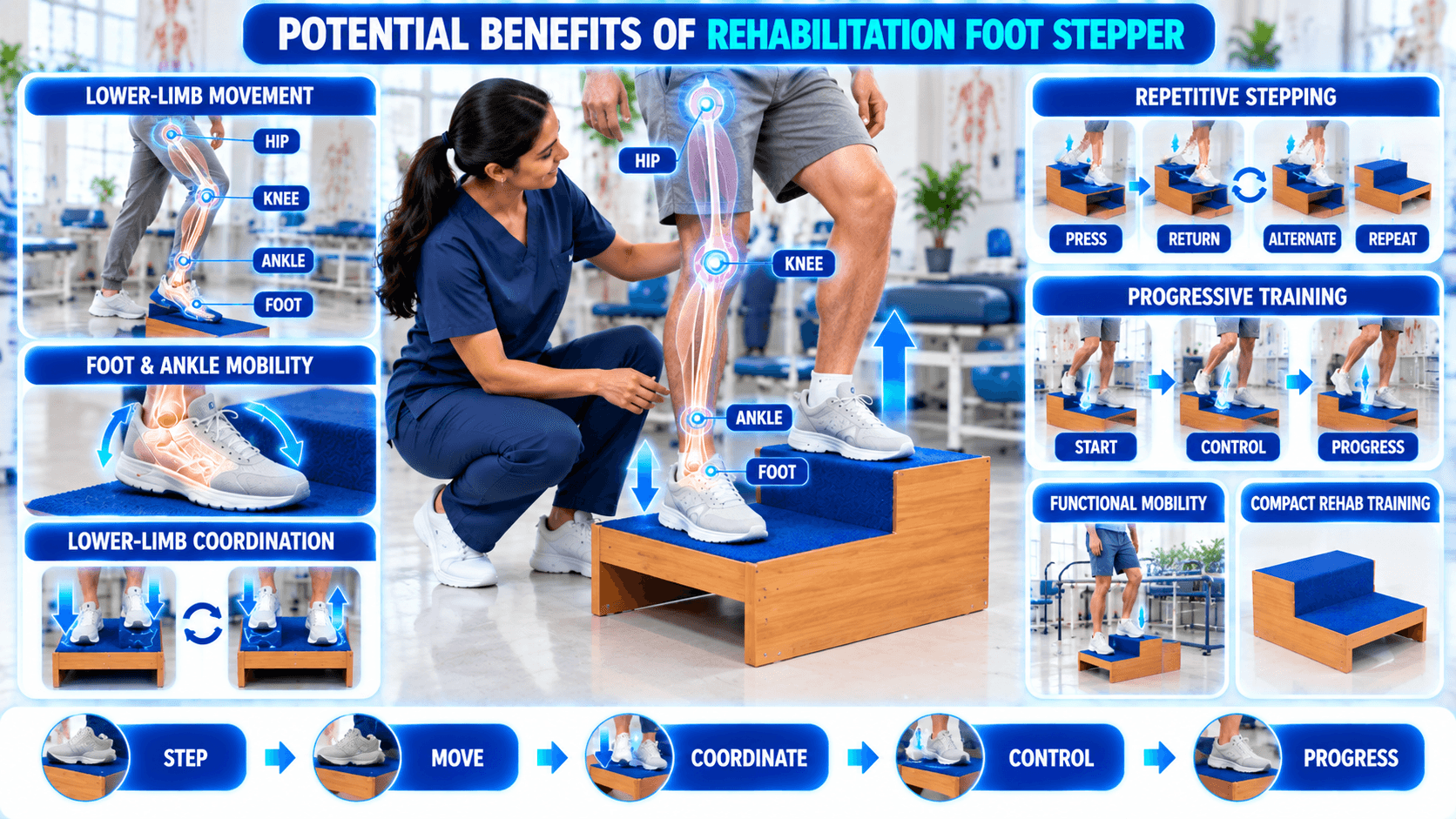
Potential Benefits
The potential benefits of a Rehabilitation Foot Stepper depend on the individual’s condition, exercise technique and rehabilitation program.
- Provides repetitive foot-operated movement
- Supports controlled lower-limb exercise
- Can encourage ankle and foot movement
- Provides a compact stepping exercise option
- Allows progressive resistance on compatible models
- Supports lower-limb coordination
- Can be incorporated into functional mobility programs
- Provides an alternative to larger exercise equipment
- May support gradual exercise progression
- Suitable for selected physiotherapy and rehabilitation environments
The equipment should be used as an exercise and rehabilitation aid rather than as an independent treatment for a specific medical condition.
Rehabilitation Foot Stepper for Foot and Ankle Exercise
Foot and ankle movement plays an important role in standing, walking and functional mobility.
The Rehabilitation Foot Stepper allows the patient to perform repeated foot-driven movements while maintaining contact with the pedals. This can provide a controlled exercise environment for patients who need progressive lower-limb activity.
Depending on the patient’s rehabilitation goals, the therapist may use the device alongside:
- Ankle mobility exercises
- Foot strengthening exercises
- Calf exercises
- Balance training
- Gait training
- Resistance exercises
- Functional movement practice
The exact exercise selection should depend on the patient’s condition and professional assessment.
Lower-Limb Strength and Conditioning
Stepping against resistance can place an exercise demand on the muscles involved in lower-limb movement.
A therapist may gradually modify the exercise by changing:
- Resistance
- Repetition count
- Exercise duration
- Movement speed
- Rest intervals
Progression should be gradual and based on the patient’s tolerance.
The aim is to maintain controlled movement rather than simply increasing resistance as quickly as possible.
Coordination and Reciprocal Movement
Alternating lower-limb movement requires coordinated action between the right and left legs.
The Rehabilitation Foot Stepper can therefore be incorporated into exercise programs where repetitive reciprocal lower-limb movement is appropriate.
The therapist can observe:
- Pedal control
- Movement symmetry
- Rhythm
- Foot positioning
- Range of movement
- Fatigue
- Ability to maintain consistent movement
These observations can help guide exercise progression.
Rehabilitation Foot Stepper for Physiotherapy Clinics
A compact foot stepper can be a practical addition to a physiotherapy exercise area.
It can be used alongside:
- Exercise cycles
- Parallel bars
- Balance boards
- Exercise stairs
- Standing frames
- Resistance bands
- Treatment tables
- Gait-training equipment
- Lower-limb exercise devices
Because the device is relatively compact compared with large rehabilitation machines, it can be positioned in an exercise corner or therapy area.
How to Use the Rehabilitation Foot Stepper
Step 1: Assess the Patient
Assess the patient’s foot, ankle and lower-limb condition before beginning exercise.
Step 2: Position the Equipment
Place the foot stepper on a stable, level surface.
Step 3: Check the Pedals
Inspect the foot platforms and resistance mechanism before use.
Step 4: Position the Feet
Place both feet securely on the appropriate pedals.
Step 5: Adjust Resistance
If the model provides resistance adjustment, select an appropriate starting level.
Step 6: Begin Slowly
Start with controlled stepping movements rather than immediately using high speed or resistance.
Step 7: Maintain Foot Contact
Keep the feet properly positioned on the pedals throughout the exercise.
Step 8: Monitor Movement
Observe movement quality, coordination, discomfort and fatigue.
Step 9: Progress Gradually
Increase duration, repetitions or resistance only when appropriate for the patient’s rehabilitation level.
Step 10: Finish the Exercise
Stop the movement gradually and remove the feet from the pedals safely.
Safety Precautions
The Rehabilitation Foot Stepper should be used according to the manufacturer’s instructions and, where appropriate, under physiotherapist supervision.
Important precautions include:
- Place the equipment on a stable surface.
- Check the pedals before every session.
- Ensure the feet are properly positioned.
- Use pedal straps when provided and clinically appropriate.
- Begin with low resistance when starting a new exercise program.
- Avoid sudden or uncontrolled movements.
- Do not exceed the recommended user weight or equipment limits.
- Stop exercise if significant pain occurs.
- Monitor patients with balance or mobility limitations.
- Allow appropriate rest periods.
- Keep the surrounding area free from obstacles.
- Inspect the resistance mechanism regularly.
Patients recovering from surgery, fracture or significant lower-limb injury should use the equipment only when exercise has been considered appropriate by their treating professional.
Who Can Use a Rehabilitation Foot Stepper?
Potential users may include:
- Physiotherapy patients
- Orthopaedic rehabilitation patients
- Sports rehabilitation patients
- Older adults requiring supervised exercise
- Patients working on lower-limb mobility
- Patients requiring controlled foot and ankle exercise
- Individuals following an appropriately prescribed rehabilitation program
Suitability depends on the patient’s medical condition, mobility and rehabilitation requirements.
Rehabilitation Foot Stepper vs Conventional Step Exercise
| Feature | Rehabilitation Foot Stepper | Conventional Stair Exercise |
|---|---|---|
| Equipment Size | Compact | Requires larger space |
| Foot Movement | Pedal-based | Step-based |
| Resistance | Model dependent | Primarily body-weight based |
| Foot Contact | Remains on pedals | Foot leaves one step during movement |
| Balance Demand | Generally more controlled | Can require greater balance |
| Exercise Setting | Controlled equipment | Stair or staircase |
| Progression | Resistance/repetitions can be adjusted | Step height and repetitions can be changed |
| Suitable for | Controlled lower-limb exercise | Functional stair training |
| Power | Usually manual | Not required |
A foot stepper and therapeutic staircase serve different purposes. A foot stepper is suited to controlled pedal-based exercise, while an exercise staircase is more directly related to functional stair-climbing practice.
Things to Consider Before Buying
Pedal Size
Check that the foot platforms provide sufficient space for the intended users.
Pedal Grip
A non-slip surface can help maintain secure foot placement.
Resistance Adjustment
If progressive rehabilitation is required, check whether resistance can be adjusted.
Movement Range
Confirm the pedal travel and movement characteristics before purchase.
Foot Straps
Check whether straps are included and whether they can be adjusted.
Frame Stability
The base should remain stable during normal exercise.
User Weight Capacity
Always verify the manufacturer’s specified maximum user weight.
Construction
Choose materials appropriate for the expected clinical workload.
Storage
A compact design can be useful where therapy-room space is limited.
Maintenance
Check the availability of replacement components and technical support.
Technical Specifications
| Specification | Details |
|---|---|
| Product Name | Rehabilitation Foot Stepper |
| Product Type | Foot & Lower-Limb Rehabilitation Exercise Equipment |
| Operation | Manual / Mechanical |
| Exercise Type | Reciprocating Foot Stepping |
| Pedals | Dual Foot Platforms |
| Resistance | Adjustable / Model Dependent |
| Movement | Reciprocal / Model Dependent |
| Foot Straps | Included / Model Dependent |
| Pedal Surface | Non-Slip / Model Dependent |
| Frame | Metal / Model Dependent |
| Power Requirement | Usually None |
| Dimensions | Model Dependent |
| User Weight Capacity | Model Dependent |
| Application | Physiotherapy & Rehabilitation |
| Primary Area | Foot, Ankle & Lower Limb |
| Suitable Environment | Clinics, Rehabilitation Centres & Therapy Areas |
| Brand | PHYSIOMODALITIES™ |
Note: Exact dimensions, pedal travel, resistance range, materials, weight and user capacity should be confirmed from the specific product model before publishing fixed numerical specifications.
Why Choose PHYSIOMODALITIES™?
PHYSIOMODALITIES™ focuses on physiotherapy and rehabilitation equipment designed for professional treatment and exercise environments.
The Rehabilitation Foot Stepper can be a practical addition to a clinic’s lower-limb rehabilitation setup, particularly where controlled stepping, foot movement and progressive exercise are required.
When selecting rehabilitation equipment, clinics should consider stability, pedal design, resistance adjustment, foot security, construction quality, user capacity, maintenance requirements, warranty and after-sales support.
Conclusion
The Rehabilitation Foot Stepper is a compact exercise and rehabilitation device designed for controlled reciprocal foot movement and lower-limb exercise. Its pedal-based design allows users to perform repetitive stepping movements while maintaining contact with the foot platforms.
It can be incorporated into physiotherapy programs focusing on foot and ankle movement, lower-limb conditioning, coordination, mobility and progressive exercise. Depending on the model, adjustable resistance, non-slip pedals and foot straps can provide additional control during training.
For professional rehabilitation environments, the device can complement larger equipment such as exercise staircases, parallel bars, balance-training systems and gait-training equipment. Appropriate patient assessment, gradual progression and safe exercise technique are important for effective use.
Frequently Asked Questions
1. What is a Rehabilitation Foot Stepper?
A Rehabilitation Foot Stepper is a compact exercise device with foot-operated pedals designed for controlled stepping and lower-limb rehabilitation exercises.
2. What is a Rehabilitation Foot Stepper used for?
It can be used for selected foot, ankle and lower-limb exercises, coordination training, controlled stepping and progressive rehabilitation programs.
3. Does a Rehabilitation Foot Stepper require electricity?
Most basic manual foot steppers do not require external electrical power. However, powered models may have different operating requirements.
4. Can resistance be adjusted?
Some rehabilitation foot steppers provide adjustable mechanical or hydraulic resistance. The available resistance settings depend on the specific model.
5. Is a Rehabilitation Foot Stepper suitable for physiotherapy clinics?
Yes. It can be incorporated into physiotherapy and rehabilitation exercise areas where controlled lower-limb movement and stepping exercises are part of the treatment program.