
The Multi Exercise Chair is versatile physiotherapy and rehabilitation equipment designed to support a wide range of assisted, active, and resistive exercises in a compact seated or reclining setup. It is commonly used for upper-limb and lower-limb rehabilitation, including exercises for the shoulder, elbow, hip, knee, and related muscle groups.
Designed for physiotherapy clinics, rehabilitation centres, hospitals, sports rehabilitation facilities, and therapy departments, the Multi Exercise Chair combines a supportive chair structure with adjustable exercise attachments, pulley mechanisms, straps, handles, and resistance options. This allows therapists to create different exercise configurations without requiring several separate pieces of equipment.
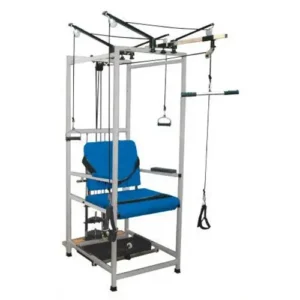
A typical multi-exercise configuration may include an adjustable or reclining backrest, overhead pulley arrangement, arm and ankle straps, handles, and graded weights. The exact attachments and dimensions can vary by manufacturer and model.
What Is a Multi Exercise Chair?
A Multi Exercise Chair is a therapeutic exercise station that allows patients to perform different rehabilitation movements while sitting or reclining with appropriate support.
Unlike a conventional chair, it is designed around physiotherapy exercise requirements. Its frame can incorporate pulley blocks, ropes, handles, straps, and resistance weights so that the therapist can select exercises according to the patient’s rehabilitation program.
Depending on the configuration, the chair can be used for:
- Shoulder and arm exercises
- Elbow movement exercises
- Hip and knee exercises
- Quadriceps exercises
- Hamstring stretching
- Assisted range-of-motion exercises
- Resistive strengthening exercises
- Reciprocal movement exercises
- Upper- and lower-extremity rehabilitation
The equipment is manually operated and does not require an electrical power source in commonly available configurations.
How Does the Multi Exercise Chair Work?
The Multi Exercise Chair uses a combination of patient positioning, pulley movement, straps, handles, and adjustable resistance.
The patient can be positioned in a seated or reclining posture depending on the exercise. The therapist then selects the appropriate attachment and adjusts the pulley or resistance arrangement. By pulling, pushing, lifting, or moving against controlled resistance, the patient can perform a selected therapeutic exercise.
An adjustable backrest can provide different working positions. Some documented models allow the backrest to move from a more upright position toward a reclining position, expanding the range of exercises that can be performed.
Adjustable Exercise Position
The adjustable backrest helps accommodate different exercises and patient positions. This can be useful when moving from seated upper-limb exercises to supported lower-limb or stretching exercises.
Pulley-Based Exercise
Pulley blocks and ropes can be positioned to facilitate assisted or resisted movements. Some models include adjustable pulley blocks and rotating pulley arms for changing the exercise angle.
Graded Resistance
Weight plates can be used to provide progressive resistance. The therapist can select an appropriate resistance level based on the patient’s exercise plan and tolerance.
Key Features of Multi Exercise Chair
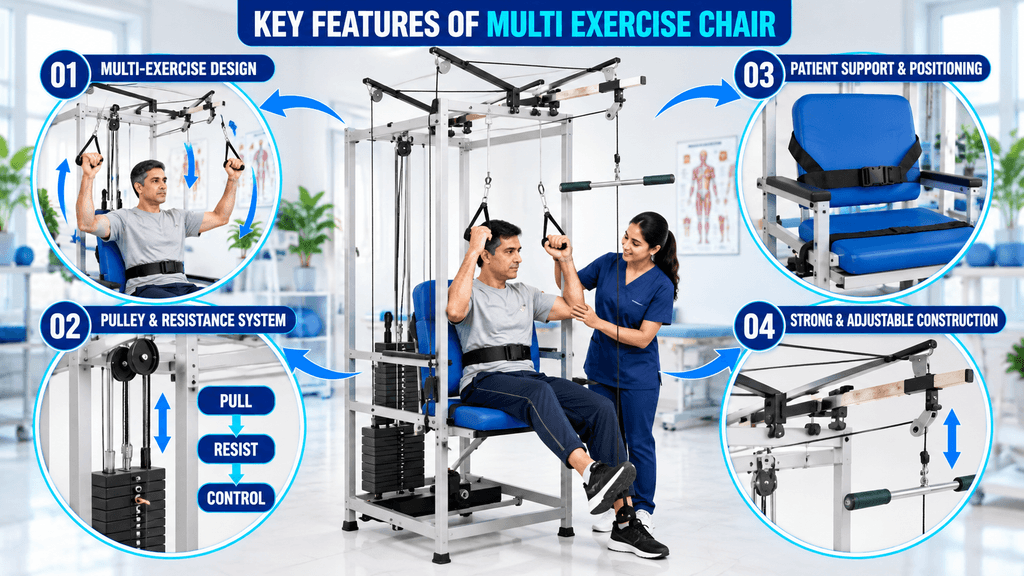
- Heavy-duty metal or mild-steel construction
- Powder-coated or polished finish depending on model
- Supportive padded seat and backrest
- Adjustable or reclining backrest on applicable models
- Adjustable armrests on selected configurations
- Overhead exercise bar
- Pulley and rope mechanism
- Adjustable pulley positioning
- Arm slings and handles
- Ankle straps
- Stabilizing straps for patient positioning
- Graded resistance through weight plates
- Compact footprint for therapy departments
- Manual operation
- Multiple upper- and lower-limb exercise options
- Suitable for professional physiotherapy environments
Some documented models use heavy-duty mild-steel square pipe for the chair and backrest, while the overhead bar and weight-guide components may use tubular or CRC pipe construction.
Applications of Multi Exercise Chair
The Multi Exercise Chair can be incorporated into rehabilitation programs where controlled movement, strengthening, stretching, and range-of-motion exercises are required.
Shoulder Rehabilitation
The pulley system can support controlled shoulder movements and assisted exercises. The therapist can position the pulley and handle according to the required movement pattern.
Elbow Exercises
Handles and pulley attachments can be used for controlled elbow flexion, extension, and other therapist-directed movements.
Knee Rehabilitation
The chair can support exercises involving knee movement and lower-limb strengthening. Quadriceps-focused exercise configurations are also available in multi-exercise chair systems.
Hip Exercises
Supported hip movements can be performed using suitable straps, pulleys, and positioning.
Muscle Strengthening
Adjustable weights allow resistance to be increased or decreased according to the prescribed exercise level.
Stretching Exercises
The chair can assist with selected stretching exercises, including lower-extremity stretching, when performed under appropriate professional supervision.
Range-of-Motion Training
The equipment can be incorporated into active, assisted, or resistive range-of-motion programs depending on the patient’s condition and therapist’s assessment.
Benefits of Multi Exercise Chair
A Multi Exercise Chair offers several practical advantages for physiotherapy and rehabilitation facilities.
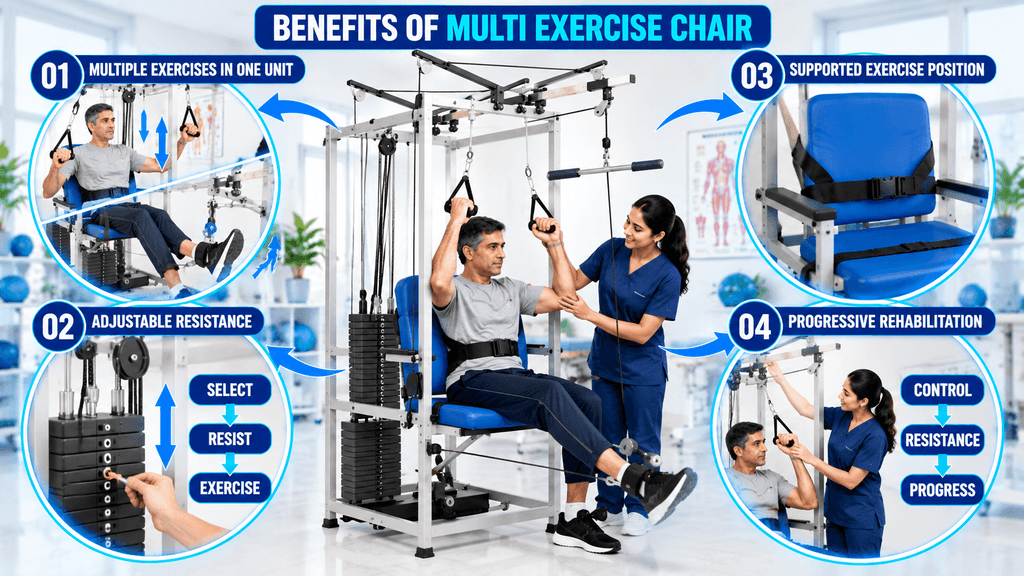
Multiple Exercises in One Unit
Its primary advantage is versatility. Different attachments and resistance arrangements allow several exercise categories to be performed using one compact station.
Space Efficient Design
A multi-purpose exercise station can be useful in clinics where treatment-room space is limited. One documented configuration has a floor area of approximately 100 cm × 67 cm, with the overhead bar extending beyond the front of the frame. Exact dimensions vary by model.
Adjustable Resistance
Resistance can be adjusted by changing the selected weight level, allowing therapists to establish different exercise intensities.
Supported Exercise Position
The chair provides a stable seated or reclining base, which can be useful for patients who require supported positioning during exercise.
Upper and Lower Limb Training
The equipment can accommodate exercises for both upper and lower extremities, reducing the need for separate exercise stations.
Suitable for Progressive Rehabilitation
As a patient’s exercise program changes, the therapist can modify resistance, positioning, pulley arrangement, and movement pattern accordingly.
Exercises Possible with Multi Exercise Chair
Depending on the chair configuration and attachments, exercises may include:
| Exercise Category | Typical Application |
|---|---|
| Shoulder exercises | Assisted and resisted shoulder movement |
| Elbow exercises | Controlled flexion and extension movements |
| Knee exercises | Quadriceps and lower-limb strengthening |
| Hip exercises | Supported hip movement |
| Hamstring exercises | Stretching and strengthening programs |
| Reciprocal exercises | Coordinated limb movements |
| Range-of-motion exercises | Active or assisted movement |
| Resistive exercises | Progressive muscle-focused training |
| Assistive exercises | Supported movement for rehabilitation |
The exact exercise selection should be determined by a qualified physiotherapist according to the patient’s assessment and treatment plan.
How to Use a Multi Exercise Chair
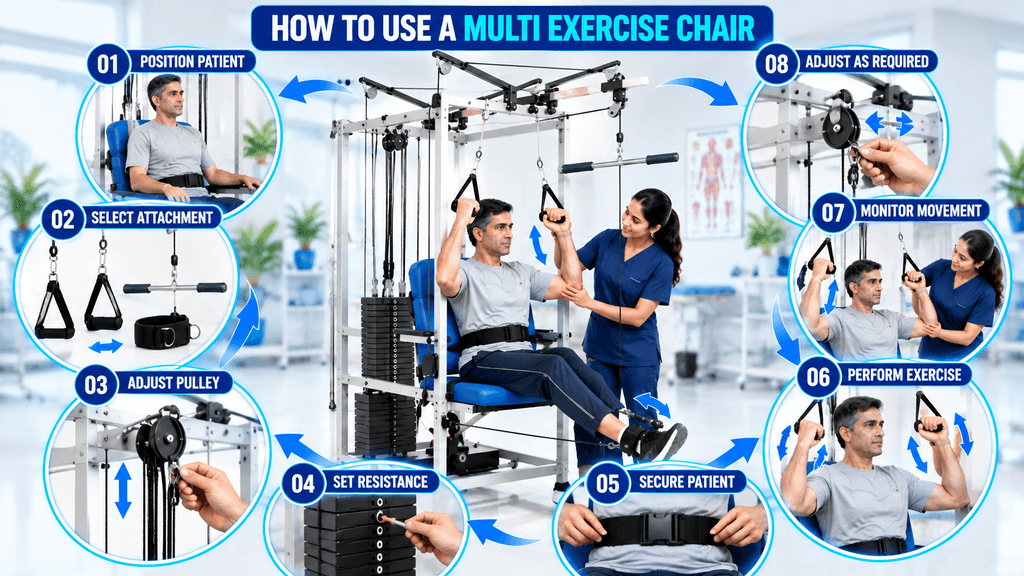
Step 1: Position the Patient
Place the patient comfortably on the chair and adjust the backrest or seating position according to the planned exercise.
Step 2: Select the Attachment
Choose the appropriate handle, sling, ankle strap, gripping bar, or pulley attachment.
Step 3: Adjust the Pulley
Position the pulley block at the required height and angle. Some models provide adjustable pulley blocks and rotating pulley arms.
Step 4: Set Resistance
Select an appropriate resistance level using the available weight plates. Begin with a suitable load rather than automatically selecting maximum resistance.
Step 5: Secure the Patient
Use stabilizing straps where required to maintain appropriate positioning during the exercise.
Step 6: Perform the Exercise
The patient performs the prescribed movement slowly and in a controlled manner while maintaining the recommended posture.
Step 7: Monitor the Movement
The physiotherapist should observe movement quality, resistance tolerance, posture, and patient comfort throughout the exercise.
Step 8: Adjust as Required
Resistance, pulley position, backrest angle, or attachment can be modified according to the rehabilitation program.
Safety Precautions
- The equipment should be used according to professional guidance.
- Check all ropes, pulleys, handles, straps, and attachment points before use.
- Confirm that resistance weights are correctly positioned.
- Secure the patient appropriately before exercises.
- Avoid sudden or uncontrolled movements.
- Do not use excessive resistance.
- Stop the exercise if significant pain, dizziness, or unusual discomfort occurs.
- Keep fingers and clothing away from moving pulley components.
- Inspect the frame and mounting components regularly.
- Follow the manufacturer’s recommended maintenance instructions.
The appropriate exercise, resistance, repetitions, and progression should be determined by a qualified physiotherapist or rehabilitation professional.
Who Can Use a Multi Exercise Chair?
The Multi Exercise Chair is primarily intended for professional rehabilitation and physiotherapy environments, including:
- Physiotherapy clinics
- Rehabilitation centres
- Hospitals
- Sports rehabilitation centres
- Orthopaedic rehabilitation departments
- Occupational therapy facilities
- Wellness and therapeutic exercise centres
- Physiotherapy teaching institutions
Multi Exercise Chairs are also listed among physiotherapy and rehabilitation equipment used in institutional settings. For example, Jamia Millia Islamia’s Centre for Physiotherapy and Rehabilitation Sciences lists a Multi Exercise Chair among its equipment.
Multi Exercise Chair vs Conventional Exercise Equipment
| Feature | Multi Exercise Chair | Conventional Single-Exercise Equipment |
|---|---|---|
| Exercise options | Multiple | Usually limited |
| Patient position | Seated/reclining | Depends on equipment |
| Pulley exercises | Yes, model-dependent | Often separate unit |
| Resistance training | Available on many models | Usually dedicated |
| Upper-limb exercises | Yes | Model-specific |
| Lower-limb exercises | Yes | Model-specific |
| Space requirement | Relatively compact | May require multiple units |
| Manual operation | Yes | Varies |
| Clinic versatility | High | Depends on equipment |
Technical Specifications
Specifications can vary between manufacturers and configurations. The following represents a commonly documented multi-exercise-chair configuration rather than a universal specification.
| Specification | Details |
|---|---|
| Product Name | Multi Exercise Chair |
| Equipment Type | Physiotherapy & Rehabilitation Exercise Equipment |
| Operation | Manual |
| Main Material | Heavy-duty Mild Steel / Metal |
| Finish | Powder Coated / Polished |
| Backrest | Padded, adjustable on applicable models |
| Seat | Padded seat |
| Exercise System | Pulley and resistance system |
| Pulley Blocks | Adjustable |
| Pulley Arm | Rotatable on applicable models |
| Stabilization | Torso / thigh straps depending on model |
| Resistance | Weight-based, model-dependent |
| Application | Upper & lower-limb rehabilitation |
| Power Requirement | Not required for manual configuration |
| Country of Origin | India, depending on manufacturer |
A documented configuration includes two pulley-rope sets, pulley block, wire handles, arm slings, ankle straps, gripping bar, snap hooks, and ten 1 kg weight plates. These accessories should be confirmed for the exact model before purchase.
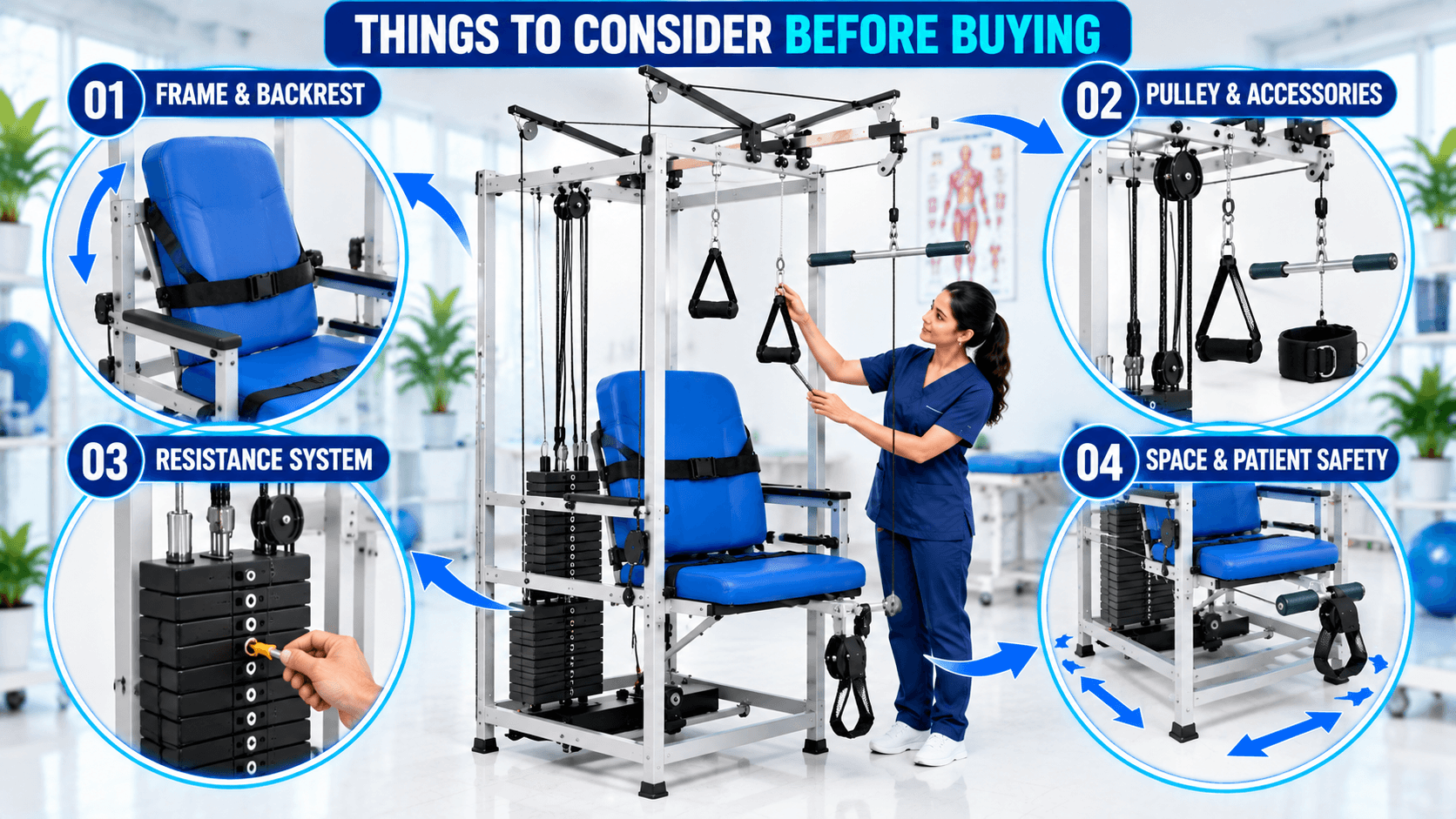
Things to Consider Before Buying
Before selecting a Multi Exercise Chair, consider:
Frame Construction
Choose a sturdy frame suitable for regular clinical use. Heavy-duty steel construction can provide the stability required for repeated rehabilitation exercises.
Backrest Adjustment
If the chair will be used for multiple exercise positions, check the available backrest adjustment range.
Pulley Configuration
Confirm how many pulley blocks are supplied and whether their height and direction can be adjusted.
Accessories
Check whether the package includes handles, slings, straps, ropes, pulley blocks, gripping bars, and resistance weights.
Resistance System
Confirm the number and weight of supplied plates and whether additional resistance can be added.
Dimensions
Measure the available treatment-room space before purchasing. Also consider the additional clearance required around the overhead exercise bar.
Patient Safety
Look for appropriate stabilizing straps and a stable base to support controlled exercise positioning.
Why Choose PHYSIOMODALITIES™
PHYSIOMODALITIES™ focuses on physiotherapy and rehabilitation equipment designed for professional clinical environments. A Multi Exercise Chair can complement a broader rehabilitation setup by combining supported positioning, pulley-based exercise, stretching, and resistance training in one workstation.
For clinics building a comprehensive physiotherapy exercise area, the equipment can be used alongside other rehabilitation products such as shoulder wheels, hand exercise equipment, ankle exercisers, parallel bars, exercise stairs, and treatment tables.
Conclusion
The Multi Exercise Chair is a practical rehabilitation workstation designed to support multiple physiotherapy exercises from a compact, supported position. With features such as adjustable positioning, pulley attachments, straps, handles, and graded resistance, it can be incorporated into upper- and lower-limb rehabilitation programs.
For physiotherapy clinics, rehabilitation centres, and hospitals, its multi-purpose design can reduce the need for several separate exercise stations while giving therapists flexibility to modify exercise positioning and resistance according to individual treatment requirements.
Frequently Asked Questions
1. What is a Multi Exercise Chair?
A Multi Exercise Chair is physiotherapy rehabilitation equipment designed for multiple seated or reclining exercises involving the upper and lower limbs.
2. Can a Multi Exercise Chair be used for shoulder exercises?
Yes. With suitable pulley attachments and handles, it can be incorporated into therapist-directed shoulder mobility, assisted, and resistance exercises.
3. Can it be used for knee rehabilitation?
Yes. Suitable configurations can support knee and quadriceps-focused exercises, along with other lower-limb rehabilitation movements.
4. Does a Multi Exercise Chair require electricity?
Common manual configurations do not require an external power source.
5. Is the Multi Exercise Chair suitable for physiotherapy clinics?
Yes. It is specifically designed as multi-purpose physiotherapy and rehabilitation exercise equipment and is used in clinical and rehabilitation environments.