
The Geometric Peg Board is a fine motor and hand rehabilitation exercise device designed to support coordination, dexterity, finger control, visual-motor skills, and functional hand training. It is commonly used in physiotherapy, occupational therapy, rehabilitation centres, special education settings, and therapeutic exercise programs.
The board uses removable geometric pegs or shapes that can be placed, removed, sorted, or matched according to the exercise being performed. These repetitive hand movements can provide structured practice for grasping, releasing, reaching, positioning, and manipulating objects.
For rehabilitation professionals, a Geometric Peg Board can be incorporated into progressive hand therapy programs where controlled movements and task-oriented activities are required.
What Is a Geometric Peg Board?
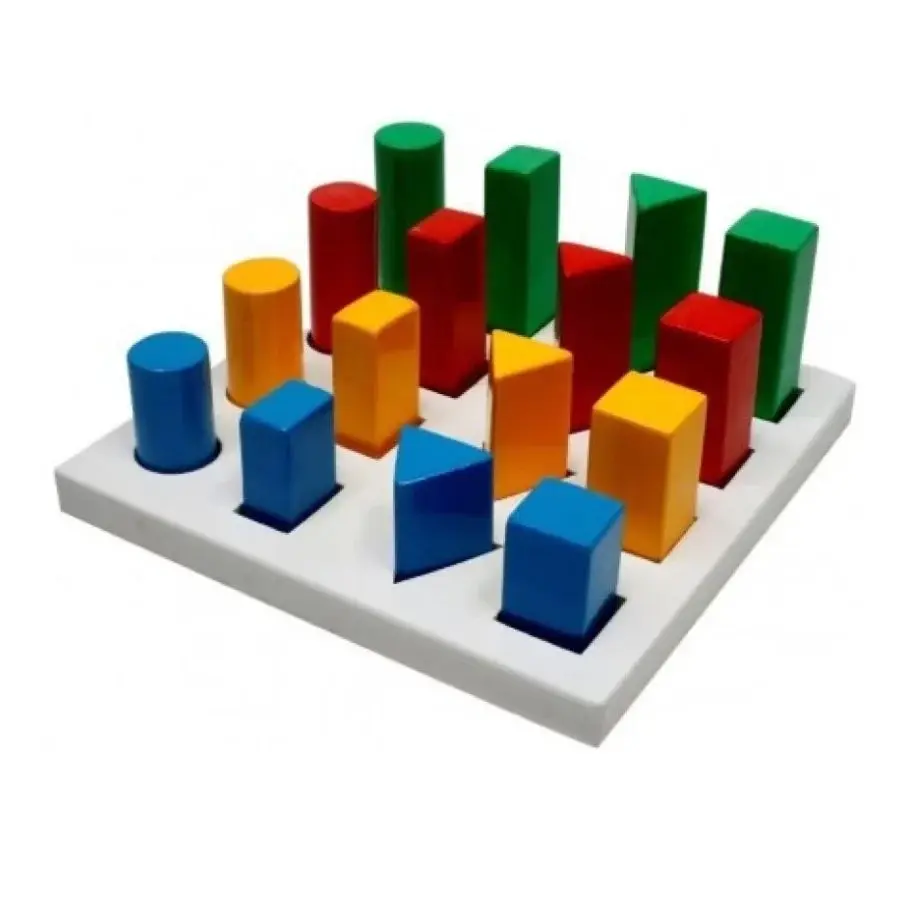
A Geometric Peg Board is a therapeutic hand-exercise board consisting of a base with multiple holes and removable geometric pieces or pegs.
The user picks up individual pieces and places them into the appropriate openings. Depending on the design, exercises can involve different shapes, sizes, positions, and sequences.
This simple activity can be adapted for:
- Fine motor training
- Hand-eye coordination
- Finger dexterity
- Grip and release practice
- Visual-motor coordination
- Object manipulation
- Hand rehabilitation
- Functional task training
- Cognitive-motor activities
The difficulty can be adjusted by changing the sequence, speed, distance, or type of object used during the exercise.
How Does a Geometric Peg Board Work?
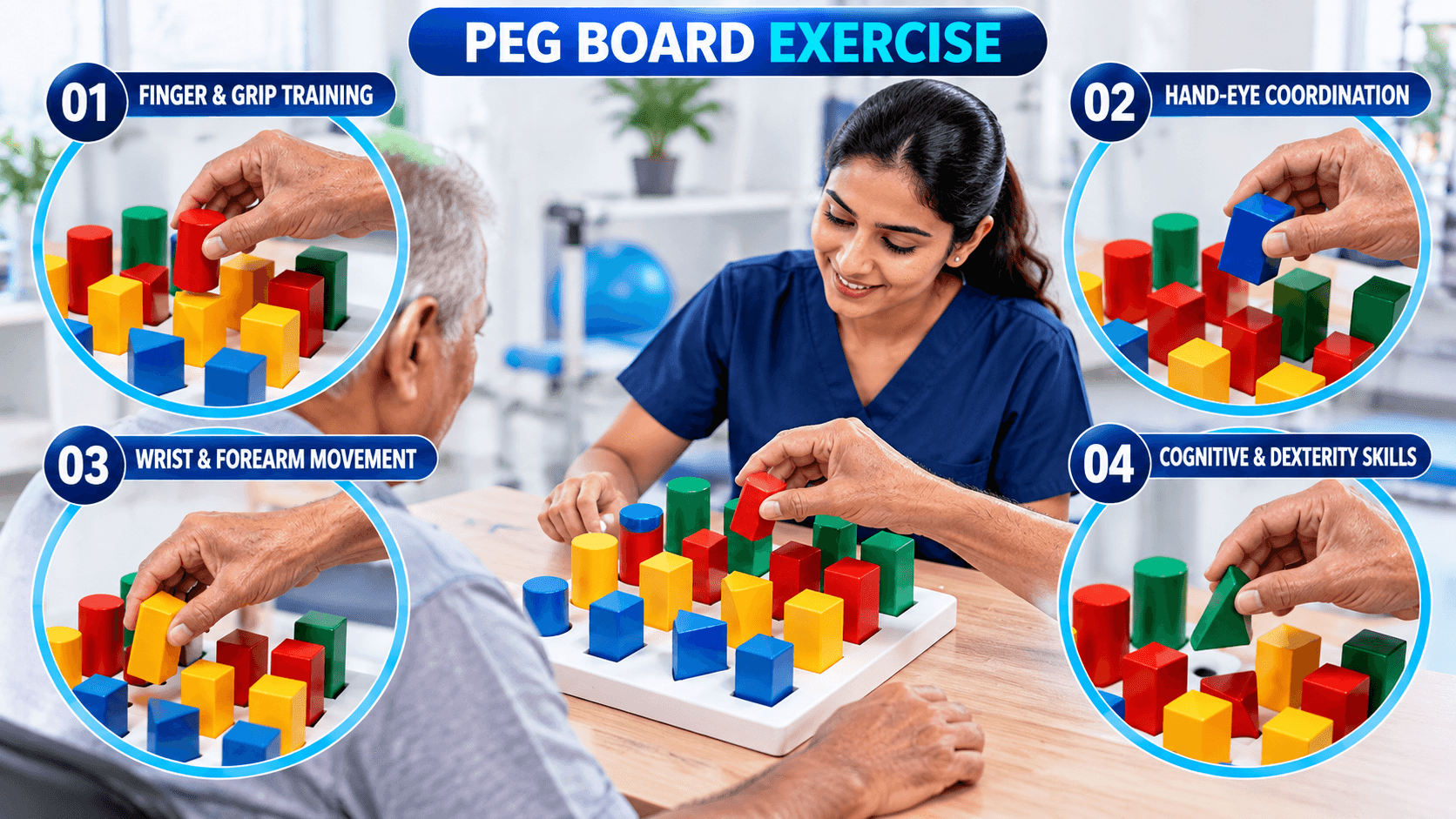
The Geometric Peg Board works through repeated placement and removal of geometric pieces.
The therapist can arrange the pieces around the patient or provide them one at a time. The patient then grasps a piece, moves it toward the board, aligns it with the appropriate opening, and places it correctly.
This activity combines several movements:
- Reaching toward the object
- Grasping the peg or geometric piece
- Maintaining finger control
- Moving the hand toward the target
- Aligning the piece with the opening
- Releasing the object
- Repeating the movement
The activity can therefore be incorporated into exercises involving both hand function and visual-motor coordination.
Shape Recognition
Different geometric shapes can introduce matching and identification tasks while the user handles each piece.
Controlled Grasping
Picking up smaller pieces encourages controlled finger and hand movements.
Placement Accuracy
The user must position each piece correctly, requiring visual guidance and hand control.
Repetition
Repeated placement and removal provide a structured way to practice the same movement pattern.
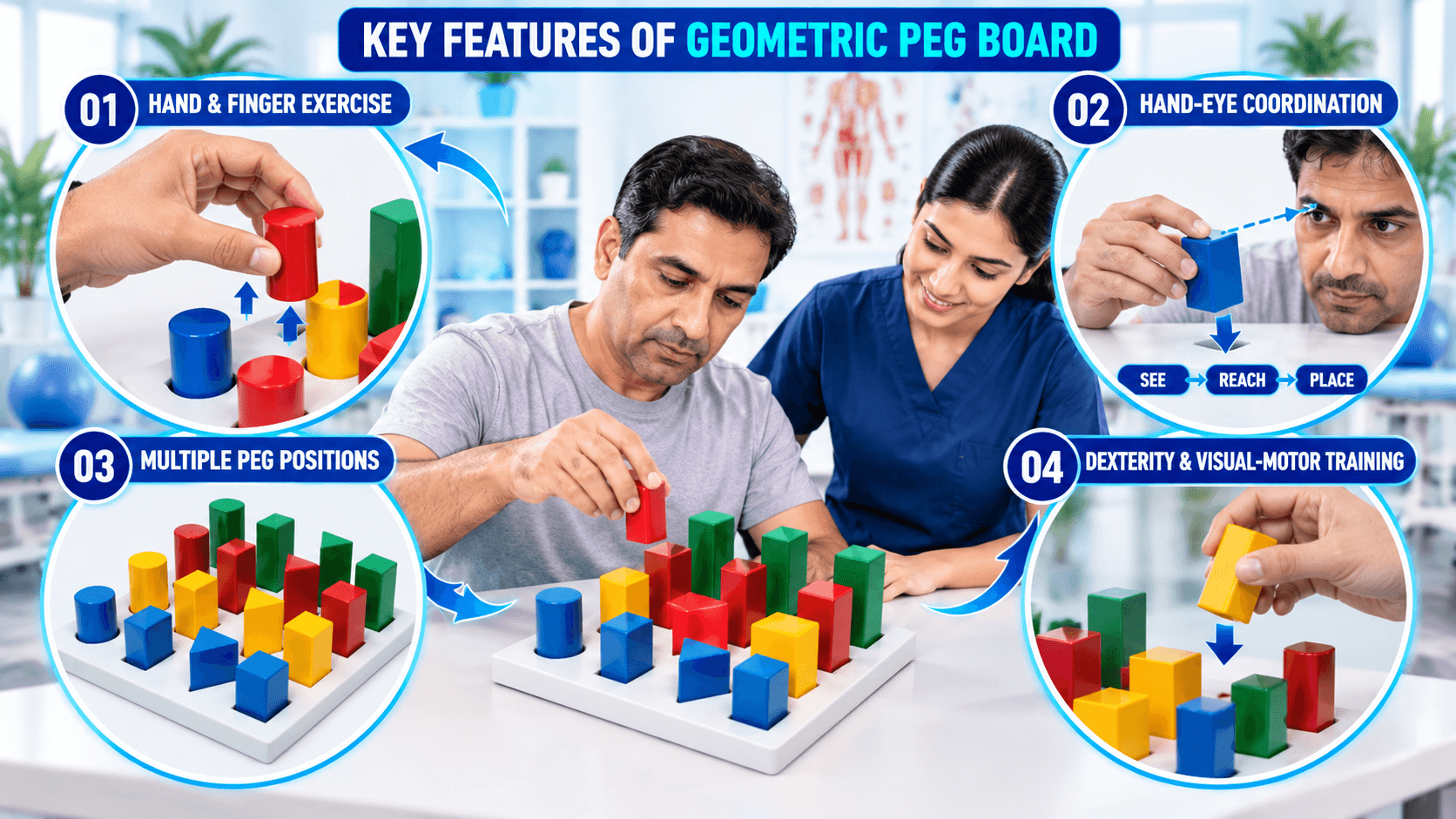
Key Features of Geometric Peg Board
- Geometric peg and shape-based exercise design
- Multiple placement positions
- Supports fine motor activities
- Useful for hand and finger exercises
- Promotes hand-eye coordination
- Supports object manipulation practice
- Suitable for repetitive task-oriented training
- Compact rehabilitation equipment
- Easy to use
- Suitable for individual therapy sessions
- Can be incorporated into occupational and physiotherapy programs
- Useful for progressive dexterity exercises
- Appropriate for clinical and educational environments
Applications of Geometric Peg Board
The Geometric Peg Board can be incorporated into different rehabilitation and therapeutic exercise programs.
Hand Rehabilitation
The board can provide repetitive grasping, movement, positioning, and release activities as part of a hand rehabilitation program.
Fine Motor Training
Small geometric pieces require controlled manipulation and can be used for finger dexterity exercises.
Hand-Eye Coordination
Matching each piece to its corresponding opening requires visual observation combined with controlled hand movement.
Finger Dexterity
Picking up and positioning individual pieces can provide structured finger-use practice.
Occupational Therapy
Occupational therapists can use geometric peg activities as task-oriented exercises for hand function and functional object manipulation.
Pediatric Therapy
Depending on the design and supervision requirements, peg-board activities can be incorporated into child-focused therapeutic and developmental programs.
Cognitive-Motor Activities
Shape matching and sequencing can combine physical manipulation with simple cognitive tasks.
Functional Rehabilitation
The repetitive manipulation of objects can complement broader programs focused on improving practical hand-use skills.
Benefits of Geometric Peg Board
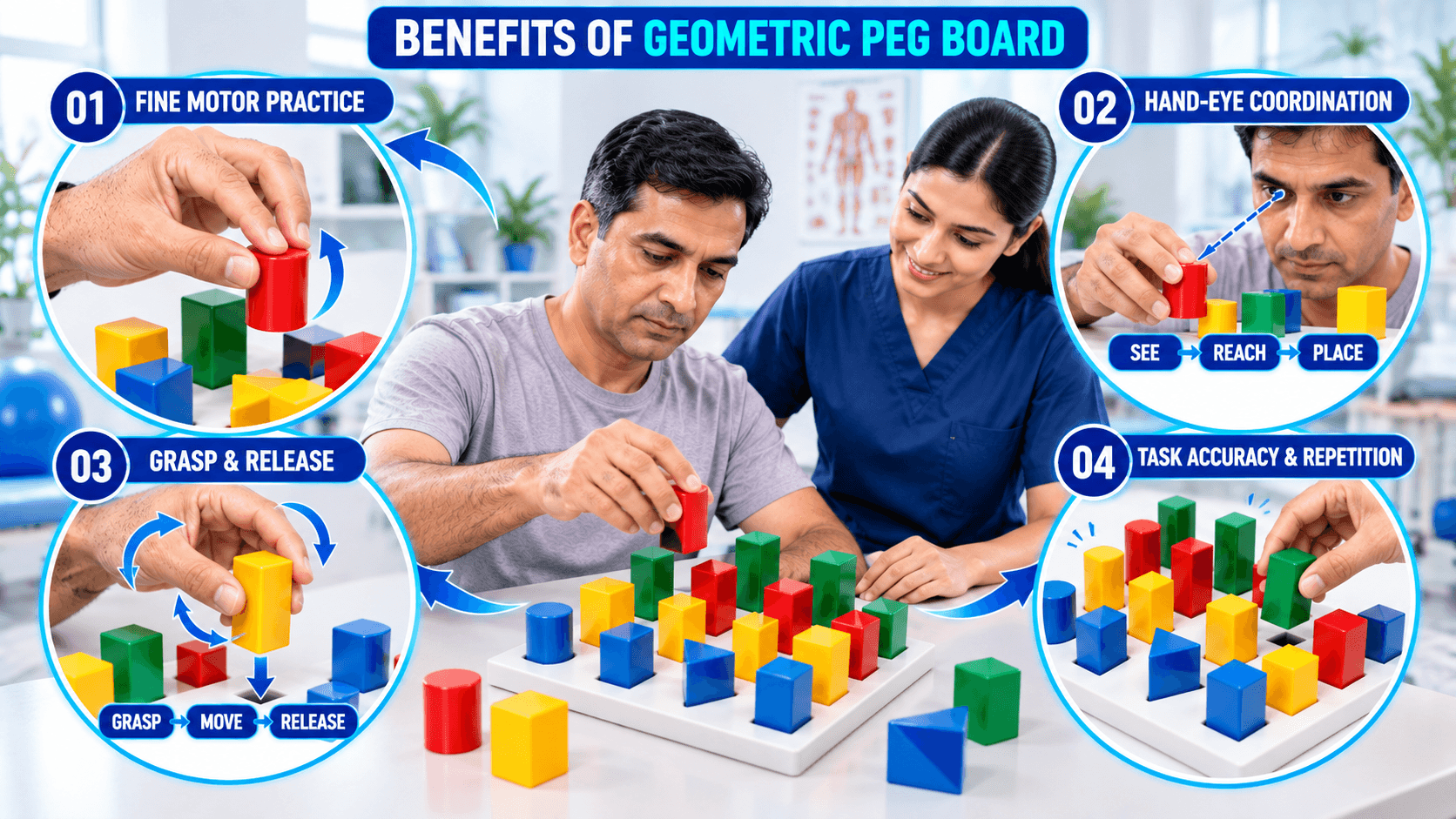
A Geometric Peg Board provides a simple and adaptable platform for structured hand exercises.
Supports Fine Motor Practice
Handling individual geometric pieces requires controlled finger movements and object manipulation.
Encourages Hand-Eye Coordination
The patient needs to visually identify the target position and guide the hand toward it.
Develops Grasp and Release Practice
Repeatedly picking up and placing pieces provides opportunities to practice controlled grasping and releasing.
Improves Task Accuracy
Matching pieces to specific locations encourages precise positioning.
Allows Repetitive Exercise
The same activity can be repeated several times, making it suitable for structured therapy sessions.
Adaptable Exercise Difficulty
Therapists can modify the activity by changing the order, distance, number of pieces, or time allowed for completing the task.
Compact and Easy to Store
A peg-board setup generally occupies limited space and can be stored easily between therapy sessions.
Exercises with Geometric Peg Board
Depending on the patient’s rehabilitation goals, a therapist may use the board for several activity patterns.
| Exercise | Primary Activity |
|---|---|
| Basic peg placement | Grasp and release |
| Peg removal | Finger and hand control |
| Shape matching | Visual-motor coordination |
| Sequential placement | Motor planning |
| Timed placement | Controlled task performance |
| Colour or shape sorting | Object identification and manipulation |
| One-hand exercise | Unilateral hand practice |
| Alternating-hand exercise | Bilateral coordination |
| Reach-and-place activity | Hand-eye coordination |
| Distance placement | Reaching and positioning |
The specific exercise should be selected according to the individual’s abilities and therapy goals.
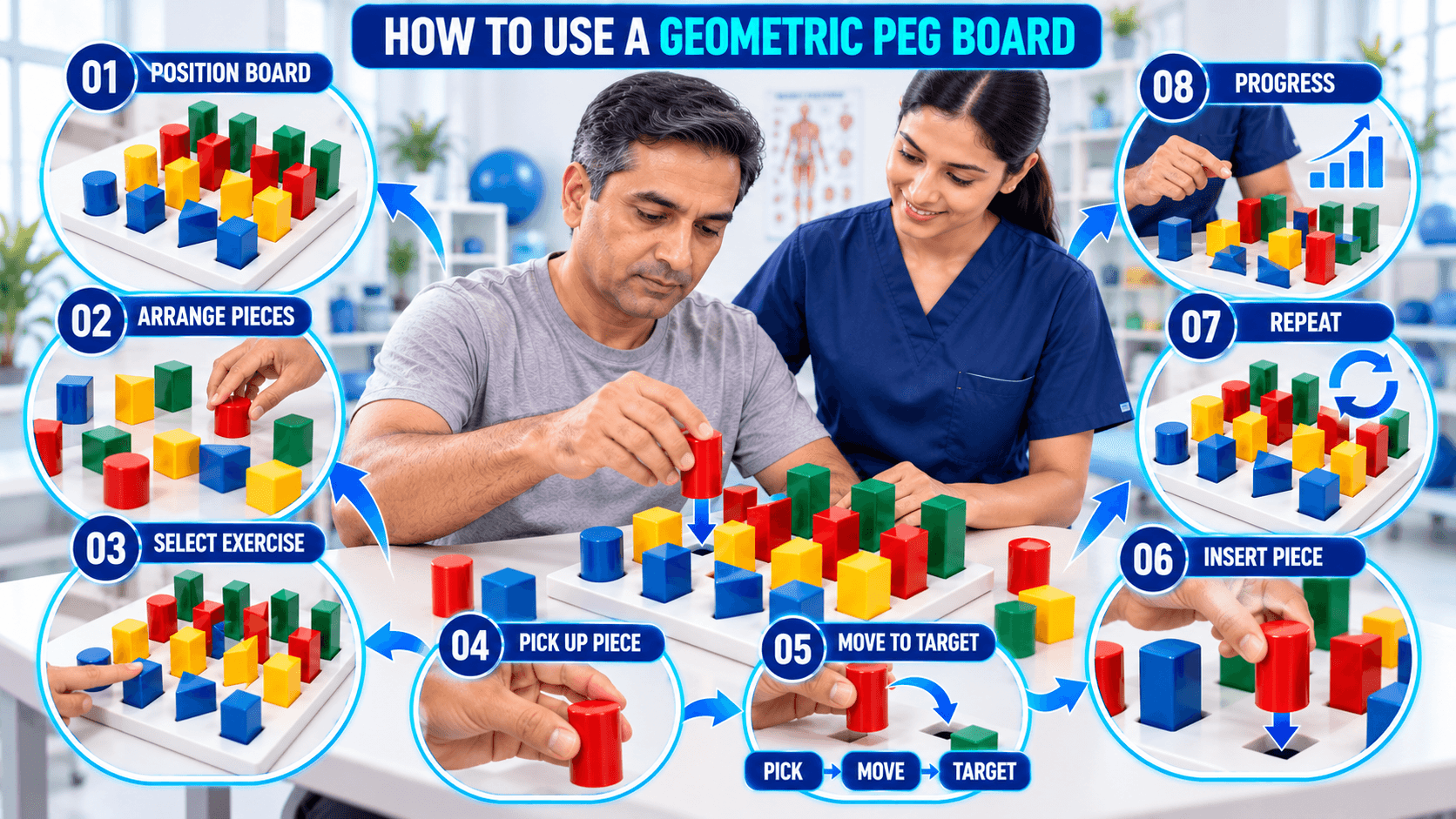
How to Use a Geometric Peg Board
Step 1: Position the Board
Place the Geometric Peg Board securely on a stable table or therapy surface at a comfortable working height.
Step 2: Arrange the Pieces
Place the geometric pegs or pieces in an accessible position.
Step 3: Select the Exercise
Choose a simple placement exercise initially, or select a matching, sequencing, or timed activity according to the therapy plan.
Step 4: Pick Up the Piece
Ask the patient to grasp one geometric piece using the required fingers or hand.
Step 5: Move Toward the Target
The patient guides the piece toward its corresponding opening while maintaining visual attention on the target.
Step 6: Insert the Piece
Align the piece correctly and place it into the board.
Step 7: Repeat
Continue the activity for the prescribed number of repetitions or duration.
Step 8: Progress the Exercise
As appropriate, the therapist can increase difficulty by changing the sequence, distance, number of pieces, or task requirements.
Safety Precautions
- Use the equipment under appropriate professional supervision when required.
- Place the board on a stable and level surface.
- Check that all pieces are intact before use.
- Do not use damaged or cracked components.
- Keep small pieces away from young children unless supervised.
- Avoid forcing stiff or painful finger movements.
- Stop the activity if significant pain or unusual discomfort occurs.
- Clean and disinfect the equipment according to the manufacturer’s recommendations.
- Store removable pieces safely after each session.
For patients recovering from injury, surgery, neurological conditions, or other functional limitations, the exercise intensity and movement pattern should be selected by an appropriately qualified professional.
Who Can Use a Geometric Peg Board?
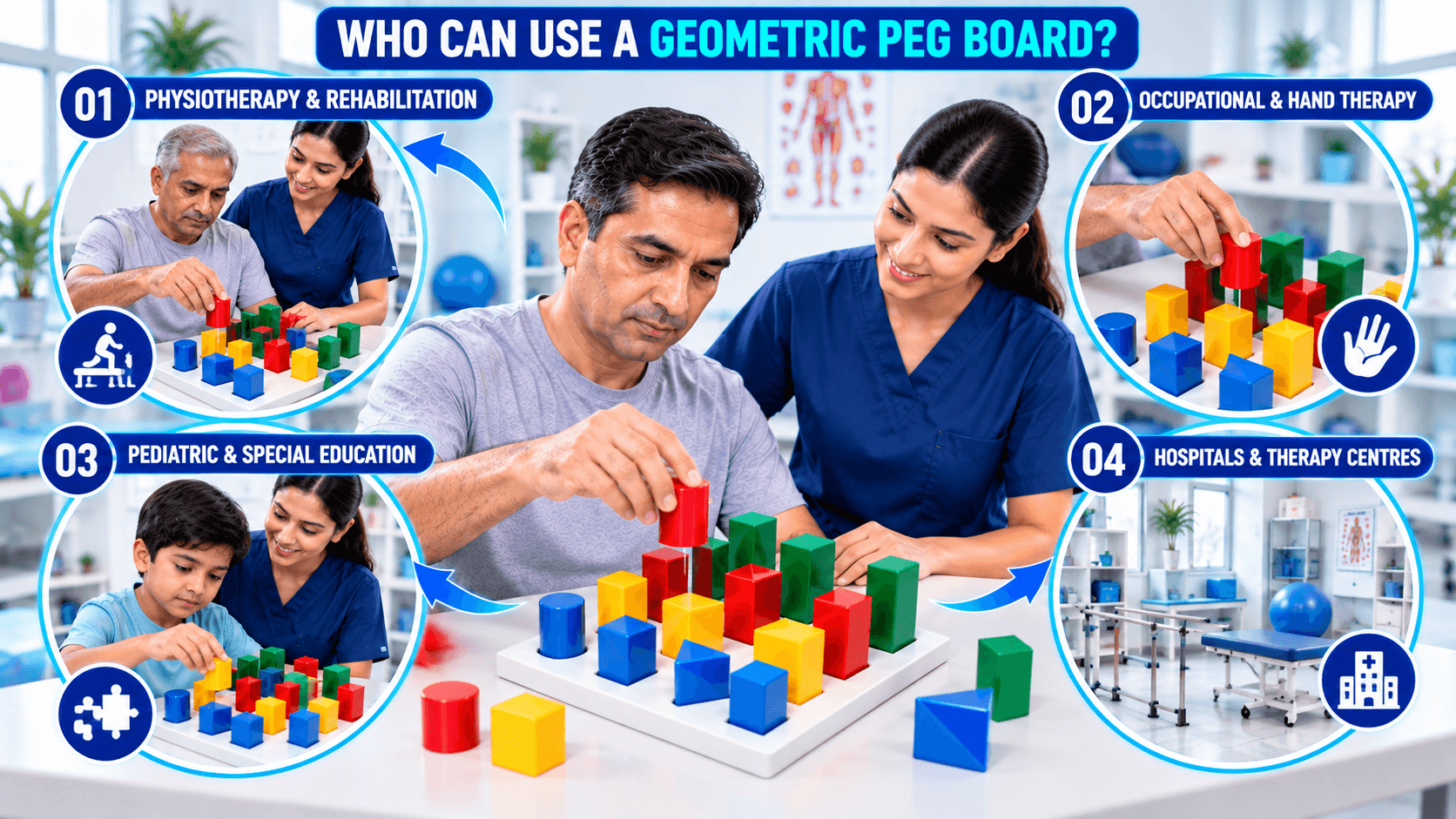
The Geometric Peg Board may be useful in:
- Physiotherapy clinics
- Occupational therapy centres
- Rehabilitation centres
- Hospitals
- Hand therapy units
- Pediatric therapy centres
- Special education facilities
- Neurorehabilitation settings
- Sports rehabilitation facilities
- Therapy and activity rooms
It can be used for both individual therapy sessions and structured exercise programs.
Geometric Peg Board for Hand Rehabilitation
Hand rehabilitation often involves repeated practice of controlled movements. A Geometric Peg Board provides a simple task-oriented activity where the patient has to pick up, move, align, and place an object.
The therapist can modify the exercise according to the patient’s functional level. A basic activity may involve placing large pieces into nearby openings, while a more challenging exercise may involve smaller pieces, greater reaching distance, sequencing, or timed completion.
This makes the board suitable as one component of a broader rehabilitation program rather than as a standalone treatment.
Geometric Peg Board vs Basic Peg Board
| Feature | Geometric Peg Board | Basic Peg Board |
|---|---|---|
| Shape-based activities | Yes | Usually limited |
| Fine motor practice | Yes | Yes |
| Hand-eye coordination | Yes | Yes |
| Shape matching | Yes | Usually limited |
| Object manipulation | Yes | Yes |
| Sequencing activities | Possible | Possible |
| Dexterity training | Yes | Yes |
| Therapy applications | Hand and functional rehabilitation | General peg exercises |
Technical Specifications
Specifications may vary according to the exact manufacturer and model.
| Specification | Details |
|---|---|
| Product Name | Geometric Peg Board |
| Equipment Type | Hand Rehabilitation & Fine Motor Exercise Equipment |
| Primary Use | Fine motor and coordination training |
| Exercise Type | Peg placement and object manipulation |
| Main Activity | Pick, move, match and place |
| Training Areas | Fingers, hand, coordination and dexterity |
| Operation | Manual |
| Power Requirement | None |
| Suitable Settings | Physiotherapy, occupational therapy and rehabilitation |
| User Group | Children and adults, depending on therapy requirements |
| Construction | Model-dependent |
| Shape/Colour Options | Model-dependent |
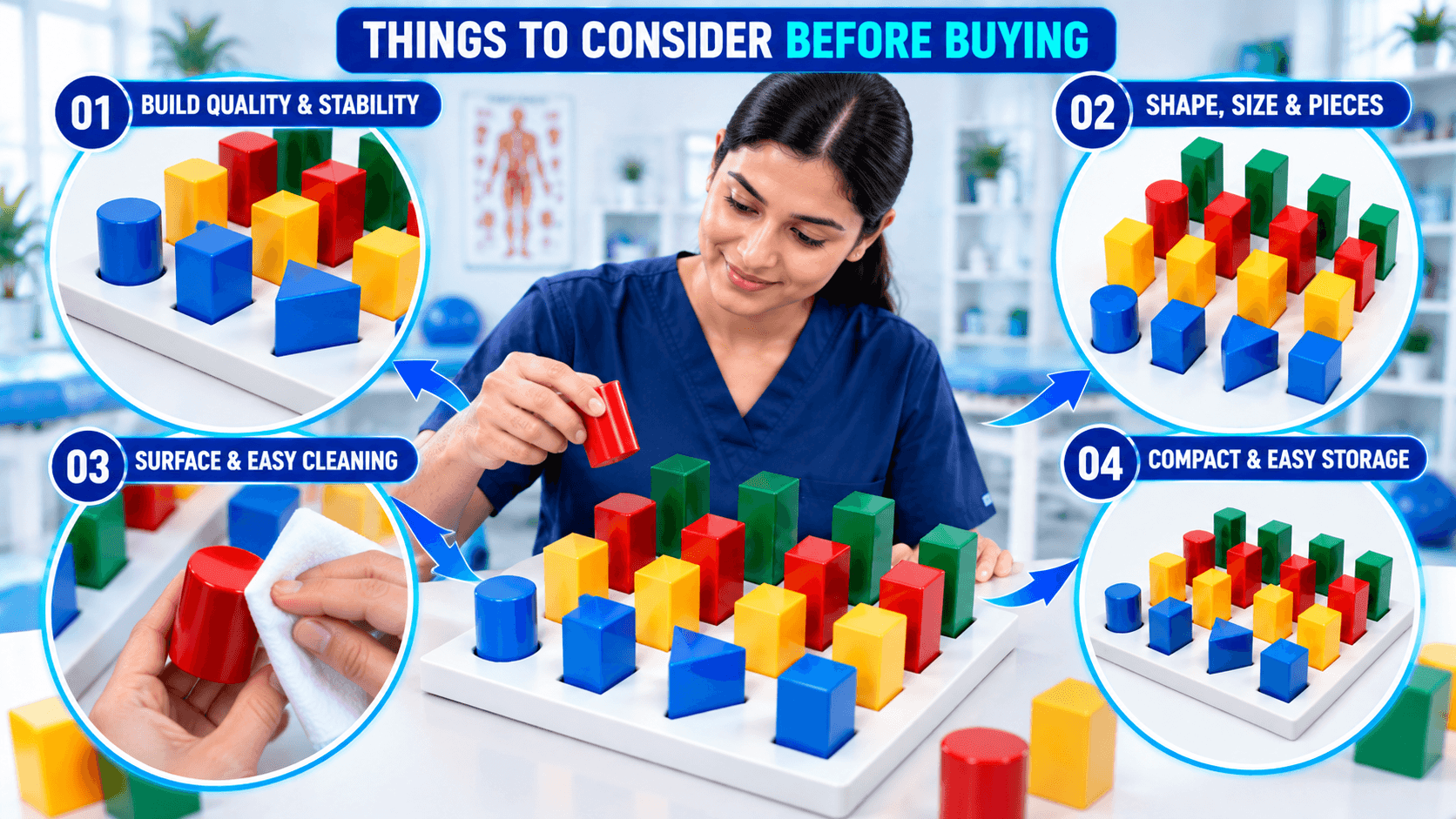
Things to Consider Before Buying
Construction Quality
Choose a board made from durable materials suitable for repeated therapy use.
Shape and Size
Check the size and variety of geometric pieces included with the board. Different sizes can provide different levels of manipulation difficulty.
Stability
The base should remain stable during repeated placement and removal of pieces.
Surface Finish
Smooth edges and properly finished components are important for comfortable handling.
Number of Pieces
Consider the number of pegs or shapes included and whether the selection supports the exercises planned by the therapist.
Cleaning
For clinical environments, select equipment that can be cleaned easily between sessions.
Storage
A compact design with a dedicated place for storing removable pieces can help prevent components from being misplaced.
Why Choose PHYSIOMODALITIES™
PHYSIOMODALITIES™ provides physiotherapy and rehabilitation equipment intended for professional therapy environments. A Geometric Peg Board can complement other hand and upper-limb rehabilitation equipment by providing a simple, repeatable platform for fine motor, dexterity, and coordination activities.
It can be included as part of a broader rehabilitation setup alongside hand exercise tables, hand grippers, peg boards, shoulder wheels, wrist and finger exercise equipment, and other therapeutic exercise devices.
Conclusion
The Geometric Peg Board is a compact and versatile hand rehabilitation tool designed for fine motor practice, hand-eye coordination, dexterity, grasp-and-release activities, and object manipulation.
Its geometric pieces create opportunities for matching, placement, sequencing, and repetitive hand exercises. Because the difficulty can be modified according to the patient’s ability, it can be incorporated into physiotherapy, occupational therapy, pediatric therapy, and rehabilitation programs.
Frequently Asked Questions
1. What is a Geometric Peg Board?
A Geometric Peg Board is a hand exercise and rehabilitation device with removable geometric pieces used for fine motor, coordination, dexterity, and object-manipulation activities.
2. What is a Geometric Peg Board used for?
It can be used for fine motor training, hand-eye coordination, grasp-and-release practice, finger dexterity, shape matching, and functional hand exercises.
3. Can children use a Geometric Peg Board?
Yes, depending on the design and the child’s age and abilities. Small removable pieces should always be used with appropriate supervision.
4. Is a Geometric Peg Board useful for hand rehabilitation?
Yes. It can be incorporated into structured hand rehabilitation programs involving controlled grasping, placement, reaching, and repetitive manipulation.
5. Does a Geometric Peg Board require electricity?
No. It is a manually operated rehabilitation exercise device and does not normally require electricity