
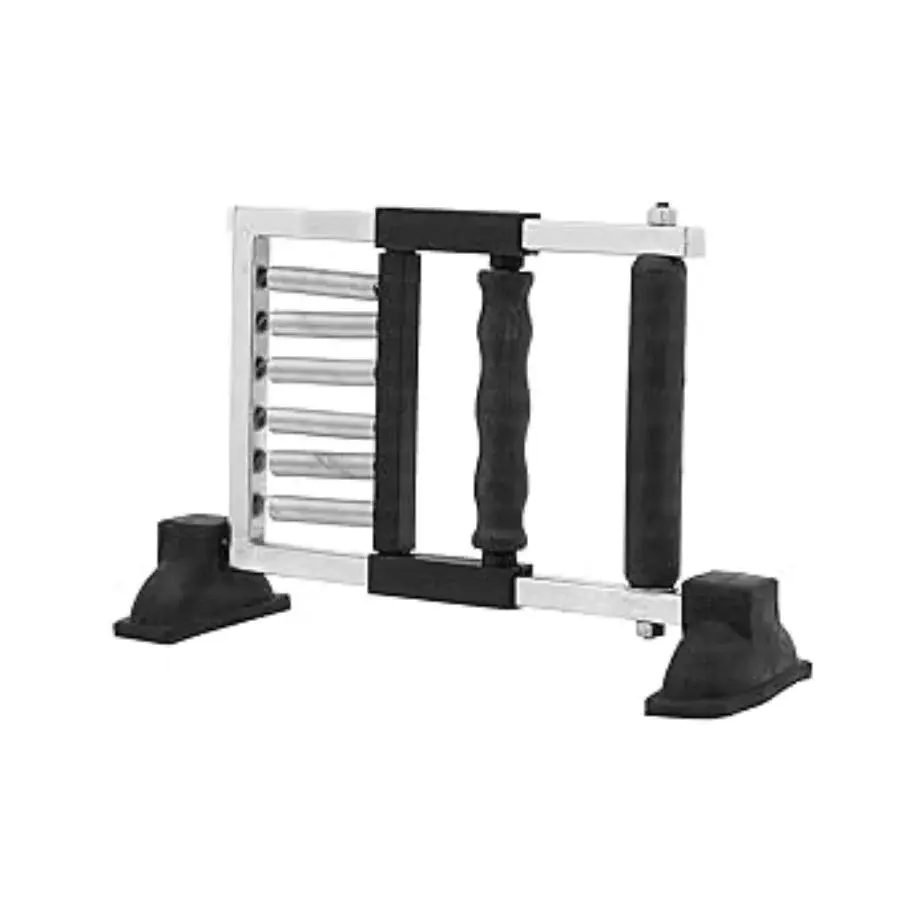
The Hand Gripper Exercise is a simple and practical rehabilitation and hand-strengthening activity designed to support controlled gripping, finger movement, hand strength, wrist stability, and forearm conditioning. Hand grippers are commonly used in physiotherapy, occupational therapy, rehabilitation, sports training, and general exercise programs.
A hand gripper provides resistance when the handles are squeezed together. Depending on the design, resistance may be fixed or adjustable, allowing the exercise intensity to be modified according to the user’s requirements.
The Hand Gripper Exercise equipment from PHYSIOMODALITIES™ can be incorporated into rehabilitation and exercise setups where progressive hand and forearm strengthening is required.
What Is Hand Gripper Exercise?
Hand Gripper Exercise refers to controlled squeezing and releasing movements performed using a hand-gripping device. The resistance provided by the gripper creates a strengthening challenge for the muscles involved in gripping and hand function.
Hand grippers may be used as part of hand therapy programs for improving grip strength, endurance, and functional hand use. Rehabilitation protocols should be individualized according to the patient’s condition and professional assessment.
Depending on the equipment design, Hand Gripper Exercise may involve:
- Repeated gripping and releasing
- Isometric grip holds
- Finger strengthening
- Grip endurance exercises
- Hand coordination activities
- Wrist and forearm conditioning
- Progressive resistance training
- Functional hand strengthening
How Does Hand Gripper Exercise Work?
The Hand Gripper Exercise works by creating resistance against the user’s squeezing motion. When the handles are compressed, the hand and forearm muscles work to overcome the resistance.
Grip Strengthening
Repeated controlled squeezing can be incorporated into programs designed to develop hand-grip strength.
Finger Activation
The fingers are involved in closing the gripper, making the exercise useful for selected finger and hand strengthening activities.
Forearm Conditioning
Grip exercises also involve muscles of the forearm that contribute to hand closure and gripping.
Isometric Training
The user can hold the gripper in a partially or fully compressed position for a controlled period, depending on the prescribed exercise.
Repetition Training
Repeated squeezing and releasing can be used for endurance-oriented hand exercise. The number of repetitions should be selected according to the individual’s rehabilitation or training program.
Key Features
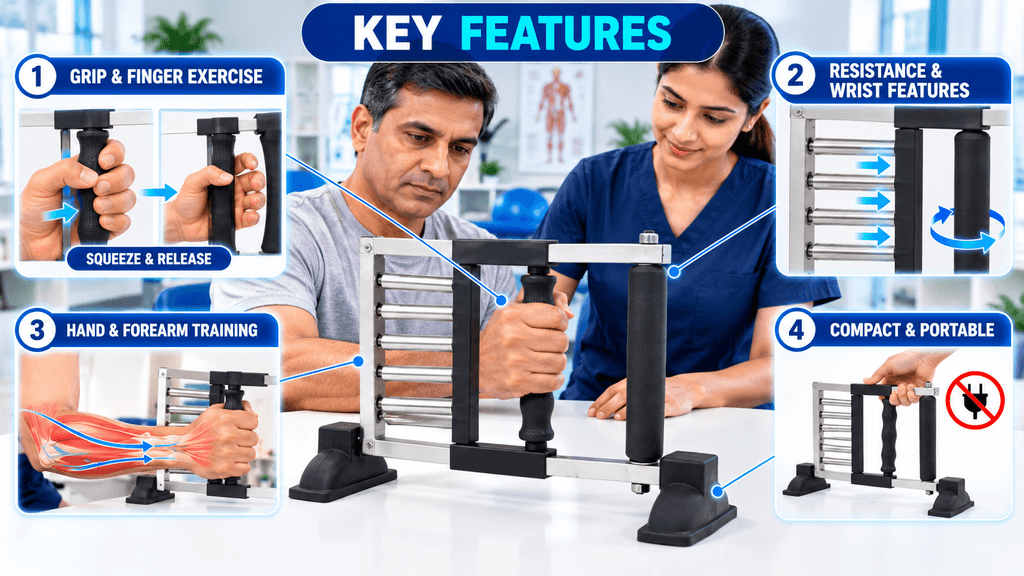
- Compact hand rehabilitation equipment
- Manual operation
- Simple squeeze-and-release mechanism
- Suitable for grip strengthening
- Supports finger exercise
- Useful for hand rehabilitation
- Can be used for forearm conditioning
- Fixed or adjustable resistance depending on model
- Easy to handle
- Portable design
- Suitable for clinic and home exercise programs
- No electricity required
- Easy to clean and maintain
- Suitable for progressive exercise programs
Applications of Hand Gripper Exercise
The Hand Gripper Exercise can be incorporated into several physiotherapy, occupational therapy, rehabilitation, and exercise programs.
Hand Rehabilitation
A hand gripper can be used for selected strengthening exercises following assessment of hand function and exercise tolerance.
Finger Strengthening
Controlled gripping can involve the fingers and may be incorporated into finger strengthening programs.
Wrist and Forearm Conditioning
Grip exercises can engage the wrist and forearm musculature and may be included in broader upper-limb conditioning programs.
Occupational Therapy
Hand-gripping activities can be included alongside other occupational therapy exercises focused on functional hand use and dexterity.
Post-Injury Rehabilitation
Under professional guidance, hand gripper exercises may form part of progressive rehabilitation after selected hand or upper-limb injuries.
Sports Training
Athletes whose activities require repetitive gripping can incorporate hand-grip exercises into their conditioning programs.
Neurological Rehabilitation
Hand grippers may be included in selected rehabilitation programs where improving active hand use and grip function is an appropriate therapy goal.
Benefits of Hand Gripper Exercise
When appropriately prescribed and performed, Hand Gripper Exercise may provide several practical benefits:
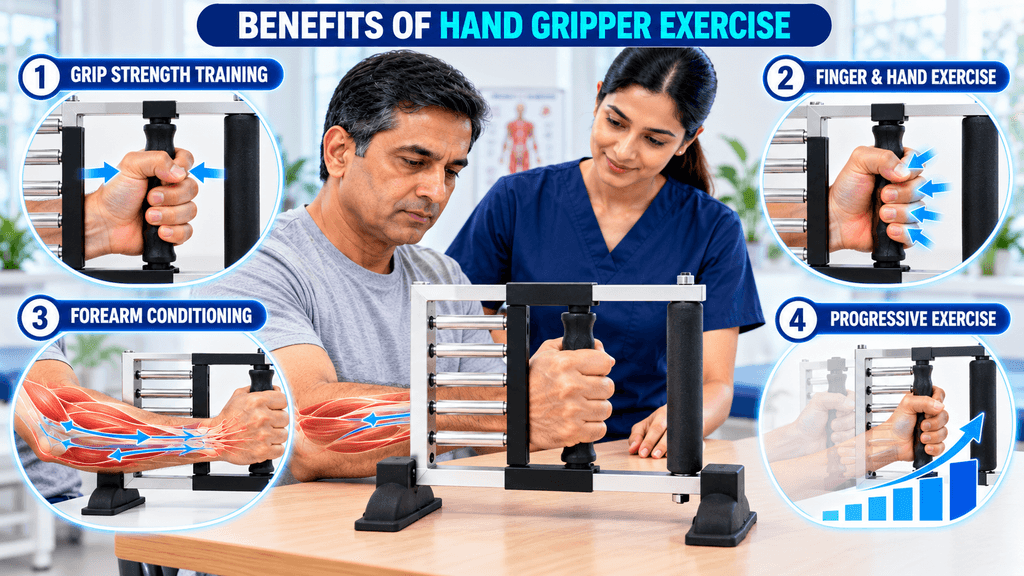
- Supports grip-strength training
- Helps exercise the fingers and hand
- Can support forearm conditioning
- Provides measurable resistance
- Allows repetitive strengthening exercises
- Can be used for progressive training
- Supports hand exercise routines
- Compact and easy to store
- Can be incorporated into occupational therapy
- Useful for rehabilitation and exercise environments
- Requires no electrical power
- Suitable for regular supervised practice
The actual benefit depends on the individual’s condition, resistance level, exercise technique, consistency, and rehabilitation goals.
Hand Gripper Exercise for Physiotherapy Clinics
A Hand Gripper Exercise device can be a useful addition to the hand rehabilitation section of a physiotherapy or occupational therapy clinic.
Hand rehabilitation frequently involves progressive exercises targeting grip, finger movement, dexterity, and functional use. A compact gripper can provide a convenient resistance-based exercise option alongside other hand therapy equipment.
It can be used together with:
- Hand exercise tables
- Finger exercisers
- Therapy putty
- Exercise balls
- Peg boards
- Finger extension bands
- Wrist exercisers
- Hand dynamometers
- Fine-motor rehabilitation equipment
Government physiotherapy facility listings also include hand grippers alongside finger exercise, hand exercise balls, therapy putty, and other upper-limb rehabilitation equipment.
Types of Hand Gripper Exercise
Basic Grip Exercise
The user holds the gripper comfortably and squeezes the handles together before slowly releasing them.
Repetition Exercise
Controlled squeezing and releasing can be repeated for a selected number of repetitions.
Isometric Grip Hold
The gripper can be compressed and held for a prescribed duration without repeated movement.
Progressive Resistance Exercise
Adjustable hand grippers can allow resistance to be modified as the user’s exercise capacity changes.
Individual Finger Exercise
Certain hand therapy devices provide separate finger resistance mechanisms rather than a conventional two-handle gripper. These can be used when individual finger training is required.
How to Perform Hand Gripper Exercise
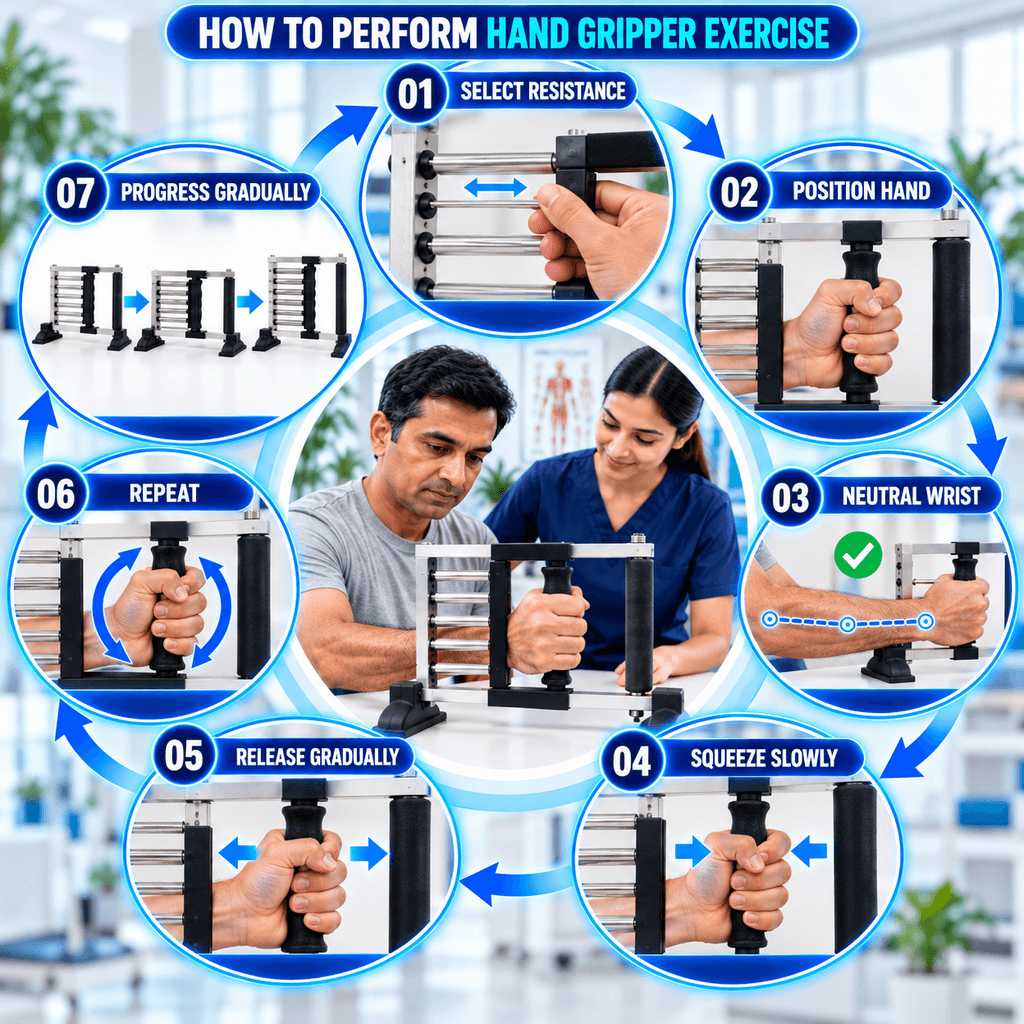
Step 1: Select the Resistance
Choose an appropriate resistance level. Beginners and rehabilitation patients should generally start with a manageable resistance rather than maximum resistance.
Step 2: Position the Hand
Place the gripper comfortably in the palm with the fingers positioned securely around the handle.
Step 3: Maintain a Neutral Wrist
Keep the wrist in a comfortable position and avoid unnecessary bending while squeezing.
Step 4: Squeeze Slowly
Close the gripper using controlled movement rather than a sudden forceful squeeze.
Step 5: Release Gradually
Return the handles to their starting position in a controlled manner.
Step 6: Repeat
Perform the prescribed number of repetitions or holds according to the exercise program.
Step 7: Progress Gradually
Resistance, repetitions, or exercise duration can be modified according to professional assessment and individual tolerance.
Safety Precautions
- Select an appropriate resistance level.
- Do not begin rehabilitation with excessive resistance.
- Avoid sudden or forceful squeezing.
- Keep the wrist in a comfortable position.
- Do not continue if significant pain develops.
- Stop exercise if unusual swelling, numbness, or other concerning symptoms occurs.
- Patients recovering from surgery should follow their clinician’s rehabilitation protocol.
- Inspect the spring, handles, and frame before use.
- Do not use damaged equipment.
- Keep fingers positioned correctly on the handles.
- Do not exceed the manufacturer’s specified resistance.
- Clean the equipment regularly when shared between patients.
Who Can Use Hand Gripper Exercise?
The equipment may be incorporated into exercise or rehabilitation programs for:
- Physiotherapy patients
- Occupational therapy patients
- Hand rehabilitation patients
- Wrist rehabilitation patients
- Forearm conditioning programs
- Sports rehabilitation patients
- Individuals working on grip strength
- Patients performing selected upper-limb exercises
- General fitness users
The appropriate resistance and exercise method should be selected according to the individual’s goals and physical condition.
Hand Gripper Exercise vs Hand Exercise Table
| Feature | Hand Gripper Exercise | Hand Exercise Table |
|---|---|---|
| Primary Use | Grip and hand strengthening | Multi-function hand rehabilitation |
| Size | Compact | Larger clinical equipment |
| Resistance | Fixed or adjustable | Usually multiple exercise mechanisms |
| Finger Exercise | Limited to model | More exercise options |
| Wrist Exercise | Limited | Available on applicable models |
| Portability | High | Low |
| Clinic Space | Very low | Requires dedicated space |
| Power | Not required | Not required |
| Best Use | Grip-focused exercise | Comprehensive hand therapy |
A hand gripper is useful when a compact grip-focused device is required, while a Hand Exercise Table may be more suitable when a clinic needs multiple hand, wrist, and forearm exercise functions.
Technical Specifications
| Specification | Details |
|---|---|
| Product Name | Hand Gripper Exercise |
| Equipment Type | Hand Rehabilitation & Exercise Equipment |
| Operation | Manual |
| Power Requirement | None |
| Exercise Type | Grip & Hand Strengthening |
| Target Areas | Fingers, Hand, Wrist & Forearm |
| Resistance | Fixed / Adjustable depending on model |
| Handle Design | Model dependent |
| Material | Model dependent |
| Resistance Range | Model dependent |
| Dimensions | Model dependent |
| Weight | Model dependent |
| Usage | Physiotherapy, Rehabilitation, Occupational Therapy & Exercise |
Exact material, resistance range, dimensions, handle configuration, and other specifications may vary according to the selected PHYSIOMODALITIES™ model.
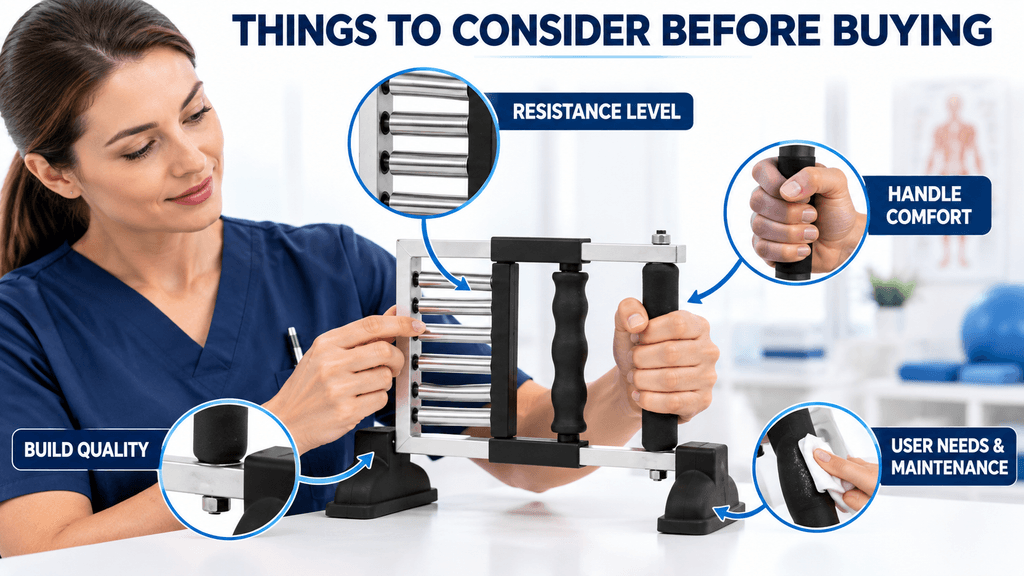
Things to Consider Before Buying
Resistance Level
Choose a gripper with a resistance level appropriate for the intended users. Adjustable models can provide greater flexibility for progressive exercise.
Handle Comfort
The handles should provide a secure and comfortable grip to help maintain proper exercise technique.
Construction Quality
A durable spring or resistance mechanism is important when the equipment is intended for repeated clinical use.
User Requirements
Consider whether the equipment is intended primarily for rehabilitation, occupational therapy, sports training, or general strengthening.
Maintenance
Choose equipment that can be easily cleaned and inspected, particularly when it will be shared between multiple patients.
Why Choose PHYSIOMODALITIES™?
PHYSIOMODALITIES™ provides physiotherapy and rehabilitation equipment designed for professional clinical environments.
The Hand Gripper Exercise can complement a rehabilitation setup by providing a compact option for grip, finger, hand, and forearm exercise.
PHYSIOMODALITIES ENTERPRISES offers equipment across physiotherapy, rehabilitation, exercise therapy, electrotherapy, and clinical treatment categories, helping clinics develop equipment setups according to their individual requirements.
Conclusion
The Hand Gripper Exercise is a compact and practical option for controlled hand and grip strengthening. Its simple resistance-based design allows users to perform squeezing, releasing, and selected isometric exercises without requiring electrical power.
It can be incorporated into physiotherapy, occupational therapy, sports rehabilitation, and general exercise programs depending on the user’s requirements. When the resistance and exercise technique are selected appropriately, it can form a useful part of a progressive hand and upper-limb rehabilitation program.
Frequently Asked Questions
1. What is Hand Gripper Exercise used for?
Hand Gripper Exercise is used primarily for grip, finger, hand, and forearm strengthening and conditioning.
2. Can a hand gripper be used for physiotherapy?
Yes. Hand grippers can be incorporated into selected physiotherapy and occupational therapy programs when appropriate for the patient’s condition.
3. Does a hand gripper require electricity?
No. A conventional hand gripper is manually operated and does not require electricity.
4. Is adjustable resistance available?
Yes, some hand gripper models provide adjustable resistance, while other models have a fixed resistance level.
5. Can Hand Gripper Exercise be used after a hand injury?
It may be incorporated into rehabilitation after selected injuries, but the timing, resistance, and exercise method should be determined according to professional assessment and the relevant rehabilitation protocol.