The Digital Cervical & Lumbar Traction Machine is a professional physiotherapy and rehabilitation device designed to provide controlled traction therapy for the cervical and lumbar regions of the spine. It combines digital controls, adjustable traction force, treatment timing, and motorized operation to help physiotherapists manage traction sessions in a structured and controlled manner.
Spinal traction is a technique in which a controlled pulling force is applied along the spine. Depending on the patient’s condition and treatment plan, traction may be used as part of a broader rehabilitation program for selected neck, lower-back, spinal mobility, and musculoskeletal conditions.
The Digital Cervical & Lumbar Traction Machine supports both cervical and lumbar applications, making it suitable for clinics that require one system for different areas of spinal rehabilitation. The available static and intermittent traction modes provide flexibility when selecting an appropriate treatment protocol.
PHYSIOMODALITIES™ designs this traction equipment for professional physiotherapy and rehabilitation environments, including physiotherapy clinics, hospitals, orthopedic facilities, chiropractic practices, rehabilitation centres, and other healthcare settings.
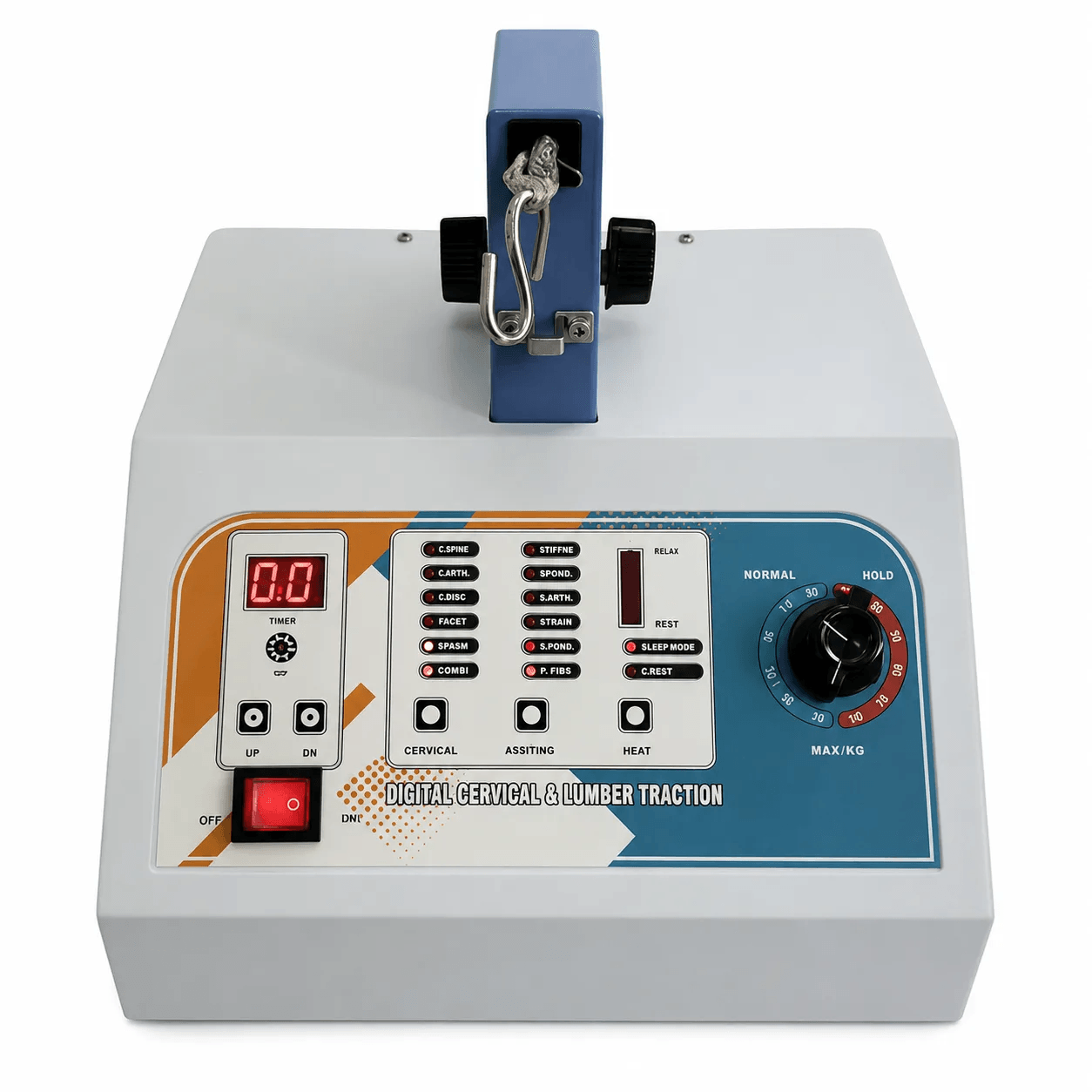
What Is a Digital Cervical & Lumbar Traction Machine?
A Digital Cervical & Lumbar Traction Machine is a motorized traction therapy system that allows a trained professional to apply controlled traction to either the cervical or lumbar region.
Unlike manually applied traction, the machine uses a motorized mechanism and digital controls to manage the selected treatment parameters. This allows the therapist to establish a more consistent treatment setup and monitor the session according to the patient’s rehabilitation plan.
The machine is designed around several important components:
- Digital control system
- Adjustable traction force
- Treatment timer
- Static traction mode
- Intermittent traction mode
- Motorized traction mechanism
- Cervical support system
- Lumbar/pelvic support system
- Patient safety controls
- Clinical-grade construction
The exact adjustment range and accessories can vary according to the supplied model configuration.
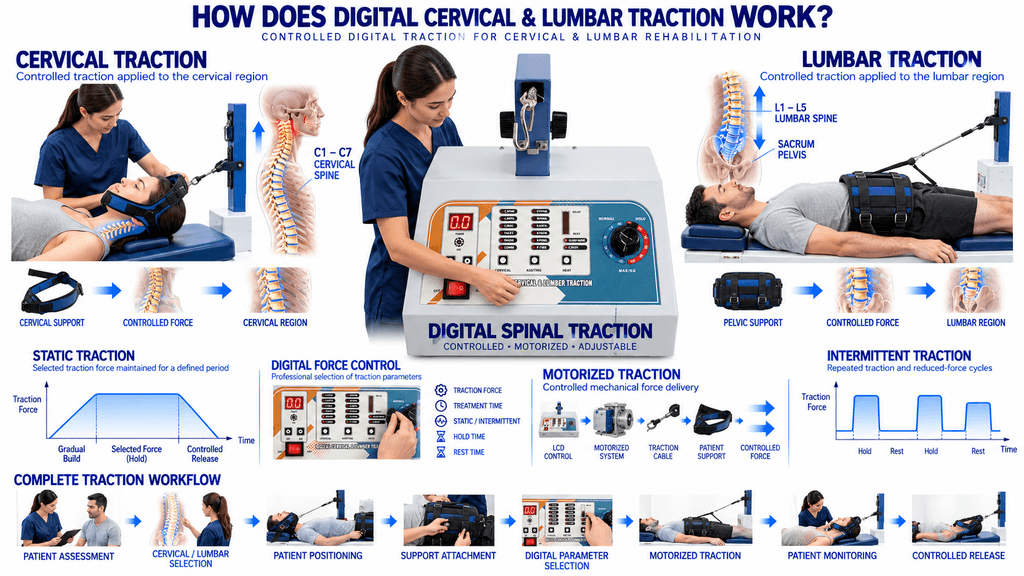
How Does Digital Cervical & Lumbar Traction Work?
Traction therapy applies a controlled mechanical force along the selected region of the spine.
For cervical treatment, the patient’s head and neck are positioned using the appropriate cervical support system. For lumbar treatment, the patient’s lower body is positioned using the appropriate pelvic or lumbar support.
Once the patient is positioned correctly, the therapist selects the required treatment settings. The motorized mechanism then delivers the selected traction pattern.
The treatment can be configured as static or intermittent depending on the available mode and professional treatment protocol.
Static Traction
Static traction maintains a selected traction force for a defined period.
This provides a continuous traction pattern during the active treatment phase. The therapist selects the force and duration according to the patient’s treatment requirements.
Intermittent Traction
Intermittent traction uses repeated traction and release or reduced-force cycles.
The therapist can configure the available hold and rest parameters where supported by the machine. This allows different traction patterns to be used for different rehabilitation protocols.
Digital Force Control
The digital control system allows the therapist to select the required traction force within the machine’s available operating range.
This provides better parameter control compared with manually estimating the applied force.
Digital Treatment Timer
A digital timer allows the therapist to set the treatment duration. This helps maintain a structured session and makes repeated treatment sessions easier to organize.
Motorized Operation
The motorized mechanism provides controlled traction movement and helps maintain the selected treatment pattern during the session.
Cervical Traction Therapy
Cervical traction focuses on the neck region of the spine.
During cervical treatment, the patient is positioned comfortably and the appropriate cervical support or halter is fitted. The therapist then selects the treatment parameters based on the patient’s assessment and rehabilitation plan.
Cervical traction may be considered within selected rehabilitation programs involving:
- Mechanical neck pain
- Cervical stiffness
- Reduced cervical mobility
- Cervical spondylosis
- Selected cervical disc-related conditions
- Selected nerve-root-related symptoms
- Neck-related musculoskeletal rehabilitation
Correct positioning is particularly important during cervical treatment. The therapist should ensure that the patient’s head, neck, and body are appropriately aligned before starting the machine.
Lumbar Traction Therapy
Lumbar traction focuses on the lower region of the spine.
The patient is positioned using the appropriate pelvic or lumbar support before the traction force is applied. The therapist selects the force, mode, and duration according to the treatment plan.
Lumbar traction may be incorporated into selected rehabilitation programs involving:
- Mechanical lower-back pain
- Lumbar stiffness
- Lumbar spondylosis
- Selected disc-related conditions
- Selected nerve-root-related symptoms
- Sciatica-related rehabilitation
- Reduced lumbar mobility
- Musculoskeletal rehabilitation
The treatment should be individualized rather than using the same traction settings for every patient.
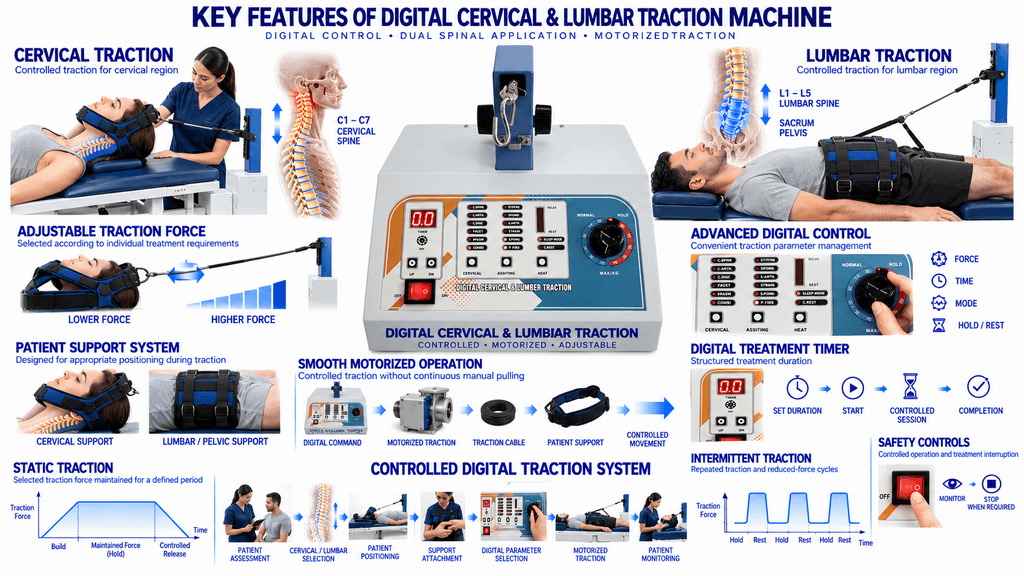
Key Features of Digital Cervical & Lumbar Traction Machine
Dual Cervical & Lumbar Application
The machine is designed to support both cervical and lumbar traction, allowing clinics to use one system for different spinal rehabilitation requirements.
Advanced Digital Control
The digital control system allows the operator to manage available traction parameters and treatment timing conveniently.
Adjustable Traction Force
The traction force can be adjusted according to the patient’s treatment requirements and the machine’s available operating range.
Static & Intermittent Modes
Different traction patterns can be selected according to the treatment protocol. Static mode maintains the selected force, while intermittent mode provides repeated traction cycles.
Digital Treatment Timer
The timer allows the therapist to establish a defined treatment duration and maintain consistency between sessions when appropriate.
Smooth Motorized Operation
Motorized traction provides controlled movement and helps deliver the selected traction pattern without requiring continuous manual pulling.
Patient Support System
Appropriate cervical and lumbar support components help position the patient during the treatment session.
Safety Controls
The machine incorporates safety mechanisms intended to allow controlled operation and treatment interruption when required.
Heavy-Duty Construction
The clinical-grade construction is designed for regular use in professional physiotherapy and rehabilitation environments.
User-Friendly Operation
The digital controls are designed to make parameter selection and treatment management practical for trained physiotherapy professionals.
Potential Benefits
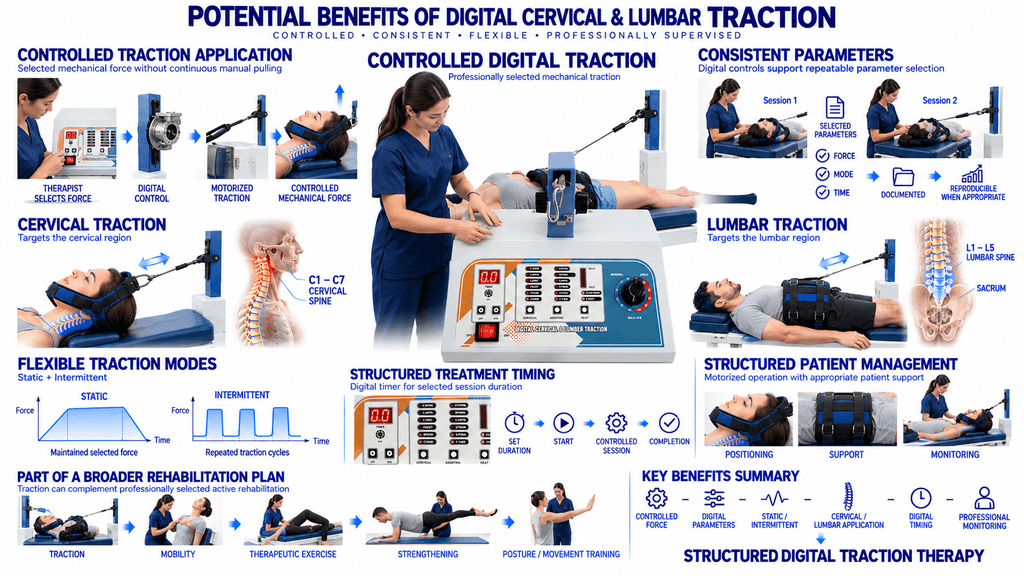
The Digital Cervical & Lumbar Traction Machine can be incorporated into suitable rehabilitation programs where controlled traction is considered appropriate.
Potential advantages include:
Controlled Traction Application
The machine allows the therapist to apply a selected mechanical traction force rather than relying on manual pulling.
Consistent Treatment Parameters
Digital controls can make it easier to reproduce selected treatment parameters during subsequent sessions.
Flexible Treatment Modes
Static and intermittent modes provide different options for traction-based rehabilitation.
Cervical and Lumbar Versatility
One machine can be used for both major spinal regions, making it practical for clinics treating different types of spinal rehabilitation cases.
Structured Treatment Timing
The digital timer allows the therapist to define a specific treatment duration.
Comfortable Treatment Management
Motorized operation and appropriate patient supports help create a structured treatment environment.
Integration With Rehabilitation
Traction can be combined with other physiotherapy approaches when clinically appropriate, such as therapeutic exercise, mobility work, strengthening, posture training, and manual therapy.
Applications of Digital Cervical & Lumbar Traction Machine
The machine can be used in professional physiotherapy and rehabilitation environments for selected traction applications.
Common applications include:
- Cervical spine traction
- Lumbar spine traction
- Neck rehabilitation
- Lower-back rehabilitation
- Spinal mobility programs
- Selected disc-related rehabilitation
- Sciatica-related rehabilitation
- Orthopedic rehabilitation
- Musculoskeletal rehabilitation
- Sports rehabilitation
- Postural rehabilitation
- Spine-care programs
Traction should be selected according to individual patient assessment rather than being used automatically for every neck or back complaint.
Conditions Commonly Considered for Traction
Cervical Spondylosis
Traction may be incorporated into selected rehabilitation programs for patients with cervical degenerative changes when considered appropriate by the treating professional.
Lumbar Spondylosis
For selected lumbar conditions, traction may form one component of a broader rehabilitation program.
Disc-Related Conditions
Some patients with disc-related conditions may be considered for traction following proper clinical assessment.
Sciatica-Related Symptoms
Traction may be considered in selected rehabilitation plans where symptoms are associated with lumbar or nerve-root-related mechanical factors.
Mechanical Neck Pain
Patients with certain mechanical neck problems may be considered for cervical traction alongside other rehabilitation methods.
Mechanical Lower-Back Pain
Lumbar traction may be included in selected lower-back rehabilitation programs depending on the clinical findings.
Reduced Spinal Mobility
Where appropriate, traction may be combined with mobility exercises and other physiotherapy techniques.
A diagnosis alone does not determine whether traction is suitable. The patient’s symptoms, examination findings, medical history, neurological status, and contraindications should all be considered.
How to Use the Digital Cervical & Lumbar Traction Machine
Step 1: Assess the Patient
Review the patient’s condition, symptoms, medical history, treatment goals, and possible contraindications before beginning traction.
Step 2: Select the Treatment Area
Determine whether cervical or lumbar traction is required according to the treatment plan.
Step 3: Position the Patient
Place the patient in the appropriate position and ensure correct alignment before attaching the support system.
Step 4: Attach the Appropriate Support
Use the cervical support for cervical traction or the appropriate pelvic/lumbar support for lumbar treatment.
Step 5: Select the Traction Mode
Choose static or intermittent traction according to the prescribed treatment protocol.
Step 6: Set the Traction Force
Select the appropriate traction force within the machine’s available range.
Step 7: Set the Treatment Time
Enter the required treatment duration using the digital timer.
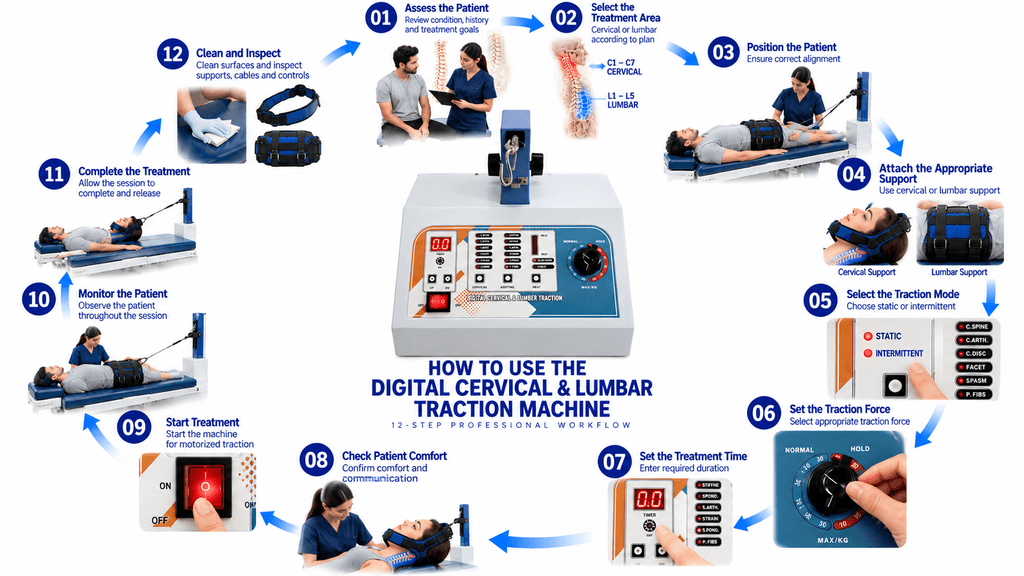
Step 8: Check Patient Comfort
Before starting, confirm that the patient is positioned comfortably and understands how to communicate discomfort.
Step 9: Start Treatment
Start the machine and allow the motorized traction mechanism to deliver the selected treatment.
Step 10: Monitor the Patient
The therapist should monitor the patient throughout the session and stop or modify treatment if unexpected symptoms occur.
Step 11: Complete the Treatment
Allow the machine to complete the treatment and release cycle before removing the patient support.
Step 12: Clean and Inspect
After treatment, clean appropriate patient-contact surfaces and inspect the belts, supports, cables, and controls before the next session.
Safety Precautions
The Digital Cervical & Lumbar Traction Machine should be operated only by appropriately trained professionals.
Important precautions include:
- Perform proper patient assessment before treatment.
- Follow the manufacturer’s operating instructions.
- Select traction force according to the patient’s treatment plan.
- Ensure correct patient positioning.
- Inspect support belts and accessories before use.
- Do not begin with unnecessarily high traction force.
- Monitor the patient throughout treatment.
- Ensure the patient can communicate discomfort.
- Use the emergency-stop mechanism when necessary.
- Stop treatment if severe or unexpected symptoms occur.
- Do not operate damaged equipment.
- Keep electrical components away from moisture.
- Perform routine equipment inspection.
- Follow recommended servicing and maintenance procedures.
Traction may be unsuitable in certain situations, including some fractures, spinal instability, infection, malignancy, severe osteoporosis, certain vascular conditions, or other clinical contraindications. A qualified healthcare professional should determine whether traction is appropriate.
Technical Specifications
| Specification | Details |
|---|---|
| Product Name | Digital Cervical & Lumbar Traction Machine |
| Product Type | Digital Traction Therapy Machine |
| Therapy Type | Cervical & Lumbar Traction |
| Control System | Digital Control System |
| Traction Modes | Static & Intermittent |
| Traction Force | Adjustable Digital Traction Force |
| Treatment Timer | Digital Adjustable Timer |
| Operation | Motorized |
| Display | Digital Display |
| Patient Support | Cervical & Lumbar Support System |
| Safety | Emergency Stop & Safety Control System |
| Movement | Smooth & Controlled Traction Movement |
| Construction | Heavy-Duty Clinical-Grade Body |
| Application | Physiotherapy & Rehabilitation |
| Usage | Professional Clinical Use |
| Power Supply | AC Power Supply |
| Country of Origin | India |
Exact force range, dimensions, electrical consumption, accessories, and other model-specific specifications should be confirmed against the supplied unit before publishing final technical data.
Professional Applications
The Digital Cervical & Lumbar Traction Machine can be incorporated into different professional healthcare environments where spinal traction therapy is part of the rehabilitation workflow.
Physiotherapy Clinics
Useful for clinics offering cervical and lumbar rehabilitation programs.
Rehabilitation Centres
Can be included within structured musculoskeletal and spinal rehabilitation services.
Orthopedic Clinics
May support selected rehabilitation programs following orthopedic assessment.
Chiropractic Clinics
Can be incorporated into professional spinal therapy workflows where traction is clinically appropriate.
Hospitals
Suitable for physiotherapy and rehabilitation departments requiring controlled traction equipment.
Sports Rehabilitation Centres
May be used as part of selected recovery and mobility programs under professional supervision.
Spine Care Centres
Can support treatment workflows focused on cervical and lumbar rehabilitation.
Digital Cervical & Lumbar Traction Machine for Modern Clinics
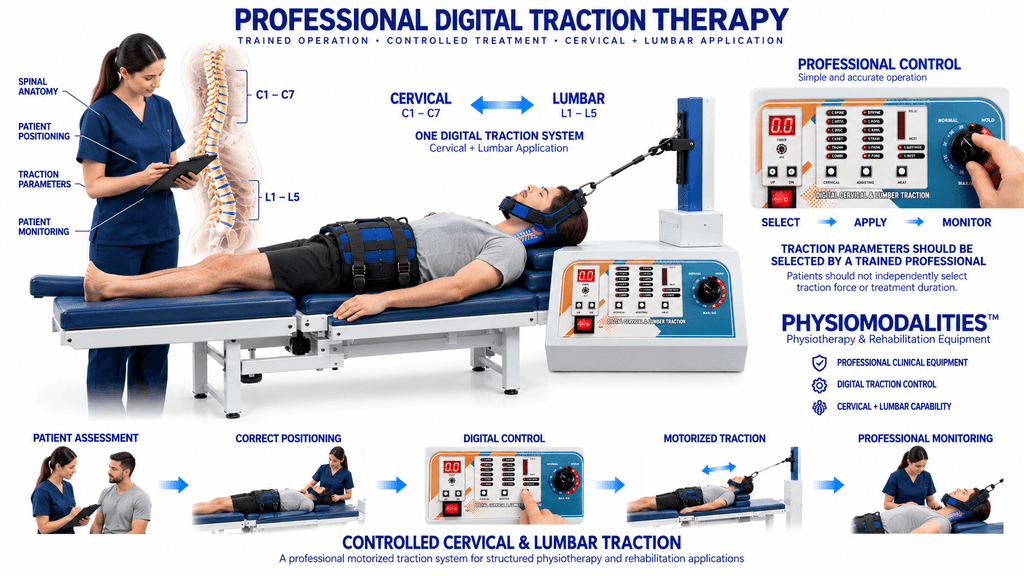
A modern physiotherapy clinic often manages patients with different rehabilitation requirements. A dual-region traction machine provides flexibility because the same system can be configured for cervical and lumbar treatment.
The digital interface also provides a more structured way to manage treatment parameters.
A typical workflow can be:
Patient Assessment → Treatment Selection → Patient Positioning → Parameter Setting → Traction → Monitoring → Treatment Completion → Documentation
This approach helps the therapist maintain an organized treatment process while keeping the patient’s individual requirements at the centre of the session.
The machine can also be incorporated into a broader physiotherapy setup alongside electrotherapy, Ultrasonic therapy, laser therapy, shockwave therapy, TECAR therapy, exercise equipment, and other rehabilitation systems.
Digital Traction vs Manual Traction
| Feature | Digital Traction Machine | Manual Traction |
|---|---|---|
| Force Application | Motorized | Manually applied |
| Parameter Control | Digital | Therapist controlled |
| Treatment Timer | Digital | Usually manual |
| Intermittent Cycles | Available on supported models | Manually performed |
| Repeatability | Easier to reproduce settings | Depends more on manual technique |
| Patient Monitoring | Required | Direct therapist involvement |
| Treatment Workflow | Structured digital setup | Manual setup |
Digital traction equipment provides controlled mechanical operation, but it does not replace the therapist’s clinical assessment or decision-making.
Who Should Operate the Machine?
The machine should be operated by trained physiotherapists, rehabilitation professionals, or other appropriately qualified healthcare practitioners.
The operator should understand:
- Spinal anatomy
- Cervical and lumbar positioning
- Traction principles
- Treatment parameters
- Patient assessment
- Contraindications
- Patient monitoring
- Emergency procedures
Patients should not independently select traction force or treatment duration without professional guidance.
Why Choose PHYSIOMODALITIES™?
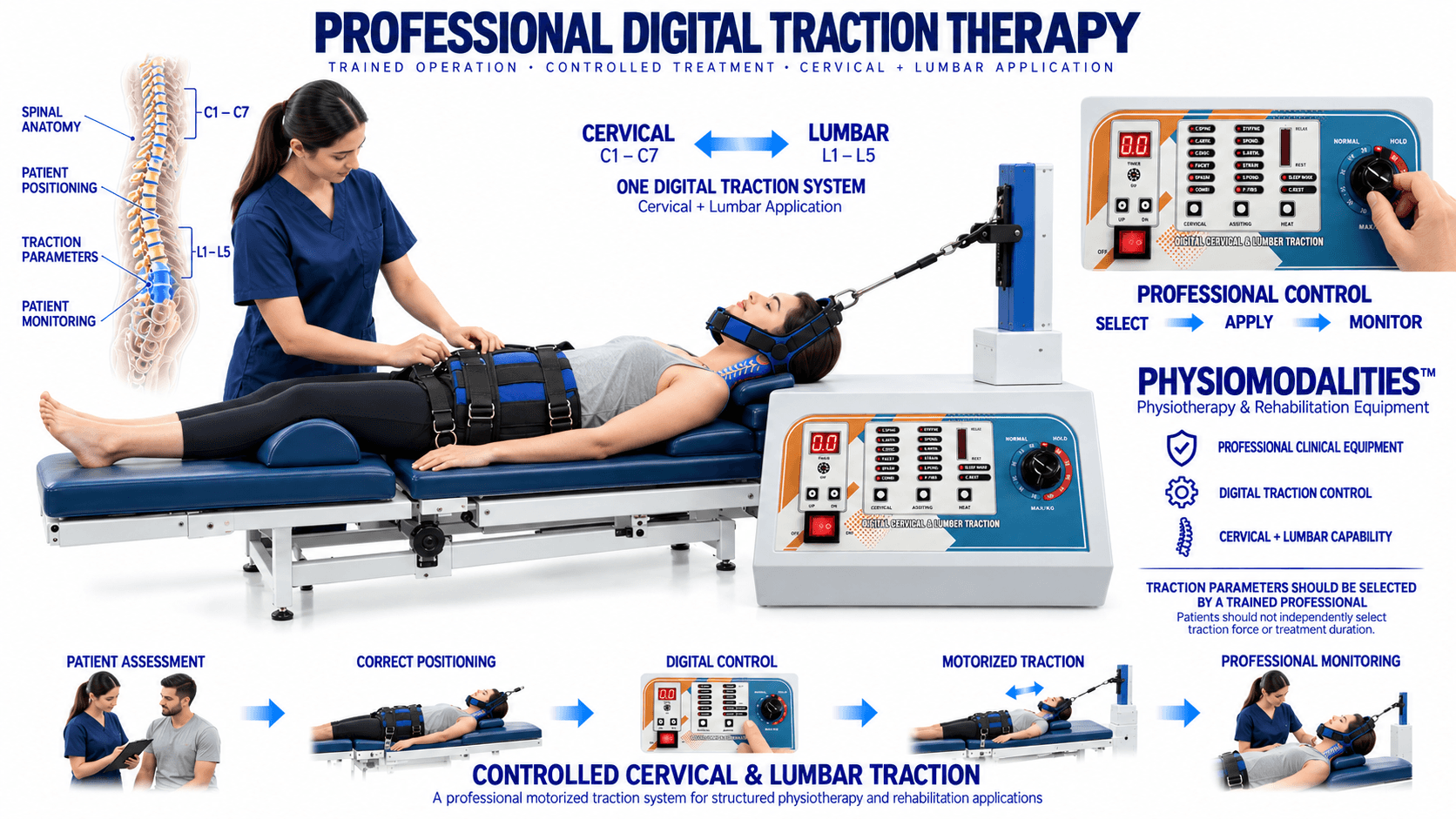
PHYSIOMODALITIES™ offers physiotherapy and rehabilitation equipment intended for professional healthcare environments.
The Digital Cervical & Lumbar Traction Machine provides a dedicated solution for clinics looking for controlled cervical and lumbar traction within one system.
PHYSIOMODALITIES ENTERPRISES provides equipment across several physiotherapy categories, including electrotherapy, Ultrasonic therapy, laser therapy, shockwave therapy, TECAR therapy, traction systems, robotic spine therapy, and rehabilitation equipment.
For clinics, a properly configured traction system can become part of a broader rehabilitation setup rather than being used as an isolated treatment device.
Conclusion
The Digital Cervical & Lumbar Traction Machine is a motorized physiotherapy system designed to provide controlled cervical and lumbar traction with digital treatment management.
Its adjustable traction force, digital timer, static and intermittent modes, motorized operation, patient support system, and safety controls make it suitable for professional physiotherapy and rehabilitation environments.
The machine can be incorporated into selected rehabilitation programs involving neck pain, lower-back problems, spinal stiffness, disc-related conditions, mobility limitations, and other musculoskeletal concerns when traction is considered clinically appropriate.
For physiotherapy clinics, its ability to support both cervical and lumbar applications provides flexibility while the digital control system helps therapists manage treatment parameters in a structured manner.
The machine should always be used following proper patient assessment, professional clinical judgment, manufacturer instructions, and appropriate safety procedures.
Frequently Asked Questions
1. What is a Digital Cervical & Lumbar Traction Machine?
It is a motorized physiotherapy device designed to provide controlled traction therapy for the cervical and lumbar regions of the spine using digital treatment controls.
2. Can the machine be used for both cervical and lumbar traction?
Yes. It is designed to support both cervical and lumbar traction using the appropriate patient positioning and support accessories.
3. What traction modes are available?
The machine supports static and intermittent traction modes, allowing the therapist to select the appropriate pattern according to the treatment protocol.
4. Is traction suitable for every neck or back condition?
No. Traction is not appropriate for every patient or condition. A qualified healthcare professional should assess the patient and determine whether traction is suitable.
5. Who should operate the machine?
The machine should be operated by a trained physiotherapist or appropriately qualified healthcare professional familiar with spinal traction therapy.