
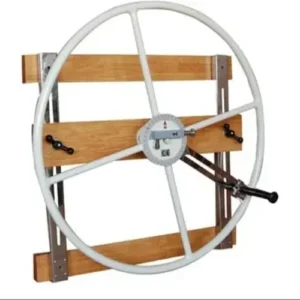
The Large Shoulder Wheel is a physiotherapy and rehabilitation exercise equipment designed to support controlled shoulder, upper-limb, and elbow movement. Its large rotating wheel allows patients to perform guided circular movements through a selected range of motion while the resistance and handle position can be adjusted according to the exercise requirement.
Large shoulder wheels are commonly used in physiotherapy clinics, rehabilitation centres, hospitals, orthopaedic departments, sports rehabilitation facilities, and exercise therapy areas. Professional models may include variable resistance, adjustable wheel height, a movable handle, and a 360-degree scale for monitoring the degree of rotation.
The Large Shoulder Wheel from PHYSIOMODALITIES™ can be incorporated into rehabilitation programs focused on shoulder mobility, upper-limb movement, controlled strengthening, and progressive exercise.
What Is a Large Shoulder Wheel?
A Large Shoulder Wheel is a rehabilitation exercise device consisting of a large rotating wheel mounted on a stable wall or support structure. The patient holds the handle attached to the wheel and rotates it using the shoulder and upper-limb movement.
Unlike a small exercise wheel, the larger diameter provides a broad movement path that can be used for progressive shoulder range-of-motion exercises. Depending on the design, the handle position can be changed to modify the arc of movement, while adjustable resistance can be used to increase or decrease exercise intensity.
It can be used for:
- Shoulder mobility exercises
- Active range-of-motion exercises
- Assisted shoulder movement
- Upper-limb rehabilitation
- Elbow movement exercises
- Shoulder strengthening
- Controlled circular movement
- Functional upper-limb training
- Progressive exercise therapy
How Does a Large Shoulder Wheel Work?
The Large Shoulder Wheel works through controlled rotation of the wheel using a handgrip. As the patient rotates the handle, the shoulder and upper limb move through a circular path.
Shoulder Range of Motion
The wheel provides a defined movement path that can be used for controlled shoulder mobility exercises.
Active Exercise
Patients who can actively move the shoulder can rotate the wheel using their own muscle effort according to the prescribed exercise.
Assisted Movement
The equipment can also be incorporated into assisted movement programs where the therapist determines the appropriate range and exercise technique.
Variable Resistance
Some professional large shoulder wheels include calibrated resistance mechanisms that allow resistance to be adjusted from low to higher levels.
Movement Measurement
Models with a 360-degree scale can provide visual feedback regarding the degree of wheel rotation, allowing movement progress to be monitored during therapy.
Key Features
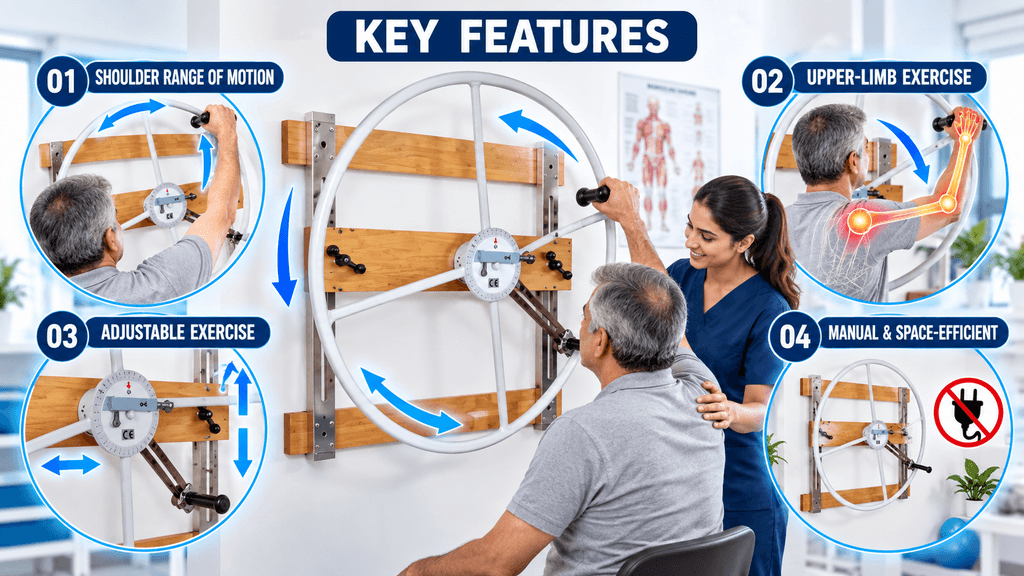
- Large-diameter shoulder exercise wheel
- Suitable for physiotherapy and rehabilitation
- Wall-mounted design on applicable models
- Smooth circular shoulder movement
- Supports active range-of-motion exercises
- Suitable for upper-limb rehabilitation
- Can support elbow movement exercises
- Adjustable resistance on applicable models
- Adjustable wheel height on applicable models
- Adjustable handle position on applicable models
- 360-degree movement scale on applicable models
- Suitable for progressive exercise
- Manual operation
- No electrical power required
- Durable clinical construction
- Space-efficient rehabilitation equipment
Applications of Large Shoulder Wheel
The Large Shoulder Wheel can be incorporated into several physiotherapy and rehabilitation programs.
Shoulder Rehabilitation
The wheel can be used for controlled shoulder movement during rehabilitation programs designed around mobility and functional upper-limb exercise.
Range-of-Motion Training
Circular wheel movement provides a structured way to perform selected active or assisted range-of-motion exercises.
Upper-Limb Rehabilitation
The equipment can be incorporated into rehabilitation programs involving the shoulder, elbow, and upper limb.
Post-Injury Rehabilitation
Following appropriate clinical assessment, controlled shoulder exercises may be introduced as part of a progressive recovery program.
Orthopaedic Rehabilitation
The wheel can be used in selected orthopaedic rehabilitation programs where controlled shoulder movement is appropriate.
Sports Rehabilitation
Sports rehabilitation clinics can incorporate the wheel into progressive shoulder mobility, conditioning, and functional exercise programs.
Elbow Movement
Certain large shoulder-wheel designs support bidirectional operation for shoulder and elbow exercises.
Functional Exercise
The wheel can form part of an exercise therapy setup designed to gradually develop controlled upper-limb movement.
Benefits of Large Shoulder Wheel
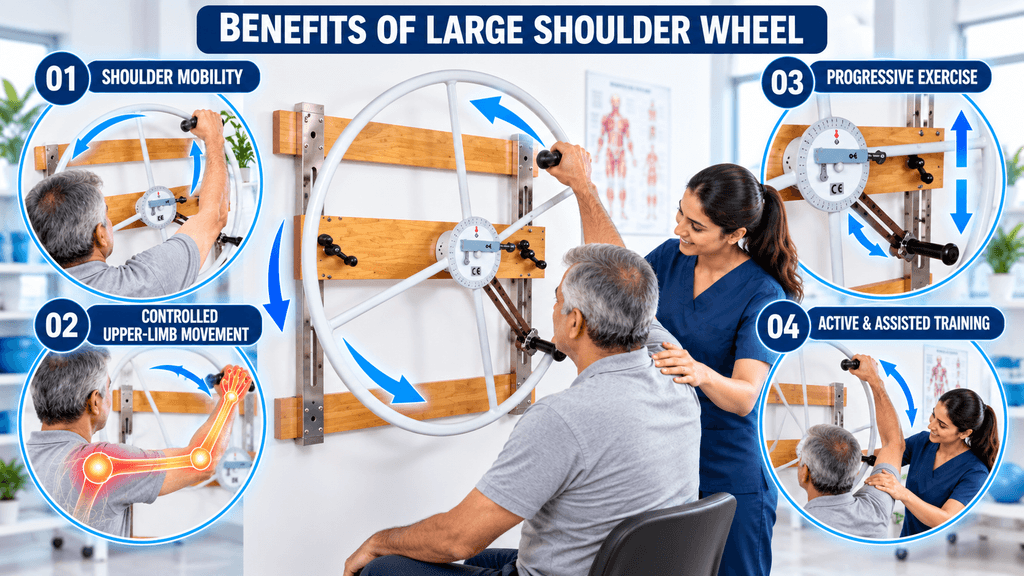
When appropriately incorporated into a rehabilitation program, the Large Shoulder Wheel may provide several practical benefits:
- Supports controlled shoulder movement
- Facilitates circular range-of-motion exercises
- Provides a stable exercise platform
- Allows progressive movement training
- Can provide adjustable resistance
- Supports active and assisted exercise
- Provides multiple handle positions on applicable models
- Allows movement feedback with a 360-degree scale on applicable models
- Suitable for shoulder and upper-limb rehabilitation
- Can be incorporated into sports rehabilitation
- Supports repeated clinical exercise sessions
- Helps therapists modify exercise difficulty according to rehabilitation stage
The actual therapeutic benefit depends on the patient’s condition, movement capacity, exercise selection, resistance, and professional rehabilitation program.
Large Shoulder Wheel for Physiotherapy Clinics
A Large Shoulder Wheel can be a valuable addition to the exercise therapy section of a physiotherapy clinic.
Its large rotating wheel provides a dedicated mechanism for controlled shoulder and upper-limb movement without requiring a separate electrical system. Wall-mounted models can also conserve floor space while providing a stable exercise station.
It can be used alongside:
- Shoulder pulley systems
- Wall-mounted climbing ladders
- Hand exercise tables
- Resistance bands
- Exercise balls
- Parallel bars
- Upper-limb exercisers
- Treatment tables
- Other rehabilitation equipment
The combination of adjustable resistance and movement positioning on applicable models allows therapists to adapt exercises according to patient requirements.
How to Use a Large Shoulder Wheel
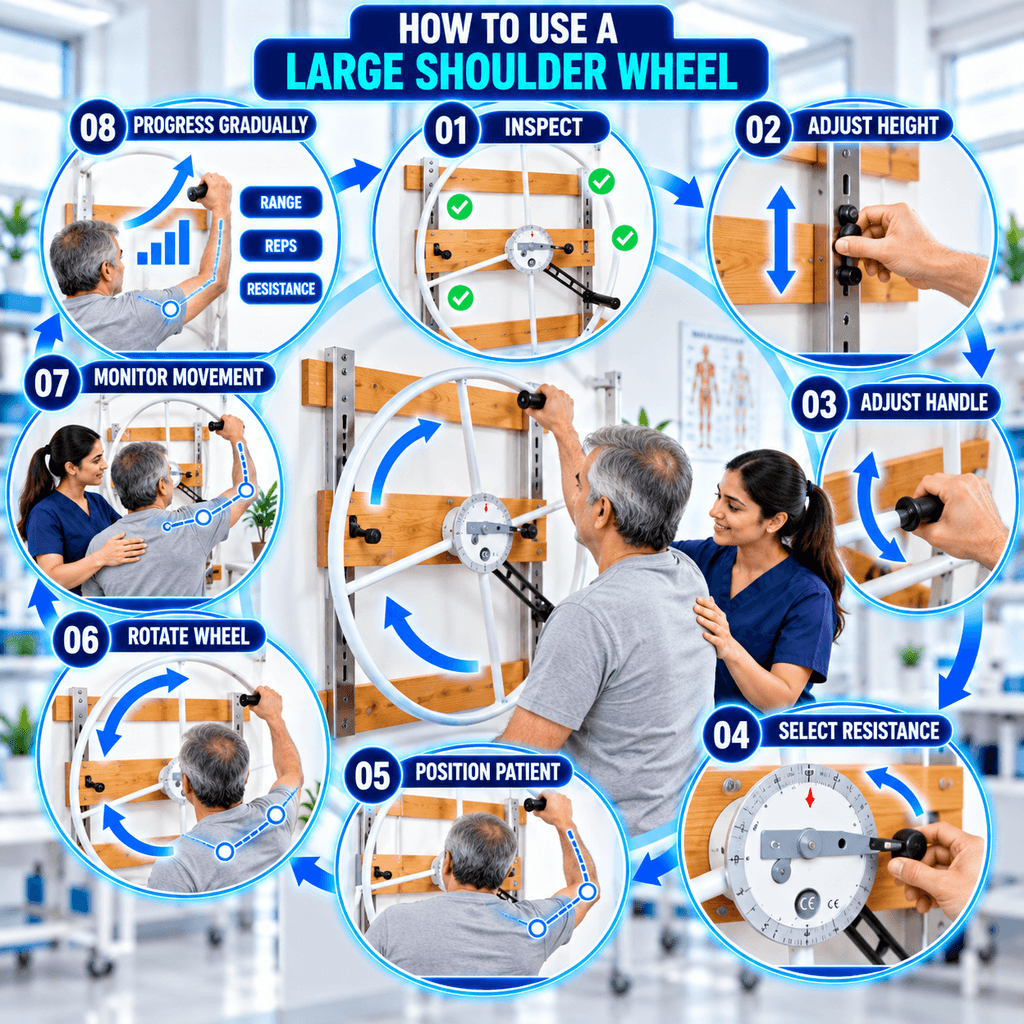
Step 1: Inspect the Equipment
Check the wheel, handgrip, resistance mechanism, mounting structure, and adjustment points before use.
Step 2: Adjust the Height
If the model provides height adjustment, position the wheel according to the patient’s height and the intended exercise.
Some documented designs provide approximately 50 cm of vertical adjustment.
Step 3: Adjust the Handle
Set the handle at an appropriate position according to the required movement arc and exercise.
Step 4: Select Resistance
If adjustable resistance is available, begin with an appropriate level based on the rehabilitation program.
Step 5: Position the Patient
The patient should stand or sit in an appropriate position with the hand securely holding the handle.
Step 6: Rotate the Wheel
Move the wheel slowly and smoothly through the prescribed range of motion.
Step 7: Monitor Movement
The therapist should observe shoulder alignment, movement quality, and patient tolerance throughout the exercise.
Step 8: Progress Gradually
Movement range, repetitions, or resistance can be progressed according to professional assessment.
Safety Precautions
- Ensure the wheel is securely mounted before use.
- Check all mounting hardware regularly.
- Inspect the wheel, handle, and resistance mechanism before exercise.
- Use an appropriate resistance level.
- Avoid sudden or forceful movements.
- Do not force the shoulder beyond the prescribed range.
- Maintain proper posture during exercise.
- Patients with significant shoulder limitations should receive suitable supervision.
- Stop the exercise if significant pain, dizziness, or other concerning symptoms develops.
- Keep fingers clear of moving mechanical components.
- Follow the manufacturer’s load and adjustment instructions.
- Perform regular maintenance and cleaning.
Who Can Use a Large Shoulder Wheel?
The equipment may be incorporated into rehabilitation programs for:
- Physiotherapy patients
- Orthopaedic rehabilitation patients
- Sports rehabilitation patients
- Patients working on shoulder mobility
- Patients requiring upper-limb exercise
- Selected elbow rehabilitation programs
- Patients progressing through range-of-motion exercises
- Individuals undergoing exercise therapy
The appropriate movement range, resistance, and exercise duration should be selected according to individual clinical requirements.
Large Shoulder Wheel vs Small Shoulder Wheel
| Feature | Large Shoulder Wheel | Small / Compact Shoulder Wheel |
|---|---|---|
| Wheel Size | Large diameter | Smaller diameter |
| Movement Path | Broad circular path | More compact movement |
| Exercise Use | Shoulder mobility & progressive exercise | Mobility and space-efficient exercise |
| Resistance | Available on applicable models | Model dependent |
| Height Adjustment | Available on applicable models | Model dependent |
| Movement Scale | Available on some models | Available on selected models |
| Installation | Usually wall mounted | Wall or compact mounting depending on model |
| Clinic Space | Requires wall space | Generally more compact |
The appropriate wheel depends on the clinic’s available space, intended exercises, patient population, and rehabilitation requirements.
Technical Specifications
| Specification | Details |
|---|---|
| Product Name | Large Shoulder Wheel |
| Equipment Type | Shoulder & Upper-Limb Rehabilitation Equipment |
| Primary Use | Shoulder Mobility & Exercise |
| Operation | Manual |
| Power Requirement | None |
| Wheel Diameter | Model dependent |
| Mounting | Wall Mounted / Model Dependent |
| Resistance | Adjustable on applicable models |
| Movement Direction | Bidirectional on applicable models |
| Height Adjustment | Available on applicable models |
| Handle Adjustment | Model dependent |
| Movement Scale | 360-degree scale on applicable models |
| Arc of Motion | Model dependent |
| Frame Material | Model dependent |
| Dimensions | Model dependent |
| Maximum Load | Model dependent |
| Usage | Physiotherapy & Rehabilitation |
Documented large shoulder-wheel designs include approximately 100 cm wheel diameters, variable resistance, a 360-degree scale, adjustable handle position, and approximately 50 cm of vertical adjustment; exact specifications vary between manufacturers and models.
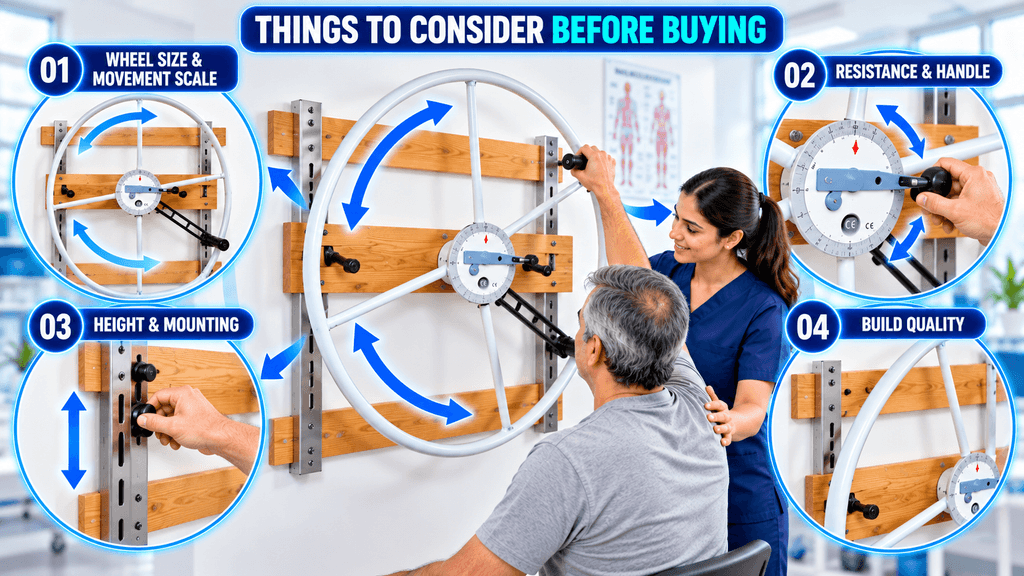
Things to Consider Before Buying
Wheel Diameter
A larger wheel provides a broad circular movement path. Select the size according to the intended rehabilitation exercises and available clinic space.
Resistance Adjustment
If progressive strengthening is required, choose a model with an adjustable resistance mechanism.
Height Adjustment
Height adjustment can make the equipment more adaptable for different patient heights and exercise positions.
Movement Scale
A 360-degree scale can provide useful visual feedback when monitoring wheel rotation and exercise progress.
Mounting Requirements
Wall-mounted equipment requires a structurally suitable wall and appropriate installation hardware.
Handle Position
An adjustable handle can allow the therapist to modify the movement arc according to the patient’s exercise requirements.
Construction Quality
A durable frame, stable mounting system, smooth wheel movement, and reliable resistance mechanism are important for repeated clinical use.
Why Choose PHYSIOMODALITIES™?
PHYSIOMODALITIES™ provides physiotherapy and rehabilitation equipment designed for professional clinical environments.
The Large Shoulder Wheel can complement a rehabilitation setup by providing a dedicated exercise station for controlled shoulder, elbow, and upper-limb movement.
PHYSIOMODALITIES ENTERPRISES offers equipment across physiotherapy, rehabilitation, exercise therapy, electrotherapy, and clinical treatment categories, helping clinics develop equipment setups according to their individual requirements.
Conclusion
The Large Shoulder Wheel is a dedicated rehabilitation exercise equipment designed for controlled shoulder and upper-limb movement. Its large rotating wheel can support range-of-motion exercises, mobility training, progressive strengthening, and functional upper-limb rehabilitation.
Depending on the model, features such as adjustable height, variable resistance, movable handle positioning, bidirectional operation, and a 360-degree movement scale can provide additional flexibility for clinical exercise programs.
When correctly installed and used under appropriate professional guidance, the Large Shoulder Wheel can be a practical addition to physiotherapy clinics, rehabilitation centres, sports rehabilitation facilities, and hospital exercise therapy areas.
Frequently Asked Questions
1. What is a Large Shoulder Wheel used for?
A Large Shoulder Wheel is used for controlled shoulder and upper-limb exercises, including range-of-motion, mobility, strengthening, and progressive rehabilitation activities.
2. Is a Large Shoulder Wheel suitable for physiotherapy clinics?
Yes. It is commonly used as exercise therapy equipment in physiotherapy and rehabilitation environments.
3. Does a Large Shoulder Wheel require electricity?
No. Standard manual shoulder wheels operate without electrical power.
4. Can the resistance be adjusted?
Many professional models include adjustable resistance, allowing exercise intensity to be modified according to the rehabilitation program.
5. What is the purpose of the 360-degree scale?
A 360-degree scale can provide visual feedback and help measure or record wheel rotation during selected shoulder exercises.