
The Wrist Joint Trainer Exercise is a rehabilitation and exercise approach designed to support wrist mobility, controlled movement, strengthening, and functional hand coordination. Wrist joint trainers are used in physiotherapy clinics, rehabilitation centres, occupational therapy departments, and exercise therapy facilities to help patients perform structured wrist and forearm exercises.
Depending on the equipment design, a wrist joint trainer may provide adjustable resistance, guided movement, or controlled exercise positions. It can be incorporated into rehabilitation programs for selected wrist-related conditions, post-injury recovery, reduced joint mobility, and hand-function training under professional supervision.
The Wrist Joint Trainer Exercise equipment from PHYSIOMODALITIES™ can complement a clinic’s upper-limb rehabilitation setup by providing a dedicated option for wrist-focused exercise and movement training.

What Is a Wrist Joint Trainer?
A Wrist Joint Trainer is a rehabilitation exercise device designed to support controlled movement and exercise of the wrist and forearm.
The wrist is involved in several everyday activities, including gripping, lifting, writing, turning objects, and performing fine motor tasks. After injury, surgery, prolonged immobilization, or certain musculoskeletal conditions, wrist movement and strength may become limited.
A wrist trainer can help therapists introduce selected exercises according to the patient’s mobility, strength, and rehabilitation stage.
Depending on the model, the equipment may support:
- Wrist flexion and extension exercises
- Radial and ulnar deviation exercises
- Forearm movement exercises
- Controlled resistance training
- Wrist mobility exercises
- Progressive strengthening
- Functional movement practice
The exact exercise options depend on the equipment’s mechanical design and available adjustments.

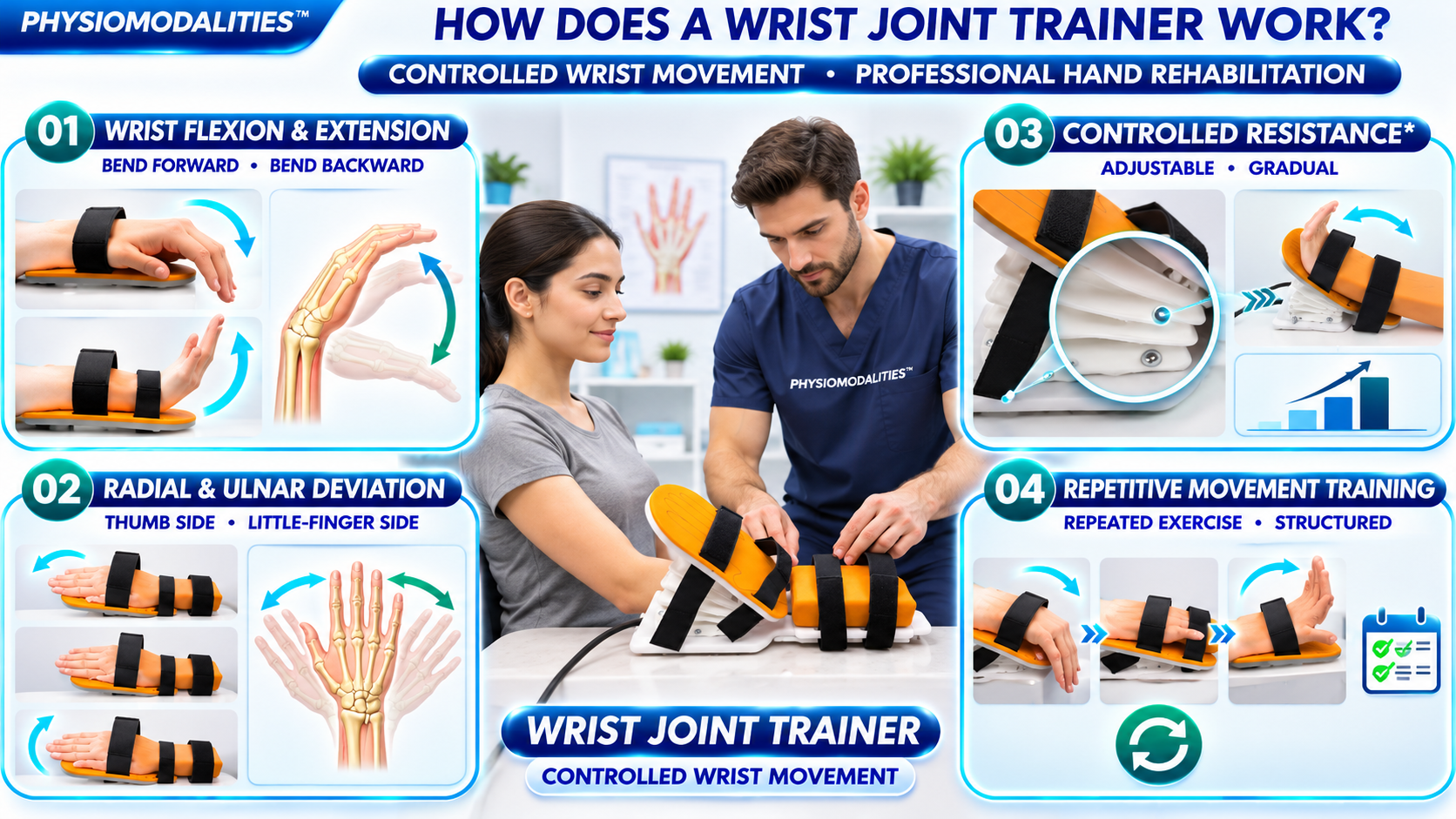
How Does a Wrist Joint Trainer Work?
A wrist joint trainer provides a structured way to perform selected wrist and forearm movements. The patient positions the hand or forearm according to the equipment design and performs controlled movements under appropriate guidance.
Wrist Flexion and Extension
These movements involve bending the wrist forward and backward. They can be included in mobility and strengthening programs according to the patient’s requirements.
Radial and Ulnar Deviation
These movements involve moving the hand towards the thumb side and little-finger side of the wrist.
Controlled Resistance Exercise
Some wrist trainers provide resistance that can be adjusted according to the patient’s exercise level. Resistance should be introduced gradually and only when appropriate.
Repetitive Movement Training
The equipment can help patients perform repeated movements in a controlled exercise position.
Key Features of a Wrist Joint Trainer
- Designed for wrist-focused rehabilitation exercises
- Supports controlled wrist movement
- Can be used for mobility training
- Suitable for selected strengthening exercises
- Supports progressive exercise programs
- May provide adjustable resistance, depending on model
- Compact rehabilitation equipment design
- Suitable for physiotherapy and occupational therapy environments
- Can complement hand and upper-limb rehabilitation equipment
- Manual operation on applicable models

Applications of Wrist Joint Trainer Exercise
The Wrist Joint Trainer Exercise can be incorporated into selected physiotherapy and rehabilitation programs.
Wrist Mobility Rehabilitation
The trainer can support controlled wrist movements when a patient has reduced mobility. Exercise selection should be based on the patient’s assessment and movement tolerance.
Wrist Strengthening
Where the equipment provides suitable resistance, it may be used for progressive wrist-strengthening exercises.
Post-Injury Rehabilitation
A therapist may incorporate wrist exercises into a rehabilitation plan following selected injuries once movement or resistance exercise has been approved.
Postoperative Rehabilitation
Wrist exercise may be introduced after certain procedures according to the surgeon’s and treating therapist’s instructions. The timing and permitted movements depend on the procedure and healing stage.
Forearm Rehabilitation
Depending on the device design, selected wrist and forearm movements may be practised as part of an upper-limb rehabilitation program.
Functional Hand Training
Wrist control contributes to activities such as gripping, lifting, writing, and handling objects. Wrist exercises may complement broader hand-function training.
Occupational Therapy
Occupational therapists may incorporate suitable wrist exercises into programs focused on everyday hand and upper-limb activities.
Potential Benefits of Wrist Joint Trainer Exercise
When selected appropriately, a wrist joint trainer may help support:
- Controlled wrist mobility exercises
- Practice of specific wrist movement patterns
- Progressive resistance training on compatible models
- Repetitive exercise practice
- Structured upper-limb rehabilitation
- Wrist and forearm exercise coordination
- Integration with functional hand exercises
- Supervised exercise in a clinical environment
Results depend on the patient’s condition, equipment design, exercise selection, consistency, and professional rehabilitation plan. The device should not be presented as a guaranteed treatment or a replacement for clinical care.

Wrist Joint Trainer for Physiotherapy Clinics
A Wrist Joint Trainer can be included in the exercise therapy section of a physiotherapy or rehabilitation clinic.
It may be used alongside:
- Hand rehabilitation equipment
- Finger exercise devices
- Hand grippers
- Therapy putty
- Resistance bands
- Upper-limb exercise equipment
- Occupational therapy tools
- Functional hand-training activities
The equipment selected should match the clinic’s intended exercises and patient requirements. Therapists should check the available movement options, resistance settings, positioning adjustments, and accessory configuration before purchase.
Common Wrist Movements Used in Rehabilitation
| Movement | Description |
|---|---|
| Wrist Flexion | Bending the wrist forward |
| Wrist Extension | Bending the wrist backward |
| Radial Deviation | Moving the hand towards the thumb side |
| Ulnar Deviation | Moving the hand towards the little-finger side |
| Forearm Pronation | Rotating the forearm so the palm faces downward |
| Forearm Supination | Rotating the forearm so the palm faces upward |
Not every wrist trainer supports all these movements. Confirm the actual movement capability of the selected model before describing it as a feature.
How to Use a Wrist Joint Trainer
The equipment should be used according to its operating instructions and the patient’s prescribed rehabilitation plan.
Step 1: Assess the Patient
Review the patient’s wrist condition, movement limitations, pain, injury history, and any postoperative restrictions.
Step 2: Inspect the Equipment
Check the frame, handles, moving parts, resistance mechanism, and adjustment points before use.
Step 3: Position the Patient
Seat the patient comfortably and position the hand and forearm according to the equipment instructions.
Step 4: Adjust the Equipment
Set the available movement position or resistance level according to the patient’s ability and the prescribed exercise.
Step 5: Demonstrate the Movement
Explain the required movement and demonstrate it before the patient begins.
Step 6: Perform Controlled Exercise
Ask the patient to move slowly and smoothly without forcing the wrist beyond a comfortable range.
Step 7: Monitor the Response
Observe movement quality, posture, and patient comfort throughout the exercise.
Step 8: Complete the Session
Finish the prescribed repetitions and return the equipment to its resting position.

Safety Precautions
- Use the equipment under appropriate professional guidance.
- Check the equipment before each session.
- Position the wrist and forearm correctly.
- Begin with a comfortable movement range.
- Use resistance only when appropriate for the patient’s rehabilitation stage.
- Avoid sudden or forceful movements.
- Do not force movement through sharp pain.
- Follow postoperative restrictions where applicable.
- Stop exercise if significant pain, swelling, numbness, or unusual discomfort occurs.
- Keep moving parts and adjustment mechanisms clear.
- Follow the manufacturer’s cleaning and maintenance instructions.
Technical Specifications
Exact specifications depend on the particular wrist joint trainer model. Confirm the product datasheet before publishing fixed measurements or performance claims.
| Specification | Details |
|---|---|
| Product Name | Wrist Joint Trainer |
| Equipment Type | Physiotherapy & Rehabilitation Exercise Equipment |
| Primary Application | Wrist Mobility and Exercise Training |
| Target Area | Wrist and Forearm, Model-Dependent |
| Exercise Type | Mobility and Strengthening, Model-Dependent |
| Resistance Adjustment | Model-Dependent |
| Movement Options | Model-Dependent |
| Operation | Manual or Mechanical, Model-Dependent |
| Dimensions | Confirm with Manufacturer |
| Material | Confirm with Manufacturer |
| Accessories | Model-Dependent |
| Intended Use | Physiotherapy and Rehabilitation |
Things to Consider Before Buying
Movement Options
Check which wrist movements the trainer supports, such as flexion, extension, or side-to-side deviation.
Resistance Adjustment
If strengthening is required, confirm whether the model provides adjustable resistance and how the resistance is changed.
Patient Positioning
Check whether the hand and forearm can be positioned comfortably and securely.
Construction Quality
Consider the frame, handles, joints, moving parts, and overall suitability for repeated clinical use.
Dimensions
Confirm the equipment’s size and the space required for installation and exercise.
Warranty and Service
Review warranty coverage, maintenance requirements, and the availability of replacement components.

Who Can Use a Wrist Joint Trainer?
A wrist joint trainer may be incorporated into rehabilitation programs for selected patients receiving care in:
- Physiotherapy clinics
- Occupational therapy departments
- Orthopaedic rehabilitation centres
- Hand therapy units
- Sports rehabilitation facilities
- Hospital rehabilitation departments
The treating professional should determine whether the equipment and exercise are suitable for the individual patient.
Why Choose PHYSIOMODALITIES™?
PHYSIOMODALITIES™ provides physiotherapy and rehabilitation equipment for professional clinical environments. A wrist joint trainer can complement a clinic’s hand and upper-limb rehabilitation equipment range by providing an option for structured wrist exercise.
When selecting rehabilitation equipment, clinics should consider the movement options, resistance mechanism, patient positioning, construction, accessories, warranty, and technical support.
Conclusion
The Wrist Joint Trainer Exercise is designed to support controlled wrist mobility and strengthening activities within a structured rehabilitation program. Depending on the model, the equipment may provide different wrist movement options and resistance settings for progressive exercise.
It can be a useful addition to physiotherapy, occupational therapy, and upper-limb rehabilitation environments when selected according to patient requirements and used under appropriate professional guidance. Always confirm the exact movement capabilities, resistance settings, dimensions, and accessories from the product datasheet.
Frequently Asked Questions
1. What is a Wrist Joint Trainer used for?
It is used for selected wrist mobility, movement-control, and strengthening exercises as part of physiotherapy and rehabilitation programs.
2. Which wrist movements can be practised?
Depending on the equipment, exercises may include wrist flexion, extension, radial deviation, and ulnar deviation.
3. Can a wrist trainer be used for strengthening?
Some models provide resistance for strengthening exercises. Confirm the resistance mechanism and follow the therapist’s instructions.
4. Is a Wrist Joint Trainer suitable for physiotherapy clinics?
Yes. It may be included in hand and upper-limb rehabilitation setups when its functions match the clinic’s requirements.
5. Can it be used after wrist surgery?
It may be used only when the treating surgeon or physiotherapist approves the exercise and specifies the permitted movement and resistance.