
Rotary Wrist Exercise is a rehabilitation exercise designed to support wrist and forearm movement, flexibility, coordination, and controlled strengthening. It is commonly incorporated into physiotherapy and occupational therapy programs for individuals working on wrist mobility and upper-limb function.
A rotary wrist exercise device provides a structured way to perform repeated rotational movements using the wrist and forearm. Depending on the equipment design, resistance and movement intensity may be adjusted to suit different stages of rehabilitation.
For physiotherapy clinics, rehabilitation centres, hospitals, occupational therapy departments, and sports rehabilitation facilities, Rotary Wrist Exercise equipment can provide a practical solution for controlled wrist and forearm training.
PHYSIOMODALITIES™ supplies physiotherapy and rehabilitation equipment designed for professional clinical environments.
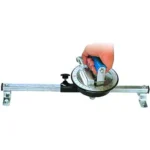
What Is Rotary Wrist Exercise?
Rotary Wrist Exercise refers to controlled rotational exercise of the wrist and forearm, generally performed using a dedicated wrist exercise device or wheel. The user holds a handle or grip and rotates it in a controlled direction according to the prescribed exercise.
The equipment may be used for:
- Wrist mobility exercises
- Forearm rotation
- Wrist strengthening
- Grip-related rehabilitation
- Coordination training
- Functional upper-limb rehabilitation
- Post-injury rehabilitation
- Sports rehabilitation
The resistance mechanism and construction can vary between models. Some devices use adjustable resistance, while others provide a simple mechanical rotation system.
How Does Rotary Wrist Exercise Work?
During a rotary wrist exercise, the hand grips the handle while the wrist and forearm perform controlled rotational movements.
The therapist can select the movement direction, repetitions, duration, and resistance according to the patient’s rehabilitation requirements.
The exercise may involve:
- Positioning the hand comfortably on the grip.
- Maintaining a stable forearm position.
- Rotating the handle through a comfortable range.
- Repeating the movement in a controlled manner.
- Adjusting resistance or repetitions progressively when appropriate.
Controlled movement is important because rehabilitation exercises should be performed according to the patient’s tolerance and the instructions of the treating professional.
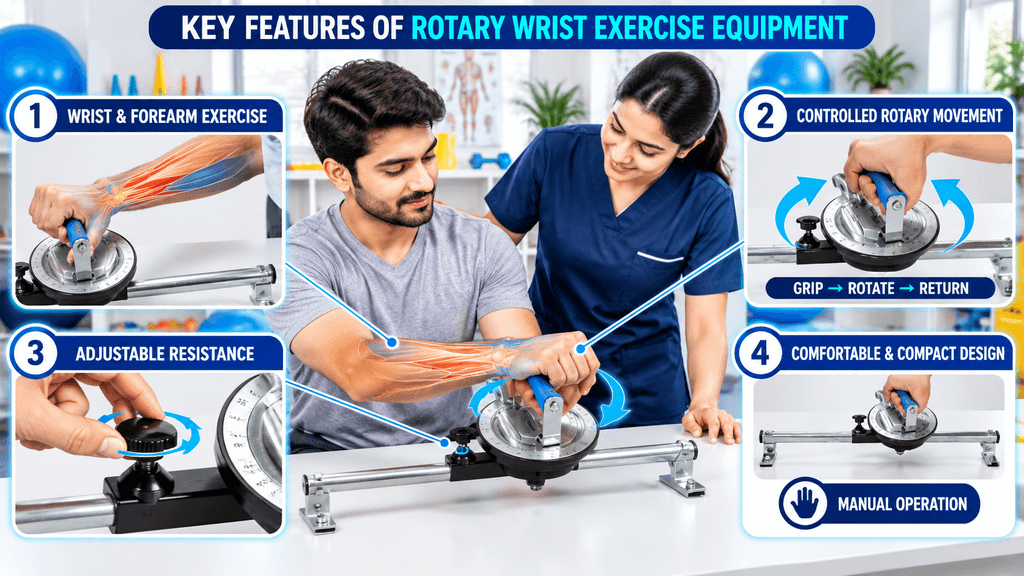
Key Features of Rotary Wrist Exercise Equipment
Wrist-Focused Exercise
The equipment is designed specifically for wrist and forearm rotational activities.
Controlled Rotation
The rotary mechanism allows repetitive wrist movement in a structured manner.
Adjustable Resistance
Depending on the model, resistance may be adjustable to accommodate different rehabilitation stages.
Comfortable Grip
A suitable handle or grip helps the user maintain control while performing the exercise.
Compact Design
Many wrist exercise devices are compact and can be installed or used in relatively small therapy spaces.
Manual Operation
Most rotary wrist exercise equipment operates mechanically without requiring electrical power.
Clinical Rehabilitation Application
It can be incorporated into physiotherapy, occupational therapy, hand rehabilitation, and sports rehabilitation programs.
Progressive Exercise
Therapists can gradually increase repetitions, duration, or resistance when clinically appropriate.
Applications of Rotary Wrist Exercise
Rotary Wrist Exercise equipment can be used in different rehabilitation environments for upper-limb training.
Wrist Rehabilitation
Controlled rotation may be included in rehabilitation programs designed to restore wrist movement following injury or periods of reduced activity.
Forearm Mobility
Rotational exercises can be incorporated into programs focused on forearm movement and functional mobility.
Wrist Strengthening
Resistance-based rotary exercises may help support progressive strengthening programs.
Occupational Therapy
The equipment can be useful for controlled hand and wrist activities that form part of occupational therapy.
Sports Rehabilitation
Athletes involved in sports requiring repetitive wrist or forearm movement may use wrist exercise equipment as part of a professionally designed rehabilitation program.
Post-Injury Rehabilitation
Depending on the injury and stage of healing, therapists may incorporate controlled wrist exercises into a broader rehabilitation plan.
Functional Training
Rotational wrist movements can be relevant to activities involving turning, gripping, twisting, and handling objects.
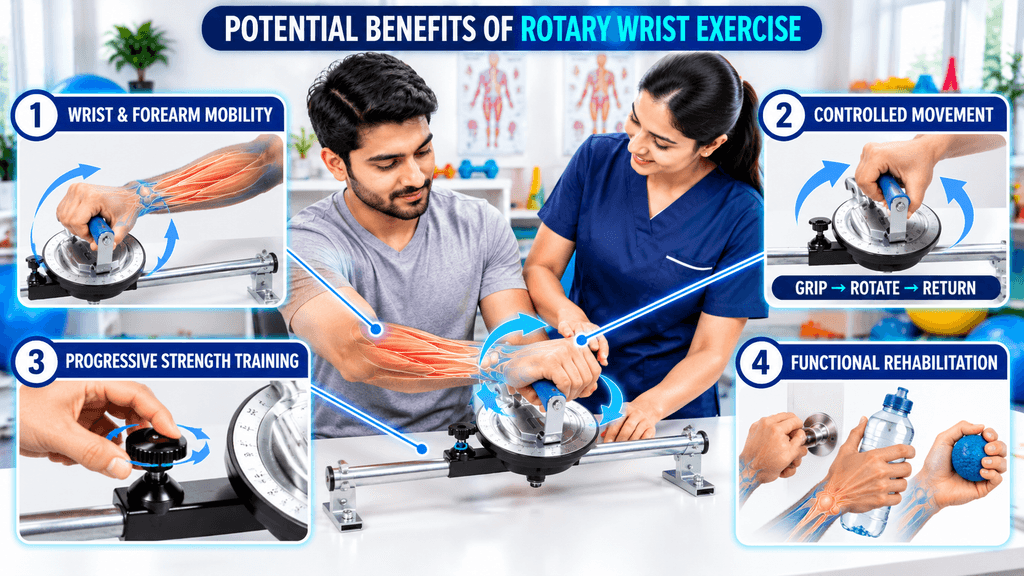
Potential Benefits
The potential benefits of Rotary Wrist Exercise depend on the individual’s condition, exercise technique, resistance level, and rehabilitation program.
Supports Wrist Mobility
Controlled rotational movement can be incorporated into exercises intended to maintain or improve wrist mobility.
Supports Forearm Movement
Rotational exercises involve coordinated movement of the wrist and forearm and may be useful during upper-limb rehabilitation.
Progressive Strength Training
When the device provides resistance, therapists can incorporate it into gradual strengthening programs.
Improves Movement Control
Repeated controlled movements may help users practice coordination and movement accuracy.
Supports Functional Rehabilitation
Wrist rotation is involved in many everyday activities, including turning handles, using tools, and manipulating objects.
Easy to Incorporate into Therapy
A dedicated wrist exercise device can provide a simple and repeatable method for performing rotational exercises.
Suitable for Progressive Programs
Exercise intensity can often be progressed according to the patient’s rehabilitation stage and professional assessment.
Common Rotary Wrist Exercises
| Exercise | Primary Focus |
|---|---|
| Clockwise rotation | Wrist and forearm control |
| Counter-clockwise rotation | Movement coordination |
| Assisted rotation | Mobility training |
| Resistance rotation | Strength development |
| Slow rotation | Movement control |
| Repeated rotation | Endurance and coordination |
| Short-range rotation | Early-stage movement practice |
| Progressive rotation | Rehabilitation progression |
The appropriate exercise, movement range, resistance, and repetitions should be determined according to the patient’s condition and rehabilitation plan.
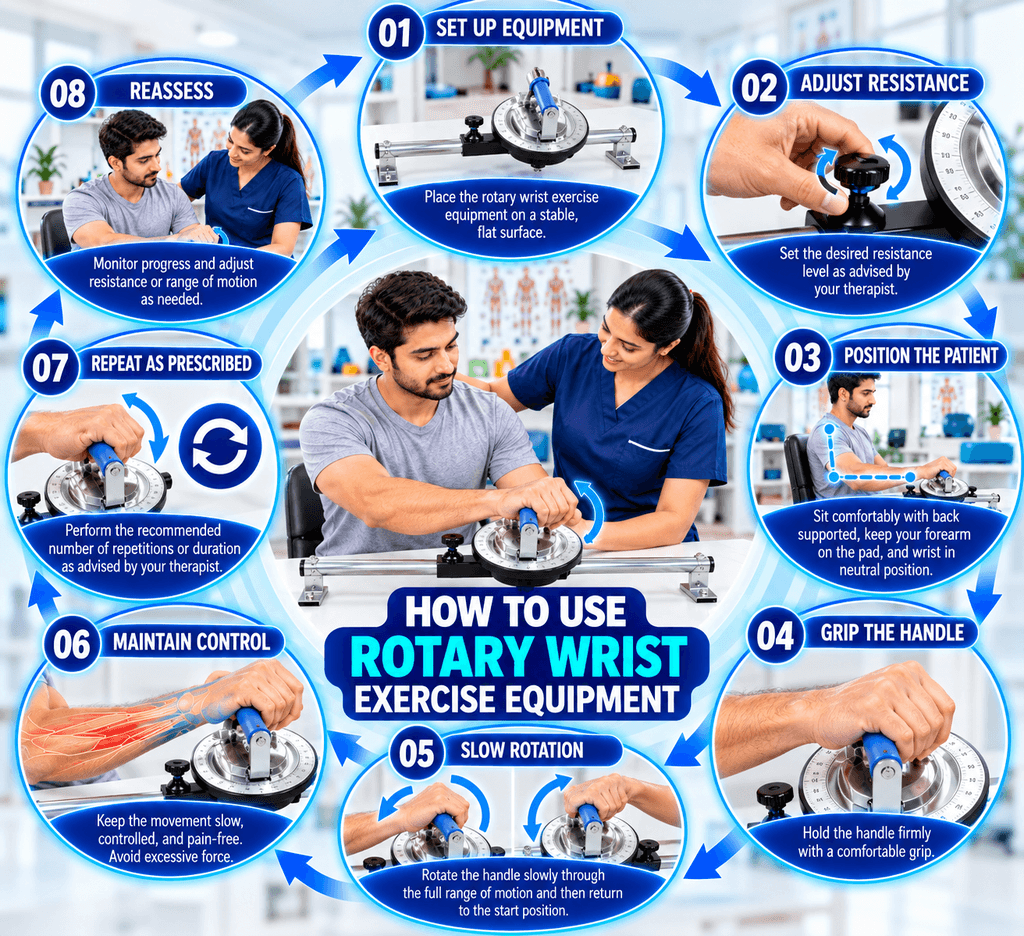
How to Use Rotary Wrist Exercise Equipment
Step 1: Set Up the Equipment
Place the device securely on a stable surface or mount it according to the manufacturer’s instructions.
Step 2: Adjust the Resistance
If the equipment provides resistance adjustment, select an appropriate starting level.
Step 3: Position the Patient
Seat the patient comfortably and position the arm and forearm according to the intended exercise.
Step 4: Grip the Handle
Hold the handle securely without excessive gripping force.
Step 5: Begin Slow Rotation
Rotate the handle gradually through a comfortable range of movement.
Step 6: Maintain Controlled Movement
Avoid sudden or jerky movements. Maintain a consistent pace throughout the exercise.
Step 7: Repeat as Prescribed
Perform the required repetitions or exercise duration according to the therapist’s program.
Step 8: Reassess
The therapist should monitor movement quality, comfort, fatigue, and tolerance before progressing the exercise.
Safety Precautions
- Use the equipment on a stable surface.
- Check all moving parts before use.
- Start with a low resistance when appropriate.
- Do not force the wrist beyond a comfortable range.
- Avoid sudden or jerky rotational movements.
- Stop if significant pain or discomfort develops.
- Follow the rehabilitation professional’s instructions.
- Do not increase resistance too quickly.
- Keep fingers clear of moving mechanical parts.
- Inspect handles, joints, and resistance mechanisms regularly.
- Follow the manufacturer’s maintenance recommendations.
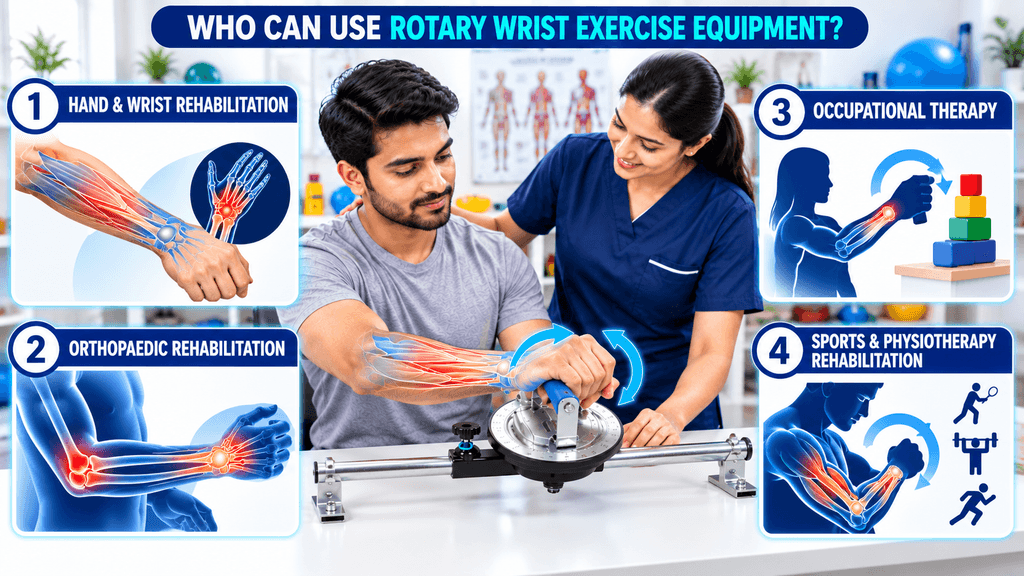
Who Can Use Rotary Wrist Exercise Equipment?
Rotary wrist exercise equipment may be suitable for use in:
- Physiotherapy clinics
- Hand rehabilitation centres
- Occupational therapy departments
- Rehabilitation hospitals
- Sports rehabilitation centres
- Orthopaedic rehabilitation units
- Pediatric therapy centres
- Neurological rehabilitation facilities
- Medical training institutions
Its suitability for a particular patient should be determined by a qualified healthcare or rehabilitation professional.
Rotary Wrist Exercise vs General Hand Exercise Equipment
| Feature | Rotary Wrist Exercise | General Hand Exercise Equipment |
|---|---|---|
| Primary focus | Wrist and forearm rotation | Hand and finger activity |
| Movement | Rotational | Grip, squeeze, pinch or finger movement |
| Wrist mobility | Directly targeted | May vary |
| Forearm involvement | Common | Usually limited |
| Resistance | Model dependent | Model dependent |
| Clinical application | Wrist and upper-limb rehabilitation | Hand and finger rehabilitation |
| Functional relevance | Turning and rotational activities | Gripping and manipulation |
Both types of equipment can complement each other in a broader hand and upper-limb rehabilitation program.
Technical Specifications
| Specification | Details |
|---|---|
| Product Name | Rotary Wrist Exercise |
| Equipment Type | Wrist & Forearm Rehabilitation Equipment |
| Primary Application | Wrist Rotation and Upper-Limb Exercise |
| Exercise Type | Rotational |
| Operation | Manual |
| Resistance | Model dependent |
| Resistance Adjustment | Model dependent |
| Handle | Ergonomic grip, model dependent |
| Construction | Model dependent |
| Mounting | Model dependent |
| Power Requirement | Normally none |
| Suitable Environment | Physiotherapy & Rehabilitation Clinics |
| Target Area | Wrist, Hand & Forearm |
| Patient Capacity | Model dependent |
| Manufacturer | PHYSIOMODALITIES™ |
Exact dimensions, resistance range, materials, mounting configuration, and other specifications should be confirmed for the selected model.
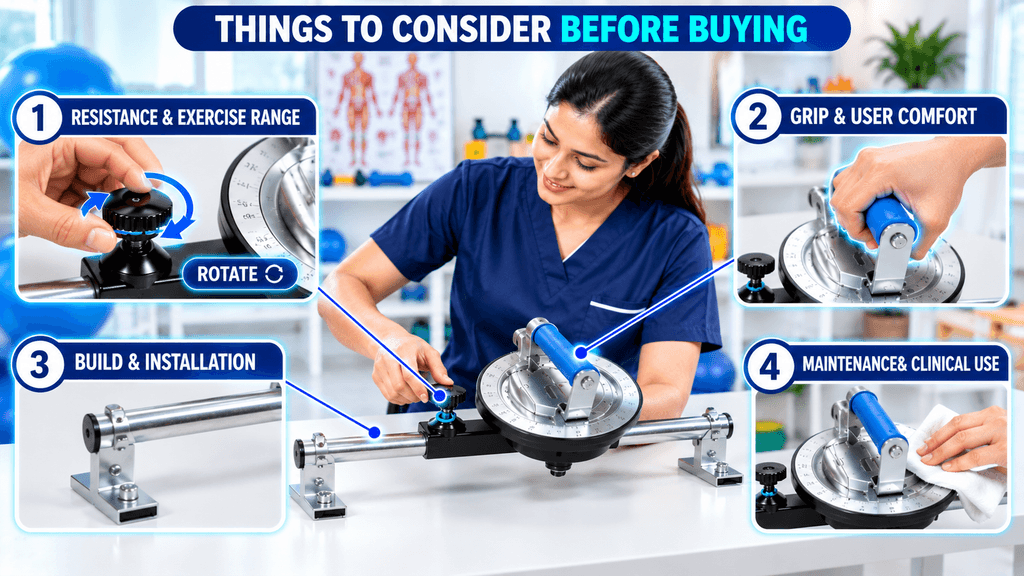
Things to Consider Before Buying
Resistance Adjustment
If the device will be used for progressive strengthening, check whether the resistance can be adjusted.
Grip Design
A comfortable and secure handle can make repeated exercises easier to perform.
Construction Quality
For professional clinical use, consider the stability and durability of the frame and moving components.
Installation
Check whether the device is tabletop, wall-mounted, floor-mounted, or designed for another installation method.
Exercise Range
Consider whether the rotation range is suitable for the intended rehabilitation activities.
Maintenance
Choose equipment with accessible moving parts and straightforward maintenance requirements.
Clinic Requirements
Consider available therapy space and how frequently the equipment will be used.
Why Choose PHYSIOMODALITIES™?
PHYSIOMODALITIES™ provides physiotherapy and rehabilitation equipment for professional clinical environments. The Rotary Wrist Exercise equipment can be incorporated into hand therapy, wrist rehabilitation, occupational therapy, and upper-limb exercise setups.
Its practical design can help therapists provide structured rotational exercise while allowing rehabilitation programs to be adapted according to individual patient requirements.
Conclusion
Rotary Wrist Exercise equipment provides a practical method for controlled wrist and forearm rotational training. It can be incorporated into physiotherapy, occupational therapy, hand rehabilitation, sports rehabilitation, and general upper-limb exercise programs.
By providing a structured movement pattern and, depending on the model, adjustable resistance, the equipment can support progressive rehabilitation activities focused on wrist mobility, movement control, and strengthening. The appropriate exercise intensity and progression should always be selected according to the individual’s condition and professional rehabilitation assessment.
Frequently Asked Questions
1. What is Rotary Wrist Exercise equipment?
Rotary Wrist Exercise equipment is a rehabilitation device designed for controlled wrist and forearm rotational movements.
2. What does Rotary Wrist Exercise target?
It primarily targets wrist and forearm movement and can be incorporated into mobility, coordination, and strengthening exercises.
3. Is Rotary Wrist Exercise suitable for physiotherapy clinics?
Yes. It can be used in physiotherapy, occupational therapy, hand rehabilitation, and sports rehabilitation environments.
4. Does Rotary Wrist Exercise equipment provide adjustable resistance?
Some models provide adjustable resistance. The available resistance mechanism depends on the specific equipment model.
5. Can Rotary Wrist Exercise be used after an injury?
It may be incorporated into rehabilitation after an injury when appropriate, but the timing, movement range, and resistance should be determined by a qualified rehabilitation professional.