The Q60 Shockwave Therapy Machine is a professional pneumatic shockwave therapy system designed for physiotherapy, rehabilitation, sports recovery, and musculoskeletal treatment environments. It uses controlled pneumatic pressure to generate mechanical shockwaves through a handpiece and deliver them to targeted treatment areas.
The Q60 combines adjustable treatment intensity, variable frequency, interchangeable applicator heads, touchscreen controls, and preset body-area programs in one compact system. Depending on the configuration, published Q60 specifications include 0.5–8.0 bar pressure, 1–22 Hz operating frequency, 500–3000 impacts, and five interchangeable treatment heads.
For physiotherapy clinics, rehabilitation centres, sports therapy facilities, and other professional settings, the Q60 Shockwave Therapy Machine can provide a flexible platform for incorporating radial shockwave therapy into treatment protocols under appropriate professional assessment.
What Is the Q60 Shockwave Therapy Machine?
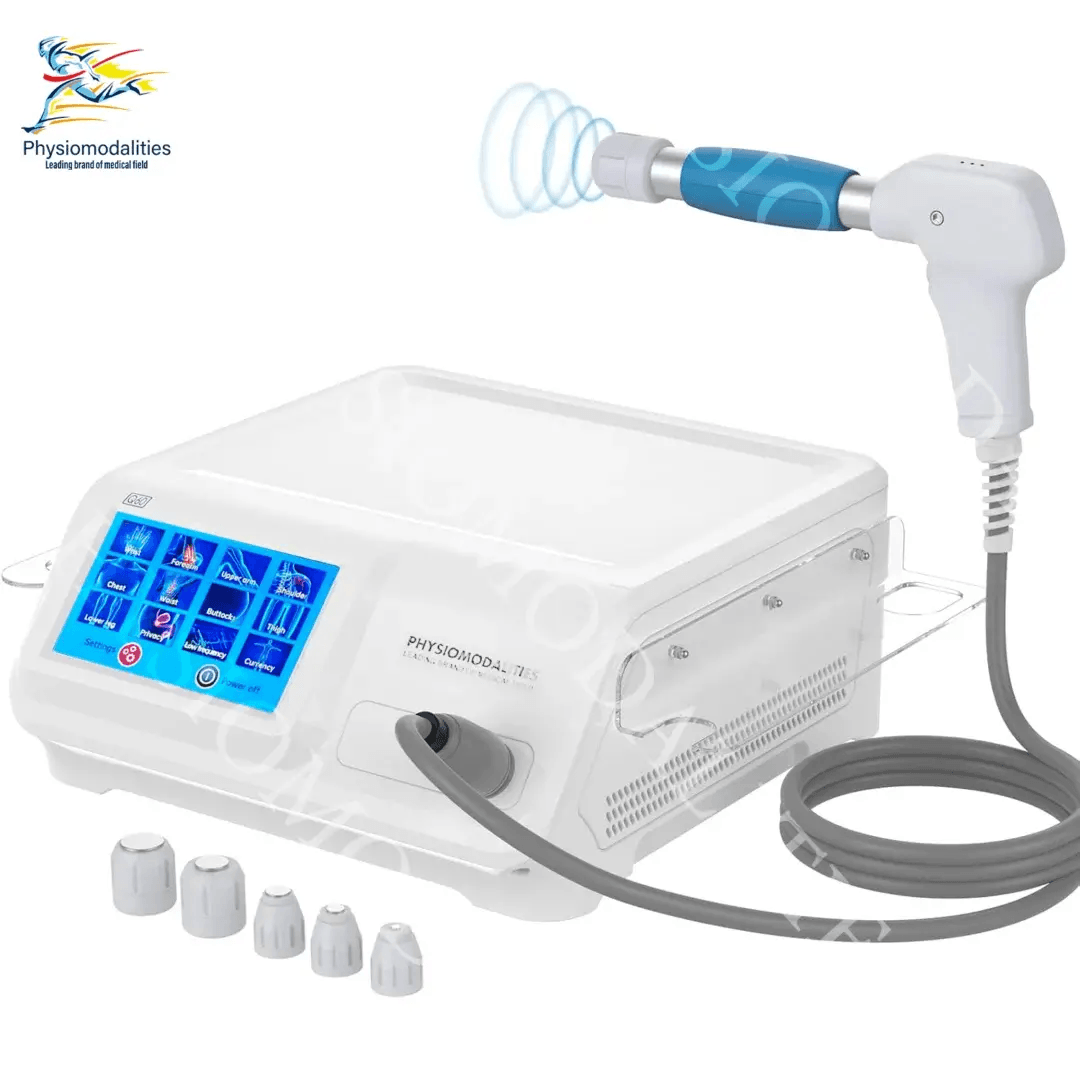
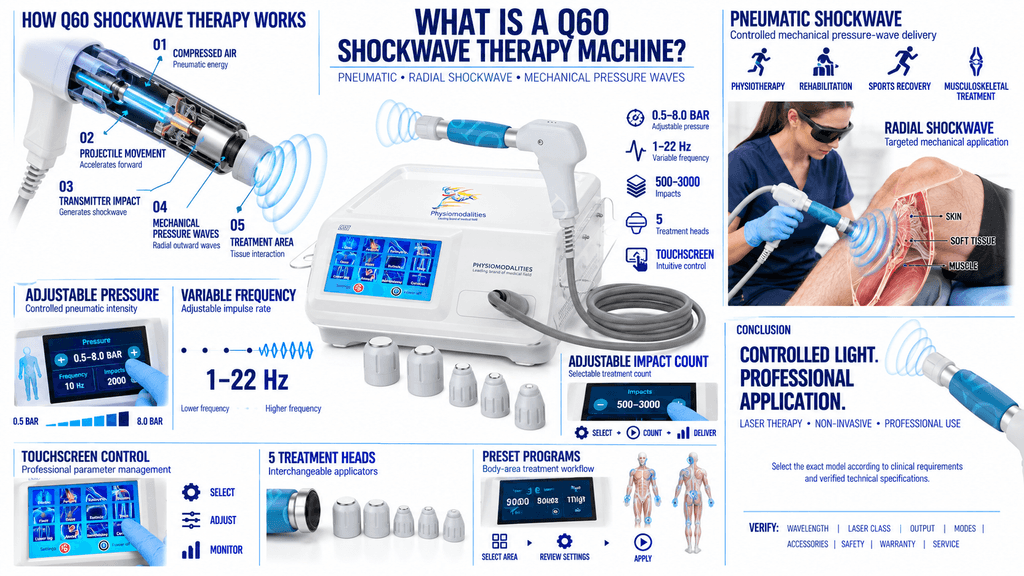
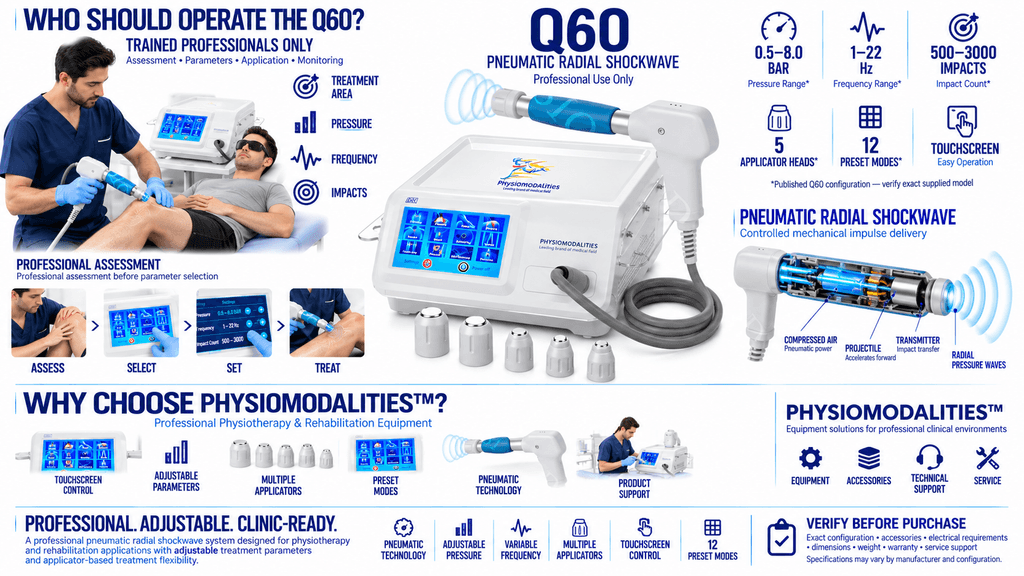
The Q60 is a pneumatic radial shockwave therapy device that produces mechanical pressure waves using compressed air. Inside the handpiece, a projectile is accelerated pneumatically and impacts an applicator, creating radial pressure waves that are transferred to the selected treatment area.
Unlike a single-purpose therapy device, the Q60 is designed with multiple settings and applicator options so treatment parameters can be adapted according to the body area, treatment objective, and professional protocol.
PHYSIOMODALITIES™ offers advanced physiotherapy equipment designed for modern clinical environments, and the Q60 concept fits applications where controlled shockwave therapy is incorporated into rehabilitation programs.
How Does Q60 Shockwave Therapy Work?
The Q60 Shockwave Therapy Machine uses pneumatic energy to create repeated mechanical impulses.
A typical treatment process involves:
- Selecting the appropriate treatment area or protocol.
- Choosing a suitable applicator head.
- Applying an appropriate coupling medium where required.
- Setting the pressure/intensity and frequency according to the professional protocol.
- Positioning the applicator over the selected treatment area.
- Delivering controlled shockwave pulses.
- Monitoring patient response and adjusting parameters when appropriate.
The mechanical stimulation produced by radial shockwaves is commonly incorporated into physiotherapy programs addressing tendon, muscle, and other soft-tissue conditions. Treatment parameters should always be selected by a trained professional rather than simply using the maximum available intensity.
Key Features of Q60 Shockwave Therapy Machine
Pneumatic Shockwave Technology
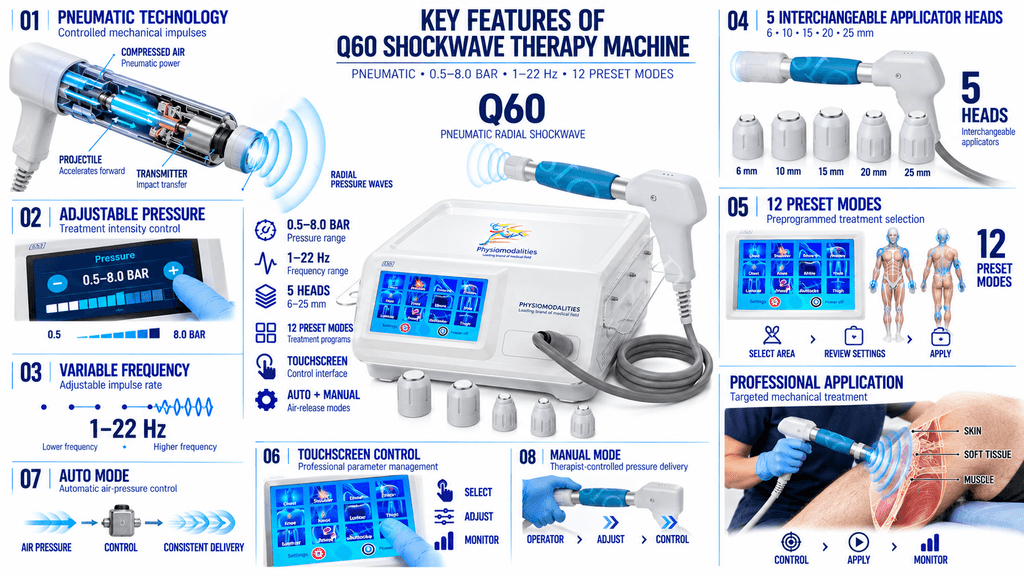
The Q60 uses a pneumatic mechanism to generate radial pressure waves. This provides controlled repetitive impulses through the treatment handpiece.
Adjustable Pressure
Published Q60 specifications list an adjustable pressure range of approximately 0.5–8.0 bar. This allows practitioners to select different treatment intensities according to the treatment protocol and patient tolerance.
Variable Frequency
The system is published with an operating frequency of approximately 1–22 Hz. Frequency selection can be adapted to the treatment protocol and desired stimulation level.
Five Interchangeable Applicator Heads
The Q60 can be supplied with five treatment heads. One published configuration specifies 6 mm, 10 mm, 15 mm, 20 mm, and 25 mm applicator sizes.
12 Preset Treatment Modes
The Q60 reference from PHYSIOMODALITIES describes 12 preprogrammed modes for different body regions and therapy requirements. These programs are intended to simplify treatment setup while still allowing professional adjustment.
Touchscreen Control
A touchscreen or touch-panel interface provides access to treatment modes and operating parameters, helping the therapist configure the machine without complicated manual controls.
Auto and Manual Air-Release Modes
The PME Q60 reference describes both automatic and manual air-release options. Auto mode maintains consistent air pressure, while manual operation allows the therapist greater control over pressure delivery.
Compact Clinical Design
The Q60 is designed to fit into professional treatment environments without requiring the footprint of larger stationary systems. Published configurations list dimensions around 45 × 36 × 16 cm and a weight around 15 kg, although these specifications may differ between supplied versions.
Applications of Q60 Shockwave Therapy
The Q60 Shockwave Therapy Machine may be incorporated into physiotherapy and rehabilitation programs for a variety of musculoskeletal applications.
Commonly published applications include:
- Plantar fasciitis
- Achilles tendinopathy
- Tennis elbow
- Golfer’s elbow
- Patellar tendinopathy
- Calcific shoulder tendinopathy
- Rotator cuff-related conditions
- Greater trochanteric pain syndrome
- Myofascial trigger points
- Shin splints
- Sports-related soft-tissue rehabilitation
- Muscle tightness and selected soft-tissue conditions
The exact suitability of shockwave therapy depends on the patient’s condition, clinical assessment, contraindications, and treatment protocol.
Potential Benefits
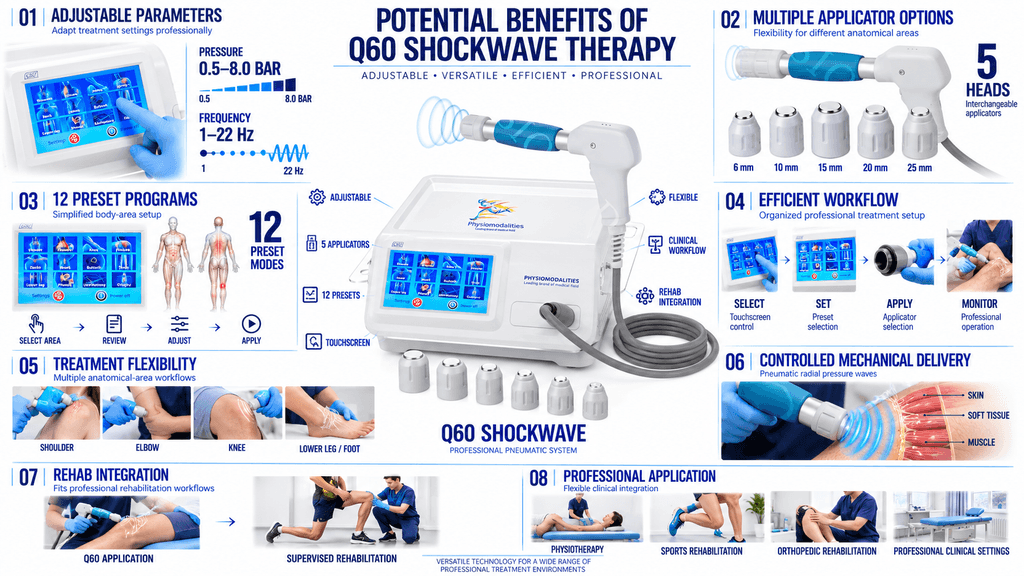
When appropriately incorporated into a professional treatment program, the Q60 can offer several practical advantages.
Adjustable Treatment Parameters
Different conditions and patients may require different treatment settings. Adjustable pressure and frequency allow the practitioner to modify the therapy rather than relying on one fixed setting.
Multiple Applicator Options
Five applicator sizes can provide flexibility when working on different anatomical regions.
Preset Programs
The 12 preset programs can simplify routine setup for body-area-based treatment protocols.
Efficient Clinical Workflow
Touchscreen operation, preset modes, and an organized applicator system can help make treatment setup more convenient in busy clinical environments.
Suitable for Rehabilitation Settings
The Q60 can be incorporated into physiotherapy, sports rehabilitation, orthopedic rehabilitation, and related professional treatment environments when clinically appropriate.
How to Use the Q60 Shockwave Therapy Machine
Step 1: Prepare the Equipment
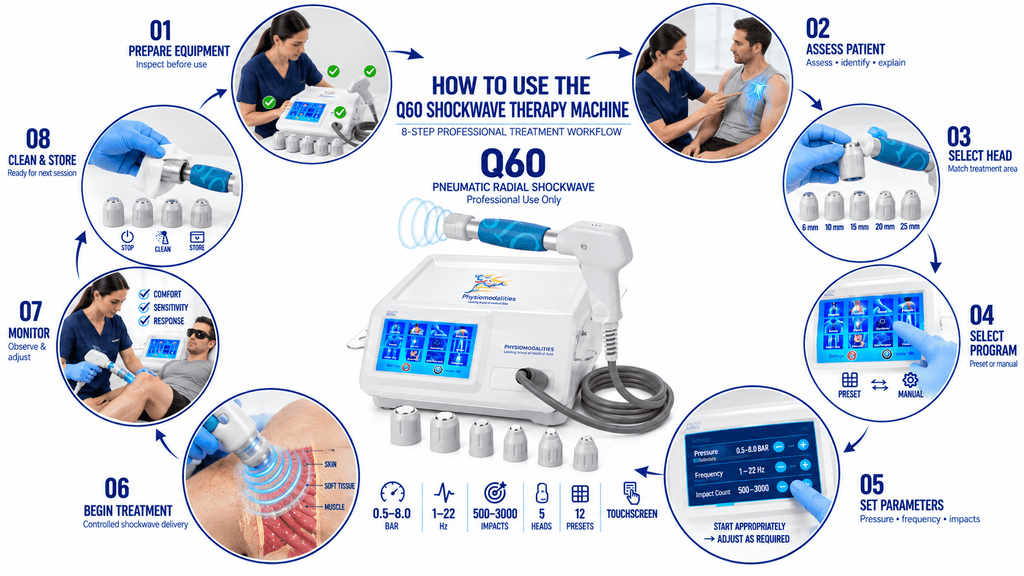
Place the machine on a stable surface with adequate ventilation. Inspect the main unit, handpiece, applicator, cables, and accessories before use.
Step 2: Prepare the Patient
Complete the appropriate clinical assessment and identify the treatment area. Explain the expected sensation and treatment procedure to the patient.
Step 3: Select the Applicator
Choose the appropriate applicator head based on the treatment area and professional protocol.
Step 4: Select the Program
The Q60 provides preset body-area modes. Select the relevant program when appropriate or use manual settings according to the treatment protocol.
Step 5: Adjust Parameters
Set pressure, frequency, and impact count according to the patient’s condition and professional assessment. Do not automatically begin with high-intensity settings.
Step 6: Begin Treatment
Position the handpiece correctly over the selected treatment area and deliver the shockwave impulses according to the established protocol.
Step 7: Monitor Patient Response
Patient comfort should be monitored throughout treatment. Parameters may need adjustment depending on sensitivity and clinical requirements.
Step 8: Clean and Store
After treatment, clean the applicator and handpiece according to the manufacturer’s instructions. Store accessories safely for the next session.
Safety Precautions
The Q60 should be operated by appropriately trained healthcare professionals familiar with shockwave therapy.
Important precautions include:
- Review the patient’s medical history before treatment.
- Follow the manufacturer’s operating instructions.
- Do not use inappropriate intensity levels.
- Avoid treating areas where shockwave therapy is contraindicated.
- Do not apply directly over open wounds or active skin infections.
- Avoid sensitive anatomical structures unless specifically indicated by the treatment protocol.
- Use appropriate protective and infection-control procedures.
- Monitor patient discomfort throughout the session.
- Stop treatment if unexpected severe pain or an adverse reaction occurs.
- Inspect the handpiece and applicator before every session.
- Use compatible accessories only.
- Perform routine maintenance according to the manufacturer’s recommendations.
Shockwave therapy should not be treated as a one-size-fits-all procedure. Patient selection and treatment parameters should be determined by a qualified professional.
Technical Specifications
| Specification | Q60 Shockwave Therapy Machine |
|---|---|
| Technology | Pneumatic / Radial Shockwave |
| Model | Q60 |
| Pressure / Intensity | Approx. 0.5–8.0 bar |
| Frequency | Approx. 1–22 Hz |
| Impact Count | Approx. 500–3000 |
| Applicator Heads | 5 |
| Published Head Sizes | 6, 10, 15, 20, 25 mm |
| Treatment Programs | 12 preset modes |
| Control | Touchscreen / Touch Panel |
| Air-Release Modes | Auto & Manual |
| Dimensions | Approx. 45 × 36 × 16 cm* |
| Weight | Approx. 15 kg* |
| Warranty | Configuration-dependent |
*Specifications can vary between Q60 manufacturers and supplied configurations. Published Q60 sources show some differences in dimensions, weight, power, and electrical specifications, so the final technical datasheet should be confirmed before purchase.
Things to Consider Before Buying
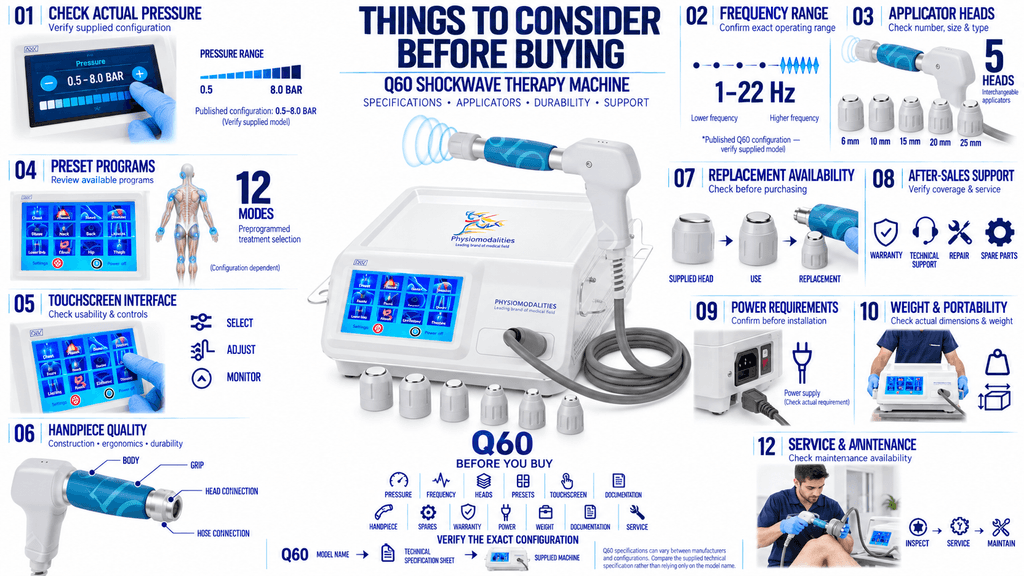
Before purchasing a Q60 Shockwave Therapy Machine, clinics should check:
- Actual pressure range supplied with the machine
- Frequency range
- Number and size of applicator heads
- Preset programs
- Touchscreen interface
- Handpiece durability
- Replacement applicator availability
- Warranty and after-sales support
- Power requirements
- Machine weight and portability
- Availability of user documentation
- Service and maintenance support
Different manufacturers use the Q60 designation, so comparing the supplied technical specification rather than relying only on the model name is important.
Who Should Operate the Q60?
The Q60 should be used by trained physiotherapists, rehabilitation professionals, or other appropriately qualified healthcare practitioners according to applicable professional and device-use requirements.
A professional should assess the patient before selecting the treatment area, intensity, frequency, number of impulses, and treatment duration.
Why Choose PHYSIOMODALITIES™?
PHYSIOMODALITIES™ focuses on physiotherapy and rehabilitation equipment for professional treatment environments. The Q60 fits clinics looking for a pneumatic shockwave platform with adjustable parameters, multiple applicator options, preset treatment modes, and touchscreen operation.
PHYSIOMODALITIES ENTERPRISES provides physiotherapy equipment for clinics and rehabilitation environments, with product support and equipment solutions intended for professional use.
Conclusion
The Q60 Shockwave Therapy Machine is a pneumatic radial shockwave system designed for professional physiotherapy and rehabilitation applications. With adjustable pressure, variable frequency, multiple applicator heads, touchscreen controls, and 12 preset treatment modes, it provides flexibility for different treatment protocols.
Published Q60 configurations commonly specify 0.5–8.0 bar pressure, 1–22 Hz frequency, 500–3000 impacts, and five applicator heads, while exact electrical, weight, and dimensional specifications may differ by manufacturer.
For clinics considering shockwave therapy equipment, the final configuration, accessories, warranty, service support, and technical specifications should be confirmed before purchase.
Frequently Asked Questions
1. What is a Q60 Shockwave Therapy Machine?
The Q60 is a pneumatic radial shockwave therapy system designed for professional physiotherapy and rehabilitation applications.
2. What is the pressure range of Q60?
A commonly published Q60 configuration provides approximately 0.5–8.0 bar adjustable pressure.
3. How many applicator heads does the Q60 have?
Published Q60 specifications list five interchangeable applicator heads, with one configuration offering 6, 10, 15, 20, and 25 mm sizes.
4. What is the frequency range of Q60?
The commonly published range is approximately 1–22 Hz.
5. Is Q60 suitable for physiotherapy clinics?
Yes, Q60 systems are designed for professional physiotherapy and rehabilitation environments, but treatment should be performed by appropriately trained professionals following suitable clinical protocols.