
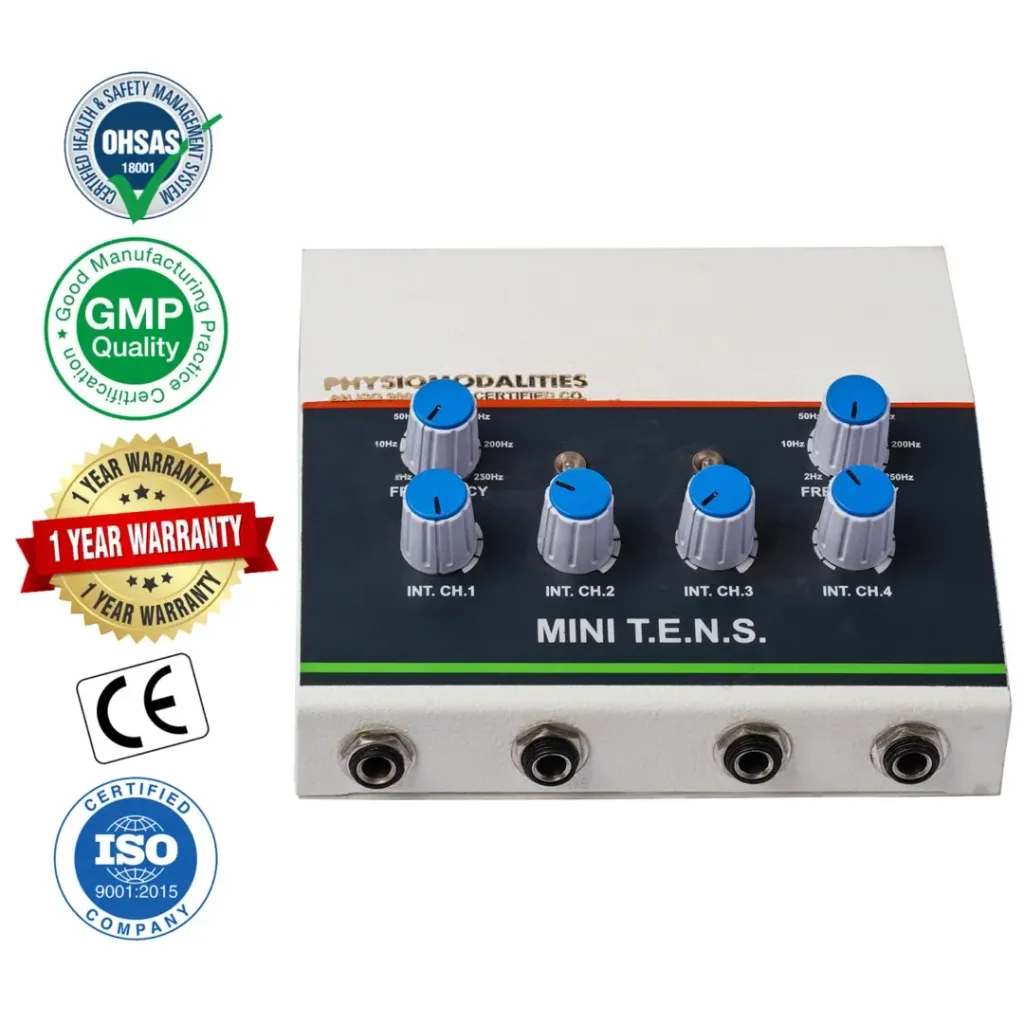
The Mini 4-Channel TENS Physiotherapy Machine is a compact electrotherapy device designed for professional physiotherapy, rehabilitation, and selected pain-management applications. Featuring four stimulation channels, this machine is designed to provide flexible electrical stimulation options within a compact and convenient setup.
A Mini 4-Channel TENS Physiotherapy Machine can be a practical equipment choice for physiotherapy clinics, rehabilitation centres, sports therapy facilities, and professional treatment rooms that require a compact TENS unit. Its four-channel configuration may allow therapists to connect multiple electrode leads according to the machine’s design and the prescribed treatment protocol.
TENS stands for Transcutaneous Electrical Nerve Stimulation. It delivers controlled electrical pulses through electrodes placed on the skin. A qualified healthcare professional can select the appropriate settings based on the patient’s assessment, treatment goals, and the manufacturer’s instructions.
The mini design can help save space in treatment areas, while the four-channel configuration offers flexibility for suitable treatment setups. Exact functions, intensity controls, preset programs, and operating parameters depend on the specific model.
What Is a Mini 4-Channel TENS Physiotherapy Machine?
A Mini 4-Channel TENS Physiotherapy Machine is an electrotherapy device that delivers controlled electrical stimulation through surface electrodes. It is designed to support selected physiotherapy and rehabilitation protocols where TENS is considered appropriate.
The term four-channel refers to the device’s four stimulation channels. Depending on the model, these channels may provide different electrode connection arrangements and adjustment options.
The compact construction makes the device suitable for treatment rooms where space and equipment convenience are important considerations.
Main Functions
- Delivers controlled electrical stimulation through surface electrodes.
- Provides a four-channel configuration, depending on the model.
- Supports selected TENS treatment protocols.
- Allows the operator to adjust stimulation intensity within the available range.
- May include preset programs or adjustable stimulation parameters.
- Offers a compact format for professional treatment environments.
The exact channel arrangement and independent control capabilities should be confirmed from the manufacturer’s technical documentation.
Understanding TENS Therapy
Transcutaneous Electrical Nerve Stimulation, commonly known as TENS, uses electrical pulses delivered through electrodes placed on the skin. It may be incorporated into selected pain-management plans under appropriate professional guidance.
TENS settings can vary according to the treatment objective, patient response, electrode placement, and equipment capabilities. A trained professional should determine the suitable settings and treatment duration.
How TENS Works
The machine generates controlled electrical pulses that pass through electrode pads placed on the skin. These pulses stimulate the targeted nerves according to the selected parameters.
The response to TENS varies between individuals and conditions. It should be considered one possible component of a broader treatment plan rather than a replacement for clinical assessment or other necessary care.
Common TENS Applications
Depending on professional assessment, TENS may be considered as part of selected treatment plans involving:
- Musculoskeletal discomfort
- Back-related discomfort
- Neck and shoulder rehabilitation
- Selected joint-related conditions
- Sports rehabilitation
- Post-injury rehabilitation
- Other appropriate pain-management programs
Suitability depends on the individual patient, the intended treatment area, contraindications, and the healthcare professional’s judgment.
Four-Channel Configuration
The four-channel design is a key feature of the Mini 4-Channel TENS Physiotherapy Machine. It provides four stimulation channels for compatible electrode connections, subject to the manufacturer’s design.
A multi-channel arrangement can offer more electrode placement flexibility than a basic single-channel device. However, the number of channels alone does not establish whether every channel can be controlled independently or used simultaneously in every mode.
Potential Advantages of Four Channels
- Flexible electrode connection options
- Support for suitable multi-electrode treatment arrangements
- Convenient access to multiple stimulation channels
- Adaptability to selected professional treatment protocols
- A compact alternative for clinics requiring multi-channel TENS equipment
Before purchasing, check the number of output channels, the number of electrode pairs supported, and whether the intensity can be adjusted independently for each channel.
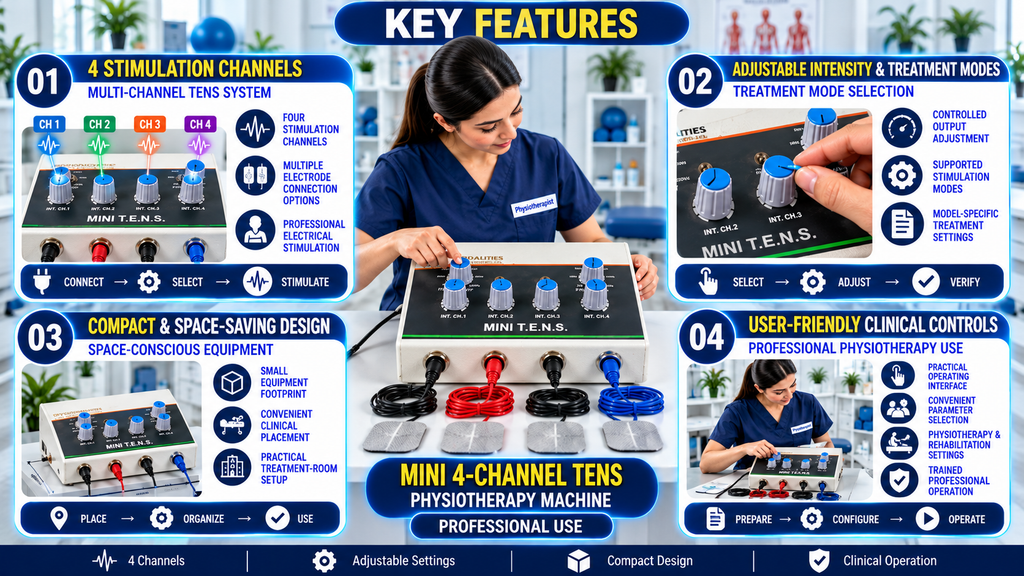
Key Features of the Mini 4-Channel TENS Physiotherapy Machine
Compact Design
The mini format is intended to help reduce equipment footprint in physiotherapy rooms, rehabilitation spaces, and other professional treatment environments.
Four Stimulation Channels
Four channels provide multiple electrode connection options, depending on the unit’s configuration and operating instructions.
Adjustable Intensity
The machine may provide adjustable output intensity so the operator can set an appropriate stimulation level within the available range. Exact intensity limits and controls should be confirmed for the selected model.
Treatment Mode Selection
Some models provide different stimulation modes or adjustable parameters. Confirm the available modes and settings before publishing or purchasing the product.
User-Friendly Controls
Depending on the model, the unit may use digital controls, buttons, a display, or other adjustment mechanisms to manage treatment settings.
Portable and Space-Conscious Format
A compact design can make the device easier to position in a treatment room or move between suitable work areas, subject to its construction and power requirements.
Professional Physiotherapy Use
The machine is intended for use within suitable physiotherapy and rehabilitation workflows by appropriately trained professionals.
Benefits of a Mini 4-Channel TENS Physiotherapy Machine
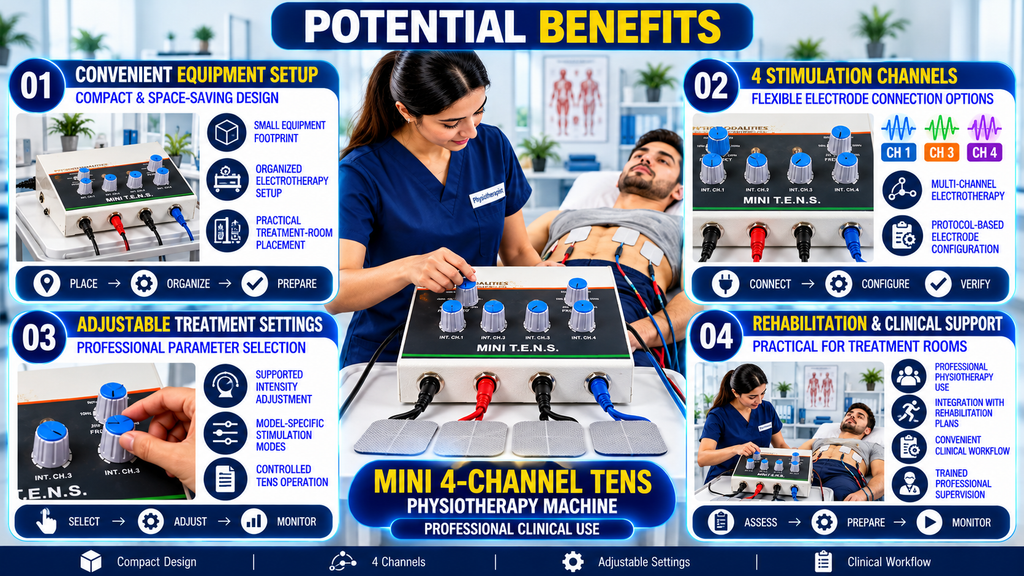
Convenient Equipment Setup
A compact TENS unit can help clinics organize their electrotherapy equipment without requiring a large machine footprint.
Multiple Electrode Connection Options
The four-channel arrangement may offer flexibility when the treatment protocol requires more than one electrode connection arrangement.
Adjustable Treatment Settings
Where supported by the model, adjustable stimulation parameters allow trained operators to select settings appropriate to the patient and treatment objective.
Supports Selected Rehabilitation Programs
TENS may be included in appropriate rehabilitation plans alongside exercise, education, manual therapy, or other recommended approaches.
Practical for Treatment Rooms
The mini design can be useful in clinics with limited space or where compact equipment is preferred.
Important: These are equipment and workflow advantages, not a guarantee of treatment results. Clinical suitability and outcomes vary by patient and condition.
Applications in Physiotherapy and Rehabilitation
The Mini 4-Channel TENS Physiotherapy Machine may be incorporated into different professional treatment environments.
Physiotherapy Clinics
Physiotherapists may use TENS as one component of an individual treatment plan when electrical stimulation is appropriate.
Rehabilitation Centres
The machine may support selected rehabilitation protocols alongside mobility work, therapeutic exercise, and other clinician-directed interventions.
Sports Rehabilitation
Sports rehabilitation professionals may consider TENS for suitable cases as part of a broader recovery plan.
Orthopaedic Rehabilitation
The device may be considered in selected orthopaedic rehabilitation programs following professional assessment.
Multi-Treatment Facilities
Compact electrotherapy equipment can be useful in facilities that need to manage space while maintaining access to appropriate treatment options.
How to Use the Mini 4-Channel TENS Physiotherapy Machine
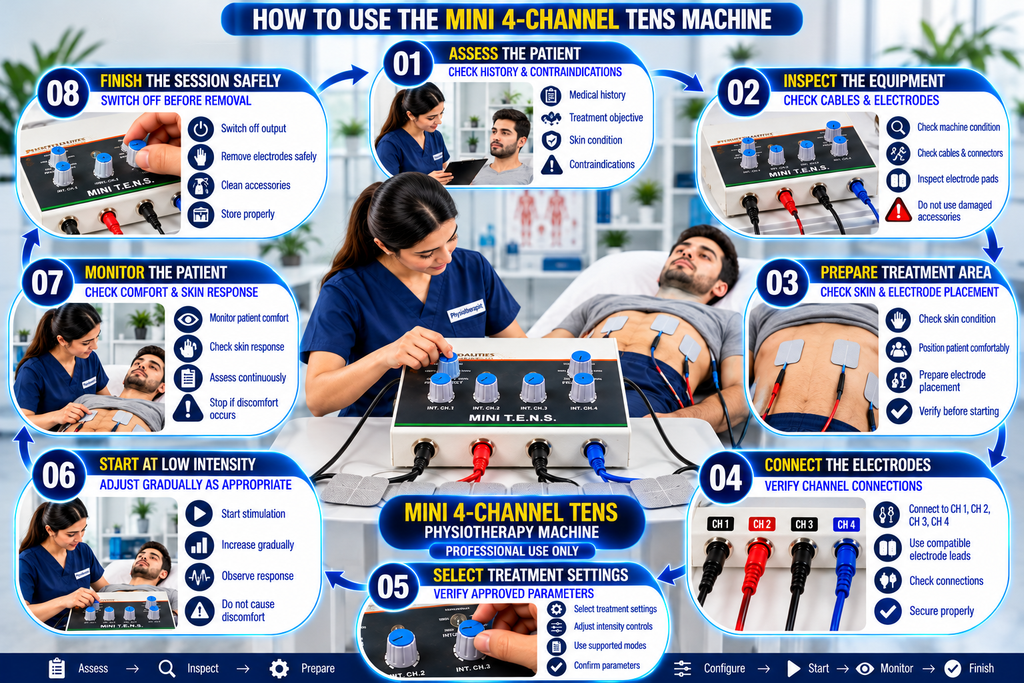
Only a qualified or appropriately trained healthcare professional should determine whether TENS is suitable and operate the device according to the manufacturer’s instructions.
Step 1: Assess the Patient
Review the patient’s condition, treatment objective, medical history, skin condition, and relevant contraindications before selecting TENS.
Step 2: Inspect the Equipment
Check the machine, cables, electrode leads, connectors, and electrode pads for damage. Do not use damaged accessories.
Step 3: Prepare the Treatment Area
Prepare the skin according to the manufacturer’s instructions. Ensure the intended electrode placement is appropriate for the patient and treatment plan.
Step 4: Connect the Electrodes
Connect compatible electrode leads to the correct output channels. Place the electrodes according to the professional treatment protocol and equipment instructions.
Step 5: Select the Settings
Choose an appropriate treatment mode and parameters if the device supports these adjustments. Do not assume that every model offers the same programs or controls.
Step 6: Start at an Appropriate Intensity
Begin with the output at a low level and increase gradually as appropriate, following the machine’s instructions and the patient’s response. Stimulation should not cause unexpected pain or excessive discomfort.
Step 7: Monitor the Patient
Observe the patient’s response during the session. Stop the treatment if unusual pain, burning, skin irritation, dizziness, or another concerning reaction occurs.
Step 8: Finish the Session Safely
Reduce the output to zero or switch off the stimulation before removing electrodes. Clean reusable accessories according to the manufacturer’s guidelines and store the machine appropriately.
Safety Precautions
Safe operation is essential when using a Mini 4-Channel TENS Physiotherapy Machine.
- Use the device only as specified in the manufacturer’s instructions.
- Ensure the operator is appropriately trained.
- Do not place electrodes across the chest or on the front of the neck.
- Do not use TENS on the head or other unsuitable areas unless explicitly directed by applicable professional guidance and the device instructions.
- Patients with pacemakers or other implanted electronic devices require appropriate medical evaluation before TENS is considered.
- Avoid placing electrodes on damaged, infected, irritated, or insensate skin unless specifically permitted under appropriate professional guidance.
- Do not apply electrodes over areas where the patient cannot reliably report discomfort.
- Follow the manufacturer’s guidance for pregnancy and other relevant precautions.
- Inspect leads, connectors, and electrode pads before each use.
- Never connect or remove electrodes while the output is active.
- Stop treatment if the patient experiences an unexpected or significant reaction.
- Keep the device and electrical connections away from water and unnecessary moisture.
- Follow the specified power supply, cleaning, maintenance, and storage instructions.
The above precautions are general guidance. The manufacturer’s instructions and patient-specific clinical assessment take priority.
Technical Specifications
The table below lists the general product configuration. Confirm exact values against the manufacturer’s datasheet before publishing final specifications.
| Specification | Details |
|---|---|
| Product Name | Mini 4-Channel TENS Physiotherapy Machine |
| Product Type | TENS Electrotherapy Device |
| Therapy Type | Transcutaneous Electrical Nerve Stimulation |
| Output Channels | 4 channels |
| Design | Mini / compact format |
| Intensity Control | Model-dependent |
| Stimulation Modes | Confirm with manufacturer |
| Preset Programs | Confirm with manufacturer |
| Frequency Range | Confirm with manufacturer |
| Pulse Width | Confirm with manufacturer |
| Treatment Timer | Model-dependent |
| Display | Model-dependent |
| Electrode Connections | Compatible with the specified model |
| Included Electrodes | Confirm package contents |
| Electrode Leads | Confirm package contents |
| Power Supply | Confirm with manufacturer |
| Dimensions | Confirm with manufacturer |
| Weight | Confirm with manufacturer |
| Warranty | Confirm with supplier |
Specification note: Do not assume that the unit includes a particular frequency range, pulse width, digital display, rechargeable battery, preset program count, or independent channel controls unless these details are confirmed for the exact model.
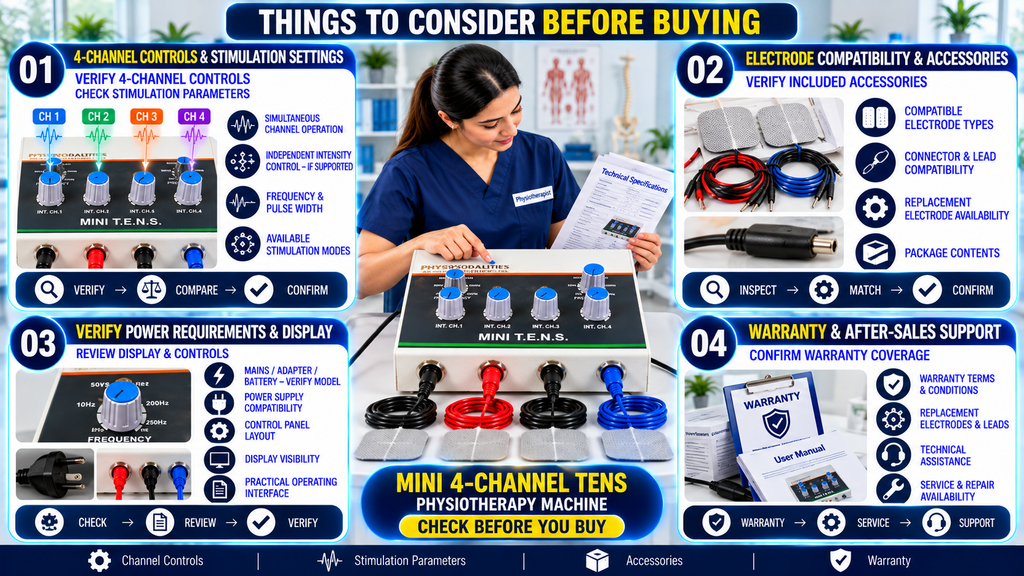
What to Check Before Buying
Channel Controls
Confirm whether all four channels operate simultaneously and whether each channel has independent intensity control.
Stimulation Parameters
Check the available frequency, pulse width, modes, and intensity range if these are important for the intended clinical use.
Electrode Compatibility
Verify the electrode type, connector style, lead compatibility, and availability of replacement accessories.
Power Requirements
Confirm whether the machine operates using an adapter, mains supply, battery, or another arrangement.
Display and Controls
Review the control layout and display type to ensure they meet the needs of the intended users.
Warranty and Service
Check warranty coverage, replacement accessory availability, technical support, and after-sales service before purchasing.
Why Choose PHYSIOMODALITIES™?
PHYSIOMODALITIES™, associated with PHYSIOMODALITIES ENTERPRISES, focuses on physiotherapy and rehabilitation equipment for professional treatment environments.
When evaluating a Mini 4-Channel TENS Physiotherapy Machine, clinics should consider the channel configuration, available stimulation settings, accessory compatibility, ease of operation, and service support.
Before finalizing an order, request the exact model datasheet and confirm the included accessories, warranty, power requirements, and operating instructions. This helps ensure that the selected equipment meets the clinic’s requirements.
Conclusion
The Mini 4-Channel TENS Physiotherapy Machine is a compact electrotherapy device designed to provide four stimulation channels for selected physiotherapy and rehabilitation applications. Its mini format can help save space, while its channel configuration offers electrode connection flexibility according to the model’s design.
The device may be incorporated into suitable professional treatment plans where TENS is considered appropriate. Its actual capabilities depend on the available controls, stimulation parameters, accessories, and manufacturer specifications.
Before purchasing, verify the technical datasheet, independent channel controls, stimulation modes, power requirements, included accessories, warranty, and after-sales support. Patient assessment, safe electrode placement, and adherence to the manufacturer’s instructions remain essential.
Frequently Asked Questions
1. What is a Mini 4-Channel TENS Physiotherapy Machine?
It is a compact electrotherapy device that delivers controlled electrical stimulation through surface electrodes and provides four stimulation channels.
2. What does four-channel TENS mean?
It refers to four stimulation channels. The exact electrode arrangement and independent channel controls depend on the model.
3. Who can operate this machine?
It should be used by an appropriately trained healthcare professional who understands TENS safety, electrode placement, and patient assessment.
4. Is the machine suitable for physiotherapy clinics?
It may be suitable for professional physiotherapy settings where a compact, multi-channel TENS device meets the clinic’s requirements.
5. What should I check before buying?
Verify channel controls, stimulation parameters, electrode compatibility, power requirements, accessories, warranty, and technical support.