
The Manual Traction Machine with 3 Fold Bed For Physiotherapy is a physiotherapy treatment system designed to support manually applied spinal traction and positioning during selected rehabilitation procedures. It combines a three-fold treatment bed with a manual traction mechanism, providing a dedicated setup for physiotherapy clinics, rehabilitation centres, orthopedic practices, and other professional healthcare environments.
Manual traction equipment is used by trained professionals to apply controlled pulling force to a selected spinal region according to an appropriate treatment plan. The three-fold bed design provides separate table sections that can support patient positioning and access to different areas of the body during treatment.
The Manual Traction Machine with 3 Fold Bed For Physiotherapy can be considered for clinics that require a practical traction setup without relying on a fully motorized traction system. Its suitability depends on the actual traction mechanism, bed construction, adjustment options, patient support features, and manufacturer’s specifications.
PHYSIOMODALITIES™ provides physiotherapy and rehabilitation equipment designed for professional clinical environments.
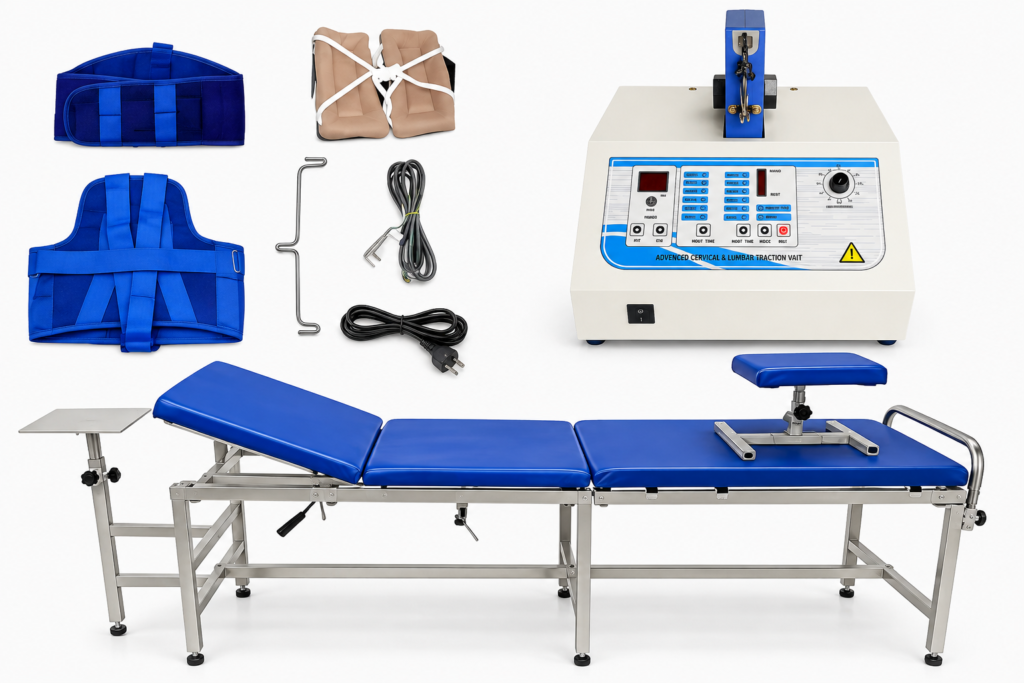
What Is a Manual Traction Machine with 3 Fold Bed?
A Manual Traction Machine with 3 Fold Bed For Physiotherapy is a treatment setup that combines a manually operated traction mechanism with a treatment table divided into three sections.
Manual traction generally involves a trained physiotherapist applying or controlling traction through a suitable mechanical arrangement. The objective is to deliver a controlled pulling force to the selected region as part of a professionally planned rehabilitation program.
The three-fold bed provides multiple table sections that may support patient positioning. Depending on the model, these sections may have different adjustment options, so the exact movement and locking mechanisms should be confirmed before purchase.
Unlike an electrically powered traction machine, a manual system may use a hand-operated mechanism or another non-motorized arrangement to control the traction force. The exact operating method depends on the supplied model.
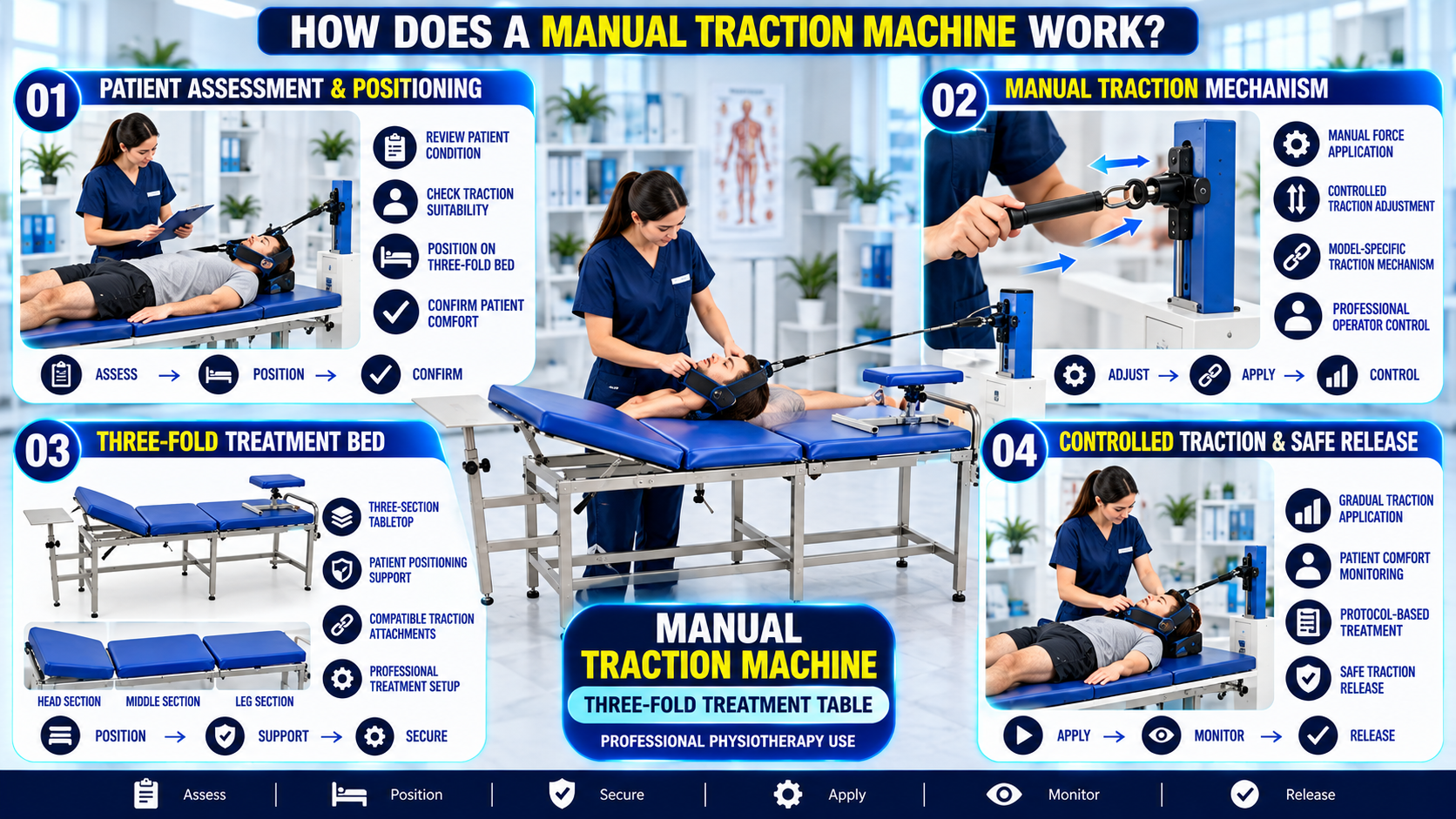
How Does a Manual Traction Machine Work?
The machine provides a stable treatment surface and a manual mechanism for applying traction according to the prescribed protocol.
The general process involves:
- Assessing the patient and confirming suitability for traction.
- Positioning the patient correctly on the three-fold treatment bed.
- Securing the appropriate support system, where provided.
- Selecting the intended treatment region and traction approach.
- Applying traction gradually using the machine’s designated mechanism.
- Monitoring patient comfort and response throughout treatment.
- Releasing the traction safely at the end of the session.
The amount and direction of traction, treatment duration, patient positioning, and support arrangement must be determined by a qualified professional. The machine should only be operated according to its specific instructions.
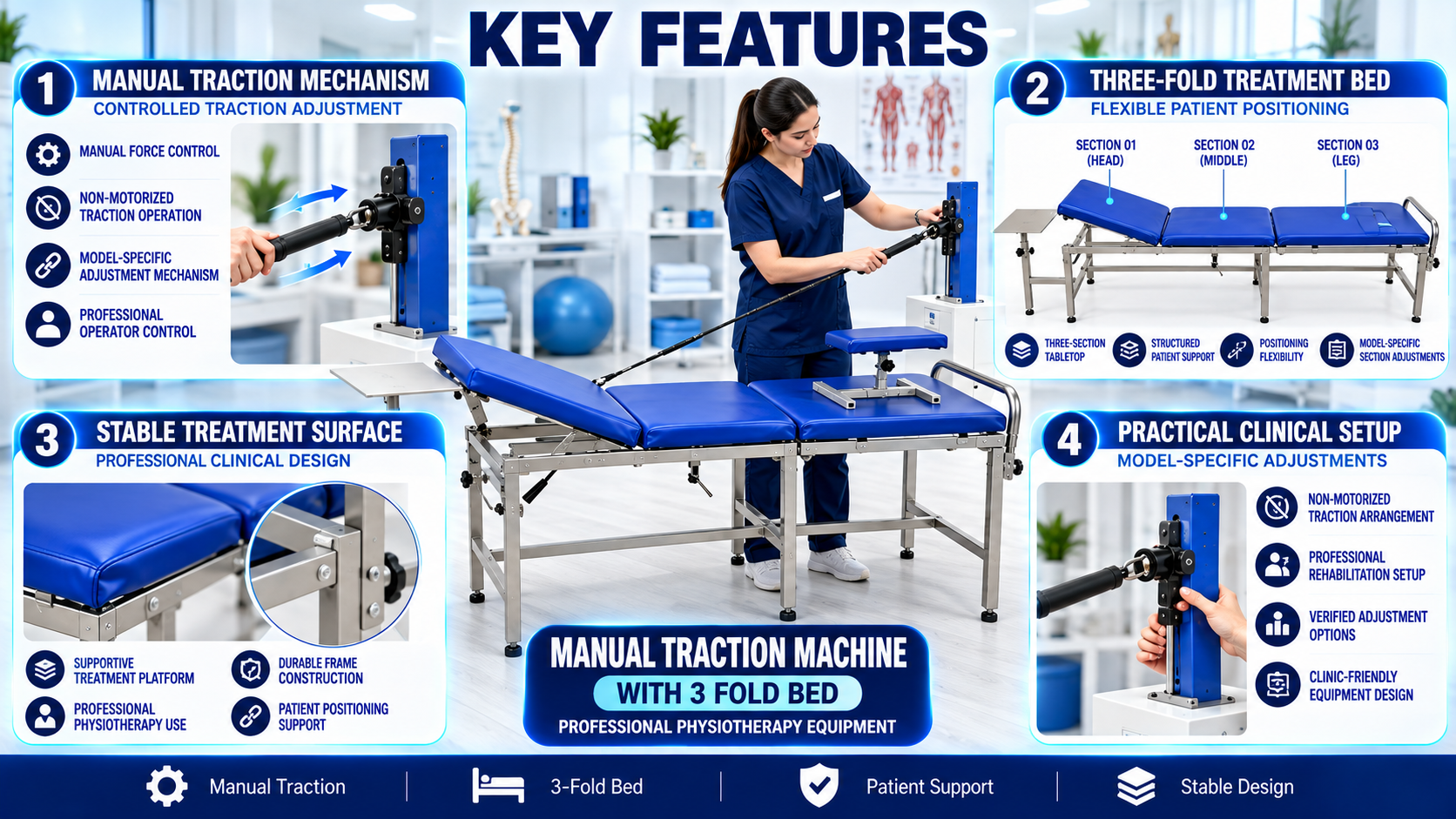
Key Features of Manual Traction Machine with 3 Fold Bed
Manual Traction Mechanism
The manual traction mechanism is designed to support controlled traction application without necessarily requiring a motorized traction drive. The exact adjustment method depends on the model.
Three-Fold Treatment Bed
The three-section design provides a structured treatment surface for patient positioning. The bed’s folding sections and adjustment options should be verified against the manufacturer’s specifications.
Patient Positioning Support
A suitable treatment bed helps position the patient for the intended procedure. Additional straps, supports, or traction accessories should be confirmed according to the package configuration.
Professional Physiotherapy Design
The system is intended for professional treatment environments where spinal traction may form part of an appropriate rehabilitation plan.
Practical Clinical Setup
A manual traction system may be useful for clinics seeking a non-motorized traction arrangement. Its suitability depends on the clinic’s treatment requirements and the machine’s capabilities.
Stable Treatment Surface
A stable frame and properly maintained bed are important for patient support during traction procedures. The frame material, load capacity, and construction details should be confirmed with the supplier.
Model-Dependent Adjustments
Depending on the design, the bed may provide adjustable sections, height adjustment, or other positioning features. Do not assume that all adjustment options are available on every model.
Applications of Manual Traction Machine with 3 Fold Bed
The Manual Traction Machine with 3 Fold Bed For Physiotherapy may be incorporated into selected rehabilitation programs when traction is considered appropriate following professional assessment.
Spinal Rehabilitation
Manual traction may be considered as one component of a rehabilitation plan for selected spinal conditions.
Lower-Back Rehabilitation
A qualified professional may consider lumbar traction for selected patients after evaluating symptoms, medical history, and contraindications.
Neck and Cervical Rehabilitation
Cervical traction requires a suitable device, appropriate patient support, and specific clinical assessment. Use this machine for cervical traction only if the model is designed for that purpose.
Musculoskeletal Physiotherapy
Traction equipment may be incorporated into broader treatment programs that include exercise therapy, mobility training, and other suitable interventions.
Rehabilitation Clinics
Physiotherapy and rehabilitation centres may use manual traction equipment where the machine’s design meets their clinical requirements.
Important: Traction is not appropriate for every patient with neck or back pain. The clinician must determine the treatment method and confirm that the equipment is suitable for the intended application.
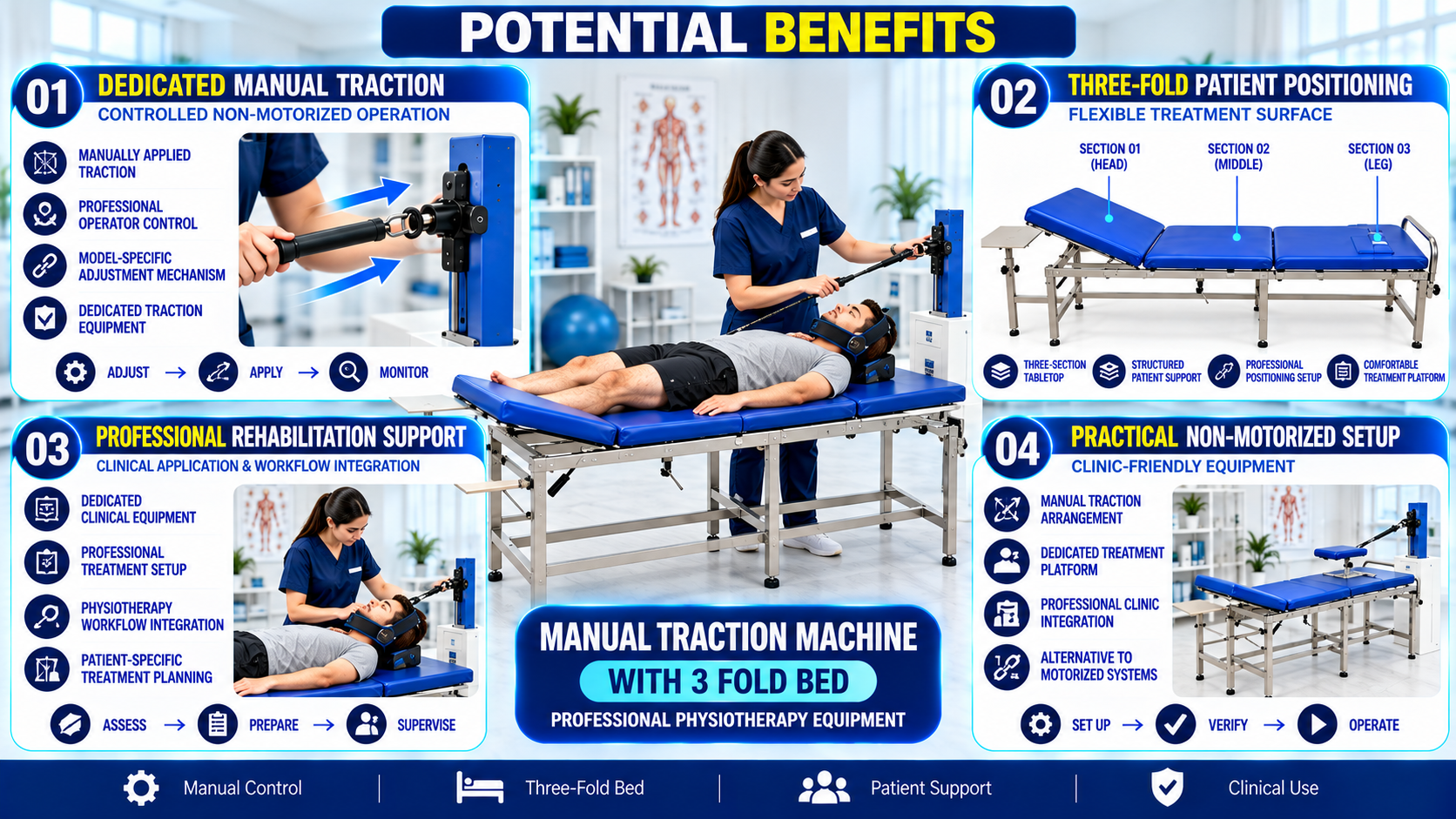
Potential Benefits of a Manual Traction System
The potential advantages of a manual traction machine depend on its construction, adjustment mechanism, accessories, and intended use.
Possible equipment-related advantages include:
- A dedicated setup for manually applied traction.
- A three-fold treatment surface for patient positioning.
- A non-motorized traction arrangement, where supported by the design.
- Integration into selected physiotherapy and rehabilitation programs.
- A treatment platform for professional clinical use.
- A practical alternative for clinics that do not require a motorized traction system.
These are equipment-related considerations, not a guarantee of clinical results. Treatment outcomes depend on patient selection, the underlying condition, professional technique, and the overall rehabilitation plan.
Manual Traction Machine vs Motorized Traction Machine
| Feature | Manual Traction Machine | Motorized Traction Machine |
|---|---|---|
| Traction Control | Manually operated, depending on design | Electrically controlled, depending on model |
| Power Requirement | May not require powered traction operation | Usually requires an electrical supply |
| Treatment Settings | Depend on the manual mechanism | May provide digital or preset settings |
| Force Adjustment | Model-dependent and operator-controlled | Model-dependent and electronically controlled |
| Bed Configuration | Depends on the supplied model | Depends on the supplied model |
| Clinical Use | Requires trained professional operation | Requires trained professional operation |
The right option depends on the clinic’s intended use, preferred workflow, required control features, and budget.
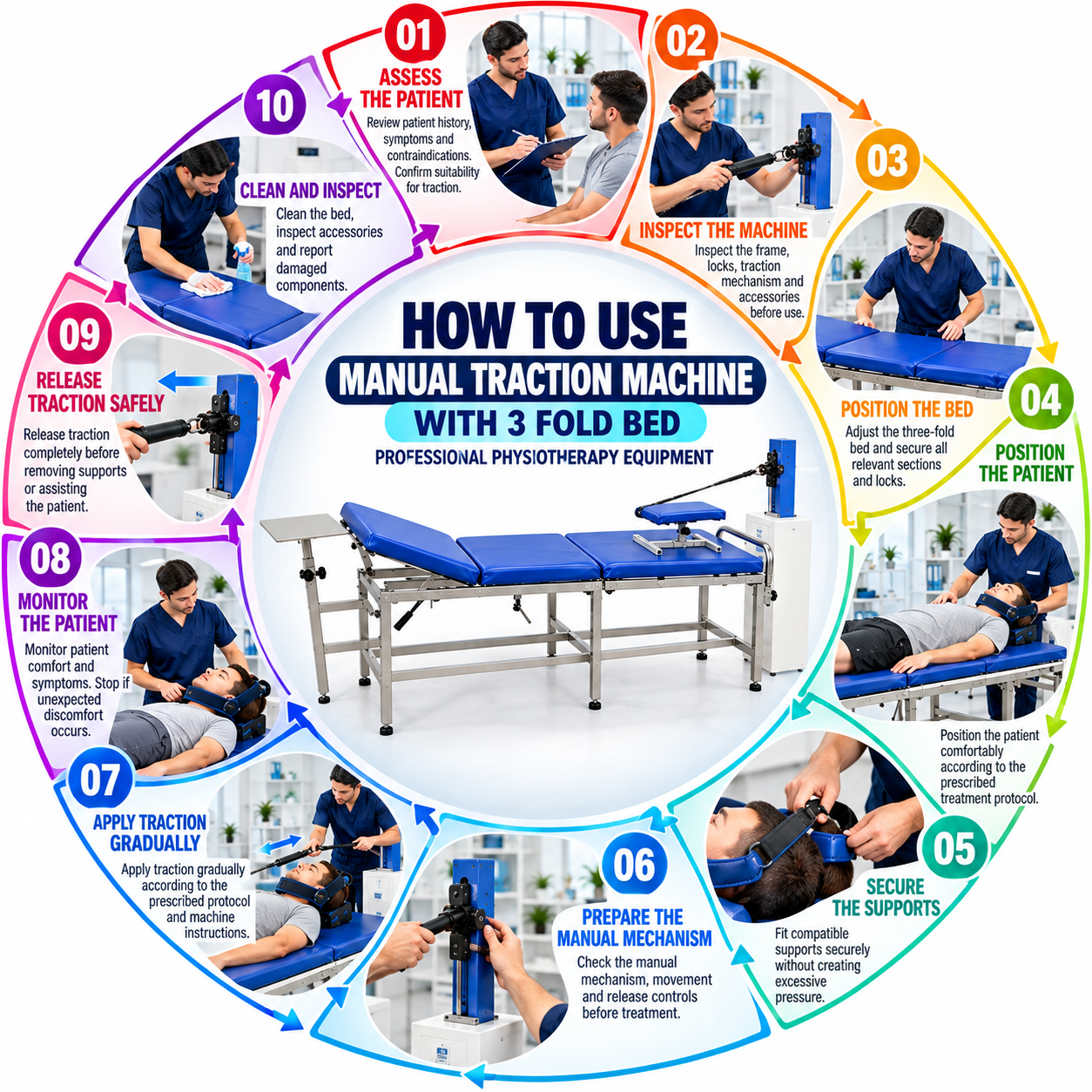
How to Use a Manual Traction Machine with 3 Fold Bed
The machine should be operated only by a trained physiotherapist or another appropriately qualified healthcare professional.
Step 1: Assess the Patient
Review the patient’s medical history, symptoms, examination findings, and contraindications. Determine whether traction is suitable and identify the intended treatment region.
Step 2: Inspect the Machine
Check the frame, bed sections, locks, traction mechanism, supports, straps, and other accessories. Do not use the equipment if any component is damaged or unstable.
Step 3: Position the Bed
Set the three-fold bed into the required configuration according to the manufacturer’s instructions. Confirm that all relevant sections and locks are secure.
Step 4: Position the Patient
Help the patient onto the bed and position them according to the selected treatment protocol. Use only the support system designed for the specific traction application.
Step 5: Secure the Required Supports
Fit any prescribed traction straps or supports correctly. Confirm that they are compatible with the machine and do not create inappropriate pressure.
Step 6: Set Up the Manual Mechanism
Prepare the traction mechanism according to the operating instructions. Confirm that it moves smoothly and that any locking or release controls function correctly.
Step 7: Apply Traction Gradually
Apply traction using the manufacturer’s recommended technique and the clinician’s treatment plan. Do not use assumed force levels or attempt to exceed the machine’s limits.
Step 8: Monitor the Patient
Observe patient comfort and symptoms throughout the procedure. Stop treatment if the patient experiences significant or unexpected pain, dizziness, numbness, weakness, or other concerning symptoms.
Step 9: Release Traction Safely
Reduce and release the applied traction according to the machine’s instructions before removing supports or assisting the patient from the bed.
Step 10: Clean and Inspect the Equipment
Clean the bed and reusable accessories according to the manufacturer’s instructions. Check the mechanism and supports after use and report any damage.
Safety Precautions
The Manual Traction Machine with 3 Fold Bed For Physiotherapy must be used with appropriate clinical assessment and supervision.
- Use the equipment only for its intended purpose.
- Follow the manufacturer’s operating instructions.
- Confirm that the bed is stable and all locks are secured.
- Inspect the traction mechanism and accessories before use.
- Select the treatment approach according to professional assessment.
- Use only compatible supports and straps.
- Apply traction gradually and within the machine’s specified limits.
- Monitor the patient throughout treatment.
- Stop treatment if unexpected or significant symptoms occur.
- Do not use damaged or unstable equipment.
- Do not exceed the specified patient weight capacity.
- Follow the manufacturer’s cleaning and maintenance instructions.
- Confirm that the specific model is suitable for cervical or lumbar traction before using it for that purpose.
Patients with suspected fracture, spinal instability, severe osteoporosis, certain neurological conditions, or other potential contraindications require appropriate clinical evaluation before traction is considered. This is not an exhaustive list; the clinician must follow relevant guidance and the manufacturer’s contraindications.
Technical Specifications
The following table identifies the main specification categories. Exact values must be confirmed from the datasheet of the supplied model.
| Specification | Details |
|---|---|
| Product Name | Manual Traction Machine with 3 Fold Bed For Physiotherapy |
| Product Type | Manual Physiotherapy Traction System |
| Bed Design | Three-Fold Treatment Bed |
| Traction Mechanism | Manual, model-dependent |
| Treatment Application | Traction-based physiotherapy, where indicated |
| Bed Sections | Three |
| Height Adjustment | Confirm with supplier |
| Bed Dimensions | Confirm with supplier |
| Patient Weight Capacity | Confirm with supplier |
| Frame Material | Confirm with supplier |
| Traction Force Range | Confirm with supplier |
| Traction Accessories | Model/package-dependent |
| Power Requirement | Depends on the supplied configuration |
| Intended Operator | Trained healthcare professional |
| Warranty | Confirm with supplier |
Specification note: Confirm bed dimensions, load capacity, frame material, force range, adjustment options, included accessories, and warranty before publishing fixed values.
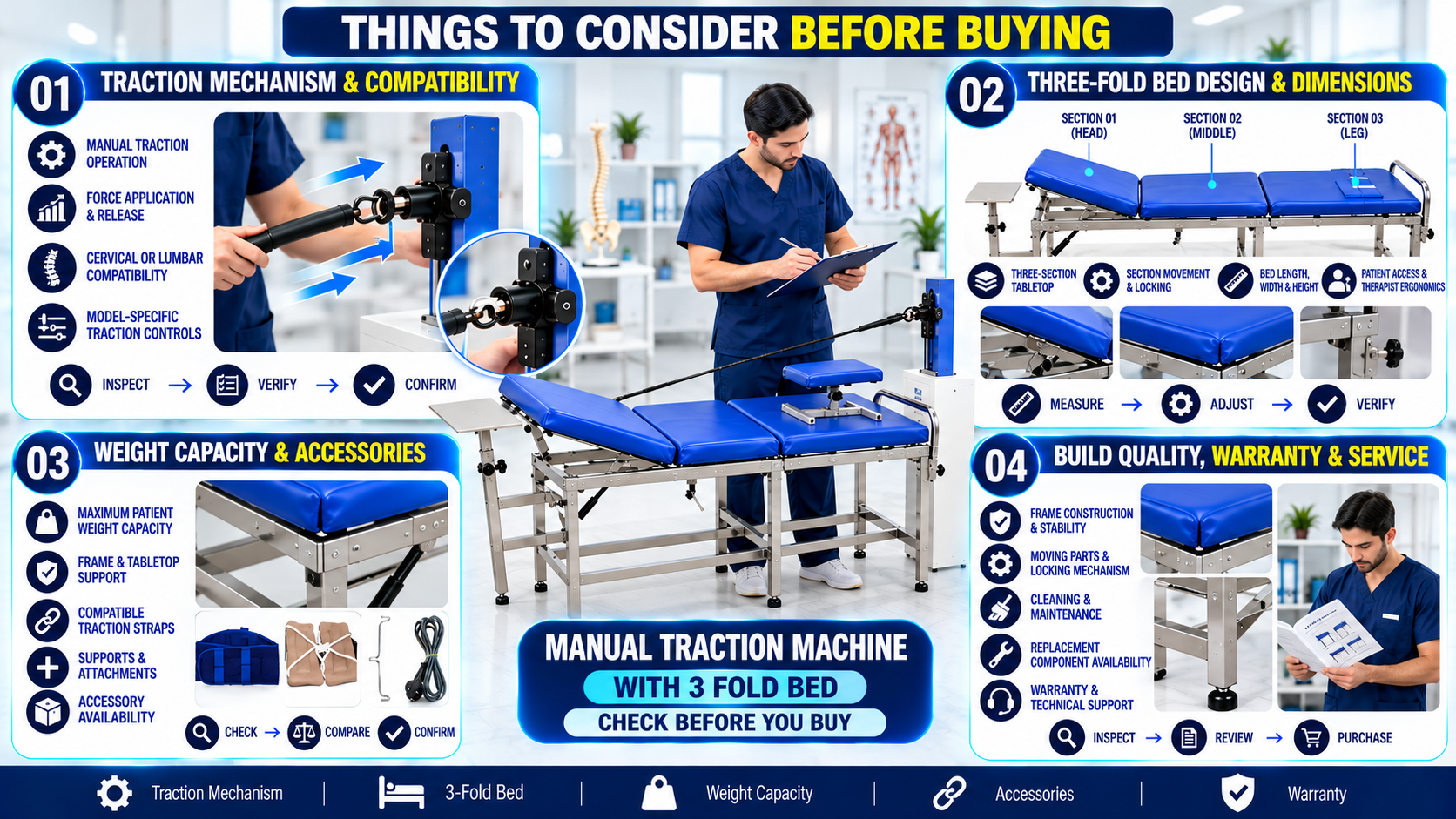
What to Consider Before Buying
Traction Mechanism
Confirm how the traction mechanism operates and how force is applied, adjusted, and released.
Three-Fold Bed Design
Check the movement and locking options of each bed section. Confirm that the design meets the positioning requirements of your clinic.
Patient Weight Capacity
Verify the maximum safe patient load from the manufacturer’s documentation.
Bed Dimensions and Height
Check the table length, width, height, and any adjustment options to ensure suitable patient access and therapist ergonomics.
Traction Accessories
Confirm which straps, supports, attachments, or other components are included in the package.
Intended Treatment Region
Verify whether the machine is designed for lumbar traction, cervical traction, or another specific application. Do not assume that one configuration supports every type of traction.
Build Quality and Maintenance
Review the frame construction, moving parts, locking mechanism, service requirements, and availability of replacement components.
Warranty and After-Sales Support
Confirm warranty coverage, maintenance support, and access to replacement accessories before purchase.
Who Should Operate a Manual Traction Machine?
The machine should be operated by a qualified physiotherapist or another appropriately trained healthcare professional who understands spinal anatomy, traction techniques, patient positioning, contraindications, and safe equipment operation.
The operator is responsible for assessing the patient, choosing the appropriate treatment approach, monitoring the session, and following the manufacturer’s instructions.
Why Choose PHYSIOMODALITIES™?
PHYSIOMODALITIES™ provides physiotherapy and rehabilitation equipment for professional clinical environments.
When selecting a Manual Traction Machine with 3 Fold Bed, clinics should consider the machine’s actual construction, traction mechanism, bed adjustment options, patient capacity, compatible accessories, warranty, and technical support.
Choosing equipment according to documented specifications helps clinics assess whether a particular model suits their treatment requirements and clinical workflow.
Conclusion
The Manual Traction Machine with 3 Fold Bed For Physiotherapy combines a manually operated traction mechanism with a three-section treatment bed for use in suitable professional physiotherapy environments. It may be incorporated into selected rehabilitation programs when traction is clinically appropriate.
Before purchasing, confirm the exact traction mechanism, supported treatment region, bed adjustments, patient weight capacity, dimensions, accessories, and warranty. Safe operation depends on professional assessment, correct positioning, patient monitoring, and adherence to the manufacturer’s instructions.
Frequently Asked Questions
1. What is a Manual Traction Machine with 3 Fold Bed?
It is a physiotherapy setup that combines a manual traction mechanism with a treatment bed divided into three sections.
2. What is a three-fold bed?
It is a treatment bed with three sections that provide a structured surface for patient positioning. The available adjustment options depend on the model.
3. Can this machine be used for cervical and lumbar traction?
That depends on the specific model. Confirm the intended treatment regions and compatible supports with the manufacturer before use.
4. Who can operate a manual traction machine?
It should be operated by a trained physiotherapist or another appropriately qualified healthcare professional.
5. What should I check before purchasing?
Check the traction mechanism, bed dimensions, patient weight capacity, adjustment options, accessories, intended treatment regions, warranty, and after-sales support.