
The Hand Robotic Glove is an advanced rehabilitation device designed to assist hand and finger movements through a wearable robotic glove system. It is developed to support structured hand rehabilitation exercises for individuals who experience difficulty with finger movement, hand opening, closing, gripping and coordination.
Unlike conventional hand exercise equipment that relies mainly on the patient’s own muscle effort, a robotic hand glove can provide powered movement assistance. Depending on the model, it may support passive finger movement, active-assisted exercise, mirror training, individual-finger practice and functional hand activities.
The Hand Robotic Glove can be incorporated into physiotherapy clinics, hospitals, neurorehabilitation centres, occupational therapy departments and selected home-rehabilitation programs under appropriate professional guidance.
PHYSIOMODALITIES™ provides physiotherapy and rehabilitation equipment designed to support professional clinical environments and structured patient rehabilitation programs.

What Is a Hand Robotic Glove?
A Hand Robotic Glove is a wearable rehabilitation device designed to assist or guide selected movements of the fingers and hand.
The glove fits around the patient’s hand and uses a powered mechanism to support finger movement. Depending on its design, the system may use pneumatic actuators, motor-driven cables, tendon mechanisms or other robotic technologies.
These mechanisms can assist movements such as:
- Finger flexion and extension
- Hand opening and closing
- Thumb movement
- Selected gripping exercises
- Finger coordination
- Pinch movement practice
- Repetitive hand-mobility exercises
Some advanced systems also include sensors, data gloves or interactive software for tracking movement and providing guided training. These features are model-dependent and should be confirmed before purchase.
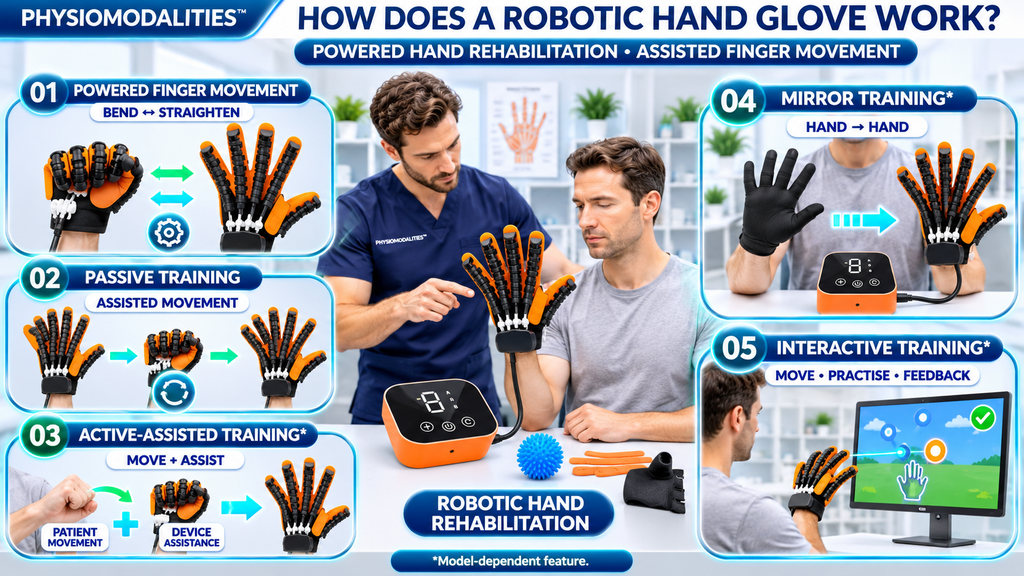
How Does a Hand Robotic Glove Work?
A robotic hand rehabilitation glove uses a wearable support structure and a powered movement mechanism to assist selected finger exercises.
The patient’s hand is positioned inside the glove, and the operator selects the available training mode. The device then assists or guides the movement according to its design and programmed settings.
Powered Finger Movement
The robotic mechanism can assist selected finger-bending and straightening movements. This can support repeated exercise when independent finger movement is limited.
Passive Movement Assistance
In passive training, the device generates the selected movement without requiring the patient to actively produce the entire movement.
Active-Assisted Training
Some robotic gloves allow the patient to participate in the movement while the device provides assistance when required. Availability depends on the model.
Mirror Training
Certain systems use a data glove on the unaffected hand to capture movement and guide corresponding movement of the affected hand.
Interactive Hand Exercise
Advanced robotic gloves may connect to rehabilitation software or virtual training environments. These systems can provide interactive exercises and movement feedback, depending on the configuration.
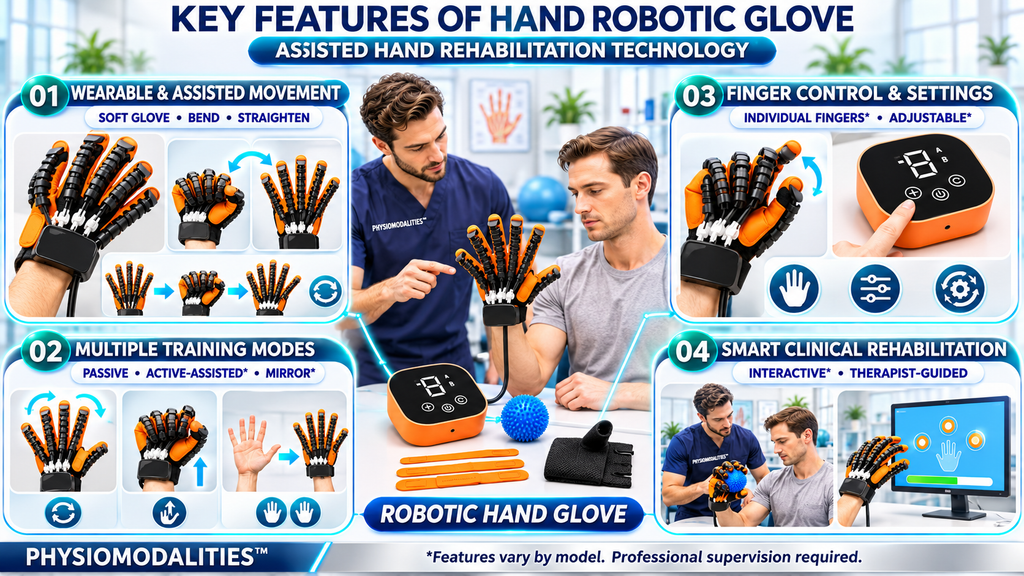
Key Features of Hand Robotic Glove
Wearable Robotic Design
The glove is designed to fit around the hand and provide a wearable interface for assisted finger movement.
Assisted Finger Flexion and Extension
The device can support selected finger-bending and straightening movements according to its available operating modes.
Hand Opening and Closing Practice
Robotic assistance can help patients practise repeated hand opening and closing exercises.
Passive Training
Supported models can provide powered passive movement for patients who have difficulty completing the movement independently.
Active-Assisted Movement
Some systems allow the patient to participate in hand movement while receiving mechanical assistance.
Mirror Training
Selected models support bilateral hand training, where movement of the unaffected hand guides the affected hand.
Individual-Finger Exercises
Certain configurations provide separate finger movement training rather than moving all fingers together.
Adjustable Training Parameters
Depending on the model, the operator may be able to adjust movement assistance, intensity, speed, range or exercise duration.
Interactive Rehabilitation
Some robotic glove systems include software-based exercises, movement tracking or virtual rehabilitation activities.
Clinical Rehabilitation Application
The equipment can be incorporated into professional hand, finger and upper-limb rehabilitation programs.
Training Modes of a Hand Robotic Glove
Training modes differ between manufacturers and models. The following are common training approaches found in robotic hand rehabilitation systems; they should not all be assumed to be available on every glove.
Passive Training
Passive training uses the powered glove to move the fingers through a selected movement pattern.
It may support exercises involving:
- Hand opening
- Hand closing
- Finger flexion
- Finger extension
- Repetitive mobility practice
Active-Assisted Training
In active-assisted training, the patient attempts to perform the movement while the device provides assistance according to the system’s design.
This approach can be considered when the patient has some voluntary movement but requires additional support.
Mirror Training
Mirror training uses movement from the unaffected hand to guide corresponding movement of the affected hand through a connected data glove or sensor system.
Individual-Finger Training
Some robotic gloves allow selected fingers to be exercised separately. This can be useful when the rehabilitation plan focuses on specific finger movements.
Pinch Training
Pinch exercises focus on thumb-to-finger movement. Certain systems provide dedicated programs for practising different pinch patterns.
Functional Training
Some advanced devices offer exercises that simulate selected everyday hand activities, such as grasping or releasing objects.
Applications of Hand Robotic Glove
The Hand Robotic Glove may be incorporated into selected rehabilitation programs involving reduced hand mobility and finger-function limitations.
Stroke Rehabilitation
Stroke can affect hand movement, finger coordination and the ability to perform daily activities. A robotic glove may be included in a professionally guided program for repeated hand and finger movement practice.
Neurological Rehabilitation
Robotic hand gloves may be considered in selected rehabilitation programs involving neurological conditions that affect hand function.
Hand Mobility Rehabilitation
The device can assist selected finger flexion, extension and hand-opening exercises when independent movement is limited.
Finger Movement Training
Finger-focused exercises can support practice involving bending, straightening, coordination and selected individual-finger movements.
Hand Injury Rehabilitation
Following appropriate clinical assessment, a robotic glove may be incorporated into selected rehabilitation programs after hand injuries.
Postoperative Rehabilitation
Use after hand surgery should only be considered when permitted by the treating surgeon and rehabilitation professional. The timing and movement range depend on the procedure and healing stage.
Occupational Therapy
Occupational therapists may incorporate robotic hand exercises into broader programs focused on hand coordination and functional activities.
Upper-Limb Rehabilitation
The device can complement other upper-limb rehabilitation equipment when the treatment plan includes hand and finger movement practice.
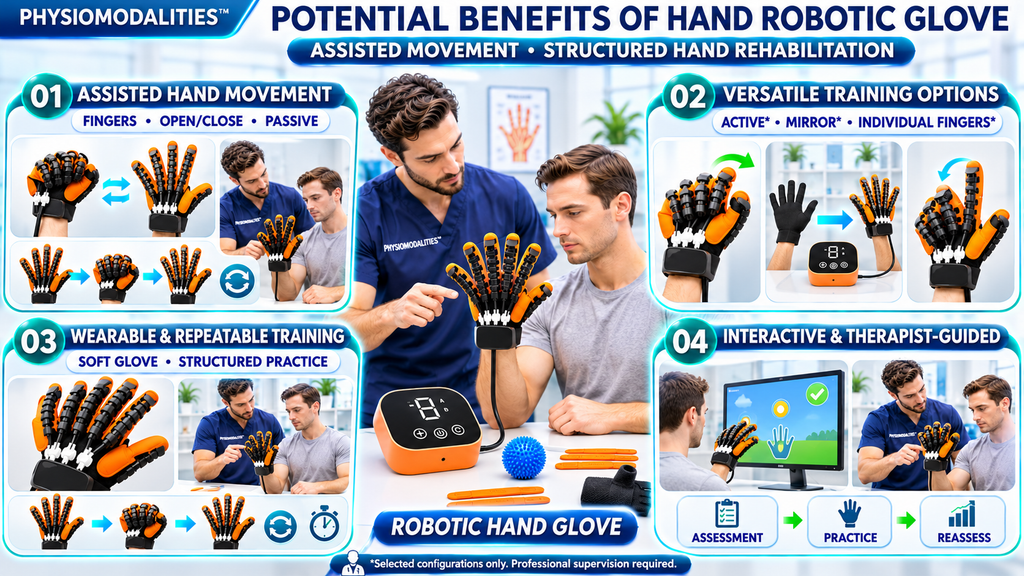
Potential Benefits of Hand Robotic Glove
The response to hand rehabilitation varies according to the patient’s condition, movement ability, treatment plan and consistency of practice.
A suitable robotic hand glove may provide:
- Assistance with selected finger movements
- Repeated hand opening and closing practice
- Support for passive movement exercises
- Active-assisted movement options on supported models
- Mirror-guided exercise on compatible systems
- Individual-finger training on supported configurations
- A wearable rehabilitation design
- Structured and repeatable exercise sessions
- Interactive training options on advanced models
- Integration with therapist-guided rehabilitation
A robotic glove should not be presented as a guaranteed cure or a replacement for professional rehabilitation. Its role should be determined through individual assessment.
Hand Robotic Glove for Physiotherapy and Neurorehabilitation Clinics
A Hand Robotic Glove can add a dedicated hand-movement training option to a professional physiotherapy or neurorehabilitation department.
Patients with reduced hand function may need repeated practice of finger bending, straightening, thumb movement, gripping and releasing. A robotic glove can provide assistance for selected exercises within a broader treatment plan.
It can be considered alongside:
- Hand exercise equipment
- Finger rehabilitation devices
- Grip-strengthening tools
- Occupational therapy equipment
- Upper-limb rehabilitation systems
- Therapeutic exercise programs
- Functional hand-training activities
- Other appropriate neurorehabilitation interventions
The selected training approach should match the patient’s abilities and clinical objectives.
Hand Robotic Glove vs Conventional Hand Exercise Equipment
| Feature | Hand Robotic Glove | Conventional Hand Exercise Equipment |
|---|---|---|
| Design | Wearable robotic glove | Manual exercise tool |
| Movement assistance | Powered assistance on supported models | Usually patient-generated |
| Passive movement | Available on selected models | Generally not powered |
| Finger flexion and extension | Assisted on supported modes | Depends on patient ability |
| Mirror training | Available on compatible systems | Requires a separate approach |
| Individual-finger practice | Model-dependent | Exercise-dependent |
| Interactive training | Available on selected models | Usually not included |
| Exercise approach | Mode-based | Manually performed |
The two equipment types serve different purposes. A therapist may use them together as part of a comprehensive rehabilitation program.
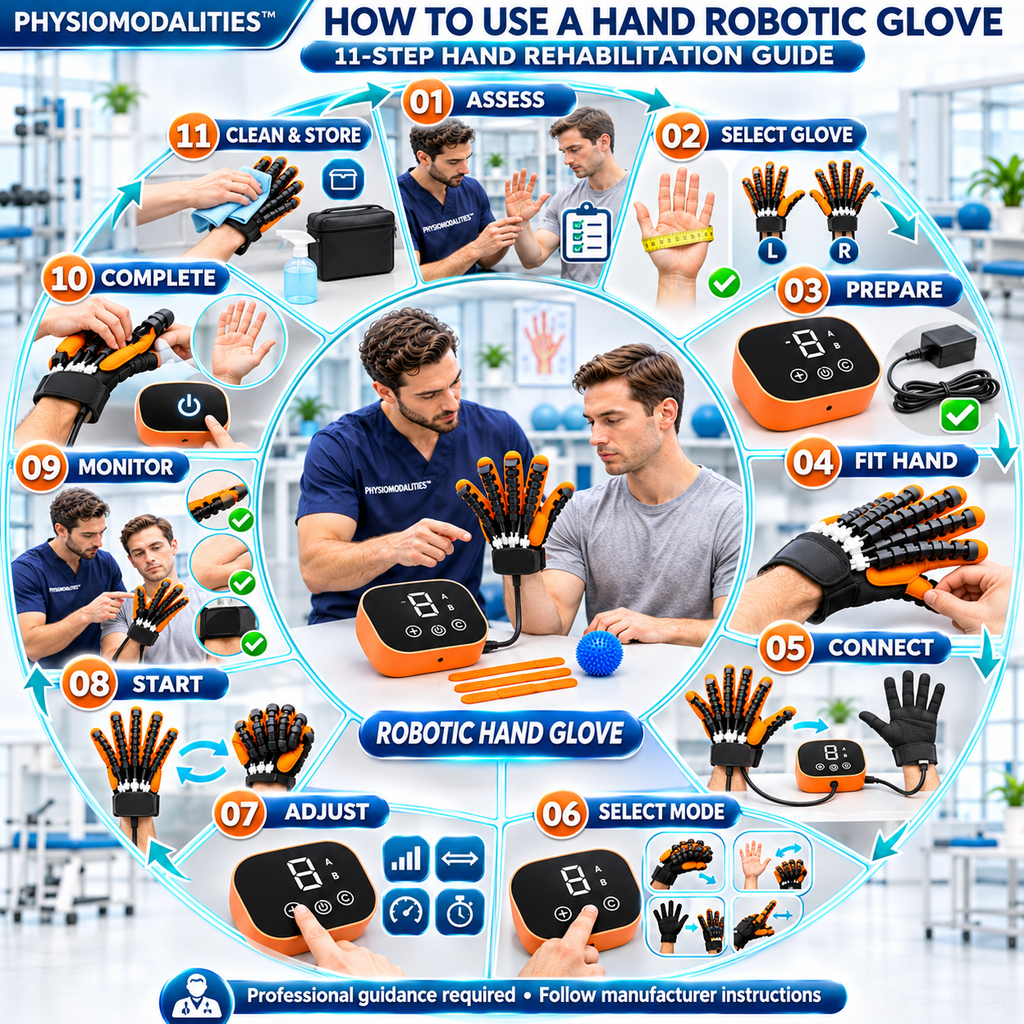
How to Use a Hand Robotic Glove
The device should be used according to its supplied user manual and the patient’s rehabilitation plan. Initial fitting and mode selection should be guided by an appropriately trained professional.
Step 1: Assess the Patient
Review hand movement, finger mobility, skin condition, sensation, comfort and relevant clinical history.
Step 2: Select the Correct Glove
Confirm the correct glove size and hand configuration. The glove should fit properly without excessive tightness.
Step 3: Prepare the Device
Place the controller on a stable surface and inspect the glove, cables, connections and power adapter.
Step 4: Position the Hand
Carefully place the patient’s hand inside the glove according to the manufacturer’s instructions.
Step 5: Connect Required Accessories
Connect the powered glove and any data glove or other accessories required for the selected training mode.
Step 6: Select the Training Mode
Choose the appropriate available mode, such as passive, active-assisted, mirror or individual-finger training.
Step 7: Adjust the Settings
Set the available movement assistance, range, speed or intensity according to the professional’s instructions and the patient’s tolerance.
Step 8: Begin Training
Start the selected exercise and observe the initial movement carefully. Do not force the fingers beyond the prescribed range.
Step 9: Monitor the Patient
Observe hand alignment, glove positioning, skin condition and patient comfort throughout the session.
Step 10: Complete the Session
Stop the device before removing the glove. Carefully release the patient’s hand and inspect the skin.
Step 11: Clean and Store the Equipment
Clean reusable components according to the manufacturer’s instructions and store the device safely.
Safety Precautions
The Hand Robotic Glove should be used responsibly and according to the manufacturer’s operating instructions.
- Obtain professional guidance before starting a rehabilitation program.
- Confirm the correct glove size and hand configuration.
- Position the fingers correctly before starting the device.
- Do not force the fingers beyond their prescribed or comfortable range.
- Monitor the skin for pressure marks, redness or irritation.
- Stop use if the patient experiences pain or unusual discomfort.
- Use additional caution where hand sensation is reduced.
- Do not use a damaged glove, controller, cable or adapter.
- Follow the manufacturer’s charging and electrical instructions.
- Clean reusable components as recommended.
- Follow the device-specific contraindications and operating instructions.
Patients with significant spasticity, fixed contractures, severe swelling, skin injuries, altered sensation or recent hand surgery should be assessed by an appropriate healthcare professional before using the device.
Technical Specifications
Specifications vary between manufacturers and models. The following table provides general specification categories for evaluating a Hand Robotic Glove.
| Specification | Details |
|---|---|
| Product Name | Hand Robotic Glove |
| Equipment Type | Robotic Hand Rehabilitation Device |
| Primary Application | Hand and Finger Rehabilitation |
| Technology | Soft Robotic / Powered Assistance, Model-Dependent |
| Movement | Finger Flexion and Extension, Model-Dependent |
| Training Modes | Passive / Active-Assisted / Mirror, Model-Dependent |
| Individual-Finger Training | Model-Dependent |
| Interactive Training | Model-Dependent |
| Glove Configuration | Left or Right Hand, Model-Dependent |
| Glove Size | Model-Dependent |
| Control System | Digital / Electronic, Model-Dependent |
| Power Supply | Model-Dependent |
| Accessories | Model-Dependent |
| Intended Use | Guided Hand and Finger Rehabilitation |
Important: Confirm the exact model, operating technology, training modes, glove size, hand configuration, electrical specifications, accessories and warranty from the manufacturer’s datasheet before publishing fixed specifications.
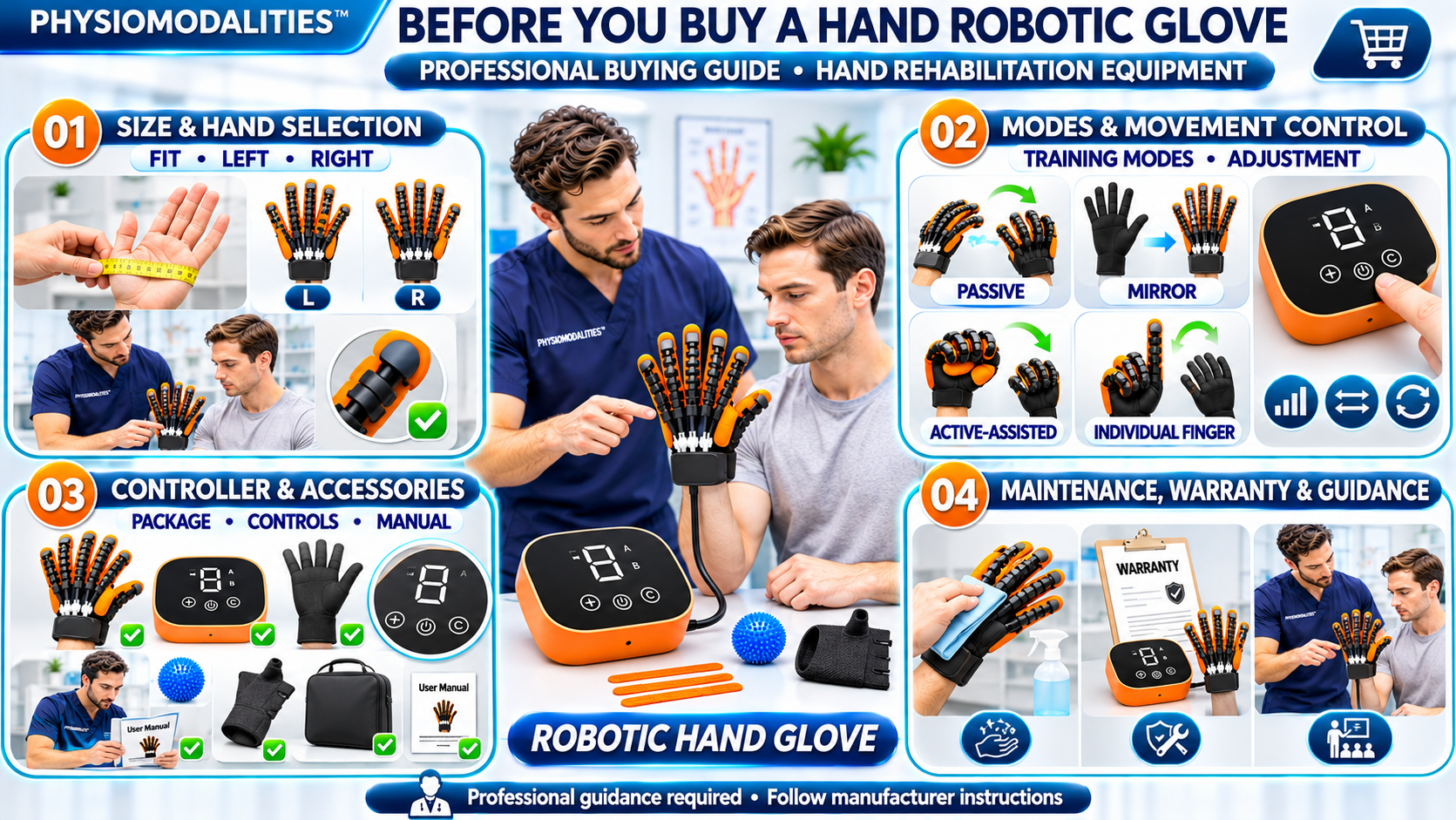
Things to Consider Before Buying
Glove Size and Fit
Choose a glove size that fits the patient’s hand appropriately. Check the manufacturer’s sizing guide before ordering.
Hand Configuration
Confirm whether the required device is for the left hand, right hand or both hands.
Training Modes
Check which modes are included in the exact model. Do not assume that every robotic glove supports passive, mirror, active-assisted and individual-finger training.
Movement Assistance
Review the available finger movement range and assistance settings.
Controller and Accessories
Confirm whether the package includes a controller, powered glove, data glove, adapter, storage case and other accessories.
Ease of Operation
Review the control interface and user manual so that clinical staff can operate the device correctly.
Cleaning and Maintenance
Check the manufacturer’s cleaning instructions and replacement-part availability.
Warranty and Technical Support
Confirm warranty coverage, servicing arrangements and availability of replacement components.
Professional Guidance
Ensure that the intended users and clinical staff understand the fitting procedure, training modes, operating instructions and safety precautions.
Who Should Operate a Hand Robotic Glove?
A Hand Robotic Glove may be used in professional rehabilitation environments under the guidance of appropriately trained healthcare professionals, including:
- Physiotherapists
- Occupational therapists
- Neurorehabilitation professionals
- Rehabilitation physicians
- Other qualified healthcare practitioners
Patients and caregivers should follow the operating and training guidance provided by the treating professional and manufacturer.
Why Choose PHYSIOMODALITIES™?
PHYSIOMODALITIES™ provides physiotherapy and rehabilitation equipment designed for professional clinical environments.
The Hand Robotic Glove can complement a clinic’s hand and upper-limb rehabilitation equipment range by providing powered assistance for selected finger and hand movement exercises.
When selecting this equipment, clinics should consider the exact model, glove size, hand configuration, available training modes, included accessories, warranty and after-sales support.
PHYSIOMODALITIES ENTERPRISES focuses on equipment for physiotherapy clinics, hospitals, rehabilitation centres and professional healthcare facilities.
Conclusion
The Hand Robotic Glove is a wearable rehabilitation device designed to assist selected hand and finger movements through a powered robotic mechanism. Depending on the model, it may provide passive movement, active-assisted exercise, mirror training and individual-finger practice.
The device can be incorporated into selected physiotherapy, occupational therapy and neurorehabilitation programs where structured hand-movement practice is required. Before purchasing, confirm the exact model, training modes, glove size, hand configuration, controller specifications, included accessories, power requirements and warranty.
Appropriate patient assessment, professional guidance and adherence to the manufacturer’s instructions are essential for responsible use.
Frequently Asked Questions
1. What is a Hand Robotic Glove?
A Hand Robotic Glove is a wearable rehabilitation device designed to assist selected finger and hand movements through a powered mechanism.
2. What is a robotic hand glove used for?
It may be used in selected rehabilitation programs for hand mobility, finger movement practice, hand opening and closing exercises and functional hand training.
3. Can a Hand Robotic Glove be used for stroke rehabilitation?
It may be incorporated into selected post-stroke hand-rehabilitation programs under the guidance of a qualified healthcare professional.
4. Does every Hand Robotic Glove have mirror training?
No. Mirror training is available only on compatible models that support the required data glove or movement-tracking system.
5. What should I check before buying a Hand Robotic Glove?
Check the glove size, hand configuration, training modes, movement assistance, controller, included accessories, warranty and technical support.