
The Exercise Straight Stair Case is a physiotherapy and rehabilitation exercise unit designed to support gait training, stair-climbing practice, lower-limb strengthening, balance exercises, and functional mobility training. Its straight staircase configuration allows patients to practice controlled step-up and step-down movements in a supervised rehabilitation environment.
It is commonly used in physiotherapy clinics, rehabilitation centres, hospitals, orthopaedic departments, sports rehabilitation facilities, and mobility training centres. By recreating a familiar stair-climbing activity in a controlled setting, the Exercise Straight Stair Case can be incorporated into progressive functional rehabilitation programs.
The exact number of steps, step height, width, handrail configuration, dimensions, and frame construction can vary according to the manufacturer and model.
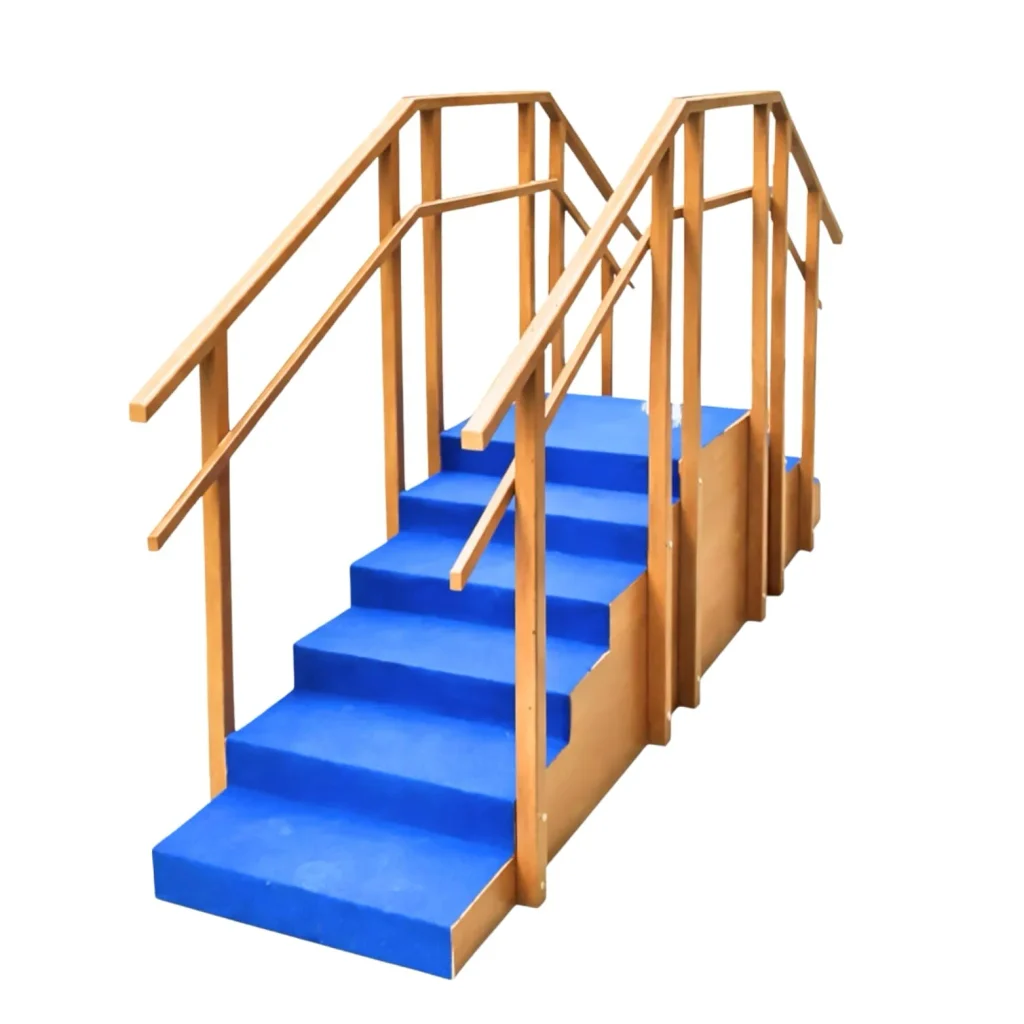
What Is an Exercise Straight Stair Case?
An Exercise Straight Stair Case is a therapeutic staircase designed specifically for physiotherapy and functional rehabilitation.
Unlike ordinary household stairs, rehabilitation staircases are designed with features that can help therapists provide a controlled environment for practicing stair negotiation. Handrails on one or both sides provide support while the patient works on stepping, balance, weight transfer, and coordination.
The equipment can be used for:
- Stair-climbing practice
- Gait rehabilitation
- Lower-limb strengthening
- Balance training
- Weight-shifting exercises
- Functional mobility training
- Step-up and step-down practice
- Coordination training
- Post-injury rehabilitation
- Pre-functional walking activities
How Does the Exercise Straight Stair Case Work?
The Exercise Straight Stair Case provides a series of steps at a controlled height and width so patients can practice ascending and descending movements.
The patient uses the handrails for support when required while placing one foot onto each step. The therapist can observe posture, foot placement, balance, weight transfer, and movement control throughout the activity.
Stair-Climbing Practice
The patient can practice moving upward and downward through the staircase while following the therapist’s prescribed technique.
Weight Transfer
Stepping onto a higher surface requires controlled transfer of body weight from one leg to the other.
Balance Training
The staircase provides an opportunity to practice maintaining balance during changes in foot position and elevation.
Lower-Limb Exercise
Repeated step-up and step-down movements can be incorporated into lower-limb strengthening and conditioning programs when appropriate.
Functional Mobility
Stair negotiation is an important daily-life activity, making stair practice useful within broader functional rehabilitation.
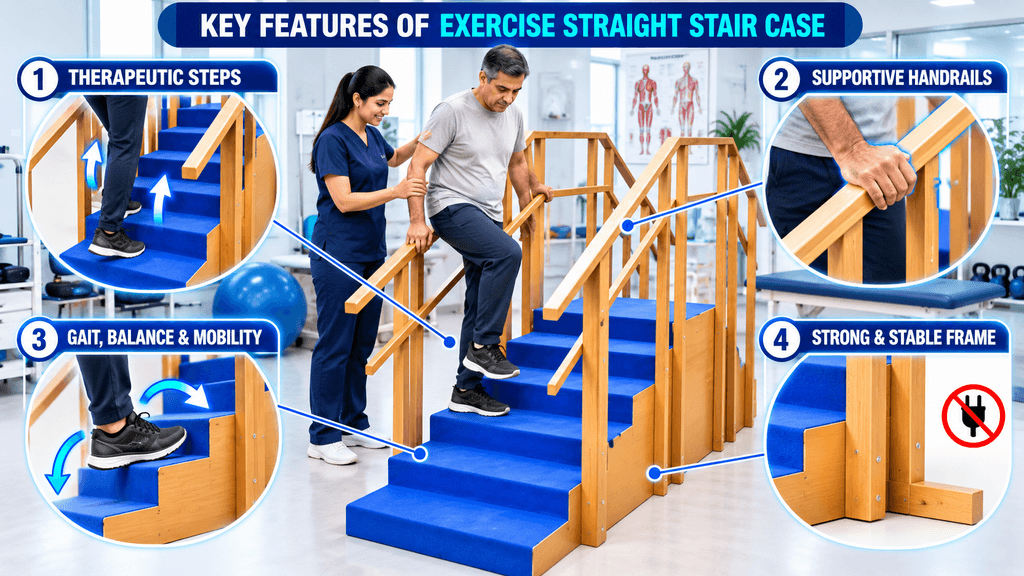
Key Features of Exercise Straight Stair Case
- Straight staircase configuration
- Heavy-duty rehabilitation frame
- Multiple therapeutic steps
- Supportive handrails
- Stable step construction
- Suitable for supervised stair training
- Designed for repeated clinical use
- Supports ascending and descending practice
- Useful for gait and mobility rehabilitation
- Suitable for balance and coordination activities
- Compact compared with full architectural stair systems
- Manual, non-powered equipment
- Suitable for physiotherapy and rehabilitation facilities
Applications of Exercise Straight Stair Case
The Exercise Straight Stair Case can be incorporated into different rehabilitation programs where functional stepping and mobility are required.
Gait Training
Therapists can use the staircase as part of progressive gait and mobility training, particularly when patients need to develop confidence with changes in elevation.
Stair-Climbing Rehabilitation
The equipment provides a controlled environment for practicing the mechanics of going up and down stairs.
Lower-Limb Rehabilitation
Step-up and step-down activities can involve the quadriceps, hamstrings, gluteal muscles, calf muscles, and other lower-limb structures.
Balance Training
Patients can practice maintaining stability while changing their foot position and elevation.
Post-Injury Rehabilitation
Once appropriate movement has been established, stair exercises may be incorporated into rehabilitation following certain lower-limb injuries.
Post-Operative Rehabilitation
When cleared by the treating professional, stair training may form part of a progressive functional rehabilitation program.
Neurological Rehabilitation
Under professional supervision, stair exercises may be incorporated into selected neurological rehabilitation programs focused on mobility and functional movement.
Sports Rehabilitation
Athletes returning to functional activity may use controlled step training as one component of a broader rehabilitation program.
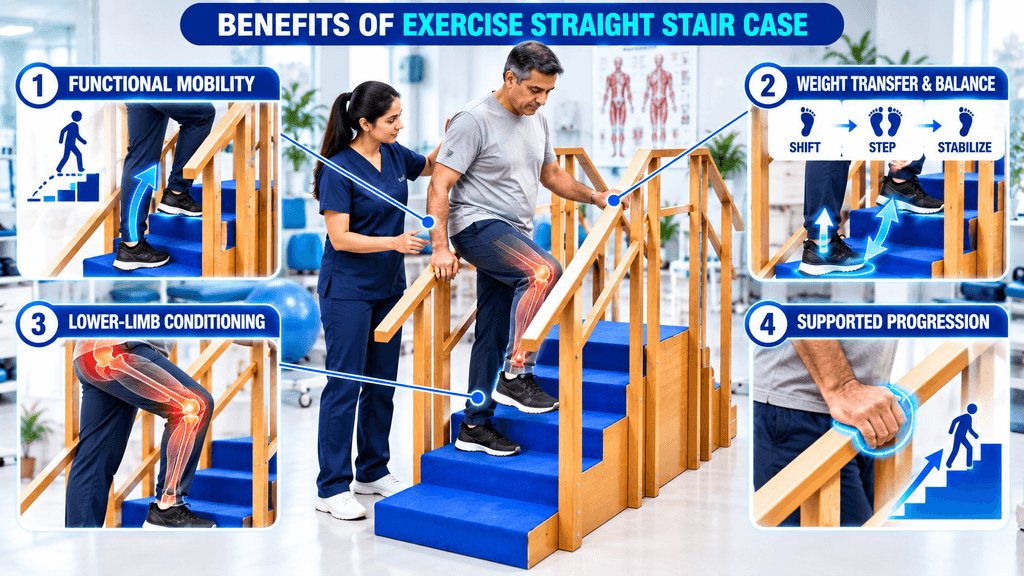
Benefits of Exercise Straight Stair Case
An Exercise Straight Stair Case provides a practical way to introduce stair-specific movement into a rehabilitation program.
Supports Functional Training
Stair climbing is a common daily activity, so practicing it in a controlled environment can complement functional mobility programs.
Encourages Controlled Weight Transfer
Stepping between different levels requires coordinated transfer of body weight.
Supports Lower-Limb Conditioning
Repeated stepping can provide a functional exercise challenge for the lower limbs when prescribed appropriately.
Helps Practice Balance
Patients can work on maintaining stability while changing elevation and foot position.
Adjustable Assistance
The handrails allow patients to use an appropriate amount of upper-limb support according to their rehabilitation stage.
Builds Movement Confidence
Repeated supervised practice can help patients become more familiar with stair-climbing movements before attempting similar activities in everyday environments.
Muscles and Movement Areas
The Exercise Straight Stair Case involves coordinated movement of multiple lower-limb and trunk structures.
| Area | Functional Activity |
|---|---|
| Quadriceps | Knee extension during stepping |
| Hamstrings | Knee and hip control |
| Gluteal muscles | Hip extension and stabilization |
| Calf muscles | Ankle control during stepping |
| Ankles and feet | Foot placement and balance |
| Core and trunk | Postural stability |
| Upper limbs | Handrail-assisted support |
The exact muscular demand depends on step height, speed, technique, assistance level, and the patient’s physical abilities.
How to Use an Exercise Straight Stair Case
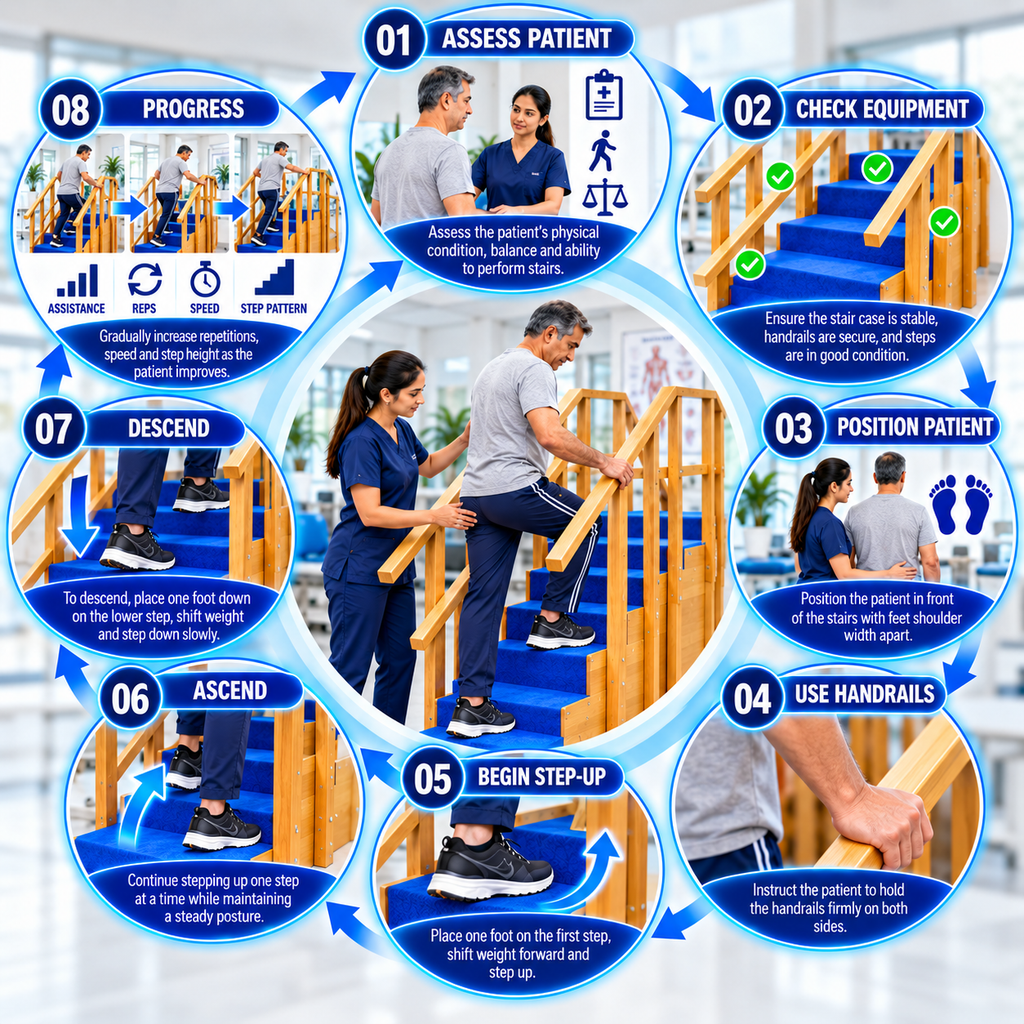
Step 1: Assess the Patient
The physiotherapist should determine whether stair training is appropriate based on the patient’s mobility, balance, strength, and rehabilitation stage.
Step 2: Check the Equipment
Make sure the staircase is stable and that the handrails and steps are secure before beginning.
Step 3: Position the Patient
Place the patient at the appropriate starting point and explain the stepping sequence.
Step 4: Use the Handrails
The patient may hold the handrails for support according to the therapist’s instructions.
Step 5: Begin Step-Up Practice
The patient steps onto the first step using the prescribed technique while maintaining controlled posture.
Step 6: Continue Ascending
The patient progresses step by step while the therapist observes foot placement, balance, knee control, and weight transfer.
Step 7: Practice Descending
Once appropriate, the patient can practice controlled step-down movements under supervision.
Step 8: Progress the Exercise
The therapist may gradually modify the level of assistance, repetitions, speed, or stepping pattern according to the patient’s progress.
Safety Precautions
- Always use the equipment according to professional guidance.
- Inspect steps and handrails before use.
- Ensure the staircase is positioned on a stable and level surface.
- Use appropriate footwear.
- Maintain hand contact with the rail when instructed.
- Avoid rushing during ascent or descent.
- Do not allow patients with significant balance limitations to use the staircase unsupervised.
- Keep the area around the staircase clear.
- Stop the exercise if significant pain, dizziness, instability, or unusual discomfort occurs.
- Follow the manufacturer’s recommended maintenance procedures.
Patients recovering from surgery, serious injury, neurological conditions, or significant mobility limitations should perform stair exercises only under appropriate professional supervision.
Who Can Use an Exercise Straight Stair Case?
The Exercise Straight Stair Case is primarily designed for professional rehabilitation environments, including:
- Physiotherapy clinics
- Rehabilitation centres
- Hospitals
- Orthopaedic rehabilitation departments
- Neurological rehabilitation centres
- Sports rehabilitation facilities
- Geriatric rehabilitation departments
- Mobility training centres
- Physiotherapy teaching institutions
The therapist should select the appropriate level of assistance and exercise difficulty according to the patient’s functional abilities.
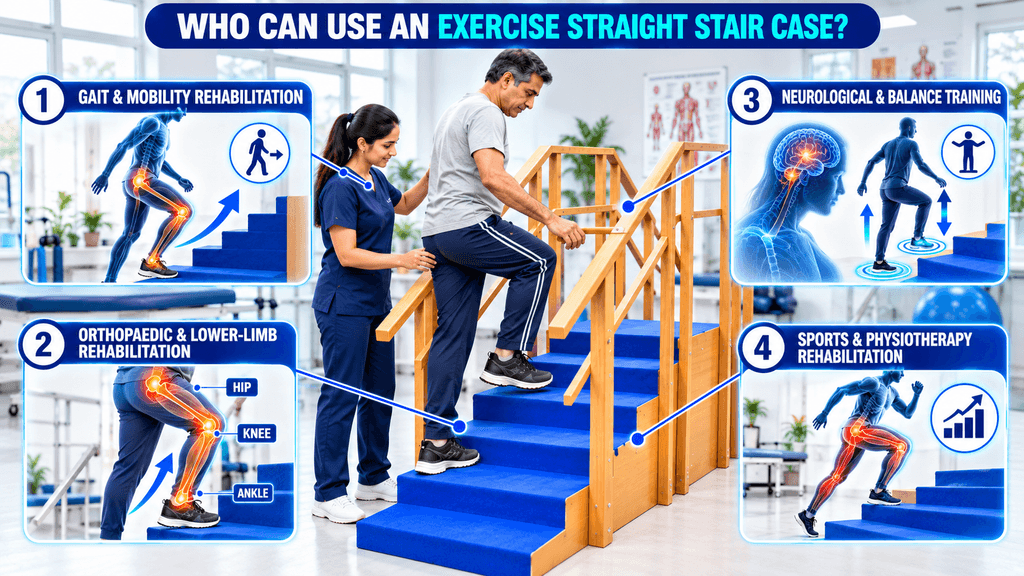
Exercise Straight Stair Case for Gait Rehabilitation
Gait rehabilitation often involves progressing from basic standing and weight-shifting activities toward more complex functional movements. The Exercise Straight Stair Case can be introduced when the patient is ready to practice changes in elevation and stair negotiation.
The therapist can observe:
- Foot placement
- Step sequencing
- Weight transfer
- Knee control
- Hip stability
- Ankle control
- Trunk posture
- Balance
- Use of handrail support
This makes the staircase a useful component of a broader functional mobility program.
Exercise Straight Stair Case vs Regular Stairs
| Feature | Exercise Straight Stair Case | Regular Household Stairs |
|---|---|---|
| Purpose | Rehabilitation training | Everyday access |
| Handrails | Designed for therapy support | Standard household design |
| Clinical supervision | Suitable for supervised exercise | Usually not supervised |
| Exercise use | Yes | Not specifically designed |
| Functional assessment | Can support therapist observation | Limited |
| Rehabilitation environment | Yes | No |
| Mobility training | Specifically intended | General stair use |
Technical Specifications
Specifications vary according to the exact model and manufacturer.
| Specification | Details |
|---|---|
| Product Name | Exercise Straight Stair Case |
| Equipment Type | Physiotherapy & Rehabilitation Exercise Equipment |
| Primary Application | Stair and gait training |
| Configuration | Straight staircase |
| Operation | Manual |
| Steps | Model-dependent |
| Step Height | Model-dependent |
| Step Width | Model-dependent |
| Handrails | Included, configuration-dependent |
| Frame | Heavy-duty metal/steel, model-dependent |
| Finish | Model-dependent |
| Power Requirement | None |
| Suitable Settings | Physiotherapy, rehabilitation and hospitals |
| Patient Capacity | Manufacturer-specific |
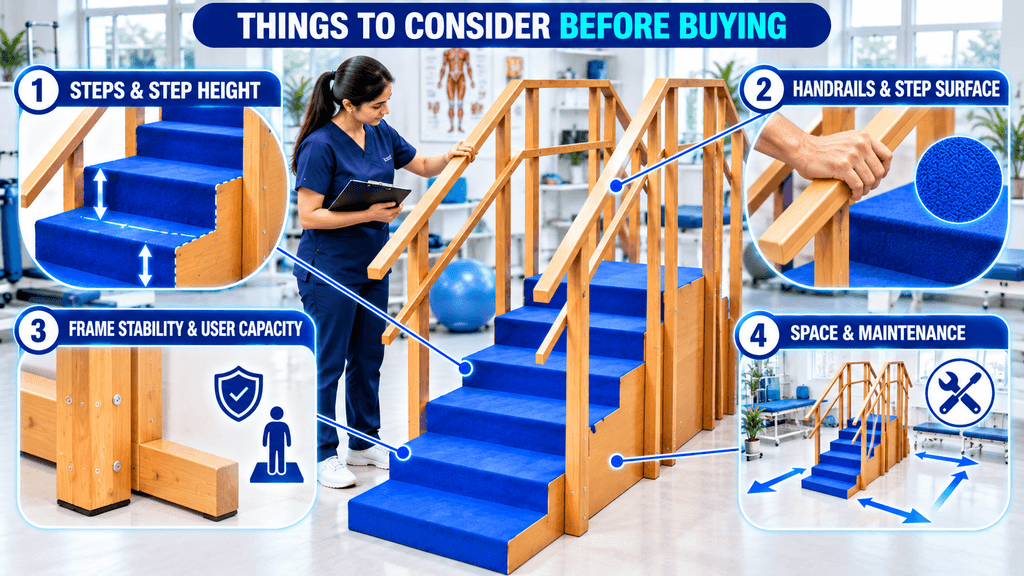
Things to Consider Before Buying
Number of Steps
Check the number of steps required for your treatment area and intended rehabilitation programs.
Step Height
Step height is important because it directly affects exercise difficulty. Confirm the manufacturer’s dimensions before purchase.
Handrail Configuration
Check whether handrails are provided on one or both sides and whether their height is appropriate for your intended users.
Step Surface
A stable, durable, and appropriately finished step surface is important for repeated clinical use.
Frame Stability
Choose a strong frame designed to remain stable during repeated patient use.
Available Space
Measure the treatment room before purchasing, including clearance around the staircase and handrails.
Patient Weight Capacity
Always confirm the manufacturer’s specified maximum user capacity.
Maintenance
Check the condition of joints, handrails, step surfaces, and frame connections regularly.
Why Choose PHYSIOMODALITIES™
PHYSIOMODALITIES™ provides physiotherapy and rehabilitation equipment designed for professional clinical environments. An Exercise Straight Stair Case can complement a rehabilitation setup alongside parallel bars, walking aids, standing frames, exercise bicycles, treatment tables, ankle exercisers, and other functional exercise equipment.
It provides a dedicated environment for controlled stair practice and can support therapists in progressing patients toward functional mobility activities.
Conclusion
The Exercise Straight Stair Case is a specialized physiotherapy rehabilitation unit designed for stair-climbing practice, gait training, balance exercises, weight transfer, and lower-limb functional training.
With stable steps and supportive handrails, it provides a controlled environment where patients can practice ascending and descending movements under professional supervision. It can be a valuable addition to physiotherapy clinics, hospitals, rehabilitation centres, sports therapy facilities, and mobility training departments.
Frequently Asked Questions
1. What is an Exercise Straight Stair Case?
An Exercise Straight Stair Case is physiotherapy equipment designed for controlled stair-climbing, gait, balance, and functional mobility training.
2. What is an Exercise Straight Stair Case used for?
It is used for stair practice, gait rehabilitation, lower-limb strengthening, balance training, weight transfer, and functional mobility exercises.
3. Can it be used after knee or leg surgery?
It may be incorporated into rehabilitation after appropriate medical clearance and when the treating professional considers stair training suitable.
4. Does an Exercise Straight Stair Case require electricity?
No. It is a manually operated rehabilitation exercise unit and does not normally require electricity.
5. Who should supervise stair exercises?
A qualified physiotherapist or appropriate rehabilitation professional should supervise patients who require therapeutic stair training, particularly those with mobility or balance limitations.