The Advance Touch Laser Therapy Machine is designed for professional physiotherapy and rehabilitation environments that require laser-based therapy equipment with a touch-operated interface. Depending on the model configuration, the machine may offer digital controls, adjustable treatment parameters, preset programs, and a display for managing therapy settings.
Laser therapy equipment may be incorporated into selected physiotherapy treatment plans by trained healthcare professionals following an appropriate assessment. The exact laser type, wavelength, output power, operating modes, and intended applications should always be confirmed from the manufacturer’s official specifications.
For clinics, rehabilitation centres, and professional treatment facilities, choosing the right machine involves assessing its control system, safety features, treatment requirements, accessories, and after-sales support.
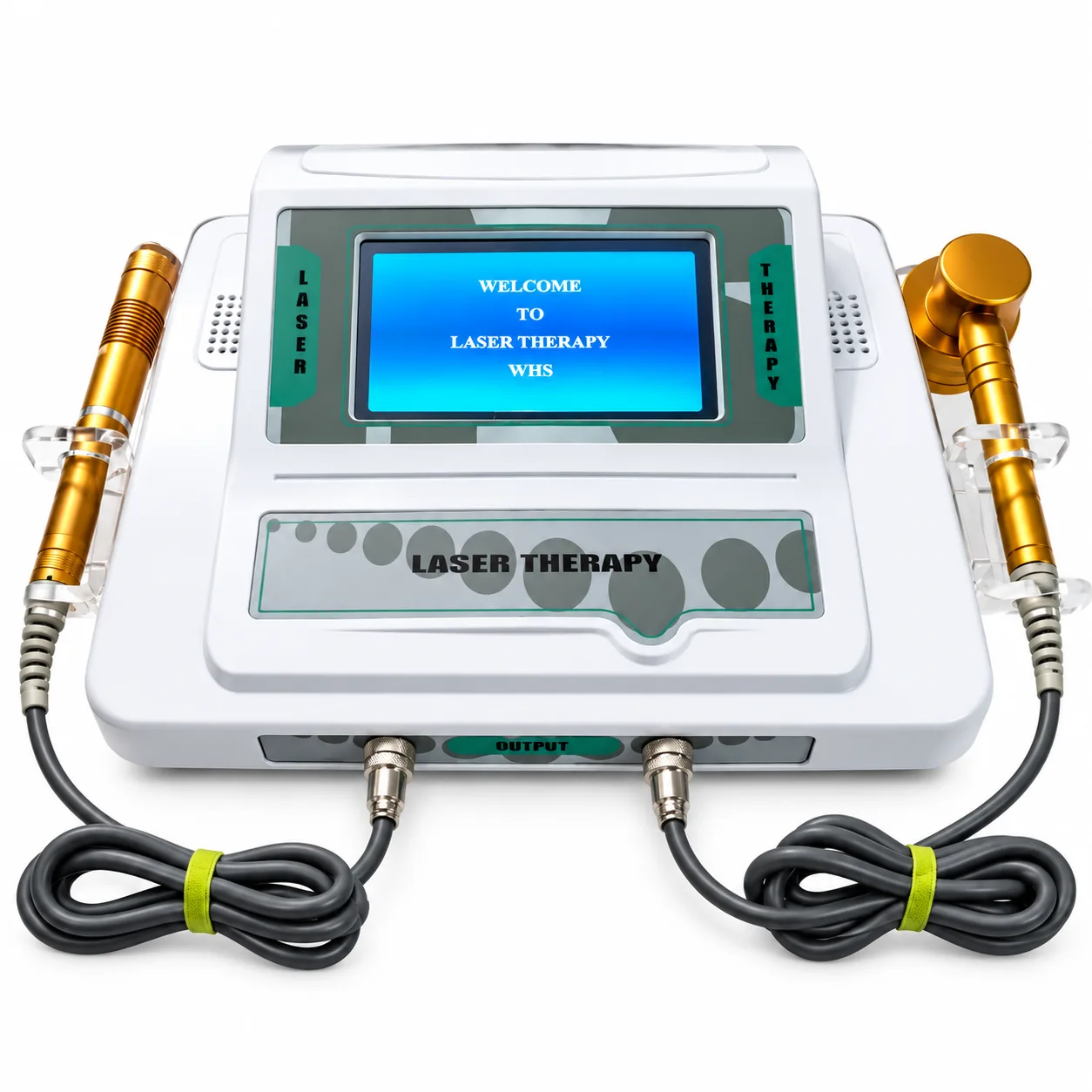
What Is an Advance Touch Laser Therapy Machine?
An Advance Touch Laser Therapy Machine is a laser-based physiotherapy device designed to deliver controlled laser energy according to the specifications of the particular model. The touch interface, where available, allows the operator to navigate menus and select supported treatment settings.
Different laser therapy machines may use different wavelengths, output levels, delivery systems, and operating modes. Therefore, users should not assume that all machines provide the same functionality or are suitable for the same applications.
The Advance Touch Laser Therapy Machine should be selected according to the intended clinical use, the manufacturer’s instructions, and the training requirements for operating the equipment.
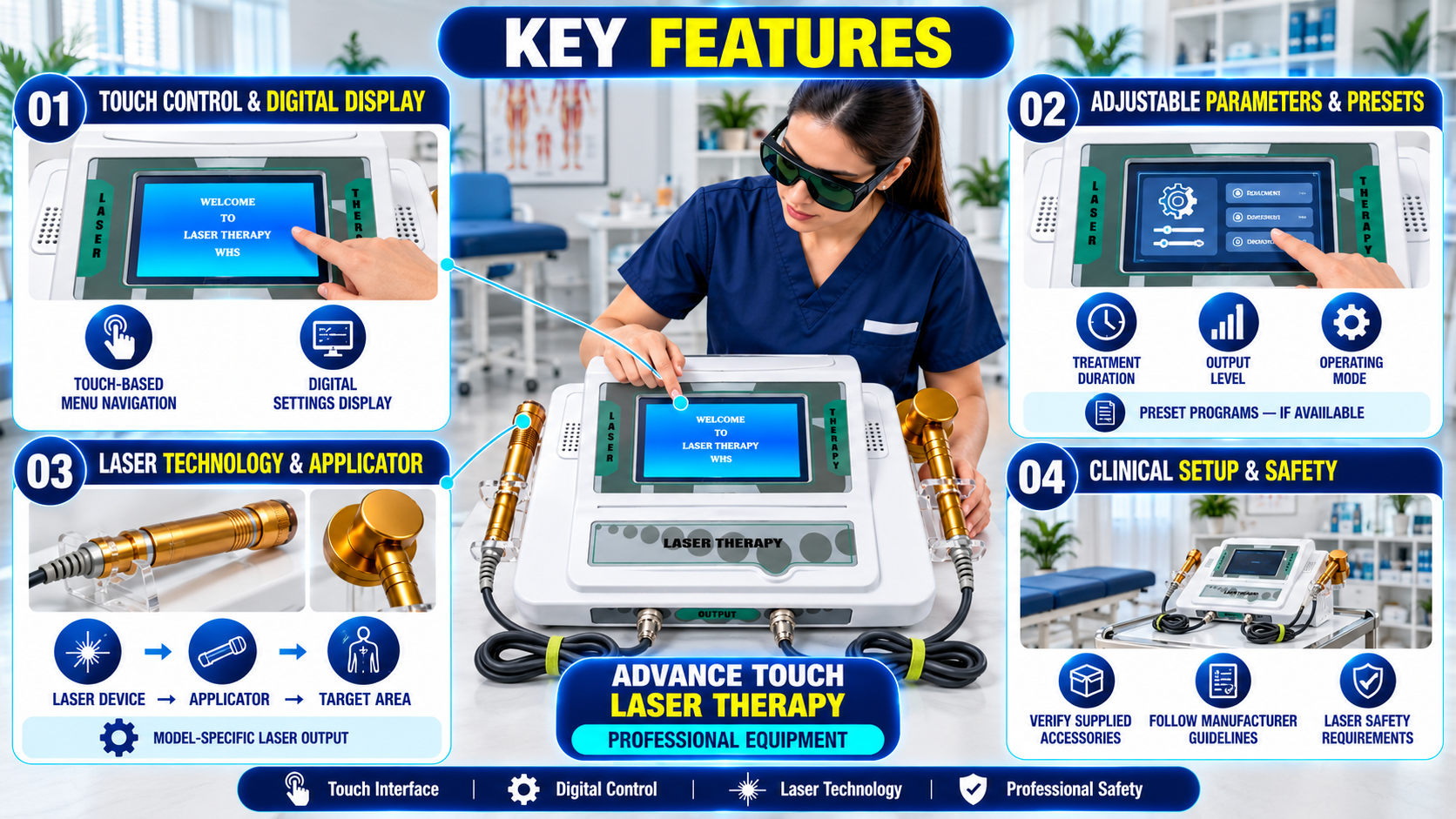
Key Features of the Advance Touch Laser Therapy Machine
1. Touch-Based Control Interface
The touch interface allows the operator to navigate available menus and access supported machine settings. The actual screen size, menu layout, language options, and control functions depend on the model.
2. Adjustable Treatment Parameters
Depending on the configuration, the device may allow the operator to select parameters such as treatment duration, output level, or operating mode. Only the settings supported by the specific model should be used.
3. Laser-Based Therapy Technology
The machine uses laser technology according to its specified wavelength and output characteristics. These technical details determine the device’s classification, intended applications, and safety requirements.
4. Digital Display
A digital display, where included, can help the operator view selected settings and machine information during operation. Display functions should be confirmed against the manufacturer’s product documentation.
5. Preset Programs
Some touch-operated laser therapy systems include preset treatment programs. The availability and purpose of such programs vary by model. Presets should be used only according to the manufacturer’s instructions and professional assessment.
6. Professional Treatment-Room Setup
A suitable laser therapy machine can be incorporated into a professional treatment environment when its specifications, safety controls, and intended use meet the facility’s requirements.
7. Model-Specific Accessories
Laser probes, applicators, protective eyewear, and other accessories may vary between models. Confirm which accessories are supplied and which must be purchased separately.
How Does Laser Therapy Equipment Work?
Laser therapy equipment delivers laser energy to a designated treatment area using the device’s specified delivery system. The energy delivered depends on parameters such as wavelength, output power, treatment duration, and the size of the treated area.
The appropriate parameters depend on the device, treatment objective, patient assessment, and professional guidance. The operator must follow the device-specific protocol instead of relying on generic settings.
An Advance Touch Laser Therapy Machine with a touch interface may make it easier to select and review available settings. However, a touch-operated control system does not replace the need for clinical training, appropriate assessment, or laser safety procedures.
Applications of an Advance Touch Laser Therapy Machine
The potential applications depend on the exact laser technology, regulatory status, and instructions provided for the model.
Physiotherapy Practice
Laser therapy equipment may be used as part of selected physiotherapy protocols when the device is appropriate for the clinical objective and used by a trained professional.
Rehabilitation Settings
Rehabilitation facilities may consider laser therapy equipment as one component of a broader care plan. The suitability of the machine depends on its verified specifications and the needs of the person receiving treatment.
Musculoskeletal Care
Certain laser devices are designed for specific musculoskeletal applications. The intended use and evidence supporting an application should be checked for the exact device rather than assumed for all laser systems.
Professional Therapy Clinics
A touch-operated system may suit clinics that prefer a digital interface for navigating available settings. Buyers should assess the interface and workflow before purchasing.
Important: These are general descriptions of possible professional settings, not a claim that every model is approved or suitable for every condition. Follow the device’s authorised intended use and applicable clinical guidance.
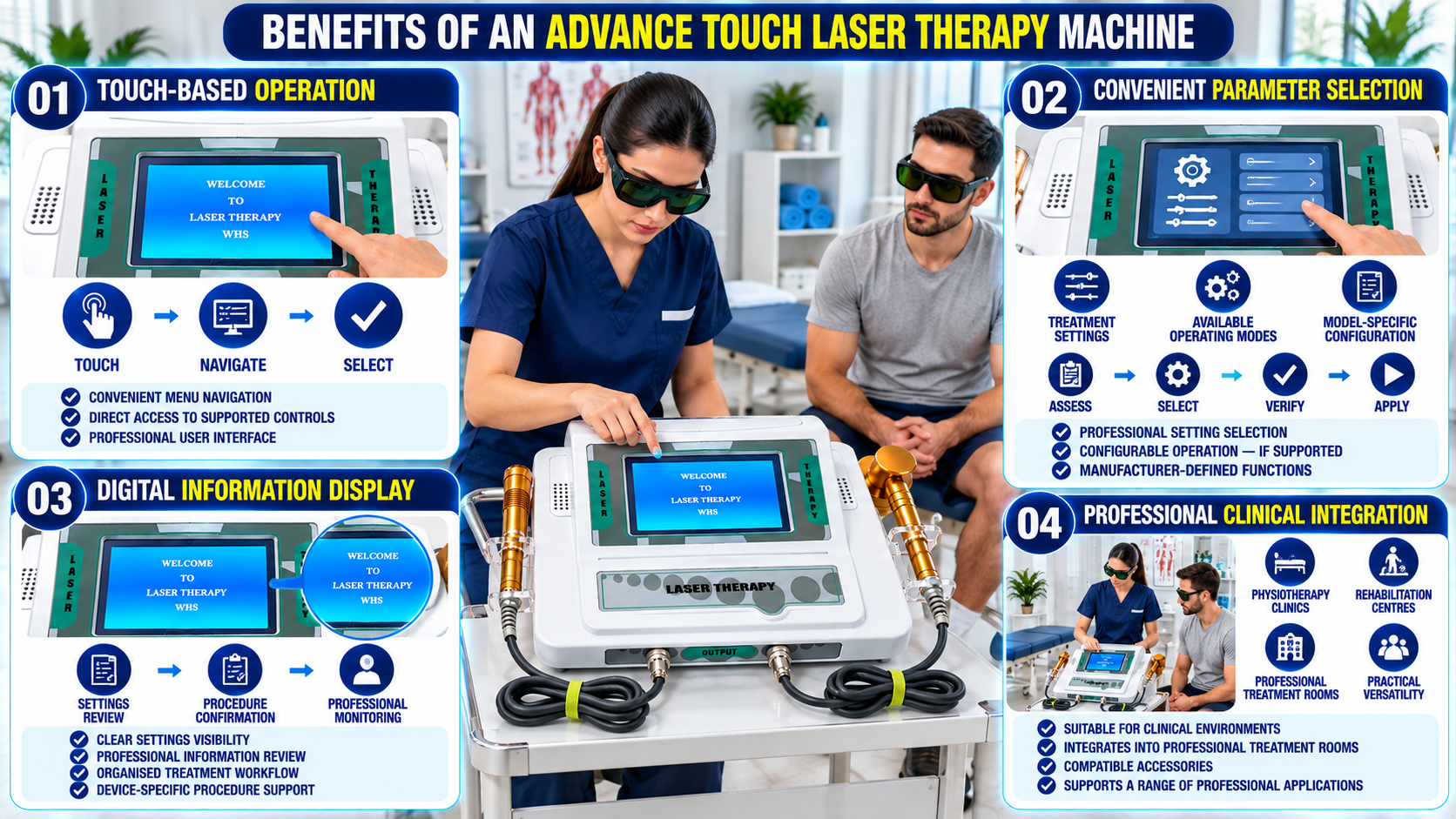
Benefits of an Advance Touch Laser Therapy Machine
A properly selected laser therapy system may offer practical equipment-management advantages.
- Touch-based operation: A supported touch interface may simplify menu navigation.
- Parameter selection: Available controls may allow the operator to select model-specific treatment settings.
- Digital information display: A screen can help present selected settings during operation.
- Professional integration: The machine may be incorporated into an appropriate physiotherapy or rehabilitation workflow.
- Configurable operation: Available modes and accessories may support the uses specified by the manufacturer.
- Organised treatment workflow: Clearly presented controls can help operators follow established device-specific procedures.
Clinical outcomes are not guaranteed and depend on the individual, the condition being treated, the treatment protocol, and the suitability of the device.
Important Technical Specifications
Before purchasing an Advance Touch Laser Therapy Machine, verify the following details with the manufacturer or authorised supplier.
| Specification | Details |
|---|---|
| Product Name | Advance Touch Laser Therapy Machine |
| Equipment Category | Laser Therapy Equipment |
| Control Interface | Touch-based, as indicated by the product name; confirm model |
| Laser Type | Confirm with manufacturer |
| Wavelength | Confirm with manufacturer |
| Output Power | Confirm with manufacturer |
| Laser Classification | Confirm from official documentation |
| Operating Modes | Model dependent |
| Preset Programs | Confirm availability |
| Treatment Timer | Confirm availability |
| Probe / Applicator | Confirm supplied configuration |
| Display Specifications | Confirm with manufacturer |
| Safety Features | Confirm from product documentation |
| Power Supply | Confirm with manufacturer |
| Dimensions and Weight | Confirm with manufacturer |
| Warranty | Confirm with supplier |
| Brand | PHYSIOMODALITIES™ |
Note: Do not publish a specific wavelength, output power, laser class, or number of programs without verifying the exact product model. These details are essential for safe operation and accurate product information.
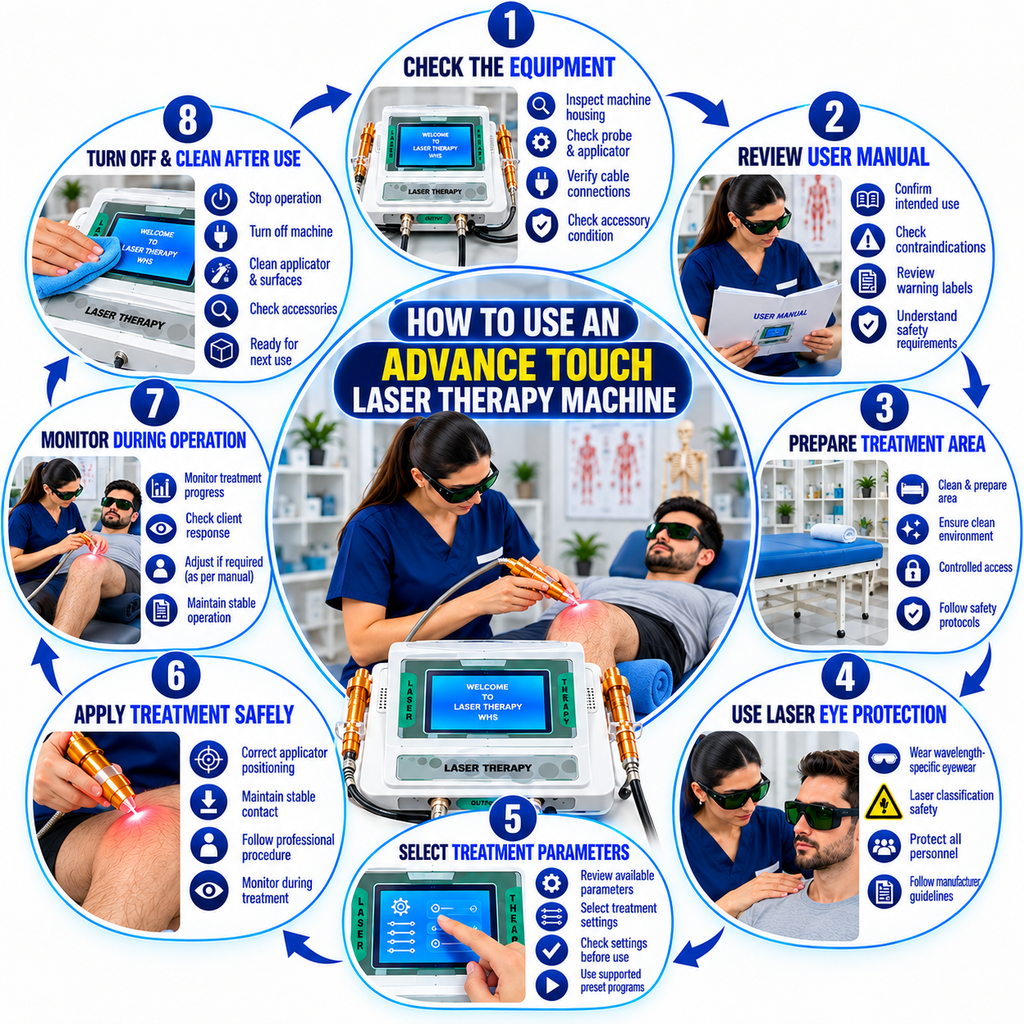
How to Use an Advance Touch Laser Therapy Machine
The following is a general equipment-preparation outline. The manufacturer’s operating manual and approved treatment protocol take priority over these steps.
Step 1: Check the Equipment
Inspect the machine, probe or applicator, cable connections, housing, and accessories for visible damage. Do not operate damaged equipment.
Step 2: Review the User Manual
Confirm the machine’s intended use, operating instructions, contraindications, warning labels, and safety requirements before the first session.
Step 3: Prepare the Treatment Area
Set up the machine in an appropriate clinical environment. Restrict access as required by the device’s laser classification and local safety procedures.
Step 4: Use Appropriate Laser Protection
Use protective eyewear specifically suitable for the device’s wavelength and laser classification. The operator and any other persons requiring protection must follow the manufacturer’s safety instructions.
Step 5: Select the Appropriate Settings
Use only the parameters and operating modes supported by the device and authorised for the intended application. Settings should be selected by a trained professional following patient assessment.
Step 6: Position the Applicator Correctly
Follow the manufacturer’s specified method for applicator placement, distance, contact, and movement. Do not improvise a delivery technique.
Step 7: Monitor the Session
Observe the device and the person receiving treatment according to the approved protocol. Stop immediately if an unexpected response, equipment fault, or safety concern occurs.
Step 8: Complete the Session Safely
End the treatment using the prescribed shutdown procedure. Clean and store the equipment and accessories according to the manufacturer’s instructions.
Laser Safety Precautions
Laser equipment requires specific safety measures. Before using an Advance Touch Laser Therapy Machine:
- Ensure that the operator has appropriate training.
- Follow the laser classification and safety information provided by the manufacturer.
- Use wavelength-appropriate protective eyewear.
- Never direct the laser beam toward the eyes or allow unintended eye exposure.
- Control access to the treatment area as required.
- Avoid reflective surfaces where specified by the safety protocol.
- Follow the device-specific warnings and contraindications.
- Inspect probes, cables, connectors, and housing before use.
- Do not use settings or accessories that are not approved for the machine.
- Stop operation if the equipment malfunctions.
- Arrange maintenance and servicing according to the manufacturer’s recommendations.
Do not assume that all laser devices have identical safety requirements. The correct precautions depend on the exact model and its laser classification.
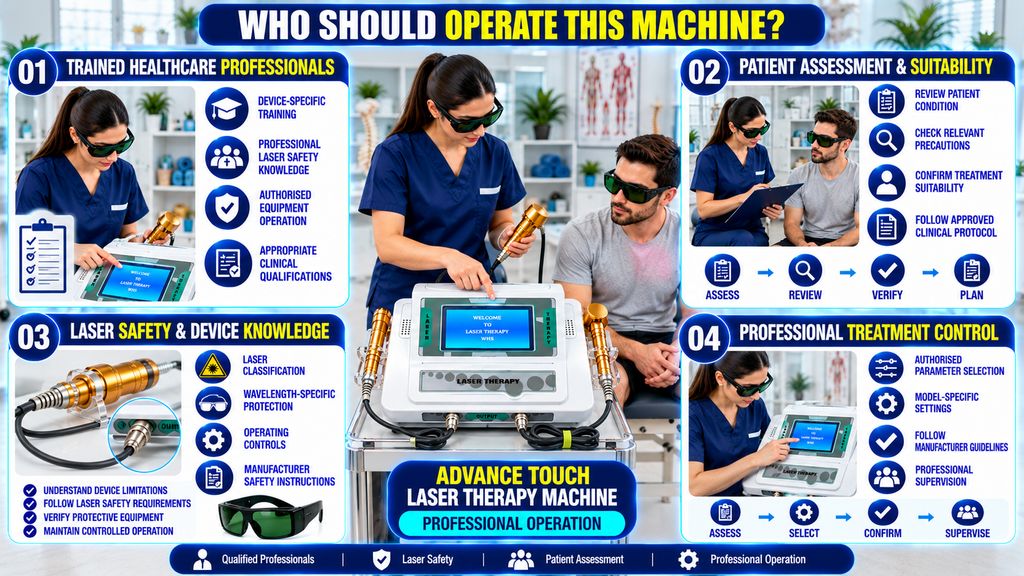
Who Should Operate This Machine?
The Advance Touch Laser Therapy Machine should be operated by appropriately trained healthcare professionals or other personnel authorised under the device’s instructions and applicable regulations.
Before treatment, the professional should assess whether the device is suitable for the intended application, review relevant precautions, and follow the approved protocol. Patients should not independently select treatment parameters or operate professional laser equipment unless the device is specifically designed and authorised for that use.
Advance Touch Laser Therapy Machine vs Conventional Laser Equipment
| Feature | Advance Touch Laser Therapy Machine | Other Laser Therapy Equipment |
|---|---|---|
| User interface | Touch-operated, subject to model confirmation | May use buttons, dials, or a touch interface |
| Parameter selection | Depends on available digital controls | Depends on the model |
| Preset programs | Confirm availability | Model dependent |
| Laser wavelength | Must be verified | Must be verified |
| Output power | Must be verified | Must be verified |
| Safety requirements | Based on laser classification and instructions | Based on laser classification and instructions |
The term “Advance Touch” alone does not establish superior performance or clinical effectiveness. Compare verified technical specifications, safety features, intended applications, usability, warranty, and service support.
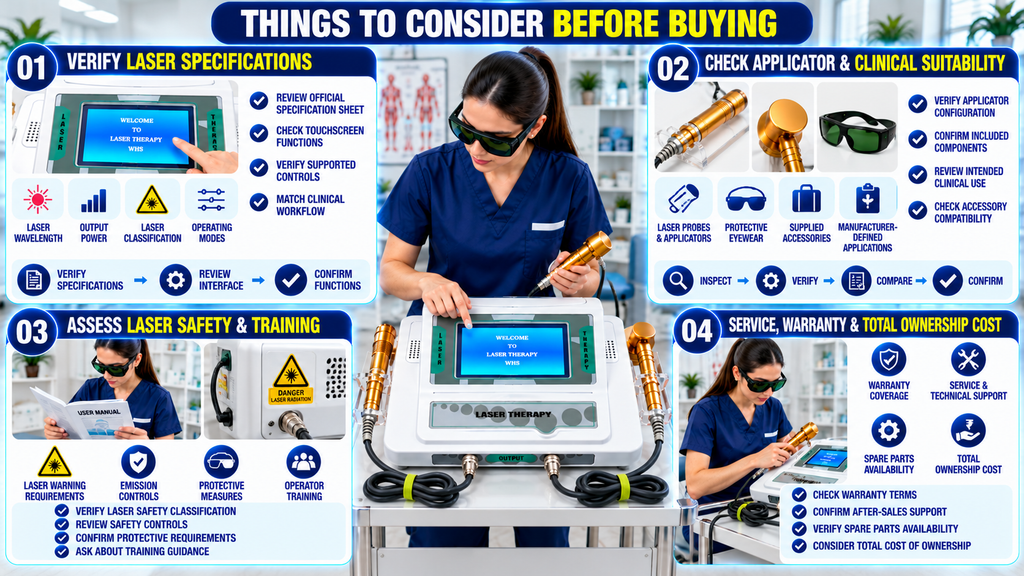
Things to Consider Before Buying
1. Verify the Laser Specifications
Check the wavelength, output power, laser classification, operating modes, and other details on the official specification sheet.
2. Review the Touch Interface
Confirm that the interface is included in the model and that its available controls meet the clinic’s workflow requirements.
3. Check the Applicator Configuration
Ask whether probes, applicators, protective eyewear, and other required accessories are included in the quoted price.
4. Confirm Intended Applications
Ensure that the manufacturer’s stated intended use matches the clinical requirements of your facility.
5. Assess Safety Features
Review the applicable warnings, emission controls, protective measures, and any required safety accessories.
6. Ask About Training and Servicing
Confirm the availability of operating guidance, technical support, maintenance, warranty coverage, and replacement accessories.
7. Compare Total Cost
Consider the machine price, accessories, maintenance, servicing, and other operating requirements rather than comparing purchase price alone.
Why Choose PHYSIOMODALITIES™?
PHYSIOMODALITIES™ by PHYSIOMODALITIES ENTERPRISES provides physiotherapy and rehabilitation equipment for professional environments. When considering an Advance Touch Laser Therapy Machine, buyers should evaluate the actual model configuration, technical documentation, intended use, safety requirements, and service support.
For accurate product selection, request the latest specifications and confirm all included accessories, warranty terms, and operating requirements before placing an order.
Conclusion
The Advance Touch Laser Therapy Machine is a laser-based physiotherapy equipment option for professional settings that require a touch-operated control interface. Its suitability depends on the verified laser specifications, available operating features, safety provisions, and intended clinical applications. Reviewing the official product documentation and following appropriate professional protocols helps buyers make an informed equipment decision.
Frequently Asked Questions
1. What is an Advance Touch Laser Therapy Machine?
It is a laser-based therapy device with a touch-operated interface, subject to confirmation of the exact model configuration.
2. Does the machine have preset programs?
Preset programs may be available, but their number and functions must be confirmed with the manufacturer.
3. Which laser wavelength does it use?
The wavelength depends on the specific model and should be verified from the official technical specifications.
4. Who should operate this machine?
Appropriately trained and authorised professionals should operate it according to the user manual and applicable regulations.
5. What should I check before buying?
Verify wavelength, output power, laser classification, operating modes, accessories, safety features, warranty, and after-sales support.