
The Ankle CPM Physiotherapy Machine is a motorized rehabilitation device designed to provide controlled and repetitive passive movement of the ankle joint. It helps support ankle mobility exercises by moving the foot through a selected range of motion without requiring the patient to generate the entire movement independently.
The machine is designed for physiotherapy clinics, hospitals, orthopedic departments, rehabilitation centres and postoperative recovery facilities where controlled ankle movement may be included in a patient’s rehabilitation program.
An Ankle CPM Physiotherapy Machine can help therapists deliver structured passive movement sessions with adjustable treatment parameters, depending on the model. Its foot-support structure helps position the lower limb while the motorized mechanism guides the ankle through selected movements.
PHYSIOMODALITIES™ provides professional physiotherapy and rehabilitation equipment designed to support clinical treatment environments and structured joint-rehabilitation programs.
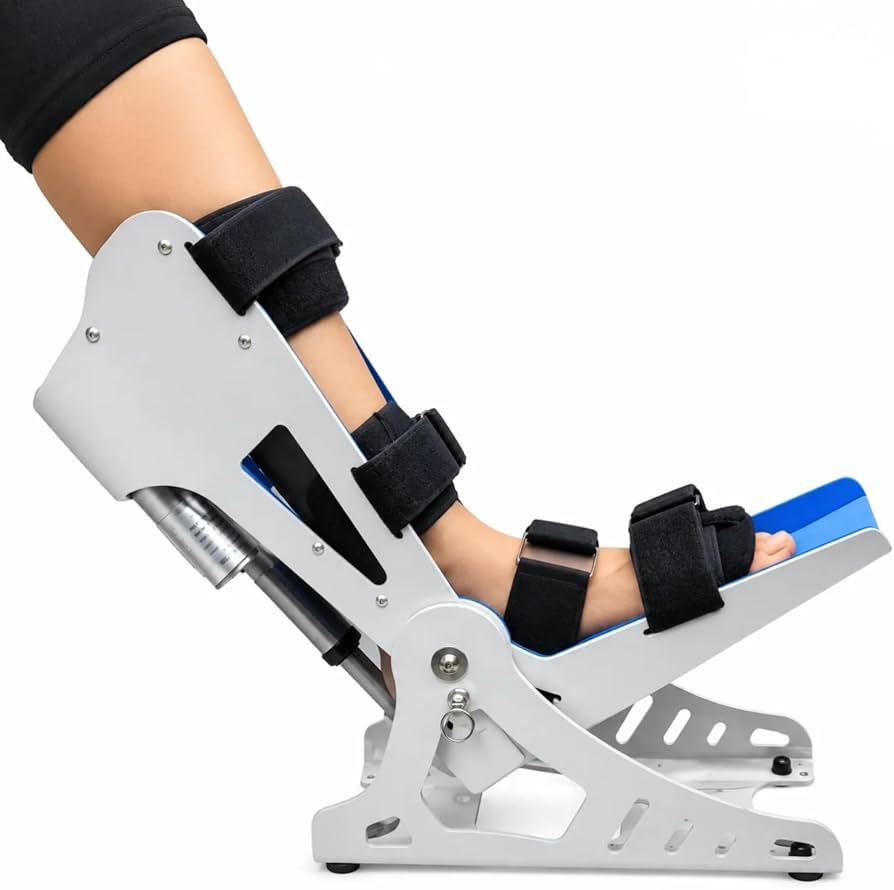
What Is an Ankle CPM Physiotherapy Machine?
An Ankle CPM Physiotherapy Machine is a powered rehabilitation device that moves the ankle joint through a controlled range of motion.
CPM stands for Continuous Passive Motion. In this type of therapy, a motorized mechanism generates repetitive joint movement while the patient remains relaxed and does not need to actively produce every repetition.
An ankle-specific CPM device is designed to support controlled movement of the foot and ankle. Depending on its mechanical configuration, it may provide:
- Ankle dorsiflexion
- Ankle plantarflexion
- Repetitive passive ankle movement
- Adjustable movement range
- Controlled movement speed
- Timed rehabilitation sessions
- Supported foot and lower-limb positioning
Some models may provide additional movement options. The exact movement range, adjustment controls and available functions depend on the specific machine.
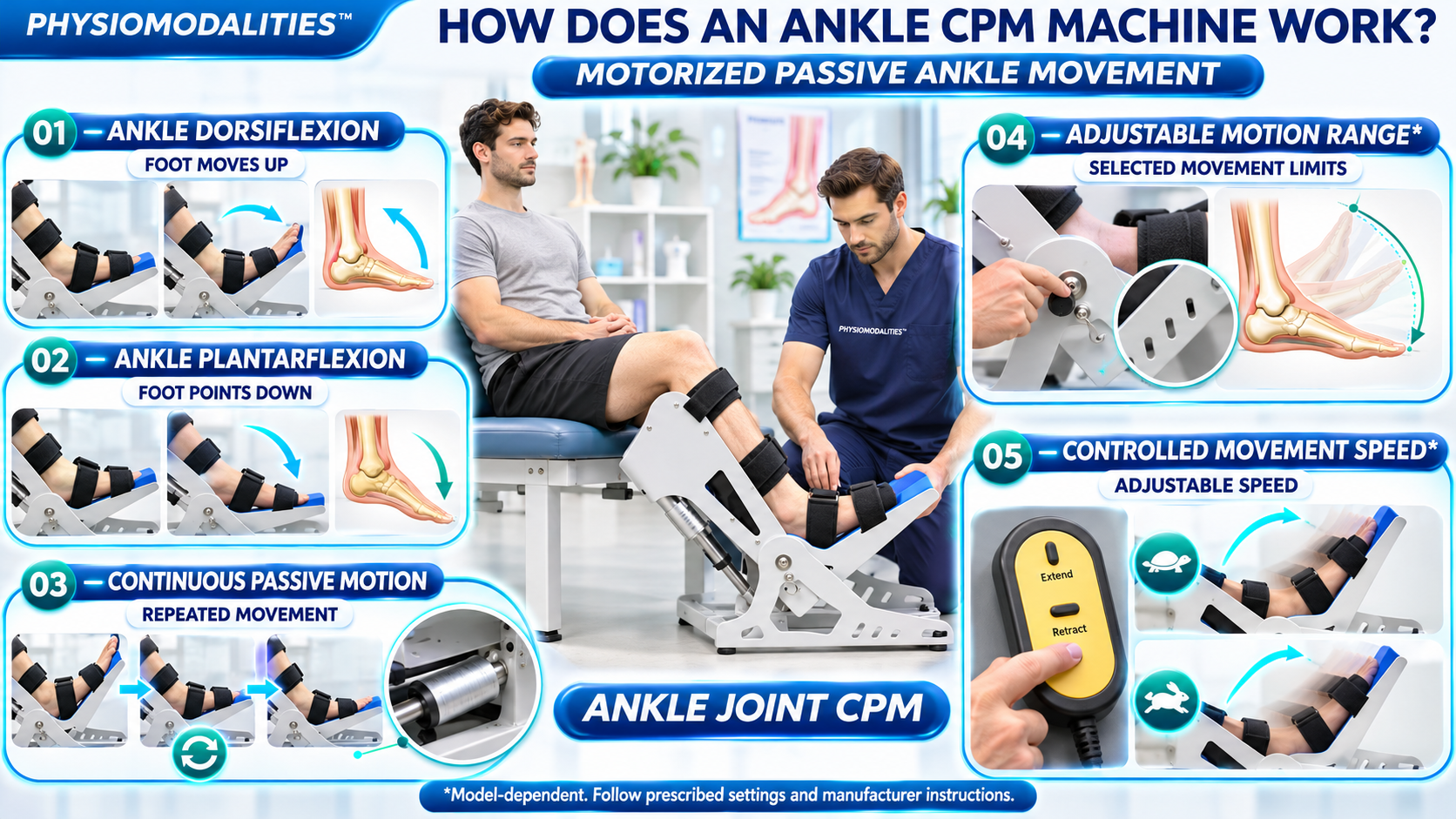
How Does an Ankle CPM Physiotherapy Machine Work?
The machine uses a motorized mechanism connected to a foot-support structure. The patient’s lower leg and foot are positioned securely according to the manufacturer’s instructions.
The operator selects the prescribed movement parameters, and the machine moves the ankle through the selected range.
Ankle Dorsiflexion
Dorsiflexion is the movement in which the foot moves upward towards the shin. An ankle CPM device can assist this movement within the selected treatment range.
Ankle Plantarflexion
Plantarflexion is the movement in which the foot points downward, away from the shin. The machine can assist repeated plantarflexion movement according to the prescribed settings.
Controlled Passive Movement
The motorized mechanism repeats the selected movement pattern without requiring the patient to actively generate every repetition.
Adjustable Range of Motion
Applicable models allow the operator to set movement limits according to the patient’s rehabilitation plan and tolerance.
Controlled Movement Speed
Some ankle CPM systems provide speed adjustment to support gradual and controlled movement.
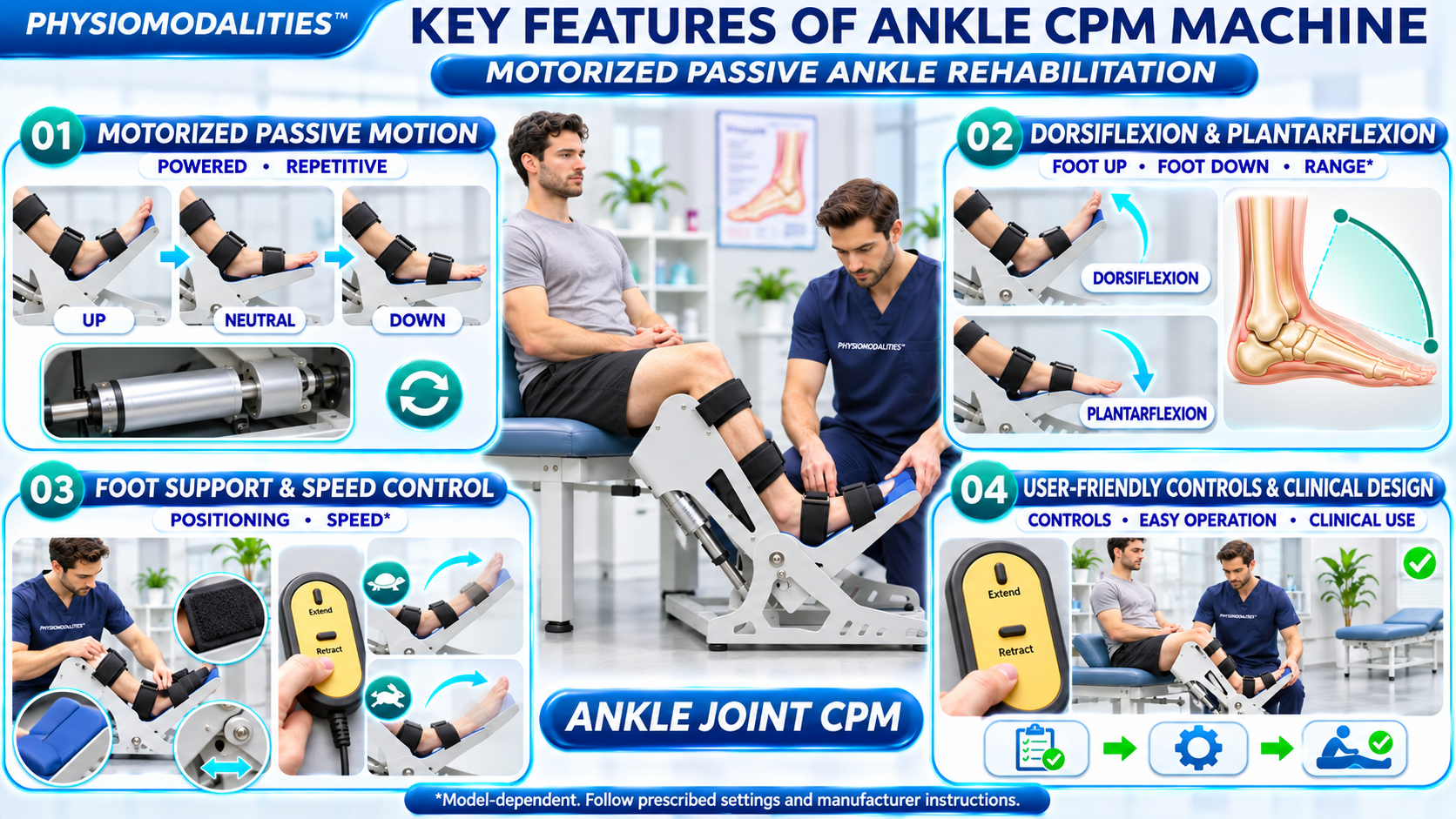
Key Features of Ankle CPM Physiotherapy Machine
Motorized Passive Movement
The machine uses a powered mechanism to produce repetitive ankle movement.
Dorsiflexion and Plantarflexion Training
The equipment is designed to support controlled upward and downward foot movement, depending on the model.
Adjustable Range of Motion
Applicable models allow the operator to set the movement range according to the prescribed rehabilitation protocol.
Adjustable Foot Support
The foot-support structure helps maintain appropriate positioning during treatment. Its adjustment options depend on the specific model.
Controlled Movement Speed
Models with speed adjustment allow the operator to select an appropriate movement rate.
Repetitive Exercise
The motorized mechanism provides repeated movement during the selected treatment session.
User-Friendly Controls
The control system allows the operator to manage available treatment settings. The exact interface may be digital or manual depending on the model.
Clinical Rehabilitation Design
The equipment is designed for use in professional physiotherapy, orthopedic and rehabilitation environments.
Applications of Ankle CPM Physiotherapy Machine
The Ankle CPM Physiotherapy Machine may be incorporated into selected rehabilitation programs where controlled passive ankle movement is considered appropriate.
Ankle Joint Mobility Rehabilitation
The machine can provide repetitive passive ankle movement as part of a supervised joint-mobility program.
Postoperative Ankle Rehabilitation
Following selected orthopedic procedures, a healthcare professional may prescribe controlled passive movement when appropriate for the surgical protocol.
Foot and Ankle Injury Rehabilitation
After certain injuries, controlled ankle movement may be included in rehabilitation once permitted by the treating professional.
Orthopedic Rehabilitation
The device may be incorporated into selected orthopedic rehabilitation programs involving reduced ankle mobility.
Physiotherapy Treatment
Physiotherapists may use ankle CPM as one component of a broader treatment plan that can also include active exercise, strengthening and functional training.
Hospital Rehabilitation
Hospitals and recovery units may use joint-specific CPM equipment when passive ankle movement is prescribed and supervised.
Potential Benefits of Ankle CPM Physiotherapy Machine
The actual response to CPM treatment depends on the patient’s condition, injury or surgical history, treatment parameters and rehabilitation plan.
An Ankle CPM Physiotherapy Machine can provide:
- Controlled ankle dorsiflexion and plantarflexion
- Repetitive passive joint movement
- Adjustable movement range on applicable models
- Consistent movement patterns
- Reduced need for active effort during passive exercise
- Supported foot positioning
- Structured rehabilitation sessions
- Integration into professional ankle rehabilitation programs
CPM should not automatically replace active rehabilitation. The treating professional determines whether passive movement, active exercise or a combination is appropriate.

Ankle CPM Machine for Physiotherapy Clinics
An Ankle CPM Physiotherapy Machine can add a dedicated ankle-mobility treatment option to a physiotherapy or orthopedic rehabilitation department.
Patients recovering from selected ankle procedures or injuries may require a carefully planned progression of joint movement. A CPM device can provide controlled passive movement when included in the treating professional’s protocol.
It can be used alongside:
- Active ankle range-of-motion exercises
- Foot mobility exercises
- Ankle strengthening exercises
- Balance and proprioception training
- Gait training
- Functional lower-limb exercises
- Occupational or sports rehabilitation activities
- Other appropriate orthopedic rehabilitation equipment
The device should complement the broader rehabilitation program rather than replace clinical assessment or active functional training.
Ankle CPM vs Manual Passive Exercise
| Feature | Ankle CPM Machine | Manual Passive Exercise |
|---|---|---|
| Movement source | Motorized mechanism | Therapist |
| Movement pattern | Programmed and repetitive | Therapist-controlled |
| Dorsiflexion and plantarflexion | Supported | Therapist-guided |
| Movement speed | Adjustable on applicable models | Therapist-controlled |
| Repetition | Machine-generated | Therapist-generated |
| Treatment duration | Timer-dependent | Therapist-managed |
| Foot support | Machine-supported | Therapist-supported |
| Monitoring | Professional supervision recommended | Direct therapist supervision |
Both approaches have different roles in rehabilitation. The appropriate method depends on the patient’s condition and the treating professional’s assessment.
Ankle CPM Physiotherapy Machine vs Knee CPM Machine
| Feature | Ankle CPM Machine | Knee CPM Machine |
|---|---|---|
| Target joint | Ankle | Knee |
| Main movement | Dorsiflexion and plantarflexion | Flexion and extension |
| Limb positioning | Foot and lower-leg support | Leg support |
| Rehabilitation focus | Ankle and foot mobility | Knee mobility |
| Device configuration | Ankle-specific | Knee-specific |
| Treatment setting | Orthopedic and physiotherapy rehabilitation | Orthopedic and physiotherapy rehabilitation |
Both devices use continuous passive motion principles, but their mechanical structures and movement patterns are designed for different joints.
How to Use an Ankle CPM Physiotherapy Machine
The machine should be operated according to the manufacturer’s instructions and the patient’s prescribed rehabilitation plan.
Step 1: Assess the Patient
Review the patient’s ankle condition, medical history, injury or surgical details and relevant contraindications.
Step 2: Prepare the Machine
Place the equipment on a stable surface and inspect the motorized mechanism, foot support, straps and controls.
Step 3: Position the Patient
Position the patient comfortably according to the machine’s design.
Step 4: Align the Ankle Joint
Position the lower leg and foot so that the ankle joint aligns correctly with the machine’s movement axis.
Step 5: Secure the Foot
Use the supplied supports and straps to maintain appropriate positioning without excessive pressure.
Step 6: Set the Movement Range
Select the prescribed dorsiflexion and plantarflexion limits according to the rehabilitation protocol.
Step 7: Adjust the Speed
If the model provides speed control, select the appropriate setting according to professional instructions.
Step 8: Begin Treatment
Start the machine and observe the initial movement carefully to confirm correct alignment and patient comfort.
Step 9: Monitor the Session
Observe the patient’s comfort, foot positioning and movement response throughout the session.
Step 10: Complete the Session
Stop the machine before releasing the foot supports. Remove the patient’s foot carefully.

Safety Precautions
The Ankle CPM Physiotherapy Machine should only be used according to professional guidance and manufacturer instructions.
- Assess the patient before starting treatment.
- Follow the surgeon’s or treating professional’s postoperative protocol where applicable.
- Align the ankle correctly with the machine’s movement axis.
- Secure the foot without excessive tightening.
- Start within the prescribed movement range.
- Do not force the ankle beyond its permitted range.
- Monitor for pain, swelling, numbness or unusual discomfort.
- Stop treatment if an unexpected reaction occurs.
- Keep clothing and other objects clear of moving mechanical components.
- Inspect the machine, foot supports and straps before each session.
- Follow the manufacturer’s cleaning and maintenance instructions.
The appropriate movement range, speed and treatment duration must be determined according to the patient’s condition and the treating professional’s instructions.
Technical Specifications
The following table lists general specification categories. Exact values depend on the selected ankle CPM model.
| Specification | Details |
|---|---|
| Product Name | Ankle CPM Physiotherapy Machine |
| Equipment Type | Motorized Rehabilitation Equipment |
| Therapy Type | Continuous Passive Motion |
| Target Joint | Ankle |
| Main Movements | Dorsiflexion and Plantarflexion |
| Movement Type | Continuous Passive Movement |
| Range of Motion | Adjustable, model-dependent |
| Movement Speed | Model-dependent |
| Treatment Timer | Model-dependent |
| Foot Support | Model-dependent |
| Control System | Digital or Manual, model-dependent |
| Power Supply | Model-dependent |
| Construction | Model-dependent |
| Intended Application | Ankle Joint Rehabilitation |
| Suitable For | Hospitals, Physiotherapy Clinics and Rehabilitation Centres |
Important: Confirm the exact dorsiflexion and plantarflexion range, speed, timer, foot-support adjustments, dimensions, weight, power requirements and accessories from the manufacturer’s datasheet before publishing fixed specifications.
Things to Consider Before Buying
Movement Range
Check the available dorsiflexion and plantarflexion range and confirm that it suits the intended rehabilitation applications.
Speed Adjustment
If different movement speeds are required, verify the available speed settings.
Foot Support and Positioning
Check the adjustment range, padding, straps and patient-support design.
Control Interface
Review the control system and confirm that therapists can easily select and monitor the available settings.
Mechanical Stability
Consider the stability and durability of the frame and moving components for regular clinical use.
Patient Compatibility
Check the manufacturer’s patient-size and foot-positioning requirements.
Maintenance and Service
Confirm warranty coverage, technical support, spare-parts availability and maintenance requirements.
Operating Instructions
Ensure that clinical staff understand the machine’s positioning, operating procedures, movement limits and safety precautions.

Who Should Operate an Ankle CPM Physiotherapy Machine?
The Ankle CPM Physiotherapy Machine should be operated under the guidance of appropriately trained healthcare professionals, including:
- Physiotherapists
- Orthopedic rehabilitation professionals
- Occupational therapists
- Rehabilitation physicians
- Other qualified healthcare practitioners
Patients and caregivers should follow the treatment instructions provided by the treating professional and equipment manufacturer.
Why Choose PHYSIOMODALITIES™?
PHYSIOMODALITIES™ provides physiotherapy and rehabilitation equipment designed for professional clinical environments.
The Ankle CPM Physiotherapy Machine can complement a clinic’s lower-limb rehabilitation equipment range by providing a dedicated option for controlled passive ankle movement.
When selecting ankle rehabilitation equipment, clinics should consider the movement range, speed controls, foot-support design, mechanical construction, accessories, warranty and after-sales support.
PHYSIOMODALITIES ENTERPRISES focuses on equipment for physiotherapy clinics, hospitals, rehabilitation centres and professional healthcare facilities.
Conclusion
The Ankle CPM Physiotherapy Machine is a motorized rehabilitation device designed to provide controlled and repetitive passive movement of the ankle joint. Its dorsiflexion and plantarflexion movements, supported foot positioning and adjustable treatment parameters on applicable models make it suitable for selected ankle mobility and orthopedic rehabilitation programs.
The machine can be incorporated into postoperative and post-injury rehabilitation when passive movement is permitted by the treating professional. Before purchasing, confirm the exact movement range, speed settings, foot-support configuration, control system, power requirements, warranty and service support.
Appropriate patient assessment, professional supervision and adherence to manufacturer instructions are essential for responsible use.
Frequently Asked Questions
1. What is an Ankle CPM Physiotherapy Machine?
It is a motorized rehabilitation device that moves the ankle through a controlled range of motion without requiring the patient to generate every movement actively.
2. What movements does an ankle CPM machine provide?
It is designed primarily for ankle dorsiflexion and plantarflexion. Additional movements depend on the specific model.
3. Can an ankle CPM machine be used after surgery?
It may be prescribed after selected procedures when permitted by the treating surgeon and rehabilitation professional.
4. Can the ankle movement range be adjusted?
Many ankle CPM models provide adjustable movement limits, but the available range depends on the specific machine.
5. Does an ankle CPM machine replace physiotherapy exercises?
No. It is generally used as one component of a rehabilitation program and does not automatically replace active exercise, strengthening, balance training or functional rehabilitation.