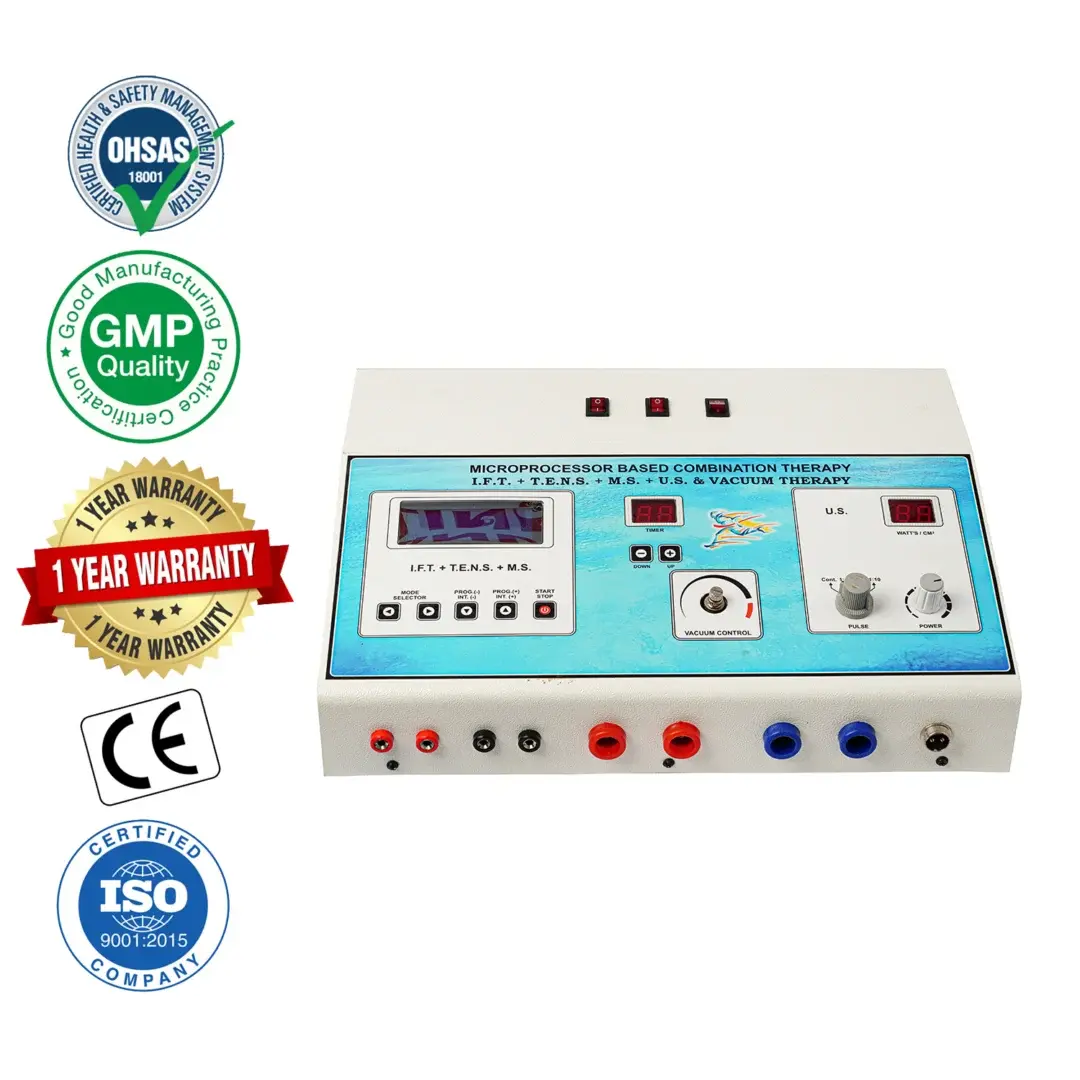
The 5-in-1 Physiotherapy Machine – IFT, TENS, MS, Ultrasonic & Vacuum Therapy is a multi-modality physiotherapy system designed for professional physiotherapy clinics, rehabilitation centres, hospitals, and sports rehabilitation facilities. It combines five therapy functions in one integrated unit, providing access to different treatment modalities within a single equipment setup.
This 5-in-1 Physiotherapy Machine integrates Interferential Therapy (IFT), Transcutaneous Electrical Nerve Stimulation (TENS), Muscle Stimulation (MS), Ultrasonic Therapy, and Vacuum Therapy. Each modality operates differently and may be incorporated into selected physiotherapy protocols according to patient assessment, treatment objectives, and the machine’s specifications.
The combination of electrical stimulation, Ultrasonic Therapy, and vacuum-assisted electrode application can be useful for clinics that require multiple therapy options in one treatment area. The exact program selection, channels, output settings, ultrasonic frequency, and vacuum controls depend on the model configuration and should be confirmed before purchase.
What Is a 5-in-1 Physiotherapy Machine?
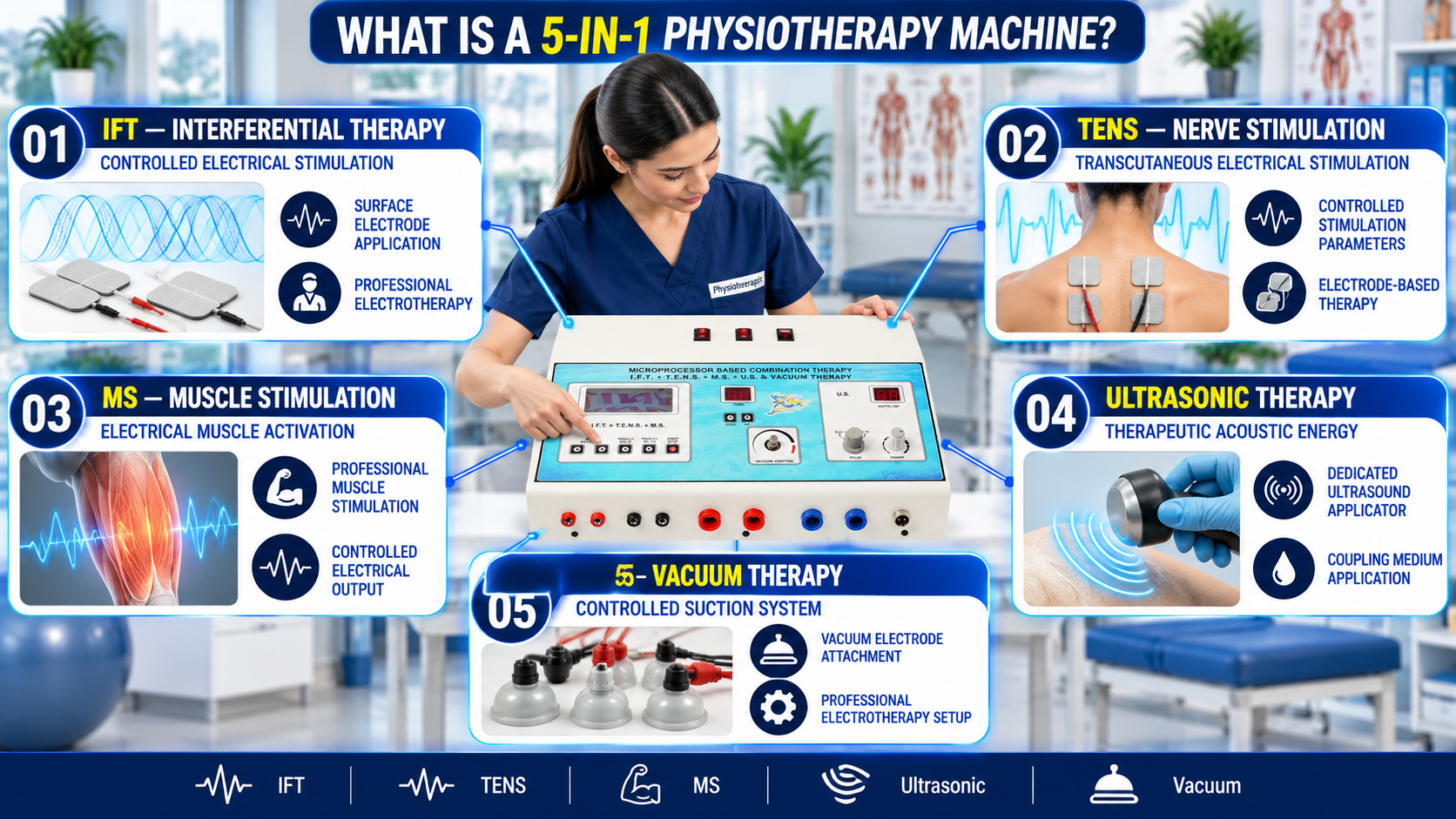
A 5-in-1 Physiotherapy Machine is an integrated therapy system that combines multiple physiotherapy modalities in one unit. Instead of requiring separate machines for every function, the system provides access to five specified therapy functions through a shared equipment platform.
The configuration covered here includes:
- IFT – Interferential Therapy
- TENS – Transcutaneous Electrical Nerve Stimulation
- MS – Muscle Stimulation
- Ultrasonic Therapy
- Vacuum Therapy
IFT, TENS, and MS use controlled electrical stimulation through electrodes. Ultrasonic Therapy uses therapeutic acoustic energy delivered through a dedicated applicator and coupling medium. Vacuum Therapy typically uses controlled suction to help secure compatible electrodes to the skin for applicable electrotherapy procedures.
Although these functions are integrated into one machine, each modality has its own operating requirements and safety considerations. A qualified professional should select the appropriate therapy based on the patient’s needs and the manufacturer’s instructions.
IFT – Interferential Therapy
Interferential Therapy, commonly known as IFT, is an electrotherapy modality that delivers controlled electrical currents through surface electrodes.
The IFT function in this combination machine gives trained operators access to interferential stimulation without requiring a separate standalone IFT unit. Treatment settings depend on the available controls and the machine’s configuration.
IFT Applications
IFT may be incorporated into selected physiotherapy programs involving:
- Musculoskeletal rehabilitation
- Pain-management protocols
- Joint-related rehabilitation
- Soft-tissue rehabilitation
- Sports physiotherapy
- Post-injury rehabilitation
- General physical therapy programs
The appropriate current settings, electrode placement, intensity, and treatment duration should be determined by a qualified professional.
TENS – Transcutaneous Electrical Nerve Stimulation
TENS delivers controlled electrical pulses through surface electrodes placed on the skin. It is commonly used as part of selected physiotherapy pain-management programs.
The integrated TENS function allows clinicians to access this modality through the combination machine’s electrotherapy section. Depending on the model, available settings may include stimulation frequency, pulse width, intensity, operating mode, and treatment duration.
TENS Applications
TENS may be considered in selected programs involving:
- Musculoskeletal discomfort
- Back-related rehabilitation
- Neck and shoulder rehabilitation
- Joint-related physiotherapy
- Sports rehabilitation
- Post-injury treatment plans
- Selected pain-management protocols
TENS should be used according to patient assessment, contraindications, and the machine’s operating instructions.
MS – Muscle Stimulation
MS stands for Muscle Stimulation. This modality delivers controlled electrical impulses through surface electrodes to produce muscle-focused stimulation.
The MS function can be incorporated into selected rehabilitation programs where muscle activation or re-education is considered appropriate. The available stimulation patterns and adjustment options depend on the machine.
MS Applications
Muscle Stimulation may be incorporated into:
- Muscle activation programs
- Muscle re-education
- Selected sports rehabilitation protocols
- Post-injury rehabilitation
- Muscle-focused physiotherapy
- Rehabilitation exercise preparation
- Selected weakness-management programs
The operator should determine appropriate electrode placement, intensity, and treatment duration according to the clinical protocol.
Ultrasonic Therapy
The Ultrasonic Therapy section uses therapeutic acoustic energy delivered through a dedicated applicator. A suitable coupling medium, such as ultrasonic gel, is generally required to support energy transmission between the applicator and the treatment area.
The ultrasonic function provides an additional treatment modality within the same equipment platform. Its operating characteristics depend on the specific configuration.
Ultrasonic Therapy Features
Depending on the model, the ultrasonic section may offer:
- Specified operating frequency
- Adjustable output intensity
- Continuous operation
- Pulsed operation
- Treatment timer
- Dedicated applicator
- Digital controls
- Preset or manual treatment settings
The frequency, maximum intensity, pulse settings, and applicator specifications must be verified from the product datasheet. Do not assume that every model supports both 1 MHz and 3 MHz or all operating modes.
Ultrasonic Therapy Applications
Ultrasonic Therapy may be included in selected physiotherapy protocols involving musculoskeletal rehabilitation and other applications supported by the device’s intended use.
Treatment should be performed using the manufacturer’s recommended applicator technique, appropriate coupling medium, and professionally selected settings.
Vacuum Therapy
Vacuum Therapy in an electrotherapy combination system generally uses controlled suction to hold compatible electrodes against the skin. Depending on the design, vacuum electrodes may be used to deliver electrical stimulation through the designated channels.
This arrangement can support electrode application and positioning during appropriate electrotherapy procedures. The vacuum function does not replace the electrical stimulation modality; it supports the application of compatible electrodes.
Vacuum Therapy Features
Depending on the machine configuration, the vacuum section may provide:
- Vacuum output control
- Compatible vacuum electrode cups
- Suction adjustment
- Connection to designated electrotherapy channels
- Controls for vacuum operation
- Accessories for electrode placement
The exact suction range, number of vacuum channels, electrode cup design, and compatibility with IFT or other modes should be confirmed with the manufacturer.
Vacuum Therapy Applications
Vacuum-assisted electrodes may be used in selected electrotherapy applications where the machine and treatment protocol support them. Electrode placement and suction settings should be selected by a trained professional, taking the patient’s skin condition and comfort into account.
Key Features of the 5-in-1 Physiotherapy Machine
Multiple Therapy Functions
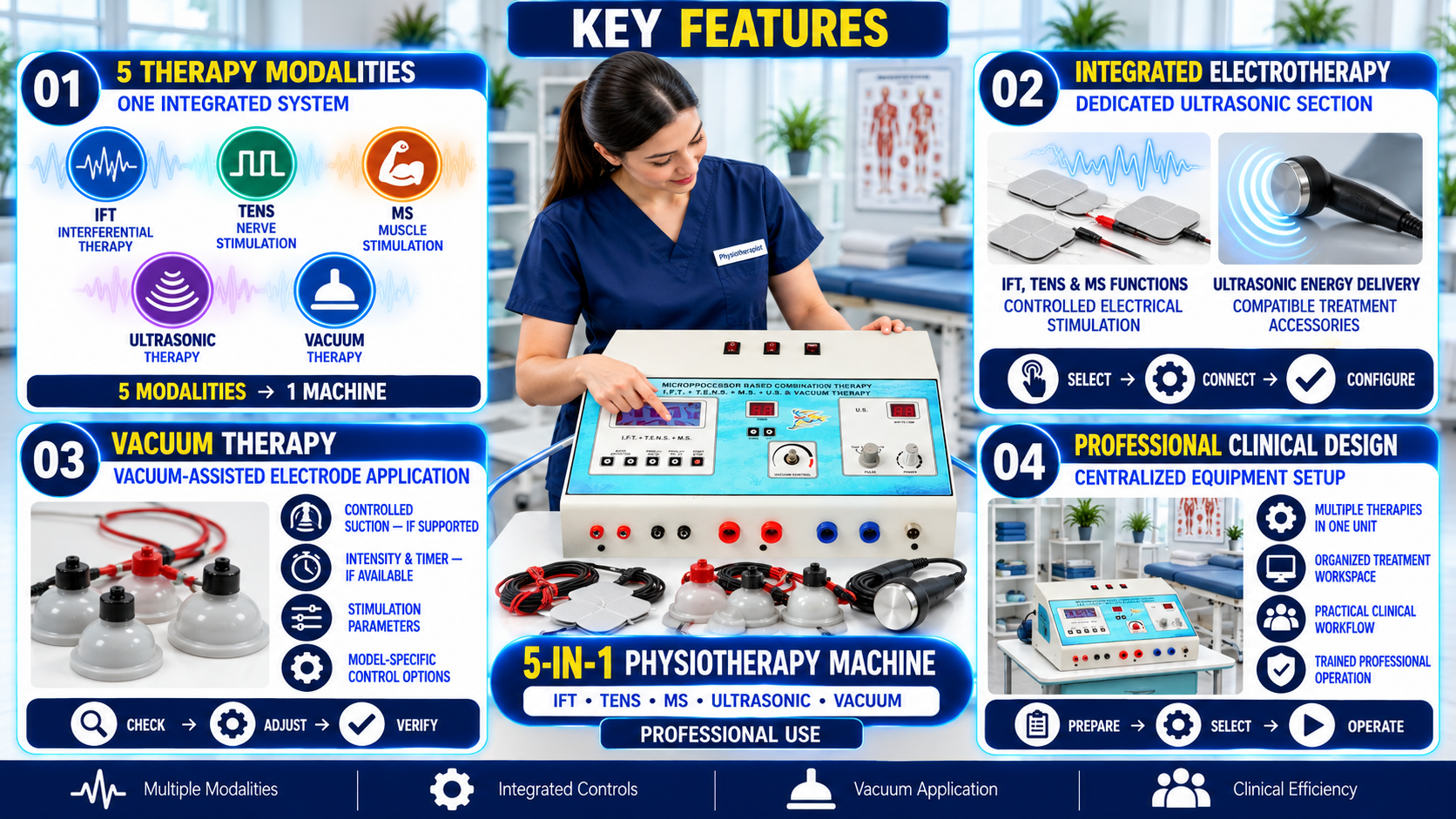
The system integrates IFT, TENS, MS, Ultrasonic Therapy, and Vacuum Therapy in one equipment platform.
Integrated Electrotherapy
IFT, TENS, and MS provide access to different electrical stimulation modalities through the available electrotherapy controls.
Dedicated Ultrasonic Section
The ultrasonic function adds another modality without requiring a separate standalone ultrasonic unit, provided the model includes the specified applicator and accessories.
Vacuum-Assisted Electrode Application
The vacuum section can support compatible electrode placement through controlled suction, depending on the system’s configuration.
Adjustable Treatment Settings
The machine may offer adjustable parameters such as intensity, timer, stimulation settings, ultrasonic output, or vacuum level. The exact controls vary by model.
Centralized Equipment Setup
Combining multiple functions in one unit can help reduce equipment duplication and organize the treatment area.
Professional Physiotherapy Use
The machine is intended for professional treatment environments where its modalities can be selected according to clinical assessment and manufacturer instructions.
Applications of the 5-in-1 Physiotherapy Machine
The 5-in-1 system may be incorporated into professional physiotherapy workflows where the included modalities are appropriate.
Physiotherapy Clinics
General physiotherapy clinics may use the system to access several treatment modalities from one equipment platform.
Rehabilitation Centres
Rehabilitation facilities can consider the machine as part of a wider setup involving therapeutic exercise, mobility training, manual therapy, and other suitable interventions.
Sports Rehabilitation
Sports physiotherapists may incorporate selected electrical stimulation or ultrasonic modalities into rehabilitation programs according to the patient’s assessment.
Orthopaedic Rehabilitation
The available functions may support selected orthopaedic rehabilitation protocols when clinically appropriate.
Pain-Management Programs
IFT and TENS may be considered as part of suitable pain-management plans.
Muscle Rehabilitation
MS provides a muscle-focused electrical stimulation option for selected rehabilitation protocols.
Multi-Modality Treatment Rooms
The integrated configuration can be useful in treatment rooms that require multiple therapy functions but have limited space for separate equipment.
These are potential professional applications, not guarantees of clinical outcomes. The suitability of each modality depends on the patient’s condition, the device’s intended use, and the clinician’s judgment.
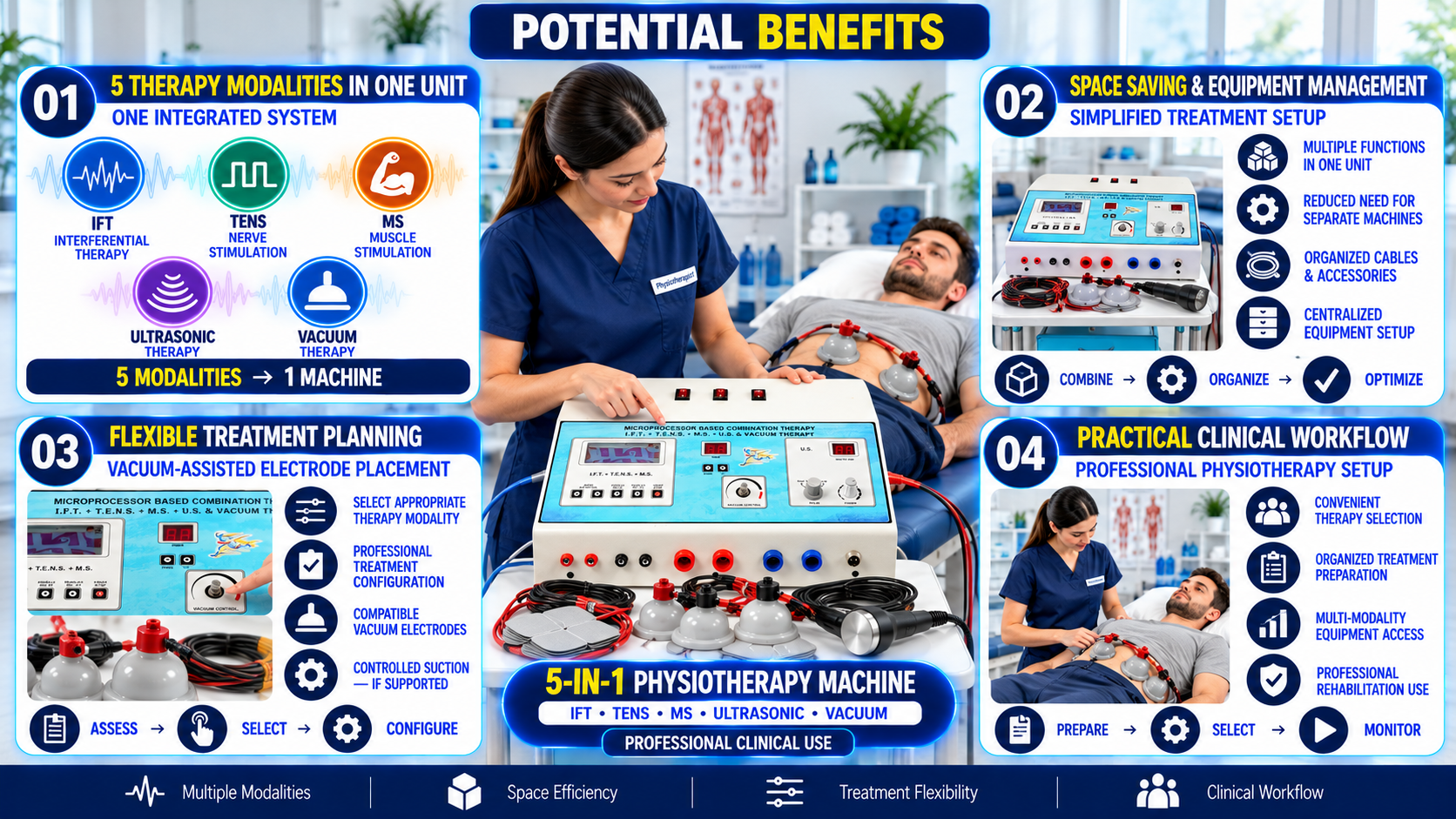
Benefits of a 5-in-1 Physiotherapy Machine
Multiple Modalities in One Unit
The main advantage is access to five therapy functions through one integrated system.
Efficient Use of Space
Combining several functions may reduce the need for separate machine housings and control panels.
Flexible Treatment Planning
A trained physiotherapist can select among the available modalities according to the treatment plan.
Vacuum-Assisted Electrode Placement
Where supported, vacuum electrodes can provide an alternative to compatible conventional electrode arrangements.
Simplified Equipment Management
A centralized unit can help organize cables, accessories, and treatment controls, depending on the design.
Practical Clinical Workflow
The system can support clinics that routinely use several of the included modalities and have verified that the configuration meets their treatment requirements.
Technical Specifications
The following table outlines the configuration described for this product. Confirm all model-specific details against the manufacturer’s official datasheet.
| Specification | Details |
|---|---|
| Product Name | 5-in-1 Physiotherapy Machine |
| Therapy 1 | IFT – Interferential Therapy |
| Therapy 2 | TENS – Transcutaneous Electrical Nerve Stimulation |
| Therapy 3 | MS – Muscle Stimulation |
| Therapy 4 | Ultrasonic Therapy |
| Therapy 5 | Vacuum Therapy |
| Electrotherapy Channels | Confirm with manufacturer |
| Preset Programs | Confirm with manufacturer |
| Ultrasonic Frequency | Confirm with manufacturer |
| Ultrasonic Modes | Model-dependent |
| Ultrasonic Intensity | Confirm with manufacturer |
| Vacuum Control | Model-dependent |
| Display | Confirm with manufacturer |
| Treatment Timer | Model-dependent |
| Electrodes and Leads | According to package configuration |
| Vacuum Electrodes | According to package configuration |
| Ultrasonic Applicator | According to package configuration |
| Power Supply | Confirm with manufacturer |
| Dimensions | Confirm with manufacturer |
| Warranty | Confirm with supplier |
Important: Verify the exact program count, electrical channels, ultrasonic frequency and intensity, vacuum specifications, accessories, and power requirements before publishing technical claims.
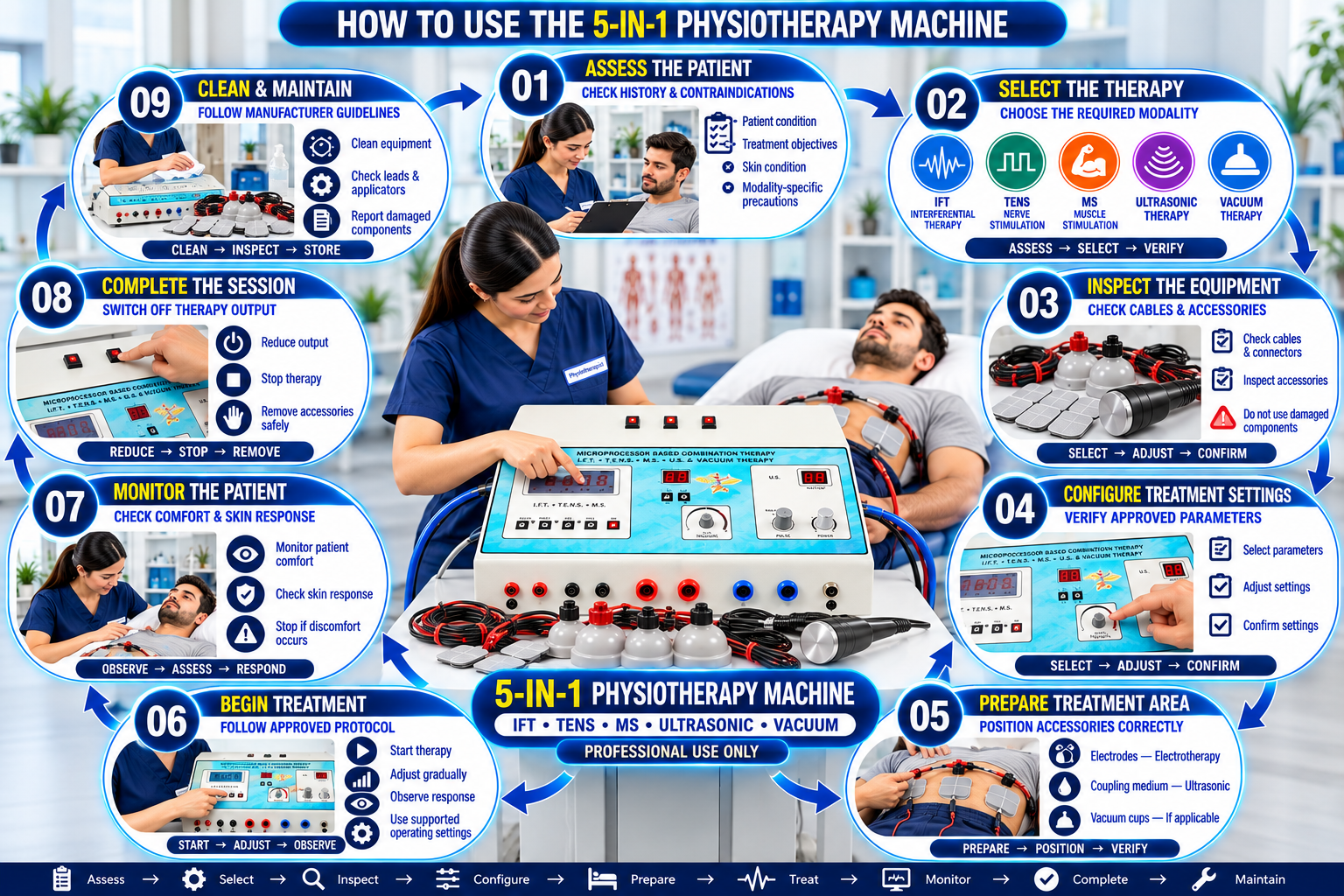
How to Use the 5-in-1 Physiotherapy Machine
Only an appropriately trained healthcare professional should operate the equipment.
Step 1: Assess the Patient
Review the patient’s condition, treatment objective, relevant history, skin condition, and contraindications for the intended modality.
Step 2: Select the Appropriate Therapy
Choose the required function: IFT, TENS, MS, Ultrasonic Therapy, or Vacuum Therapy-supported electrotherapy. Not every modality needs to be used in every session.
Step 3: Inspect the Equipment
Check the power cable, electrode leads, vacuum tubes, electrode cups, ultrasonic applicator, connectors, and other accessories for damage.
Step 4: Configure the Treatment Settings
Select a suitable preset or manual setting if available. Confirm the parameters against the clinical protocol and the manufacturer’s instructions.
Step 5: Prepare the Treatment Area
For electrical stimulation, position electrodes according to the selected treatment protocol. For ultrasonic therapy, use an appropriate coupling medium. For vacuum-assisted electrodes, ensure correct cup placement and suitable suction settings.
Step 6: Begin Treatment Gradually
Start the selected modality according to the approved procedure. Adjust the settings only within the permitted operating range.
Step 7: Monitor the Patient
Observe the patient’s comfort and skin response. Stop treatment if burning, unexpected pain, excessive discomfort, skin irritation, or another concerning response occurs.
Step 8: Complete the Session
Reduce electrical output before removing electrodes. Switch off the applicable functions and remove accessories according to the instructions.
Step 9: Clean and Maintain
Clean reusable accessories using manufacturer-approved methods. Check electrode cups, leads, applicators, and connections regularly.
Safety Precautions
- Use the machine only according to the manufacturer’s instructions.
- Allow only appropriately trained professionals to operate it.
- Review the contraindications for each modality separately.
- Do not place electrical stimulation electrodes across the chest or the front of the neck.
- Patients with implanted electronic devices require appropriate clinical evaluation before electrical stimulation is considered.
- Avoid placing electrodes on damaged or compromised skin unless specifically directed by an appropriate healthcare professional.
- Use suitable coupling gel for Ultrasonic Therapy.
- Follow the recommended ultrasonic applicator technique.
- Monitor the skin and patient comfort when using vacuum-assisted electrodes.
- Do not apply excessive suction or use unsuitable electrode cups.
- Inspect cables, electrodes, vacuum tubing, and applicators before use.
- Do not operate damaged equipment.
- Keep the machine away from unnecessary moisture and water.
- Follow all model-specific warnings and contraindications.
- Stop treatment if an unexpected or significant reaction occurs.
- Clean and maintain accessories according to manufacturer instructions.
Things to Consider Before Buying
Verify the Five Functions
Confirm that the model includes IFT, TENS, MS, Ultrasonic Therapy, and Vacuum Therapy, and clarify how each function operates.
Check the Electrotherapy Channels
Ask about the available channels, intensity ranges, stimulation controls, and whether channels can be adjusted independently.
Review Program Availability
Confirm the number of preset programs and which modalities each program supports.
Check Ultrasonic Specifications
Verify frequency, maximum intensity, continuous and pulsed modes, timer, and applicator details.
Review Vacuum Therapy Controls
Confirm vacuum adjustment, the number of compatible electrode cups, tubing, and the supported electrode configurations.
Confirm Accessories
Ask whether electrode leads, electrodes, vacuum cups, ultrasonic applicator, coupling gel, power cable, and user manual are included.
Verify Warranty and Service
Review warranty coverage, technical support, replacement accessories, and servicing availability before purchase.
Why Choose PHYSIOMODALITIES™?
PHYSIOMODALITIES™, from PHYSIOMODALITIES ENTERPRISES, focuses on physiotherapy and rehabilitation equipment for professional treatment environments.
When evaluating a 5-in-1 Physiotherapy Machine, clinics should consider the required modalities, electrotherapy channels, program availability, ultrasonic specifications, vacuum controls, accessories, warranty, and after-sales support.
Request the exact product datasheet before ordering to confirm the model’s configuration. Selecting equipment according to the clinic’s actual treatment requirements can help create a more practical and organized physiotherapy setup.
Conclusion
The 5-in-1 Physiotherapy Machine – IFT, TENS, MS, Ultrasonic & Vacuum Therapy combines five therapy functions in one integrated system designed for professional physiotherapy and rehabilitation environments. Its combination of electrical stimulation, Ultrasonic Therapy, and vacuum-assisted electrode application can provide multiple treatment options within a centralized equipment setup.
Before purchasing, verify the electrotherapy channels, program count, ultrasonic frequency and output, vacuum controls, included accessories, power requirements, warranty, and technical support. Each modality should be selected according to professional patient assessment and used in accordance with the manufacturer’s instructions.
Frequently Asked Questions
1. What functions are included in this 5-in-1 Physiotherapy Machine?
The specified configuration includes IFT, TENS, MS, Ultrasonic Therapy, and Vacuum Therapy.
2. What is the purpose of Vacuum Therapy in this machine?
The vacuum section generally uses controlled suction to hold compatible electrodes against the skin during supported electrotherapy procedures.
3. Does the machine include Ultrasonic Therapy?
Yes, the described configuration includes an ultrasonic function. Its frequency, output, and operating modes should be confirmed for the exact model.
4. Who can operate this physiotherapy machine?
A qualified physiotherapist or appropriately trained healthcare professional should operate the equipment.
5. What should I check before buying?
Confirm the five functions, channels, preset programs, ultrasonic specifications, vacuum controls, accessories, warranty, and after-sales support.