
A Hand Exercise Table is commonly incorporated into physiotherapy clinics, occupational therapy departments, rehabilitation centres, hospitals, hand therapy units, and sports rehabilitation facilities. Depending on the model, the table may include pulleys, cords, leather loops, weights, hand grips, wrist rollers, and supination-pronation or wrist circumduction attachments.
The Hand Exercise Table from PHYSIOMODALITIES™ can be used as part of a progressive rehabilitation setup where therapists need a dedicated platform for focused upper-limb and hand exercises.
What Is a Hand Exercise Table?
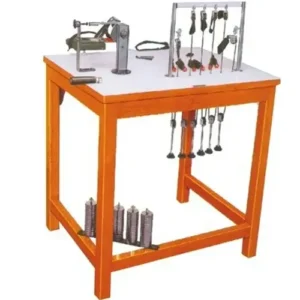
A Hand Exercise Table is a therapeutic exercise unit specifically designed to provide a convenient platform for hand, finger, wrist, and forearm rehabilitation.
Unlike a standard treatment table, it incorporates dedicated exercise mechanisms that allow patients to perform controlled movements against adjustable resistance. Some designs use pulley-and-weight systems for finger and hand exercises, while others include wrist rollers and rotating mechanisms for forearm and wrist movement.
The equipment may support exercises involving:
- Finger movement
- Grip training
- Hand strengthening
- Wrist mobility
- Forearm strengthening
- Wrist circumduction
- Supination and pronation
- Finger coordination
- Controlled resistance exercises
- Functional hand rehabilitation
How Does a Hand Exercise Table Work?
The Hand Exercise Table provides a stable surface and a selection of exercise attachments that allow therapists to create controlled hand and wrist exercise routines.
Finger Exercise
Pulley and cord systems with finger loops can be used to provide controlled resistance or assisted movement for individual fingers or groups of fingers.
Grip Exercise
Selected attachments can be incorporated into grip-focused exercises to progressively challenge hand strength according to the patient’s rehabilitation program.
Wrist Exercise
Wrist rollers and resistance mechanisms can be used for controlled wrist movements and strengthening exercises.
Supination and Pronation
Some Hand Exercise Table designs include a dedicated wrist roller or rotating handle for forearm supination and pronation exercises.
Wrist Circumduction
A wrist-circumduction mechanism may be used to facilitate controlled circular wrist movements and progressive mobility exercises.
Resistance Training
Weight-based systems allow therapists to adjust resistance according to the exercise and rehabilitation stage. Certain models use multiple small weights to allow gradual progression.
Key Features
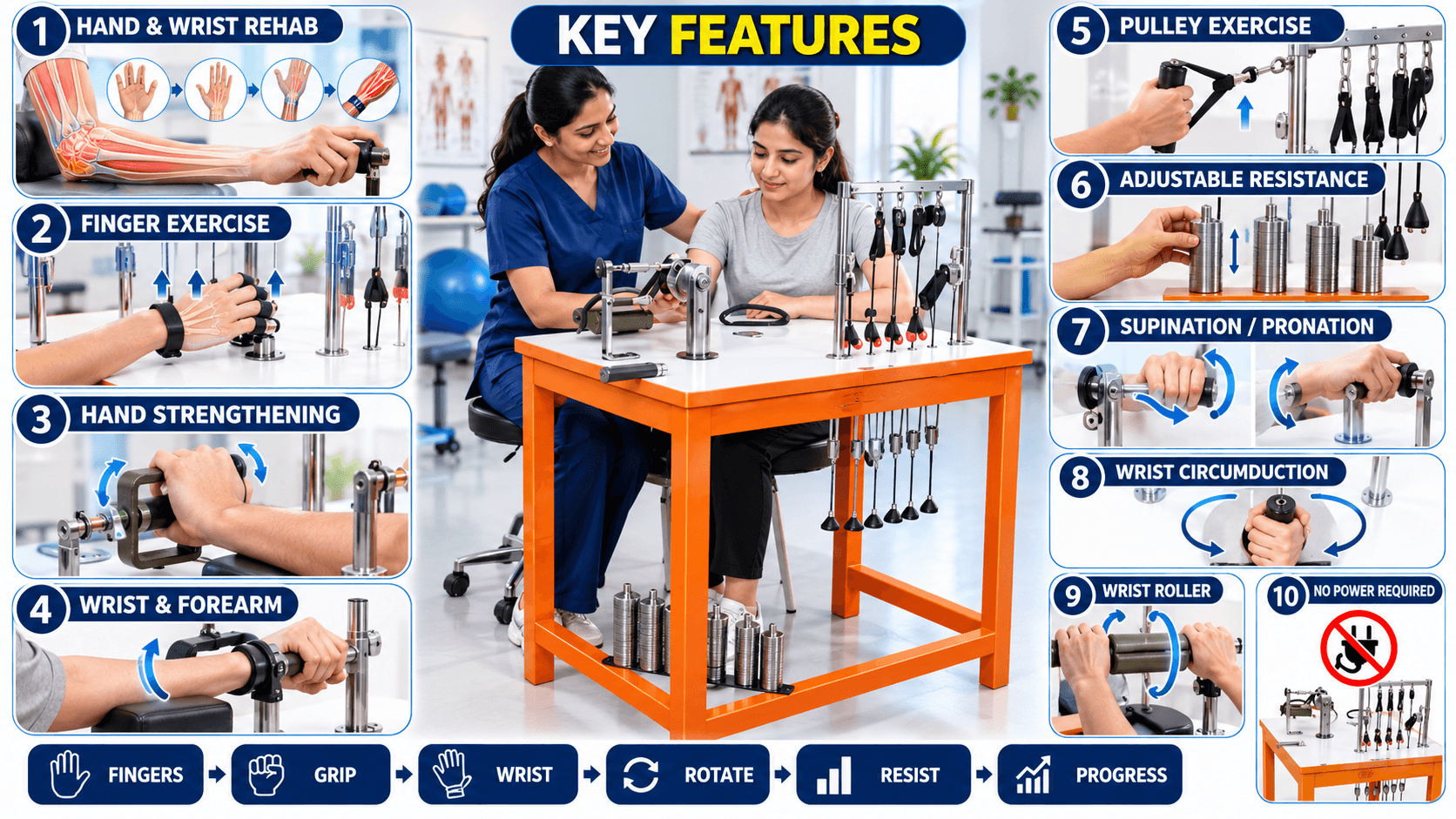
- Dedicated hand and wrist rehabilitation design
- Stable therapeutic exercise table
- Suitable for finger exercises
- Supports hand strengthening activities
- Designed for wrist and forearm exercises
- Pulley-based exercise mechanism on applicable models
- Leather or hand loops depending on model
- Adjustable resistance through weights on applicable models
- Wrist roller attachment on applicable models
- Supination and pronation exercise facility
- Wrist circumduction exercise facility
- Suitable for occupational therapy
- Suitable for physiotherapy clinics
- Supports progressive rehabilitation
- Manual operation
- No electrical power required
- Compact clinical exercise equipment
Applications of Hand Exercise Table
The Hand Exercise Table can be incorporated into different rehabilitation programs where controlled hand and upper-limb exercise is required.
Finger Rehabilitation
The equipment can be used for structured finger exercises involving flexion, extension, controlled resistance, and coordination.
Hand Strengthening
Therapists can incorporate resistance-based exercises to work on hand strength and functional gripping ability.
Wrist Rehabilitation
The table provides a dedicated platform for selected wrist mobility and strengthening exercises.
Forearm Rehabilitation
Supination and pronation exercises can be incorporated using the appropriate rotating attachment.
Post-Surgical Rehabilitation
Following appropriate clinical assessment and clearance, the equipment may be incorporated into rehabilitation programs after selected hand, wrist, or forearm procedures.
Occupational Therapy
Hand Exercise Table equipment is commonly included among occupational therapy equipment alongside other fine-motor and functional training devices.
Neurological Rehabilitation
Selected hand and finger exercises may be incorporated into rehabilitation programs for patients with neurological conditions when prescribed by a qualified professional.
Sports Rehabilitation
Sports rehabilitation facilities can use the equipment for progressive hand, wrist, and forearm conditioning following injury or periods of reduced activity.
Benefits of Hand Exercise Table
When appropriately incorporated into a professional rehabilitation program, the Hand Exercise Table may provide several practical benefits:
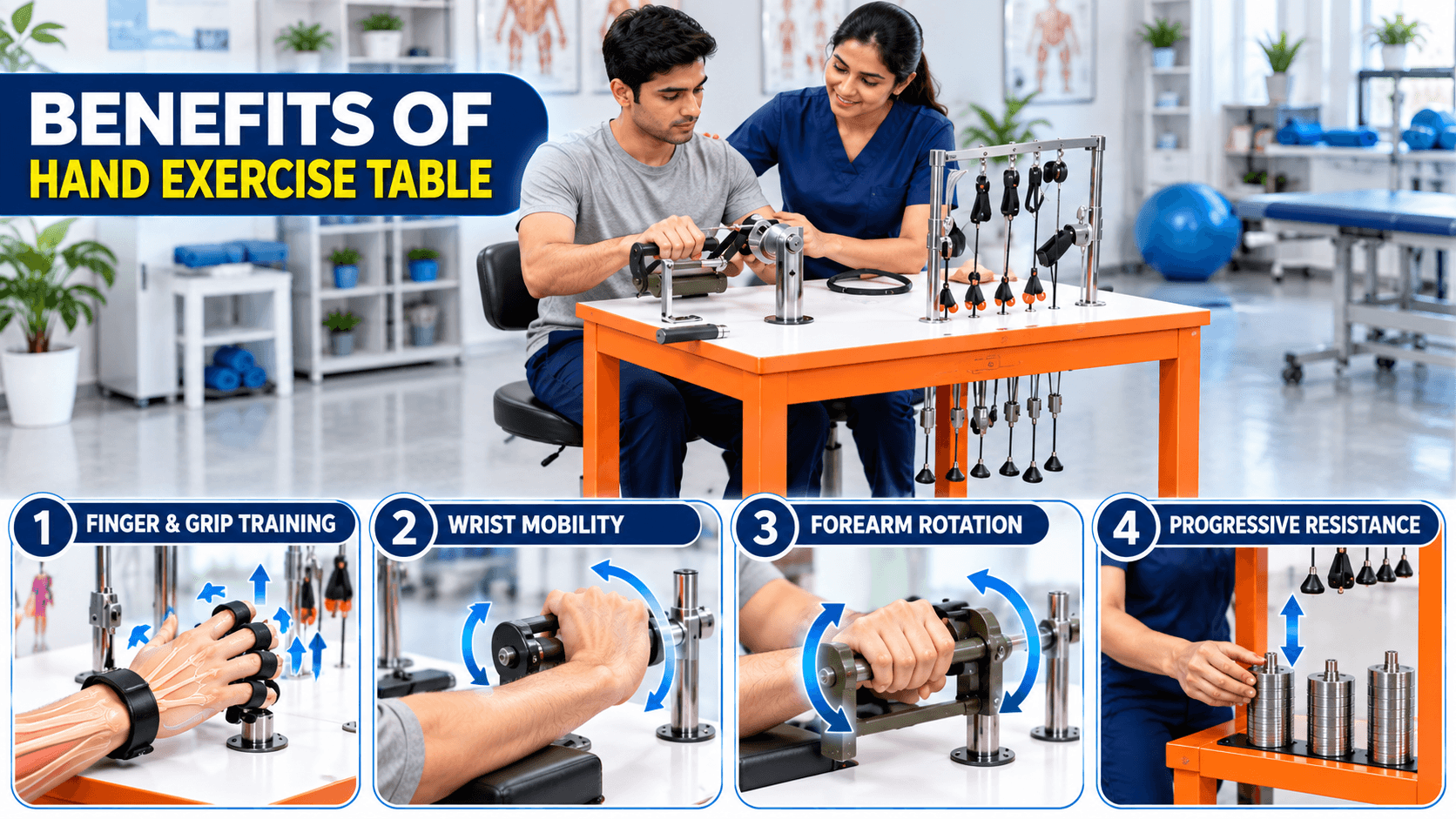
- Provides a dedicated area for hand therapy
- Supports controlled finger exercises
- Helps facilitate progressive hand strengthening
- Supports wrist mobility exercises
- Allows forearm rotation exercises
- Provides adjustable resistance on applicable models
- Supports grip-focused rehabilitation
- Allows therapists to vary exercise difficulty
- Can support coordination-focused exercises
- Useful for occupational therapy programs
- Suitable for repeated clinical use
- Combines several hand exercise functions in one unit
The therapeutic outcome depends on the patient’s condition, exercise selection, resistance level, consistency, and professional rehabilitation program.
Hand Exercise Table for Physiotherapy Clinics
A Hand Exercise Table can be a useful addition to the exercise therapy section of a physiotherapy or rehabilitation clinic.
Hand and wrist rehabilitation often requires repetitive, controlled movement with carefully selected resistance. A dedicated exercise table allows the therapist to position the patient’s hand comfortably while using different attachments for specific movements.
It can be used alongside equipment such as:
- Finger exercisers
- Peg boards
- Shoulder wheels
- Resistance bands
- Grip exercisers
- Therapeutic putty
- Wrist exercisers
- Fine-motor rehabilitation equipment
This makes the Hand Exercise Table suitable for clinics that provide both physiotherapy and occupational therapy services.
How to Use a Hand Exercise Table
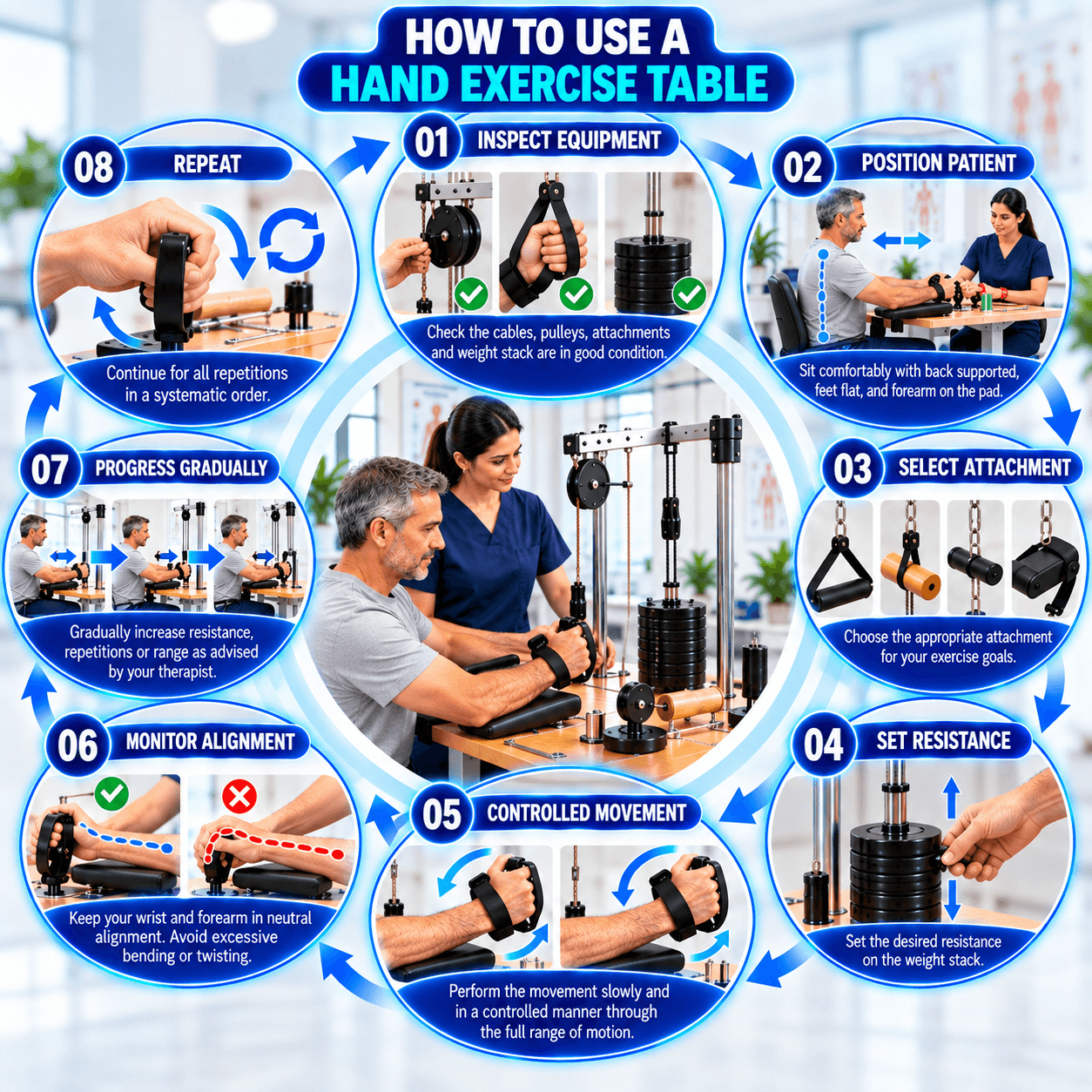
Step 1: Inspect the Equipment
Check the table, frame, pulleys, cords, loops, handles, and weights before starting the exercise.
Step 2: Position the Patient
Seat the patient comfortably and position the hand, wrist, and forearm according to the selected exercise.
Step 3: Select the Attachment
Choose the appropriate finger loop, handle, wrist roller, or other attachment for the intended movement.
Step 4: Set Resistance
If the equipment uses weights, select an appropriate resistance level based on the rehabilitation plan.
Step 5: Perform Controlled Movement
The patient should perform the prescribed movement slowly and in a controlled manner.
Step 6: Monitor Alignment
The therapist should observe wrist, finger, and forearm positioning and avoid unnecessary compensatory movements.
Step 7: Progress Gradually
Resistance, repetitions, or movement range may be progressed according to professional assessment and patient tolerance.
Safety Precautions
- Inspect the equipment before every session.
- Ensure pulleys and cords are properly positioned.
- Check that weights are securely attached.
- Do not use damaged cords, loops, handles, or pulleys.
- Start with an appropriate resistance level.
- Avoid sudden or forceful movements.
- Maintain correct wrist and finger alignment.
- Do not continue an exercise that produces significant pain.
- Patients recovering from surgery should follow professional rehabilitation instructions.
- Keep fingers clear of moving pulley mechanisms.
- Ensure the table remains stable during exercise.
- Clean and maintain the equipment according to the manufacturer’s recommendations.
Who Can Use a Hand Exercise Table?
The equipment may be incorporated into rehabilitation programs for:
- Physiotherapy patients
- Occupational therapy patients
- Hand rehabilitation patients
- Wrist rehabilitation patients
- Forearm rehabilitation patients
- Patients requiring grip training
- Patients performing finger coordination exercises
- Selected post-surgical rehabilitation programs
- Sports rehabilitation patients
- Neurological rehabilitation programs
The specific exercise and resistance should be selected according to the patient’s clinical requirements.
Hand Exercise Table vs Standard Treatment Table
| Feature | Hand Exercise Table | Standard Treatment Table |
|---|---|---|
| Primary Purpose | Hand and upper-limb exercise | General treatment and examination |
| Hand Attachments | Available depending on model | Usually not included |
| Finger Exercise | Supported | Limited |
| Wrist Exercise | Dedicated mechanisms available | Usually requires separate equipment |
| Resistance Training | Available on applicable models | Usually not integrated |
| Pulley System | Available on applicable models | Generally not included |
| Occupational Therapy | Highly suitable | Limited |
| Power Requirement | None for manual models | Usually none |
The choice depends on the type of rehabilitation services offered by the clinic and the specific exercises required.
Technical Specifications
| Specification | Details |
|---|---|
| Product Name | Hand Exercise Table |
| Equipment Type | Hand & Upper-Limb Rehabilitation Equipment |
| Primary Use | Hand, Finger, Wrist & Forearm Exercise |
| Operation | Manual |
| Power Requirement | None |
| Table Structure | Model dependent |
| Table Top | Laminated / model dependent |
| Frame | Steel / model dependent |
| Pulleys | Model dependent |
| Finger Loops | Model dependent |
| Resistance Weights | Model dependent |
| Wrist Exerciser | Available on applicable models |
| Supination-Pronation | Available on applicable models |
| Wrist Circumduction | Available on applicable models |
| Dimensions | Model dependent |
| Load Capacity | Model dependent |
| Suitable For | Physiotherapy, Occupational Therapy & Rehabilitation |
Some professional models use a tubular steel frame with a laminated top, multiple pulleys, finger loops, weight hangers, and wrist exercise attachments. One documented model, for example, uses six pulleys and multiple graduated weights; however, specifications vary between manufacturers and models.
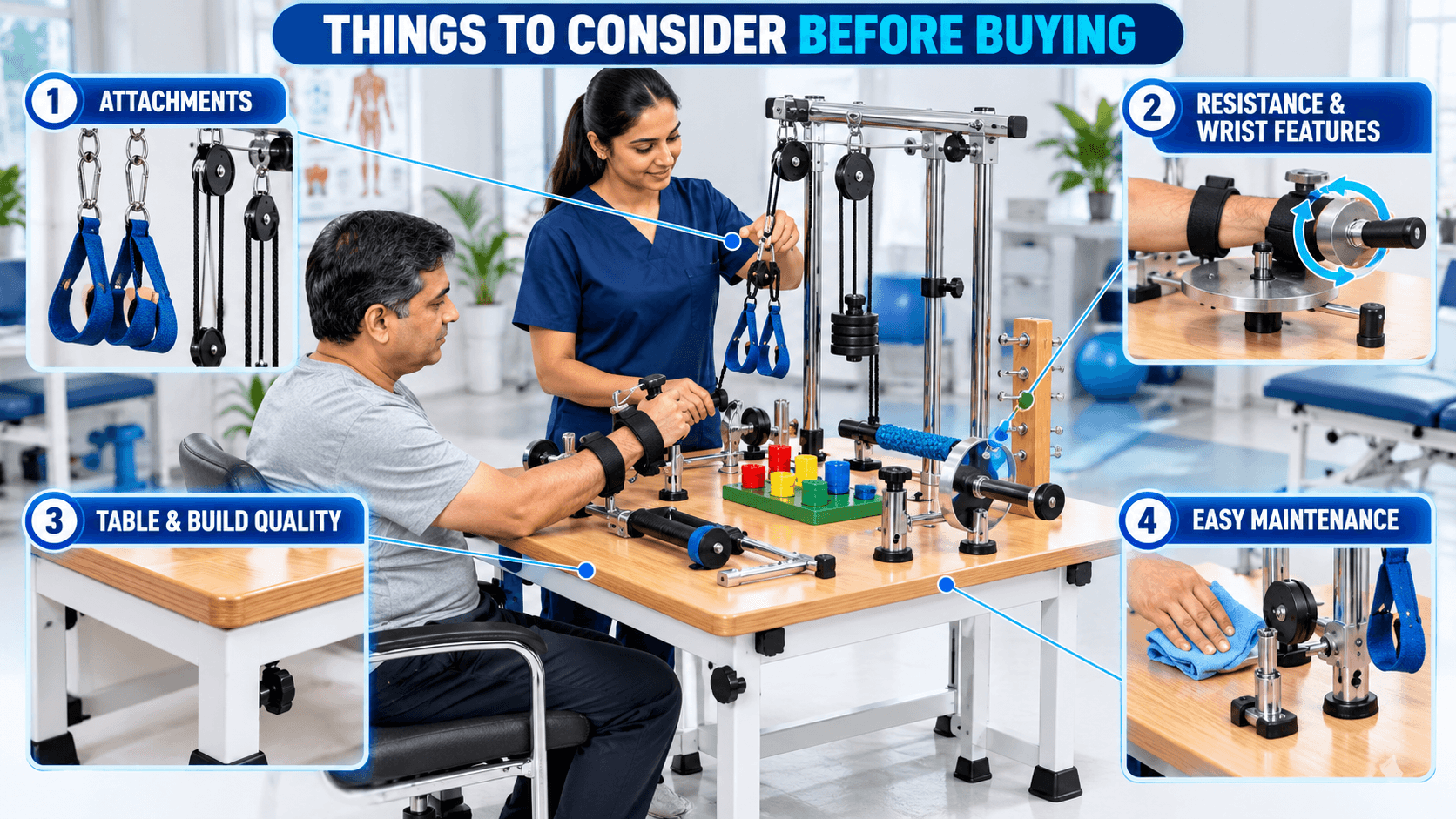
Things to Consider Before Buying
Exercise Attachments
Check whether the table includes the attachments needed for your intended rehabilitation programs, such as finger loops, pulleys, weights, and wrist rollers.
Resistance Options
If progressive strengthening is important, consider a model with multiple resistance levels or graduated weights.
Table Height
The table height should allow comfortable positioning of the patient and therapist during exercise.
Construction Quality
A strong frame and durable tabletop are important for repeated clinical use.
Wrist Exercise Features
For comprehensive hand rehabilitation, consider whether the equipment includes supination-pronation and wrist-circumduction mechanisms.
Maintenance
Choose equipment with accessible components that can be inspected, cleaned, and maintained easily.
Why Choose PHYSIOMODALITIES™?
PHYSIOMODALITIES™ provides physiotherapy and rehabilitation equipment designed for professional clinical environments.
The Hand Exercise Table can complement a rehabilitation setup by providing a dedicated platform for finger, hand, wrist, and forearm exercises.
PHYSIOMODALITIES ENTERPRISES offers equipment across physiotherapy, rehabilitation, exercise therapy, electrotherapy, and clinical treatment categories, helping clinics develop equipment setups according to their individual requirements.
Conclusion
The Hand Exercise Table is a specialized rehabilitation equipment designed for controlled exercise of the fingers, hand, wrist, and forearm.
With suitable attachments such as pulley systems, finger loops, resistance weights, and wrist exercise mechanisms, it can support a variety of progressive rehabilitation activities. Its dedicated design makes it particularly useful for physiotherapy, occupational therapy, hand therapy, and rehabilitation environments.
When selected appropriately and used under professional supervision, a Hand Exercise Table can become a practical component of a structured hand and upper-limb rehabilitation setup.
Frequently Asked Questions
1. What is a Hand Exercise Table used for?
It is used for hand, finger, wrist, and forearm rehabilitation exercises, including strengthening, mobility, grip, coordination, and controlled resistance training.
2. Is a Hand Exercise Table suitable for occupational therapy?
Yes. It can be incorporated into occupational therapy programs focused on hand function, finger movement, wrist mobility, and functional upper-limb rehabilitation.
3. Does a Hand Exercise Table require electricity?
No. Standard manual models operate without electricity.
4. What exercises can be performed on a Hand Exercise Table?
Depending on the model, exercises may include finger resistance exercises, grip training, wrist movement, supination-pronation, wrist circumduction, and forearm exercises.
5. Are weights included with every Hand Exercise Table?
No. Accessories and resistance systems vary by model. Some models include multiple graduated weights, while others may have different attachment configurations.