
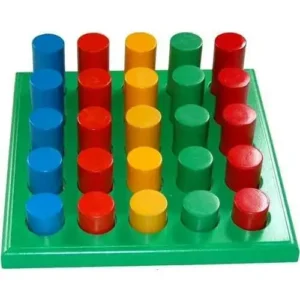
The Five Round Peg Board is a compact occupational therapy and rehabilitation exercise device designed to support hand-eye coordination, fine motor skills, grasping, placement, dexterity, and cognitive-motor activities. It provides a structured tabletop exercise in which users pick up and place pegs into corresponding holes, making it useful for hand rehabilitation and therapeutic skill development.
Peg-board activities are commonly incorporated into occupational therapy because they require coordinated grasping, release, visual guidance, and accurate placement. Round pegs can be particularly convenient to handle, while variations in peg size, height, colour, or arrangement can be used to create different levels of challenge.
The Five Round Peg Board from PHYSIOMODALITIES™ is suitable for physiotherapy clinics, occupational therapy departments, rehabilitation centres, hospitals, and other therapy environments where structured hand and coordination exercises are required.
What Is a Five Round Peg Board?
A Five Round Peg Board is a tabletop rehabilitation activity board containing round pegs and corresponding holes. The user grasps individual pegs and places them into the appropriate positions on the board.
The activity combines several components of hand function, including:
- Grasp and release
- Finger control
- Hand-eye coordination
- Fine motor activity
- Visual-motor coordination
- Dexterity
- Reaching and placement
- Colour recognition
- Sequencing and matching
The exact arrangement and number of pegs can vary by product design. The PME version is listed as a 25-peg round peg board, with multiple peg sizes and colours intended to make the activity more engaging and adaptable.
How Does the Five Round Peg Board Work?
The Five Round Peg Board works through a simple but purposeful grasp-and-place activity.
The patient selects a peg, picks it up using the hand and fingers, identifies the appropriate position, and places it into the corresponding hole. Repeating this process allows the therapist to structure exercises around coordination, dexterity, and controlled hand movement.
Grasping
Picking up each peg requires the patient to use the fingers and hand to establish an appropriate grip.
Placement
The peg must be aligned with the corresponding hole before it can be inserted, requiring controlled hand positioning.
Hand-Eye Coordination
The user visually identifies the target and coordinates hand movement toward that position.
Fine Motor Control
Repeated peg manipulation can be incorporated into activities requiring controlled finger and hand movements.
Colour and Pattern Recognition
When coloured pegs are provided, the therapist can introduce matching, sorting, sequencing, and recognition activities.
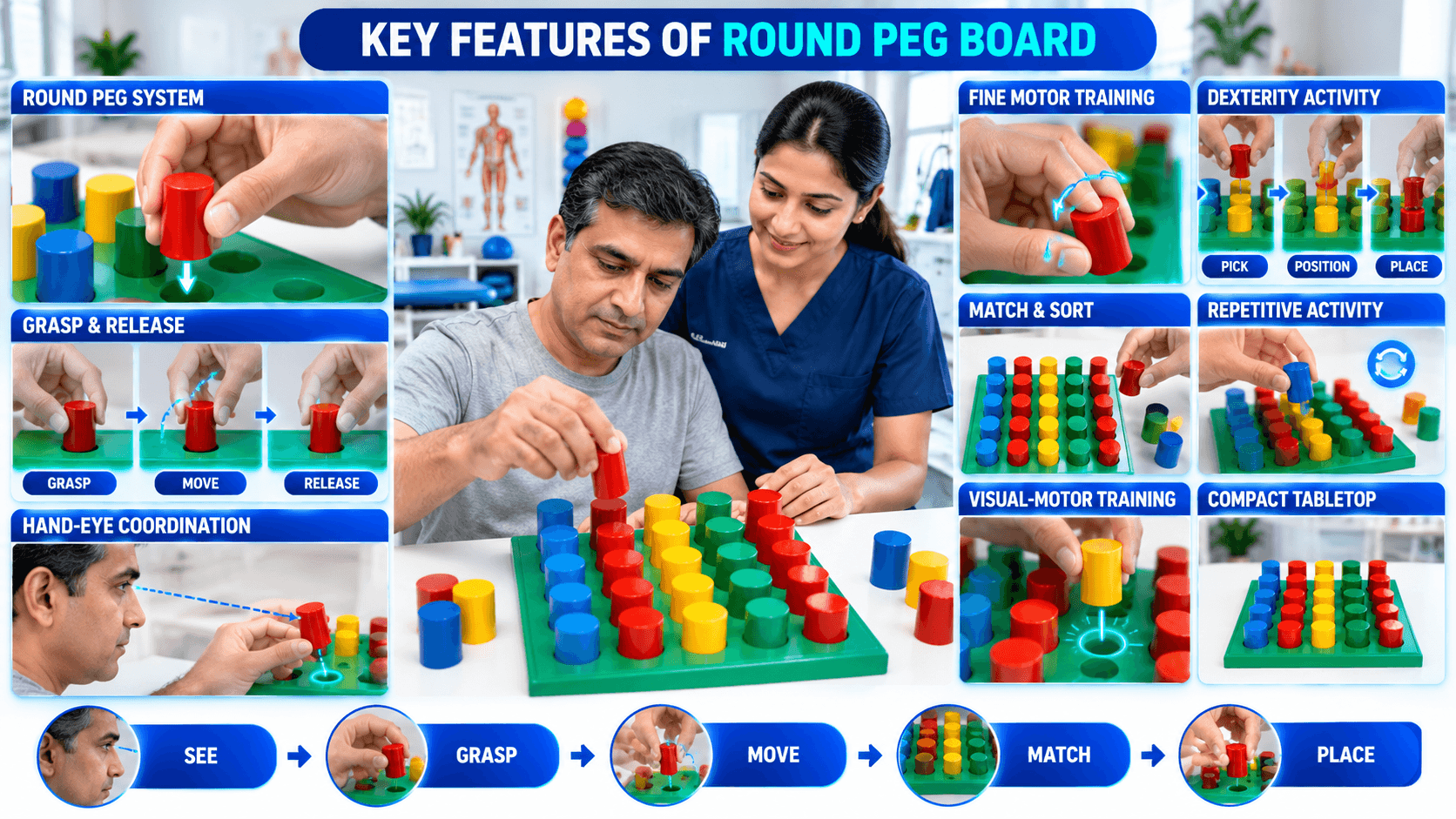
Key Features
- Designed for rehabilitation and occupational therapy
- Round peg-based exercise system
- Multiple pegs for repetitive hand activities
- Different peg sizes and colours depending on configuration
- Supports grasp-and-release activities
- Encourages hand-eye coordination
- Suitable for fine motor exercises
- Useful for dexterity training
- Supports visual-motor activities
- Can be used for matching and sorting tasks
- Compact tabletop design
- Easy to store and handle
- Suitable for physiotherapy and occupational therapy clinics
- Useful for rehabilitation centres and hospitals
Applications of Five Round Peg Board
The Five Round Peg Board can be incorporated into a variety of occupational therapy and rehabilitation activities.
Hand Rehabilitation
The board can be used for structured hand exercises involving repeated grasping, movement, and placement of pegs.
Fine Motor Training
Picking up, controlling, and accurately positioning individual pegs provides an activity for practising fine motor movements.
Hand-Eye Coordination
The placement task requires the patient to coordinate visual information with controlled hand movement.
Dexterity Exercises
Repeated peg manipulation can provide a simple and measurable activity for hand dexterity practice.
Grasp and Release Training
The user repeatedly grasps a peg, transfers it, and releases it into the appropriate opening.
Colour Matching
If the board contains different coloured pegs, therapists can introduce colour-based matching and sorting exercises.
Cognitive-Motor Activities
The board can be used for activities involving recognition, sequencing, matching, and decision-making alongside physical hand movement.
Occupational Therapy
Peg boards are widely used in occupational therapy for activities involving grasp, release, pincer and tripod-type hand functions, bilateral coordination, and visual-perceptual skills.
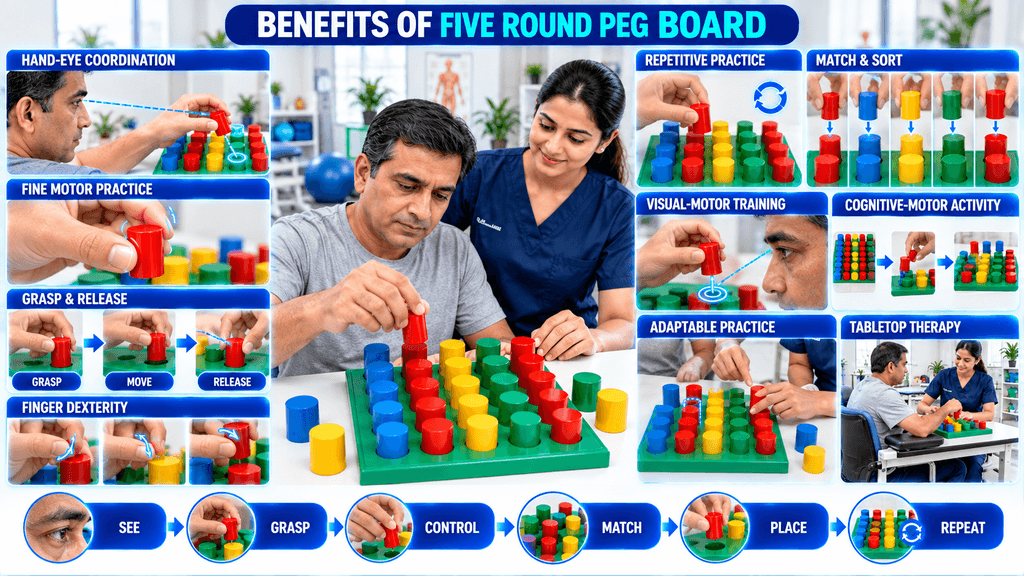
Benefits of Five Round Peg Board
When appropriately incorporated into a therapy program, the Five Round Peg Board may provide several practical benefits:
- Supports hand-eye coordination
- Provides structured fine motor practice
- Encourages controlled grasp and release
- Supports finger and hand dexterity exercises
- Provides repetitive placement practice
- Can be used for visual-motor activities
- Allows colour matching and sorting exercises
- Supports cognitive-motor activities
- Provides a simple tabletop therapy task
- Can be adapted to different patient abilities
- Useful for rehabilitation and occupational therapy settings
These activities provide opportunities for structured practice, but individual progress depends on the patient’s condition, therapy plan, consistency, and ability.
Five Round Peg Board for Physiotherapy and Occupational Therapy Clinics
A Five Round Peg Board is particularly useful in the upper-limb and occupational therapy section of a rehabilitation clinic.
Its compact tabletop format allows therapists to use it during individual therapy sessions without requiring large floor space. It can also be combined with other hand rehabilitation equipment such as finger exercisers, wrist exercise devices, hand therapy tools, puzzles, and functional activity boards.
Because peg placement is a simple and repeatable activity, the therapist can modify the task by changing the order of placement, colour matching requirements, number of repetitions, or peg selection according to the patient’s ability.
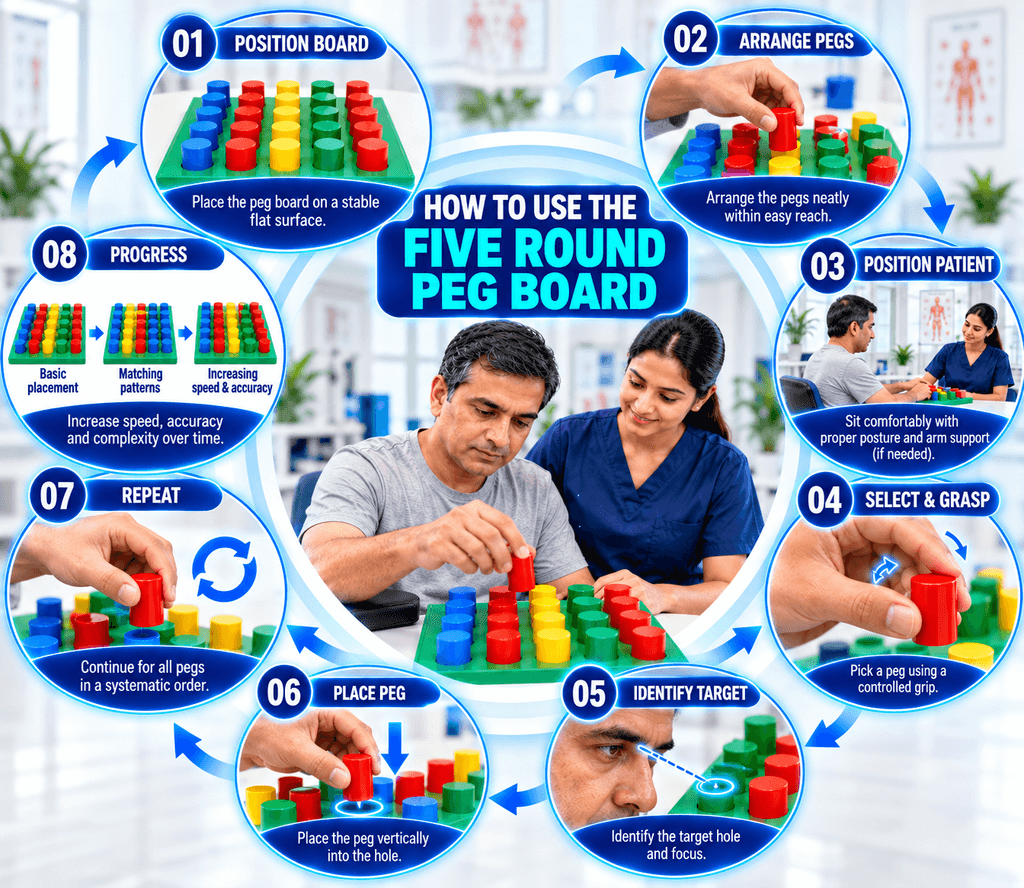
How to Use the Five Round Peg Board
Step 1: Position the Board
Place the board securely on a stable, flat table or therapy surface.
Step 2: Arrange the Pegs
Arrange the pegs according to the selected exercise. Different colours, sizes, or positions can be used to create different activities.
Step 3: Position the Patient
Seat the patient comfortably with the board positioned within an appropriate reaching distance.
Step 4: Select a Peg
Ask the patient to pick up a selected peg using the prescribed hand or grip.
Step 5: Identify the Target
The patient identifies the corresponding hole or target position.
Step 6: Place the Peg
The patient guides the peg into the appropriate hole using controlled hand and finger movement.
Step 7: Repeat the Activity
Repeat the exercise according to the therapist’s prescribed repetitions and activity level.
Step 8: Progress the Exercise
The therapist can increase the challenge by changing the placement sequence, using colour matching, increasing repetitions, or selecting different peg sizes where available.
Safety Precautions
- Inspect the board and pegs before use.
- Do not use damaged or splintered wooden components.
- Keep small components away from children who may place objects in their mouth.
- Ensure the board is positioned securely on the table.
- Select an activity appropriate for the patient’s hand function.
- Do not force painful finger or wrist movement.
- Provide supervision where required.
- Keep the therapy area clean and organized.
- Clean the equipment according to the clinic’s hygiene procedure.
- Store pegs safely after each therapy session.
Who Can Use a Five Round Peg Board?
The equipment may be incorporated into therapy programs for:
- Occupational therapy patients
- Physiotherapy patients requiring hand exercises
- Hand rehabilitation patients
- Upper-limb rehabilitation programs
- Patients working on coordination
- Patients performing fine motor activities
- Individuals requiring dexterity exercises
- Rehabilitation centre patients
- Patients performing cognitive-motor activities
The specific activity should be selected according to the patient’s functional ability and therapy objectives.
Five Round Peg Board vs Other Peg Boards
| Feature | Five Round Peg Board | Multi-Shaped Peg Board |
|---|---|---|
| Main Shape | Round pegs | Multiple shapes |
| Primary Activity | Peg placement | Shape and peg placement |
| Fine Motor Training | Yes | Yes |
| Hand-Eye Coordination | Yes | Yes |
| Colour Activities | Depending on model | Commonly available |
| Shape Recognition | Limited | More extensive |
| Exercise Complexity | Simple to moderate | Moderate to advanced |
| Application | Hand & coordination training | Fine motor & visual-perceptual activities |
Different peg-board designs can be selected according to the therapy objective. Round peg boards are commonly used for grasping and placement activities, while multi-shaped boards can add shape-discrimination tasks.
Technical Specifications
| Specification | Details |
|---|---|
| Product Name | Five Round Peg Board |
| Equipment Type | Occupational Therapy & Rehabilitation Equipment |
| Application | Hand, Fine Motor & Coordination Training |
| Peg Type | Round |
| Number of Pegs | 25P configuration |
| Peg Sizes/Colours | Vary according to configuration |
| Board Type | Therapy/Activity Board |
| Operation | Manual |
| Power Requirement | None |
| Exercise Type | Grasp, Placement & Coordination |
| Usage | Physiotherapy, Occupational Therapy & Rehabilitation |
| Suitable For | Clinics, Hospitals & Rehabilitation Centres |
*The PME product listing identifies this model as a 25-peg Five Round Peg Board. Exact dimensions, material, peg dimensions, and colour configuration should be confirmed according to the supplied model. *
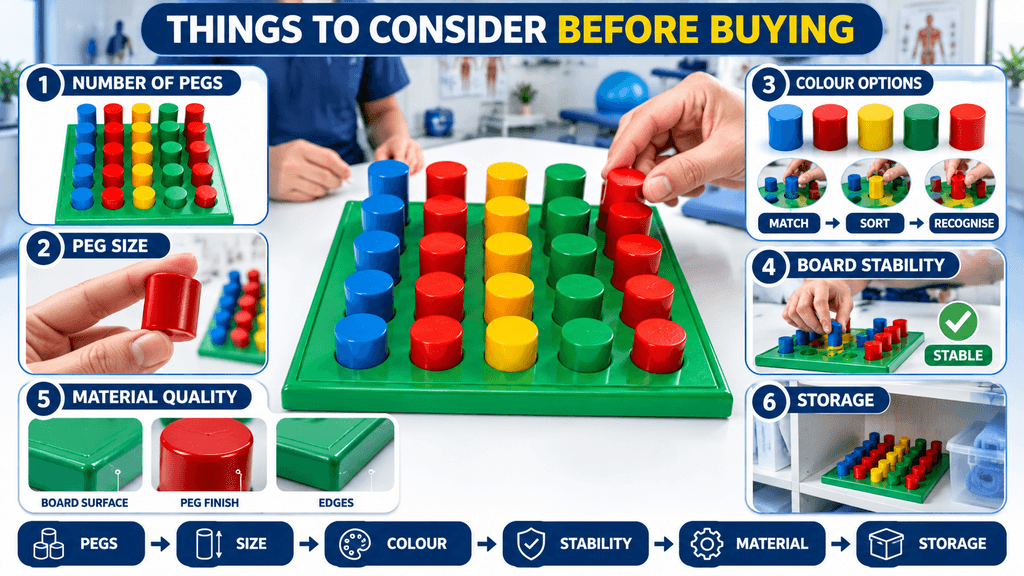
Things to Consider Before Buying
Number of Pegs
Consider the number of pegs required for the intended therapy activities. The PME product is listed in a 25-peg configuration.
Peg Size
Different peg sizes can create different levels of grasping and placement difficulty.
Colour Options
Multiple colours can support matching, sorting, and recognition activities.
Board Stability
The board should remain stable during repeated peg insertion and removal.
Material Quality
Durable board and peg construction is important for repeated use in professional therapy environments.
Storage
A compact board with easy-to-store pegs can help keep the therapy area organized.
Why Choose PHYSIOMODALITIES™?
PHYSIOMODALITIES™ provides physiotherapy, rehabilitation, and occupational therapy equipment designed for professional therapy environments.
The Five Round Peg Board provides a straightforward activity-based approach to hand, coordination, dexterity, and visual-motor exercises. Its compact format makes it convenient for use on therapy tables and workstations.
PHYSIOMODALITIES ENTERPRISES offers equipment across physiotherapy, rehabilitation, exercise therapy, occupational therapy, and clinical treatment categories, helping clinics develop practical therapy setups according to their requirements.
Conclusion
The Five Round Peg Board is a practical occupational therapy and rehabilitation tool designed for structured hand and coordination activities. Through repeated grasping, transferring, matching, and peg placement, it can be incorporated into fine motor, dexterity, hand-eye coordination, and cognitive-motor exercises.
Its compact tabletop design makes it convenient for physiotherapy clinics, occupational therapy departments, rehabilitation centres, and hospitals. The activity can also be modified according to the patient’s ability by changing the placement sequence, repetitions, colours, or available peg sizes.
For professional rehabilitation, the exercises should be selected and progressed according to the patient’s functional ability and therapeutic goals.
Frequently Asked Questions
1. What is a Five Round Peg Board used for?
A Five Round Peg Board is used for hand rehabilitation, fine motor exercises, grasp-and-release activities, hand-eye coordination, dexterity, and visual-motor training.
2. How many pegs does the Five Round Peg Board have?
The PHYSIOMODALITIES™ product is listed as a 25-peg configuration.
3. Can it be used for occupational therapy?
Yes. Peg boards are commonly used in occupational therapy for grasping, placement, hand coordination, fine motor, and visual-perceptual activities.
4. Can the Five Round Peg Board be used for colour matching?
Yes. When different coloured pegs are supplied, therapists can incorporate colour matching, sorting, and sequencing activities.
5. Does the Five Round Peg Board require electricity?
No. It is a manual tabletop therapy device and does not require electrical power.