
The Exercise Ball is a versatile physiotherapy and rehabilitation equipment designed to support balance training, core strengthening, flexibility, posture exercises, mobility training, and functional rehabilitation. Also commonly used as a stability or therapy ball, it provides an unstable exercise surface that encourages controlled muscle engagement while performing different movements.
Exercise balls are widely incorporated into physiotherapy clinics, rehabilitation centres, fitness facilities, sports training environments, and home exercise programs. Depending on the patient’s condition and exercise objective, the ball can be used for sitting exercises, supported stretching, balance activities, trunk stabilization, strengthening, and functional movement training.
The Exercise Ball from PHYSIOMODALITIES™ can be incorporated into a wide range of exercise therapy and rehabilitation programs, offering a simple and adaptable tool for progressive physical training.
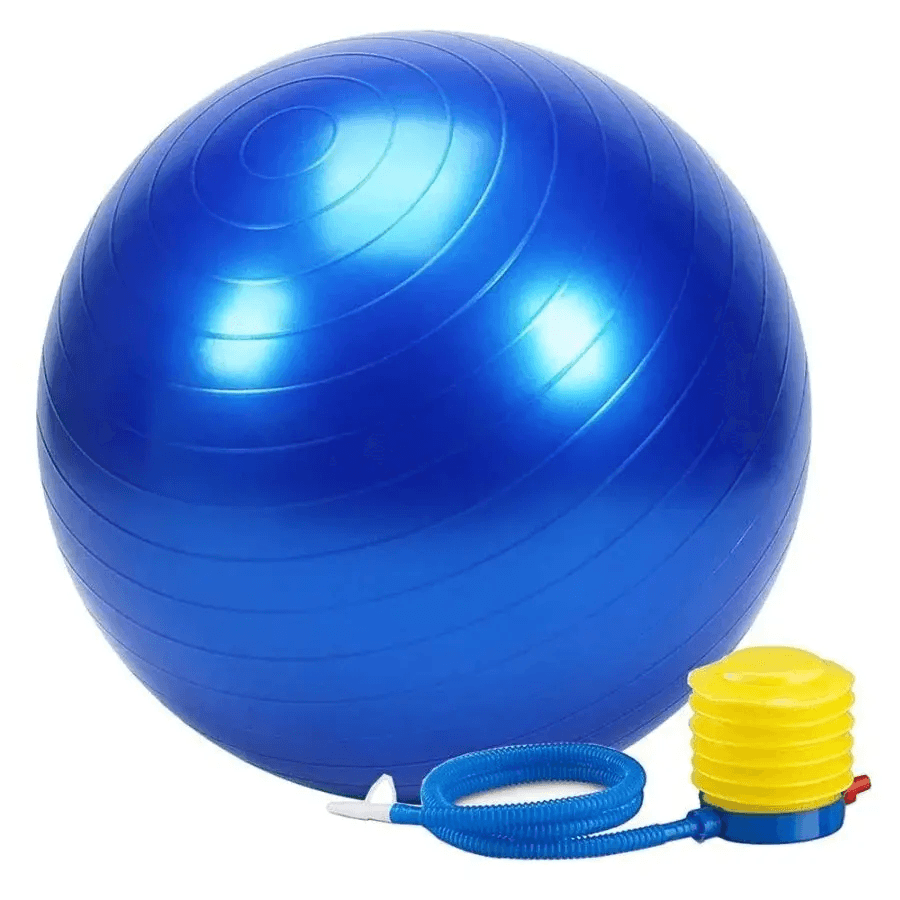
What Is an Exercise Ball?
An Exercise Ball is an inflatable, resilient ball used for controlled physical exercises. Its rounded and unstable surface requires the body to make continuous small adjustments to maintain balance and positioning.
Unlike a fixed exercise bench or chair, an exercise ball introduces an element of instability. This can increase the need for postural control and coordinated muscle activation during suitable exercises.
Depending on the size and design, exercise balls can be used for:
- Core exercises
- Balance training
- Postural exercises
- Flexibility exercises
- Mobility training
- Lower-limb exercises
- Upper-body exercises
- Functional rehabilitation
- Stretching
- Stability training
The appropriate ball size and exercise should be selected according to the user’s height, physical ability, and rehabilitation requirements.
How Does an Exercise Ball Work?
An Exercise Ball provides an unstable surface that requires controlled body adjustments during exercise.
When a person sits, lies, kneels, or supports part of the body on the ball, the body has to maintain alignment while responding to the movement of the ball. This can make otherwise simple exercises more challenging.
Core Stabilization
The unstable surface can encourage activation of the trunk muscles during suitable exercises. Core-focused exercises may include seated balance, pelvic movements, supported crunch variations, and controlled trunk exercises.
Balance Training
The ball can be used to develop balance and postural control through supervised exercises.
Flexibility and Stretching
The curved surface provides different support positions that can be used for selected stretching and mobility exercises.
Strengthening Exercises
Exercise balls can be incorporated into bodyweight strengthening routines for the abdomen, back, hips, legs, shoulders, and arms.
Functional Exercise
Therapists can use the ball to introduce controlled instability into functional movements and progressive rehabilitation activities.
Key Features
- Versatile physiotherapy exercise equipment
- Suitable for rehabilitation and fitness exercises
- Supports balance and stability training
- Useful for core strengthening
- Suitable for posture and mobility exercises
- Can be used for stretching
- Supports functional movement training
- Available in different sizes depending on model
- Lightweight and portable
- Easy to store when deflated
- Suitable for individual and supervised exercise
- Can be incorporated into progressive rehabilitation programs
- Suitable for physiotherapy clinics and rehabilitation centres
- Multi-purpose exercise application
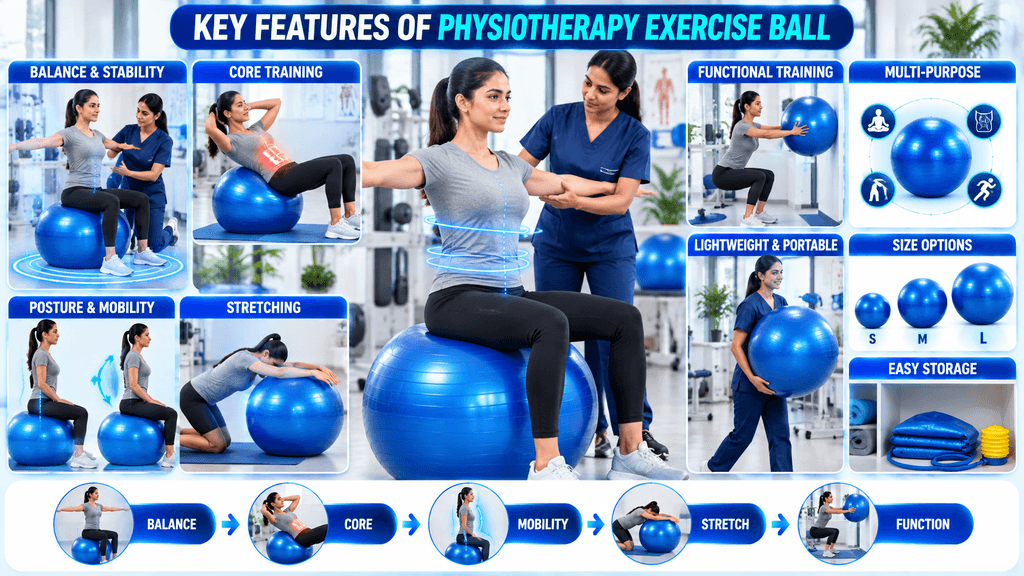
Applications of Exercise Ball
The Exercise Ball can be used across different physiotherapy and rehabilitation programs.
Physiotherapy Exercise
Therapists can incorporate the ball into exercise-based rehabilitation for controlled strengthening, mobility, balance, and functional training.
Core Strengthening
The ball can add instability to selected trunk exercises, encouraging controlled stabilization and postural control.
Balance Training
Seated or supported exercises can be used to challenge balance progressively according to the patient’s ability.
Posture Training
Exercise-ball activities may be incorporated into programs that focus on trunk alignment, sitting control, and postural awareness.
Lower-Limb Rehabilitation
The ball can be used for selected hip, knee, and lower-limb exercises, including supported strengthening and movement activities.
Upper-Limb Exercise
It can also be incorporated into certain upper-body exercises, stretching routines, and weight-bearing activities.
Sports Training
Athletes may use exercise balls for stability, mobility, strengthening, and functional conditioning.
General Fitness
Exercise balls can be used for a variety of general fitness and conditioning exercises when appropriate.
Benefits of Exercise Ball
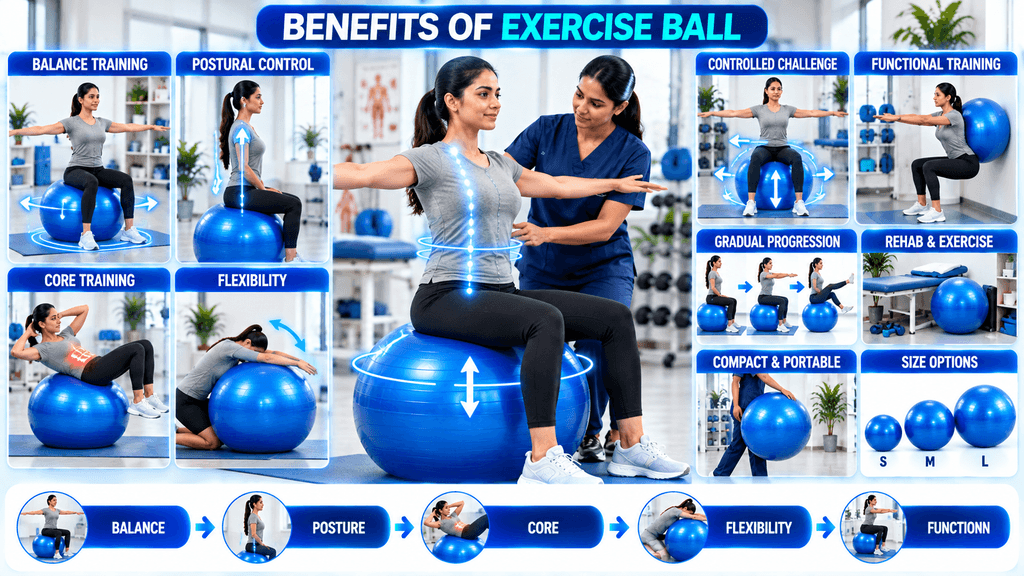
When used correctly as part of an appropriate exercise program, an Exercise Ball may provide several practical benefits:
- Supports balance training
- Encourages postural control
- Can be incorporated into core exercises
- Supports flexibility and stretching
- Provides an unstable exercise surface
- Can make selected exercises progressively challenging
- Supports functional movement training
- Useful for rehabilitation and exercise therapy
- Suitable for different age and fitness groups when appropriately selected
- Easy to integrate into clinic exercise programs
- Compact and portable compared with many larger rehabilitation devices
The benefits depend on the exercise performed, ball size, user’s ability, and overall rehabilitation program.
Exercise Ball for Physiotherapy Clinics
An Exercise Ball is a useful addition to the exercise therapy section of a physiotherapy clinic because it can be used for multiple types of rehabilitation exercises.
A single ball can support different exercise positions, including sitting, lying, kneeling, and supported movement. This allows therapists to adapt exercises according to the patient’s current ability and gradually increase the challenge.
Exercise balls can be used alongside other rehabilitation equipment such as parallel bars, resistance bands, balance boards, treatment tables, stair training equipment, and strengthening devices.
For clinics with limited space, the ball can be particularly convenient because it can be moved easily and stored when not in use.
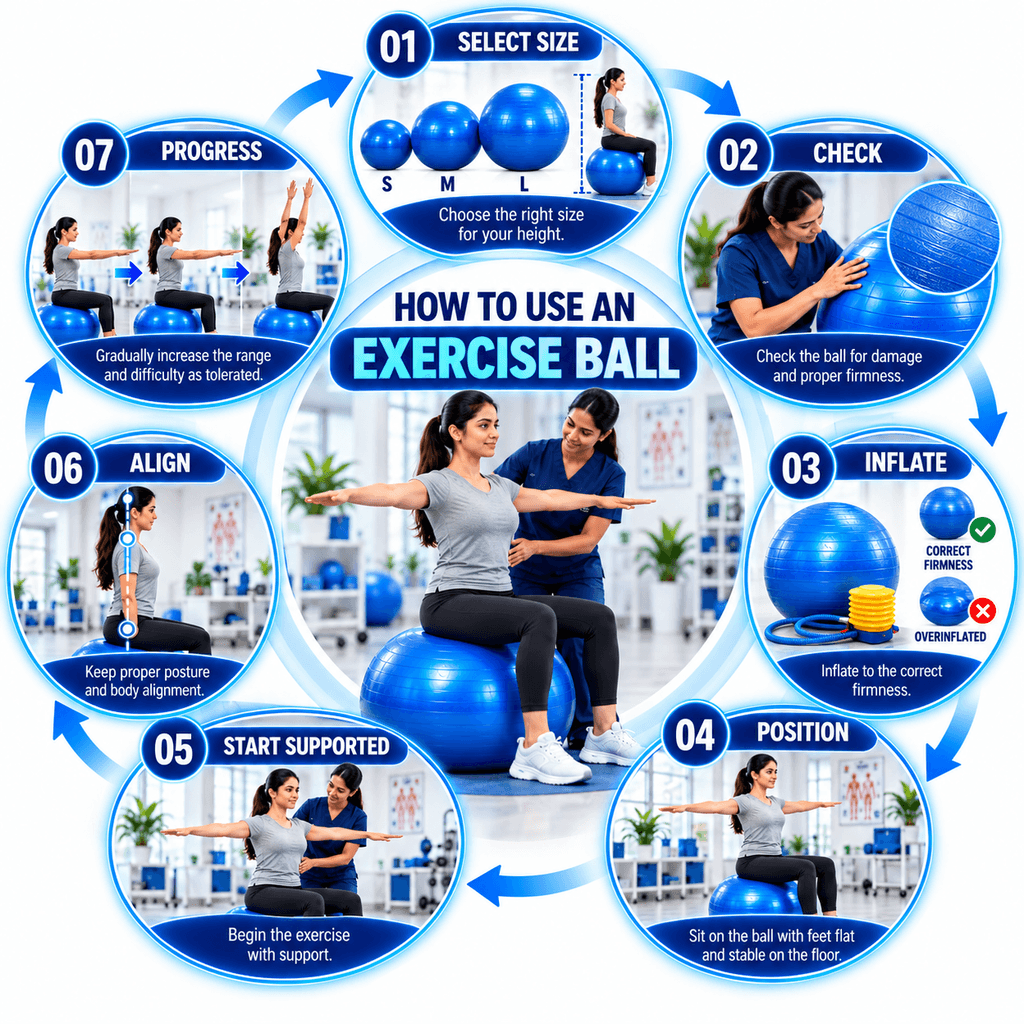
How to Use an Exercise Ball
Step 1: Select the Appropriate Ball Size
Choose a ball size according to the user’s height, exercise requirements, and manufacturer’s recommendations.
Step 2: Check the Ball
Before use, inspect the surface for cuts, punctures, excessive wear, or other damage.
Step 3: Inflate Correctly
Inflate the ball according to the manufacturer’s recommended pressure. Avoid overinflation.
Step 4: Position the Ball
Place the ball on a clean, stable, and non-slippery surface.
Step 5: Begin With a Supported Exercise
New users should begin with simple and controlled movements, preferably with professional supervision when used for rehabilitation.
Step 6: Maintain Proper Alignment
Maintain controlled posture and avoid sudden movements while exercising.
Step 7: Progress Gradually
As balance and strength improve, the therapist can introduce more challenging exercises.
Safety Precautions
- Inspect the ball before every use.
- Do not use a ball with visible damage or excessive wear.
- Inflate according to manufacturer instructions.
- Avoid placing the ball on sharp or abrasive surfaces.
- Use appropriate footwear or exercise conditions to reduce slipping.
- Beginners should perform challenging balance exercises with supervision.
- Keep adequate space around the ball.
- Do not perform exercises beyond the user’s ability.
- Avoid sudden or uncontrolled movements.
- Use additional support when necessary.
- Follow professional rehabilitation instructions for patients recovering from injury or surgery.
- Replace the ball if its structural integrity becomes questionable.
Who Can Use an Exercise Ball?
An Exercise Ball can be incorporated into exercise programs for:
- Physiotherapy patients
- Rehabilitation patients
- Sports participants
- Fitness users
- Individuals working on balance
- Individuals performing flexibility exercises
- Patients undergoing functional rehabilitation
- Users performing core strengthening exercises
The exercise selection should be adjusted to the user’s age, ability, physical condition, and rehabilitation goals.
Exercise Ball vs Conventional Exercise Surface
| Feature | Exercise Ball | Fixed Exercise Surface |
|---|---|---|
| Stability | Unstable | Stable |
| Balance Challenge | Higher | Generally lower |
| Core Engagement | Can increase during suitable exercises | Depends on exercise |
| Portability | High | Varies |
| Exercise Variety | Multiple positions | Exercise dependent |
| Storage | Compact | May require more space |
| Rehabilitation Use | Balance, strength & mobility | General exercise & support |
An exercise ball does not replace a stable treatment surface. Instead, it provides another exercise option for appropriate patients and activities.
Technical Specifications
| Specification | Details |
|---|---|
| Product Name | Exercise Ball |
| Equipment Type | Physiotherapy & Exercise Equipment |
| Application | Rehabilitation, Fitness & Exercise Therapy |
| Material | Model dependent |
| Size | Model dependent |
| Diameter | Model dependent |
| Inflation | Air-filled |
| Surface | Textured or smooth depending on model |
| Weight Capacity | Model dependent |
| Usage | Balance, Strengthening, Mobility & Flexibility |
| Power Requirement | None |
| Suitable For | Clinics, Rehabilitation Centres, Fitness & Home Exercise |
Exact diameter, material, weight capacity, surface design, and colour may vary according to the selected PHYSIOMODALITIES™ model.
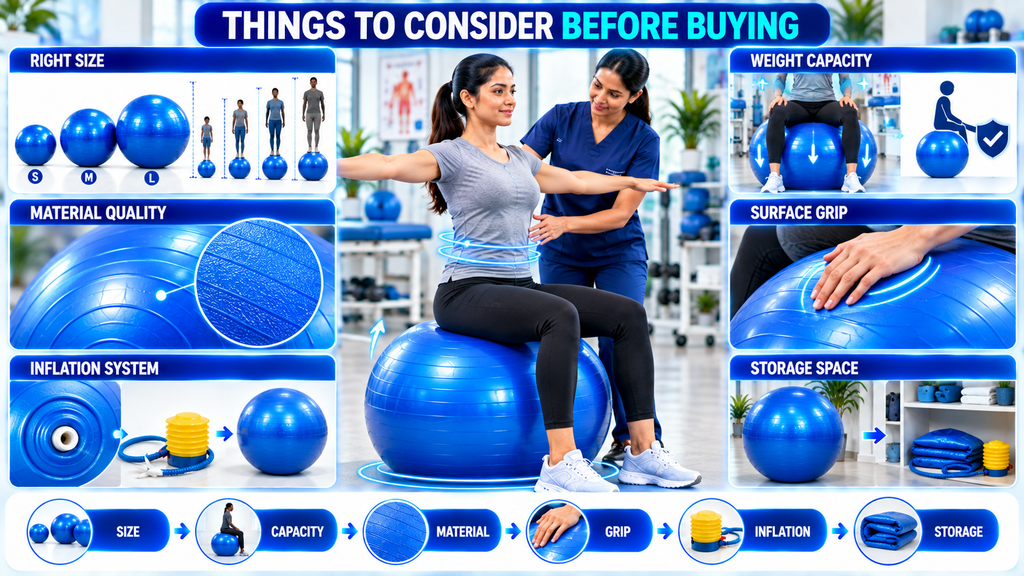
Things to Consider Before Buying
Ball Size
Selecting the correct diameter is important for comfortable and effective positioning. Ball size should be matched to the user’s height and intended exercise.
Weight Capacity
Check the manufacturer’s stated maximum user weight before purchase.
Material Quality
A durable material is important for repeated use in professional environments.
Surface Design
A textured or anti-slip surface may provide additional grip during certain exercises.
Inflation System
Consider whether the product includes a suitable inflation valve and pump or whether these accessories need to be purchased separately.
Storage
Consider available clinic space and whether the ball can be deflated for storage when required.
Why Choose PHYSIOMODALITIES™?
PHYSIOMODALITIES™ provides physiotherapy and rehabilitation equipment designed for clinical and exercise therapy environments.
The Exercise Ball can complement a clinic’s rehabilitation setup by providing a flexible tool for balance, strengthening, mobility, posture, and functional exercise.
PHYSIOMODALITIES ENTERPRISES offers equipment across physiotherapy, rehabilitation, exercise therapy, electrotherapy, and clinical treatment categories, helping clinics build equipment setups according to their specific requirements.
Conclusion
The Exercise Ball is a versatile and practical rehabilitation tool that can be incorporated into balance training, core strengthening, mobility exercises, flexibility work, posture training, and functional rehabilitation.
Its unstable surface provides therapists with an adaptable way to progress selected exercises according to the patient’s ability. Because it is lightweight, portable, and suitable for multiple exercise positions, it can be used in physiotherapy clinics, rehabilitation centres, sports facilities, fitness environments, and appropriate home exercise programs.
For professional rehabilitation, exercise selection and progression should be based on the individual’s condition and therapeutic requirements.
Frequently Asked Questions
1. What is an Exercise Ball used for?
An Exercise Ball is used for balance, stability, core strengthening, flexibility, mobility, posture, and functional rehabilitation exercises.
2. Can an Exercise Ball be used in physiotherapy?
Yes. Exercise balls are commonly incorporated into physiotherapy and rehabilitation exercise programs for suitable patients.
3. How do I choose the correct Exercise Ball size?
The appropriate size depends mainly on the user’s height, exercise requirements, and manufacturer recommendations.
4. Can an Exercise Ball improve balance?
It can be incorporated into supervised balance exercises because its unstable surface requires controlled postural adjustments.
5. Is an Exercise Ball suitable for home use?
Yes. It can be used at home for appropriate exercises, provided the ball is correctly inflated, placed on a safe surface, and used according to the user’s ability.