The Percussion Massage Gun is a handheld mechanical massage and soft-tissue therapy device designed to deliver rapid, repetitive percussive movements to targeted muscle areas. It can be incorporated into physiotherapy, sports recovery, exercise therapy, and muscle-care routines where controlled soft-tissue stimulation is appropriate.
Percussion massage devices use interchangeable or fixed massage attachments to apply rhythmic pressure to soft tissues. Research suggests that percussive massage may provide short-term improvements in range of motion and flexibility in some settings, although the overall evidence base remains developing and treatment parameters are not yet standardized across devices.
The Percussion Massage Gun from PHYSIOMODALITIES™ is suitable for physiotherapy clinics, sports rehabilitation centres, fitness and recovery facilities, wellness setups, and professional soft-tissue therapy environments.
What Is a Percussion Massage Gun?
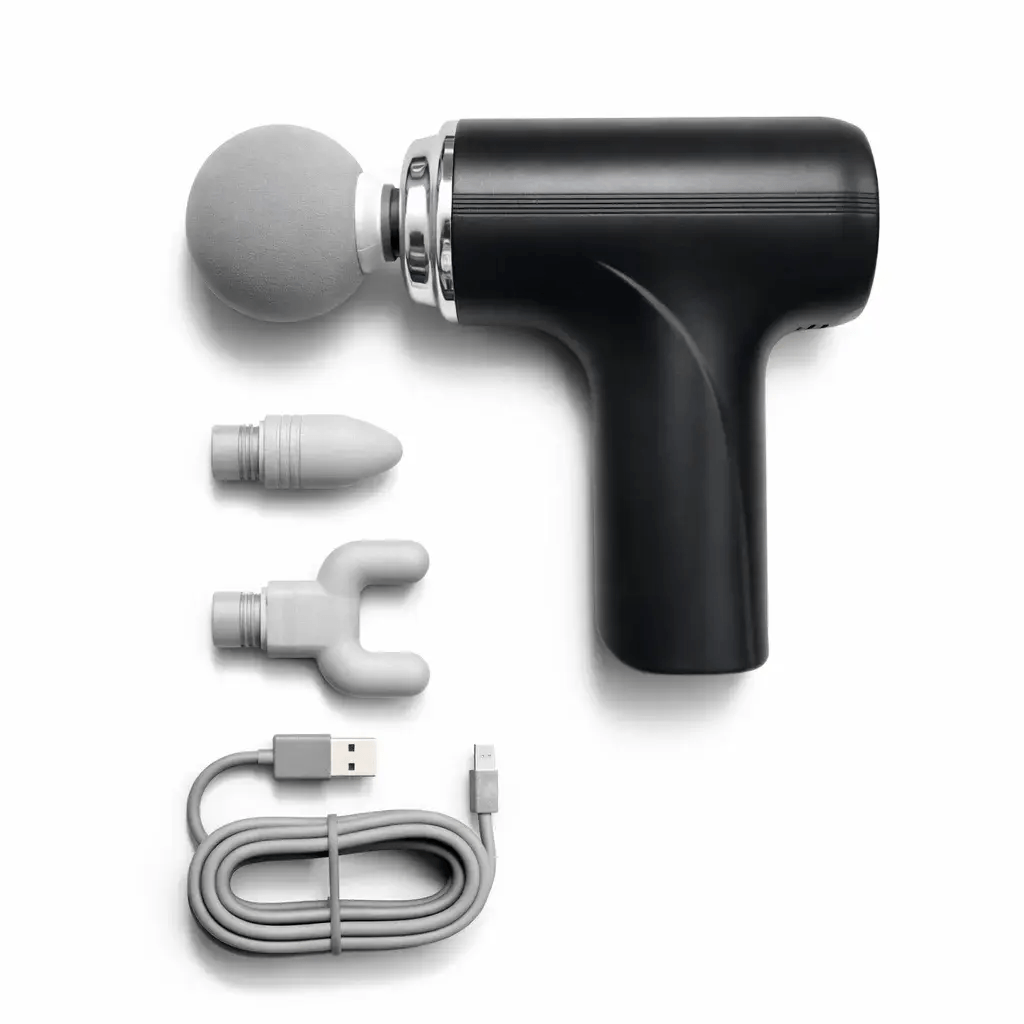
A Percussion Massage Gun is a handheld powered device that produces repeated mechanical strokes or vibrations through a massage attachment.
Unlike a conventional handheld massage tool, the device produces rapid repetitive movements that can be applied to selected muscle groups. Different attachment heads may provide different contact sensations and are generally selected according to the treatment area and intended application.
Massage guns are commonly used in sports and clinical contexts for warm-up, recovery, soft-tissue work, and part of a broader rehabilitation program. However, they should be considered an adjunct rather than a replacement for diagnosis, exercise therapy, manual therapy, or other clinically indicated treatment.
How Does a Percussion Massage Gun Work?
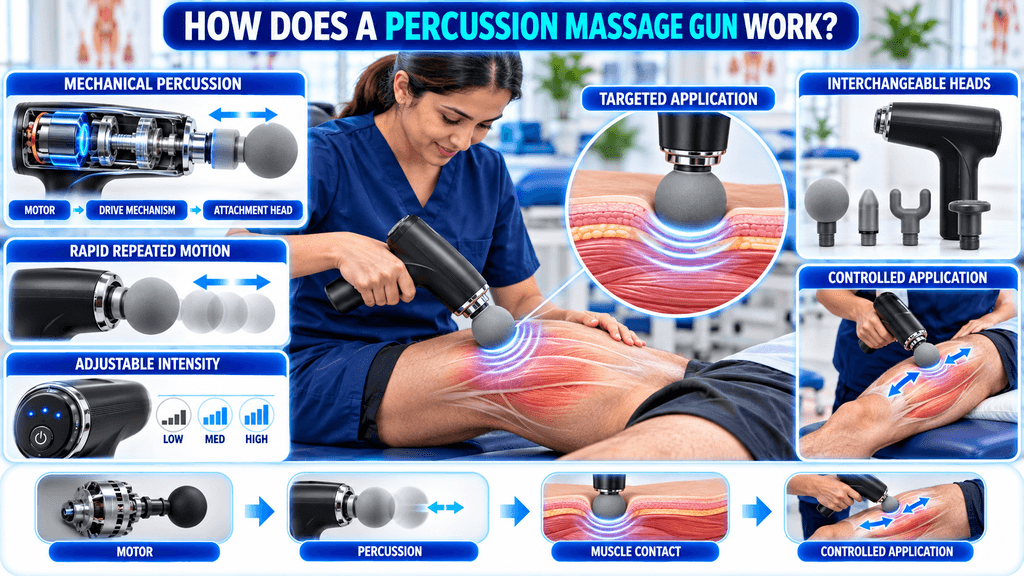
The device contains a motor-driven mechanism that moves the attachment head back and forth at a rapid rate.
When the attachment contacts a muscle, it produces repetitive mechanical stimulation. The therapist or user controls the location, pressure, speed, and duration according to the device design and intended use.
Mechanical Percussion
The attachment delivers repeated strokes to the soft tissue. This creates a rhythmic tapping or percussive sensation.
Targeted Muscle Application
The device can be moved over selected muscle groups rather than applying the same pressure to an entire body area.
Adjustable Intensity
Many massage guns provide multiple speed or intensity settings, allowing the application to be adjusted according to the treatment area and user tolerance.
Interchangeable Attachments
Depending on the model, different massage heads may be supplied for broader or more focused contact.
Short-Duration Application
Professional use generally involves controlled application rather than prolonged aggressive pressure. Research has noted considerable variation in reported massage-gun frequencies, amplitudes, treatment times, and application methods, so there is currently no single standardized protocol for all devices.
Key Features
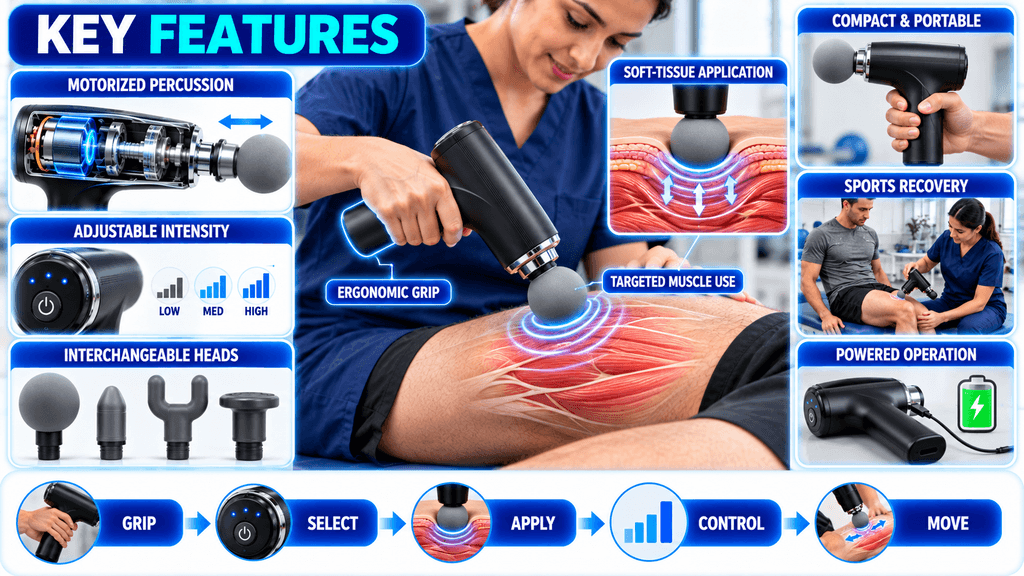
- Handheld percussion massage design
- Motorized mechanical stimulation
- Multiple intensity or speed levels on applicable models
- Interchangeable massage heads on applicable models
- Targeted muscle application
- Ergonomic handheld design
- Suitable for professional and recovery environments
- Useful for selected soft-tissue applications
- Compact and portable
- Easy to handle during treatment
- Suitable for sports recovery routines
- Can complement physiotherapy programs
- Rechargeable or powered operation depending on model
- Designed for repeated use
Applications of Percussion Massage Gun
The Percussion Massage Gun can be incorporated into different physiotherapy, sports, and recovery routines when clinically appropriate.
Muscle Warm-Up
Percussive massage may be incorporated into a warm-up routine before physical activity. The objective is generally to prepare selected soft tissues for movement rather than replace conventional warm-up activities.
Post-Exercise Recovery
Massage guns are frequently used following exercise. Research has investigated their potential effects on recovery, range of motion, flexibility, and perceived muscle soreness. Evidence remains mixed and varies according to the application protocol.
Muscle Tightness
A therapist may use controlled percussion over selected muscle groups when addressing perceived muscle tightness as part of a wider treatment plan.
Range-of-Motion Preparation
Some studies suggest that percussive massage can temporarily improve range of motion and flexibility. It may therefore be incorporated before mobility or exercise work where appropriate.
Sports Rehabilitation
Sports physiotherapy programs may use percussive therapy as one component of recovery and soft-tissue management.
Exercise Therapy
The device can complement stretching, strengthening, mobility, and functional exercise rather than replacing these rehabilitation methods.
Soft-Tissue Therapy
Controlled percussive stimulation can be incorporated into soft-tissue treatment according to professional assessment and the characteristics of the target tissue.
Potential Benefits
When appropriately applied, the Percussion Massage Gun may offer several potential benefits:
- Provides targeted mechanical stimulation
- May temporarily improve range of motion
- May support short-term flexibility
- Can be incorporated into warm-up routines
- May be used as part of exercise recovery
- Provides a convenient handheld treatment format
- Allows targeted application to selected muscle groups
- Can complement stretching and mobility exercises
- Suitable for sports and rehabilitation environments
- Offers adjustable intensity on applicable models
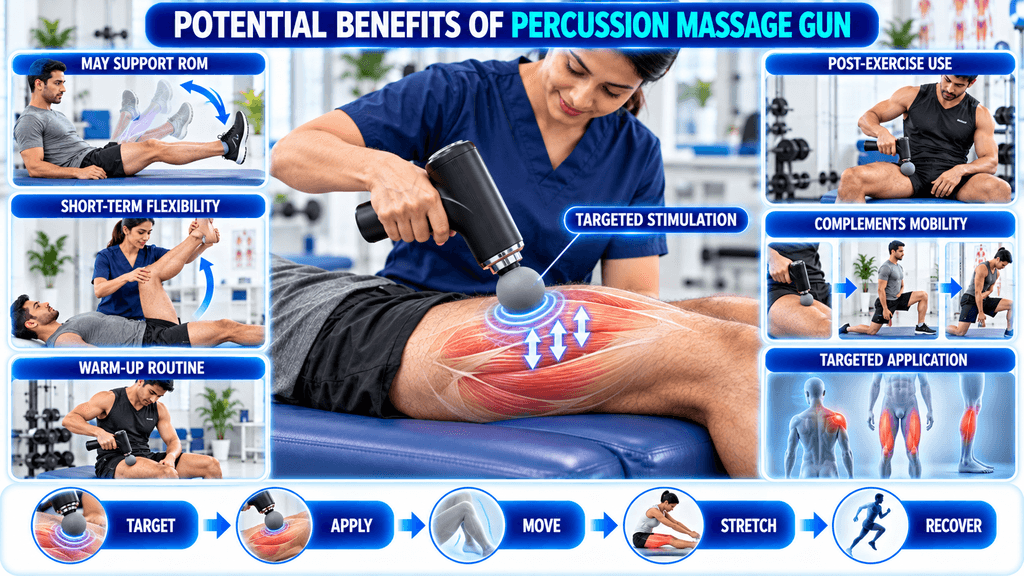
A systematic review found that massage guns may improve short-term range of motion, flexibility, and some recovery-related outcomes, but also noted limited research and variation in treatment parameters.
A controlled 2024 study of active adults found little effect from a five-minute massage-gun application immediately after strenuous calf exercise and recommended caution when using the device immediately after demanding lower-body exercise.
Percussion Massage Gun for Physiotherapy Clinics
A Percussion Massage Gun can be a convenient addition to the soft-tissue and exercise therapy section of a physiotherapy clinic.
Its handheld format allows therapists to move between treatment areas without requiring a large treatment system. Depending on the clinical objective, it may be used alongside stretching, strengthening, mobility training, manual therapy, and other physiotherapy interventions.
For sports rehabilitation centres, it can also be incorporated into recovery workflows where controlled soft-tissue stimulation is considered appropriate.
How to Use a Percussion Massage Gun
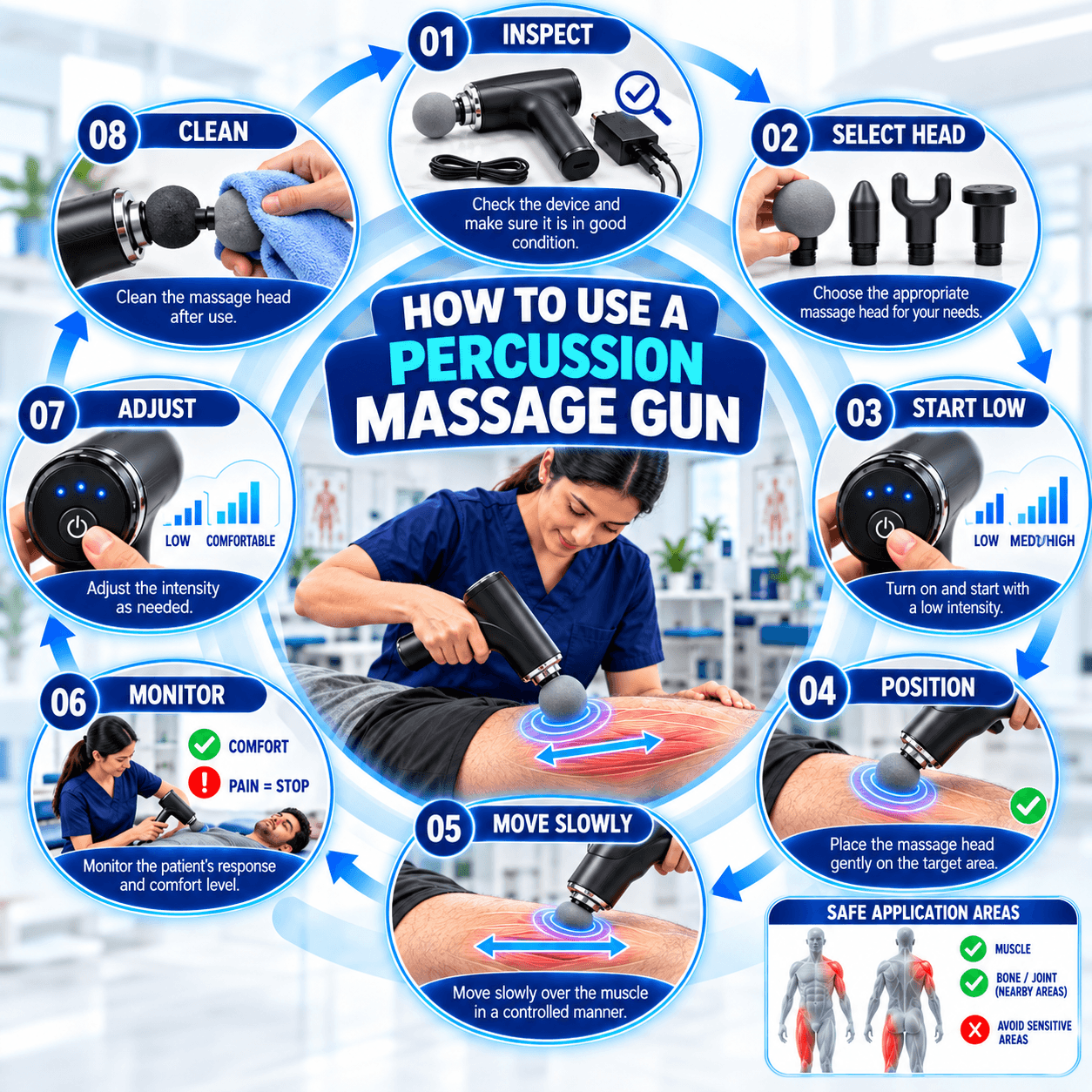
Step 1: Inspect the Device
Check the massage gun, attachment head, charging connection, housing, and controls before use.
Step 2: Select the Attachment
Choose an appropriate massage head according to the device instructions and intended treatment area.
Step 3: Select a Low Setting
Start with a lower intensity and increase only when appropriate and comfortable.
Step 4: Position the Device
Place the attachment gently against the intended muscle area.
Step 5: Move the Device Slowly
Glide the device over the muscle rather than keeping strong pressure on one small point for an extended period.
Step 6: Monitor Response
Observe comfort, tissue response, and any unusual pain or symptoms.
Step 7: Adjust Intensity
The intensity can be adjusted according to tolerance and professional guidance.
Step 8: Clean the Attachment
Clean patient-contact surfaces according to the clinic’s hygiene protocol after use.
Safety Precautions
- Use the device according to the manufacturer’s instructions.
- Start with a low intensity when introducing percussion therapy.
- Do not apply excessive pressure.
- Avoid using the device directly over bones or joints.
- Avoid direct application over the front or side of the neck.
- Do not use directly over open wounds or irritated skin.
- Avoid applying percussion over areas of significant acute swelling or unexplained pain.
- Do not use directly over suspected fractures.
- Use caution around areas with altered sensation.
- Patients with significant medical conditions should obtain appropriate professional advice before use.
- Do not use aggressive percussion as a substitute for diagnosis or clinical assessment.
- Stop immediately if severe pain, unusual swelling, numbness, dizziness, or other concerning symptoms occurs.
Aggressive or inappropriate use can cause adverse effects. A published case report described rhabdomyolysis following percussion massage and emphasized the importance of appropriate and safe use, particularly in people with underlying conditions.
Who Can Use a Percussion Massage Gun?
Depending on the intended application and local professional practice, the device may be used in:
- Physiotherapy clinics
- Sports rehabilitation centres
- Fitness and recovery facilities
- Athletic training environments
- Wellness and soft-tissue therapy settings
- Rehabilitation centres
- Home recovery environments under appropriate guidance
For clinical rehabilitation, the therapist should determine whether percussion therapy is suitable for the patient’s condition.
Percussion Massage Gun vs Conventional Massage
| Feature | Percussion Massage Gun | Conventional Manual Massage |
|---|---|---|
| Application | Mechanical percussion | Therapist’s hands |
| Power | Motor/battery depending on model | No power required |
| Intensity | Device-controlled on applicable models | Therapist-controlled |
| Attachment | Interchangeable on applicable models | Hands/fingers |
| Portability | Generally high | No equipment required |
| Treatment Area | Targeted | Broadly adaptable |
| Clinical Use | Adjunct soft-tissue/recovery tool | Manual treatment technique |
The two approaches are not necessarily interchangeable. Selection depends on the treatment objective, patient condition, and therapist’s assessment.
Technical Specifications
| Specification | Details |
|---|---|
| Product Name | Percussion Massage Gun |
| Equipment Type | Percussive Massage / Soft-Tissue Device |
| Operation | Motorized |
| Application | Targeted muscle and soft-tissue areas |
| Intensity | Adjustable on applicable models |
| Speed Settings | Model dependent |
| Massage Heads | Model dependent |
| Power Source | Rechargeable battery or AC depending on model |
| Display | Model dependent |
| Handle | Ergonomic handheld design |
| Usage | Physiotherapy, Sports Recovery & Muscle Care |
| Suitable For | Clinics, Rehabilitation Centres & Recovery Facilities |
Exact speed range, amplitude, battery capacity, operating time, weight, attachments, and other specifications depend on the selected PHYSIOMODALITIES™ model.
Things to Consider Before Buying
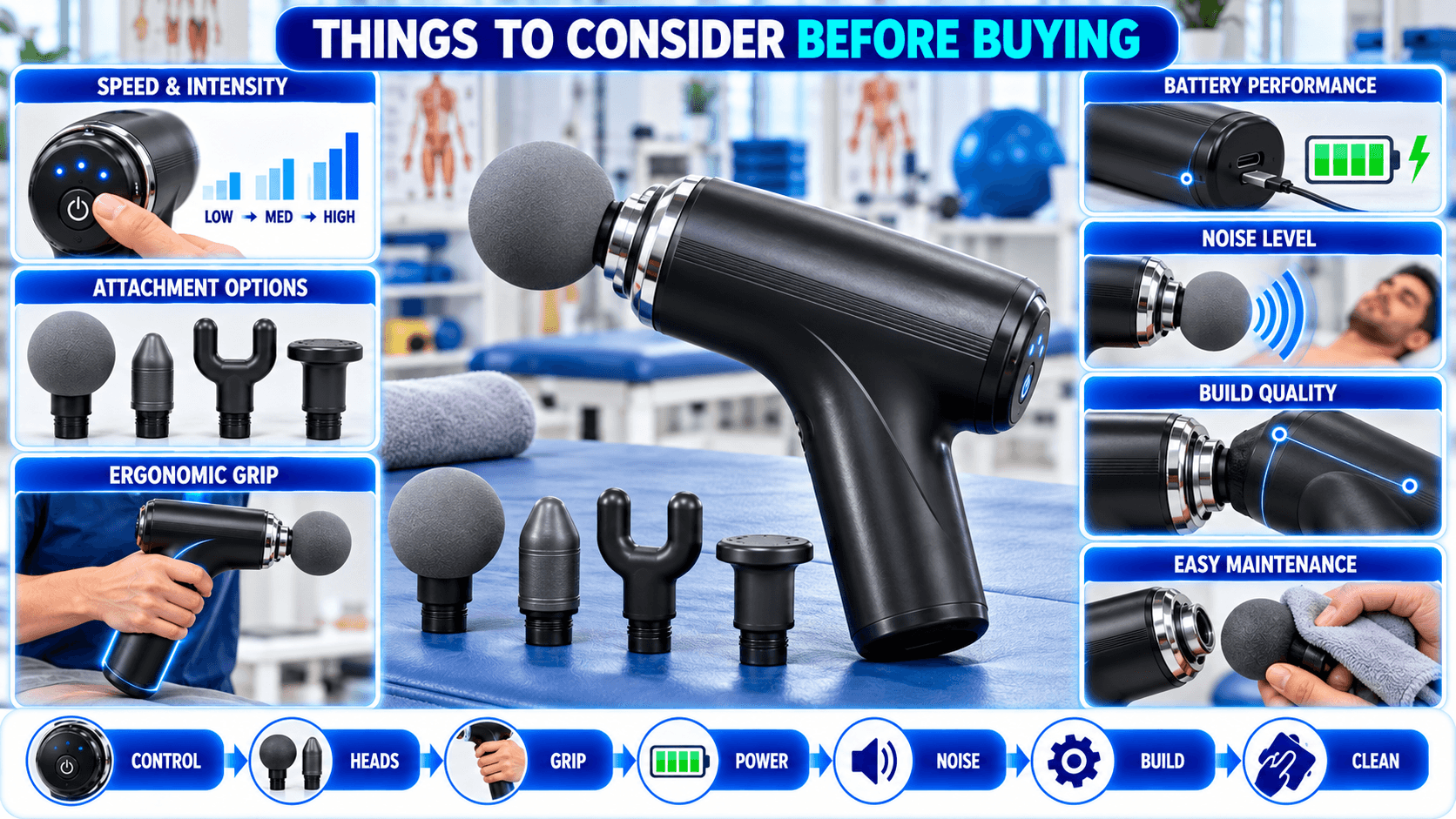
Speed and Intensity Settings
Multiple settings provide greater flexibility when different treatment areas require different levels of mechanical stimulation.
Massage Attachments
Consider the number and type of attachments supplied with the device and whether they match the intended application.
Ergonomic Design
A balanced handle can make repeated professional use more comfortable.
Battery Performance
For portable clinical use, consider charging time, operating duration, and battery capacity.
Noise Level
A quieter motor can be useful in clinics where multiple treatments are performed simultaneously.
Build Quality
The device should be durable enough for the intended frequency of professional use.
Maintenance
Attachments and patient-contact surfaces should be easy to clean and maintain.
Why Choose PHYSIOMODALITIES™?
PHYSIOMODALITIES™ provides physiotherapy and rehabilitation equipment for professional clinical environments.
The Percussion Massage Gun can complement a clinic’s soft-tissue, sports recovery, and exercise therapy equipment by providing a portable method of controlled mechanical percussion.
PHYSIOMODALITIES ENTERPRISES offers equipment across physiotherapy, rehabilitation, electrotherapy, exercise therapy, and clinical treatment categories, supporting clinics in developing comprehensive treatment setups.
Conclusion
The Percussion Massage Gun is a compact handheld device designed to provide rapid mechanical percussion to selected muscle and soft-tissue areas. It can be incorporated into physiotherapy, sports recovery, mobility, warm-up, and exercise therapy programs when appropriate.
Current research indicates potential short-term effects on range of motion and flexibility, but evidence remains developing and there is no universally standardized protocol for massage-gun use.
For professional settings, the device is best considered an adjunct to a broader rehabilitation program rather than a standalone treatment. Proper intensity, application technique, treatment duration, and patient selection are important for safe and appropriate use.
Frequently Asked Questions
1. What is a Percussion Massage Gun used for?
A Percussion Massage Gun is used to provide targeted mechanical percussion to muscles and soft tissues. It may be incorporated into warm-up, recovery, mobility, and physiotherapy programs.
2. Can a Percussion Massage Gun improve flexibility?
Research suggests that percussive massage may temporarily improve range of motion and flexibility in some situations, although results depend on the application and individual response.
3. Can it be used after exercise?
It can be incorporated into recovery routines, but immediate use after strenuous exercise should be approached carefully because research findings are mixed.
4. How many speed settings does a massage gun have?
The number of speed settings varies by model. The exact speed range and frequency should be checked in the specifications of the selected device.
5. Is a Percussion Massage Gun suitable for physiotherapy clinics?
Yes. It can be used as an adjunct tool in physiotherapy, sports rehabilitation, soft-tissue therapy, and recovery programs when appropriate.