
The Manual Tilt Table is a specialised physiotherapy and rehabilitation equipment designed to provide controlled patient positioning from a horizontal position toward an upright standing position. It is commonly used for standing therapy, postural training, weight-bearing practice, neurological rehabilitation and functional mobility programs.
A manual tilt table allows the therapist to gradually change the patient’s body angle using a mechanical tilting mechanism. Safety straps and a supportive padded surface help maintain appropriate patient positioning during therapy. Many available models provide a tilt range of up to 90 degrees, although the exact range depends on the model.
The Manual Tilt Table can be used in physiotherapy clinics, hospitals, rehabilitation centres and neurological rehabilitation departments where controlled verticalisation and standing practice are required.
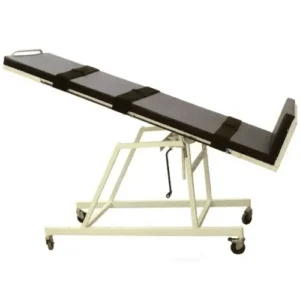
What Is a Manual Tilt Table?
A Manual Tilt Table is a rehabilitation table that can be manually adjusted from a lying or horizontal position toward an upright position.
The table provides a stable platform for patients who may have difficulty independently moving from lying to standing. By gradually changing the angle, a physiotherapist can introduce upright positioning according to the patient’s tolerance and rehabilitation plan.
Most manual tilt table designs include a padded tabletop, patient safety straps, a footboard and a mechanical tilting system. Some models also feature hand grips and lockable caster wheels for easier positioning within the clinic.
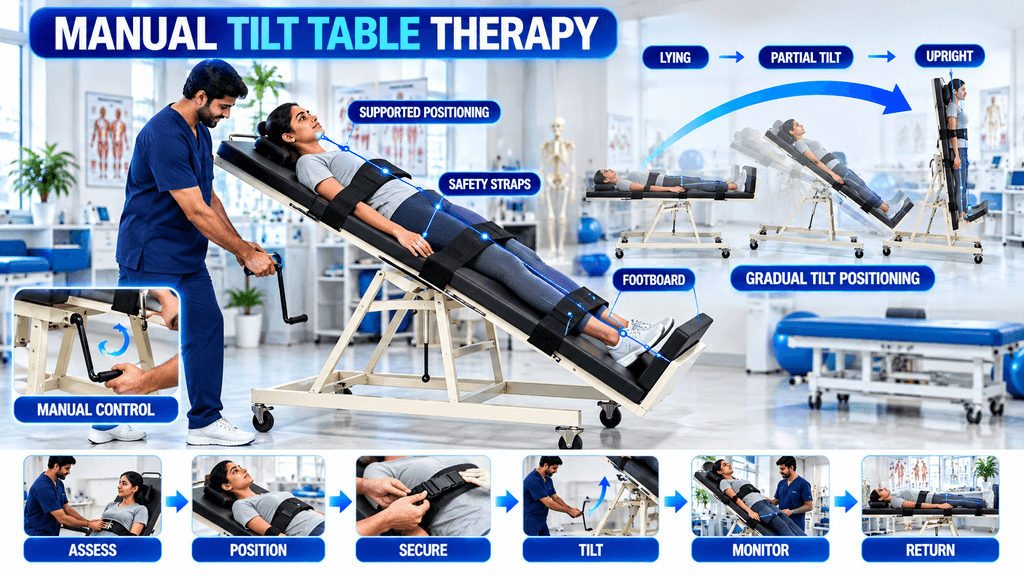
How Does a Manual Tilt Table Work?
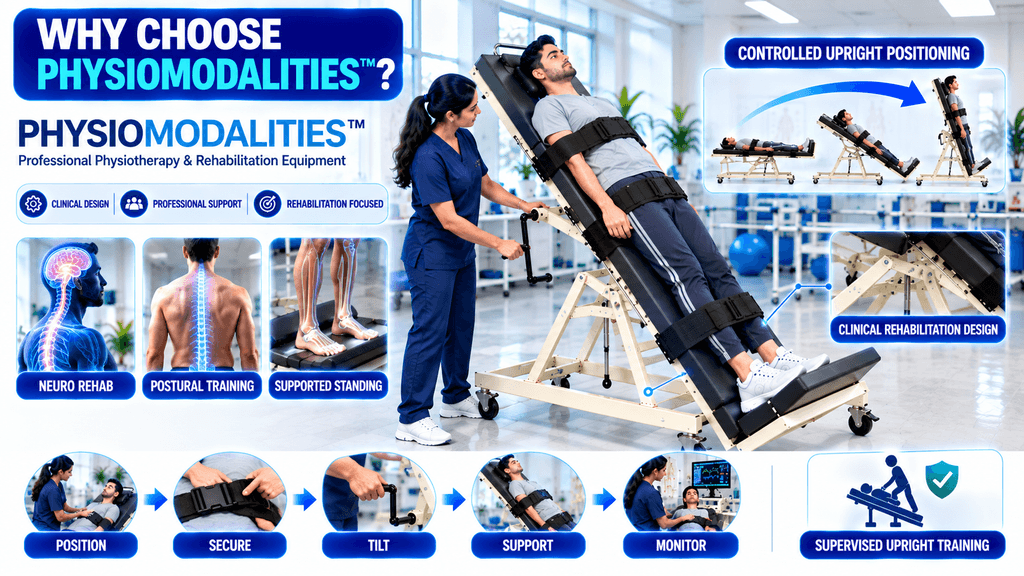
The patient is positioned securely on the padded table and supported using the available straps. The therapist then operates the manual tilting mechanism to gradually raise the table.
The controlled change in position can allow the patient to progressively experience a more upright posture.
A typical session may involve:
- Assessing the patient’s condition and suitability.
- Positioning the patient on the table.
- Securing the patient with appropriate straps.
- Positioning the feet against the footboard.
- Checking body alignment and comfort.
- Gradually adjusting the tilt angle.
- Monitoring the patient’s response.
- Maintaining the prescribed position for the appropriate duration.
- Gradually returning the table to a safer or resting position.
The speed and final angle should be selected according to the patient’s clinical condition and the therapist’s treatment protocol.
Key Features
Manual Tilting Mechanism
The table uses a mechanical system that allows the therapist to change the angle without requiring an electric motor.
Adjustable Tilt Angle
Many manual models provide a tilt range from approximately 0° to 90°, allowing gradual progression toward upright positioning. Exact adjustment range is model-dependent.
Patient Safety Straps
Multiple straps can be used to help secure the patient’s body during tilting. Three-strap configurations are common among manual models.
Cushioned Tabletop
A padded surface provides support and comfort during prolonged positioning and rehabilitation sessions.
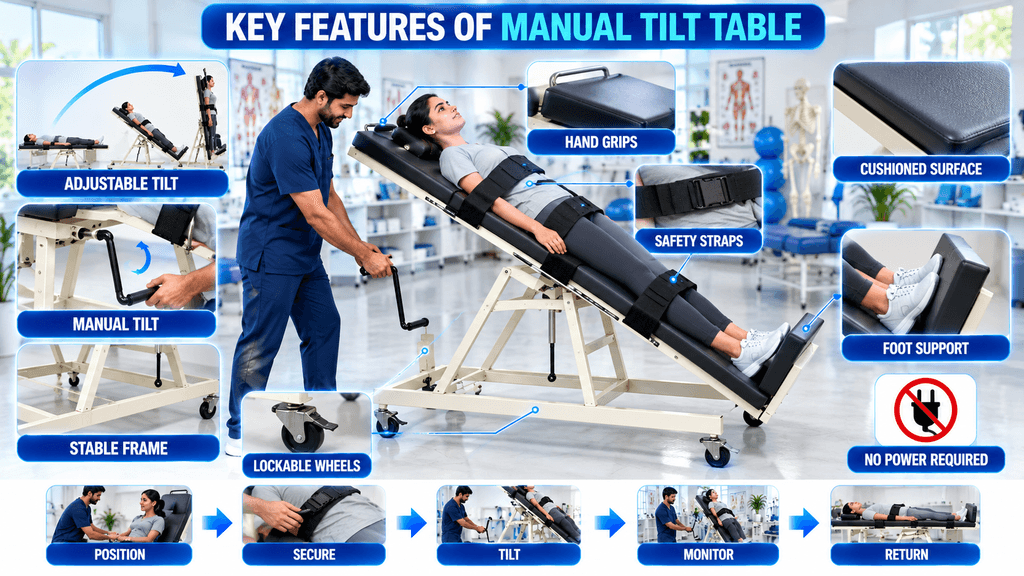
Foot Support
A stable footboard helps provide lower-limb support when the table is positioned toward upright standing.
Hand Grips
Some models include gripping handles that can be used during selected rehabilitation activities.
Heavy-Duty Frame
Manual tilt tables are commonly constructed with steel or mild-steel frames designed for repeated clinical use.
Lockable Wheels
Depending on the model, caster wheels can allow the table to be moved within the therapy area and locked securely during treatment.
No Electrical Power Required
A manual tilt mechanism does not require an electrical power supply, making it convenient for clinics where a simple mechanical rehabilitation system is preferred.
Applications of Manual Tilt Table
The Manual Tilt Table can be incorporated into several physiotherapy and rehabilitation programs.
Standing Therapy
The table can help therapists introduce gradual upright positioning for patients who have difficulty independently maintaining a standing position.
Neurological Rehabilitation
Manual tilt tables may be used as part of rehabilitation programs involving neurological conditions where supported upright positioning is appropriate.
Postural Training
The equipment can provide a controlled environment for practising upright posture and body alignment.
Weight-Bearing Training
Gradually increasing the patient’s upright angle can be incorporated into weight-bearing rehabilitation when clinically appropriate.
Balance and Functional Training
Once an appropriate upright position has been achieved, selected exercises may be performed under professional supervision.
Orthopaedic Rehabilitation
A tilt table may be incorporated into selected orthopaedic rehabilitation programs where controlled positioning and gradual weight-bearing are required.
Post-Surgical Rehabilitation
In appropriate cases, a therapist may incorporate supported upright positioning into a post-operative rehabilitation plan after considering surgical restrictions.
Mobility Rehabilitation
The table can support rehabilitation programs for patients working toward improved functional mobility.
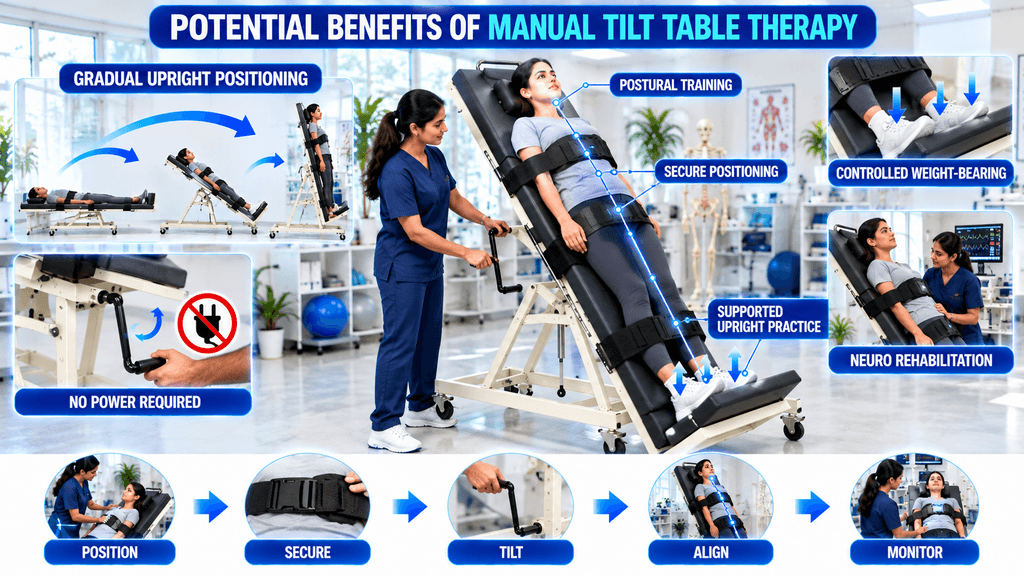
Potential Benefits
The potential benefits of Manual Tilt Table therapy depend on the patient’s condition, treatment stage and clinical protocol.
- Provides controlled progression toward upright positioning
- Supports therapist-guided standing practice
- Provides secure patient positioning
- Allows gradual changes in body angle
- Supports selected weight-bearing activities
- Can assist with postural training
- Provides a stable platform for rehabilitation exercises
- May be useful in neurological rehabilitation
- Can complement functional mobility programs
- Does not require electrical power
The equipment should be considered a rehabilitation aid and not a replacement for individual clinical assessment.
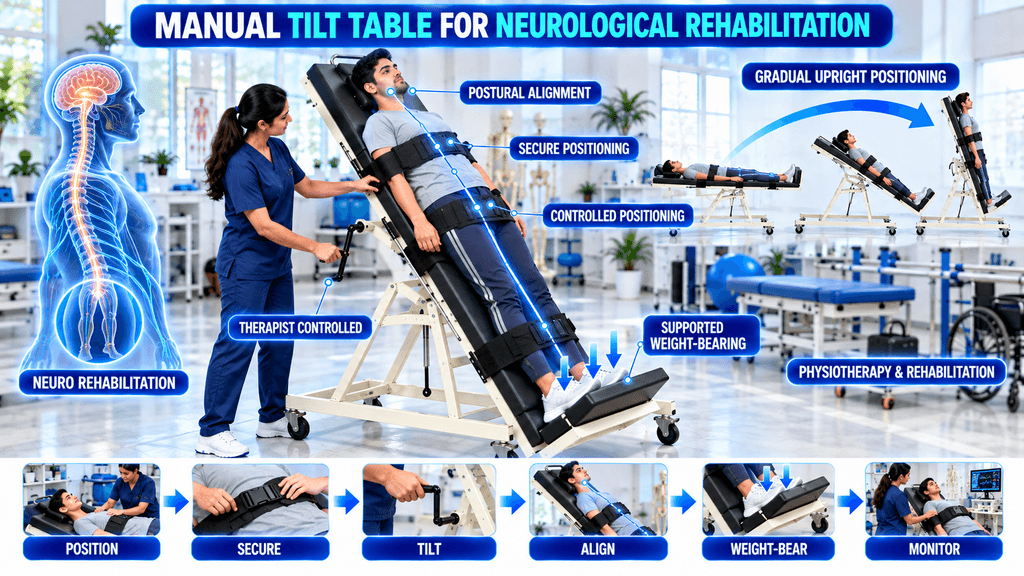
Manual Tilt Table for Neurological Rehabilitation
Neurological rehabilitation can involve challenges related to mobility, balance, postural control and the ability to tolerate upright positioning.
The Manual Tilt Table provides therapists with a controlled method of progressively changing the patient’s position.
Depending on the patient’s condition, the therapist may use the equipment as part of a program involving:
- Supported standing
- Postural alignment
- Weight-bearing practice
- Lower-limb activation
- Balance preparation
- Functional mobility training
The exact treatment approach should be determined according to the patient’s assessment and rehabilitation goals.
Standing and Weight-Bearing Training
Gradual transition from lying toward upright positioning can be useful in selected rehabilitation programs.
The manual tilt mechanism allows the therapist to increase the angle progressively rather than requiring the patient to move independently into standing immediately.
This can be particularly useful when a patient requires substantial external support during the early stages of standing rehabilitation.
The therapist can monitor:
- Posture
- Foot positioning
- Weight distribution
- Patient comfort
- Balance
- Fatigue
- Response to increasing tilt angle
Manual Tilt Table for Physiotherapy Clinics
The Manual Tilt Table can be a useful addition to a rehabilitation area where therapists provide neurological, orthopaedic and functional mobility training.
It can be used alongside:
- Standing frames
- Parallel bars
- Gait-training equipment
- Exercise staircases
- Rehabilitation cycles
- Treatment tables
- Balance-training equipment
- Muscle stimulators
- Other physiotherapy rehabilitation equipment
Because the manual version does not depend on an electric actuator, it can also be useful in clinics looking for a straightforward mechanical tilt solution.
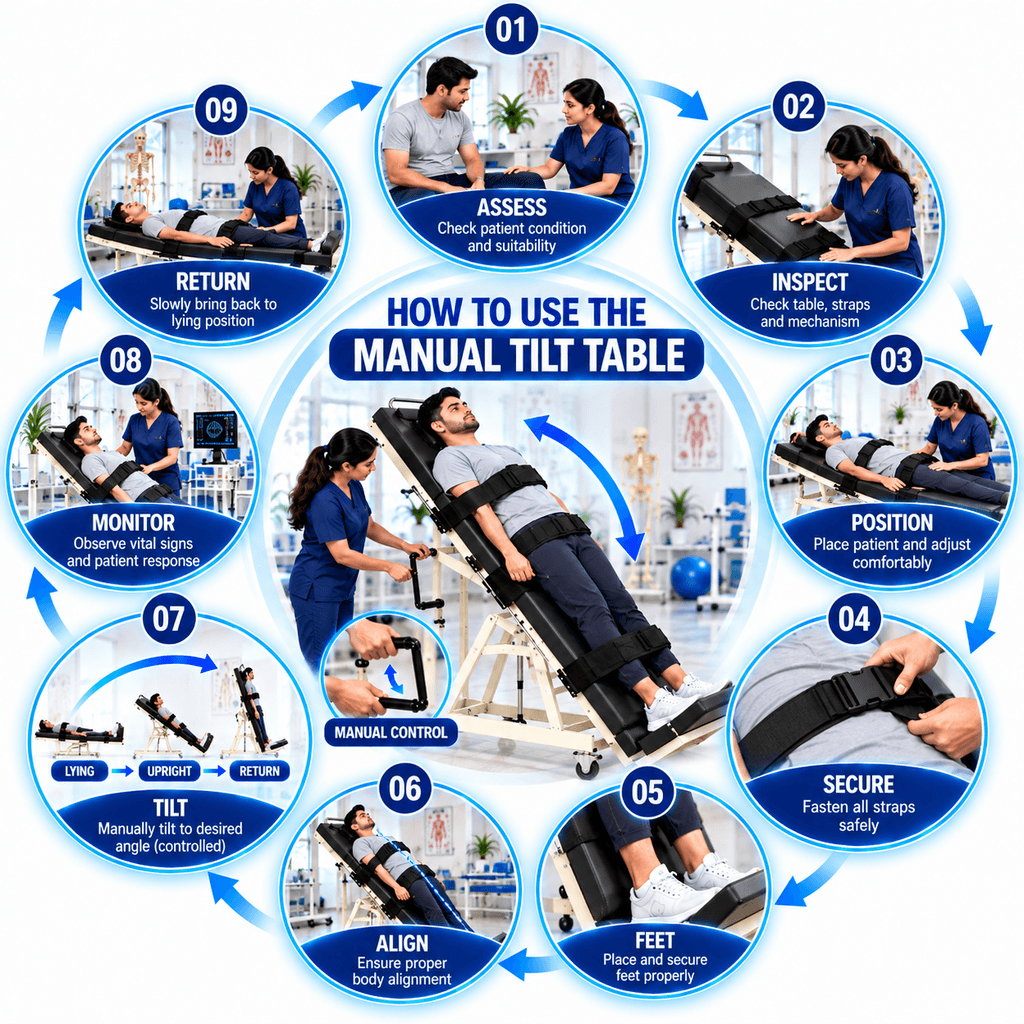
How to Use the Manual Tilt Table
Step 1: Patient Assessment
Assess the patient’s medical condition, mobility, balance and ability to tolerate upright positioning.
Step 2: Inspect the Table
Check the frame, wheels, straps, footboard, padding and tilting mechanism before positioning the patient.
Step 3: Position the Patient
Place the patient comfortably on the table according to the manufacturer’s instructions.
Step 4: Secure the Patient
Use the appropriate safety straps to maintain secure positioning.
Step 5: Position the Feet
Place the patient’s feet correctly against the footboard or designated support.
Step 6: Check Alignment
Ensure that the patient’s body is positioned appropriately before beginning the tilt.
Step 7: Begin Tilting
Operate the manual mechanism gradually and avoid sudden changes in angle.
Step 8: Monitor the Patient
Observe comfort, posture, balance and overall response during the session.
Step 9: Return Gradually
When the session is complete, return the table to the appropriate position in a controlled manner.
Safety Precautions
The Manual Tilt Table should be operated by trained physiotherapists or appropriately qualified healthcare professionals.
Important precautions include:
- Check all straps before each session.
- Ensure caster wheels are locked during treatment.
- Confirm that the footboard is secure.
- Never tilt the patient suddenly.
- Increase the angle gradually.
- Monitor the patient throughout the session.
- Stop treatment if the patient develops significant discomfort, dizziness or another concerning response.
- Follow post-operative restrictions where applicable.
- Never exceed the manufacturer’s specified patient weight limit.
- Keep the surrounding treatment area clear.
- Inspect the mechanical tilting system regularly.
- Follow manufacturer instructions for cleaning and maintenance.
Patients with significant medical conditions should undergo appropriate clinical assessment before supported standing therapy.
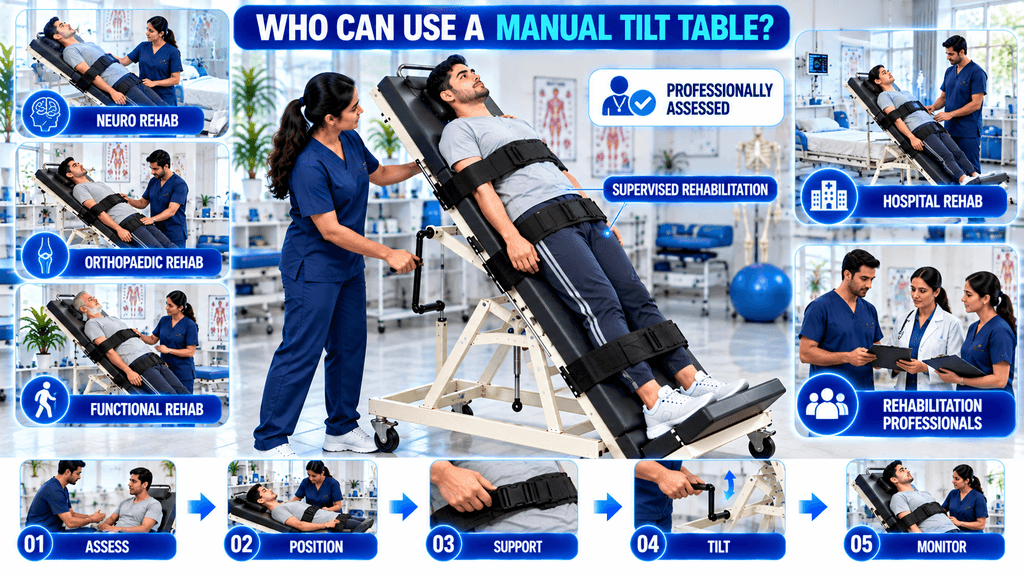
Who Can Use a Manual Tilt Table?
The equipment is primarily intended for professional rehabilitation environments.
Potential users include:
- Physiotherapists
- Neurological rehabilitation professionals
- Orthopaedic rehabilitation teams
- Occupational therapists
- Rehabilitation centres
- Hospital physiotherapy departments
Patient suitability depends on the individual’s condition and the recommendation of the treating healthcare professional.
Manual Tilt Table vs Motorized Tilt Table
| Feature | Manual Tilt Table | Motorized Tilt Table |
|---|---|---|
| Operation | Manual mechanical mechanism | Electric motor |
| Power Required | No | Yes |
| Tilt Adjustment | Therapist-operated | Motor-controlled |
| Control | Manual | Electrical control |
| Maintenance | Mechanical maintenance | Mechanical + electrical maintenance |
| Clinical Use | Standing & rehabilitation | Standing & rehabilitation |
| Power Failure Dependency | No | Yes |
| Cost Consideration | Generally simpler configuration | Generally more complex |
| Exact Features | Model dependent | Model dependent |
A manual or motorized configuration should be selected according to the clinic’s workflow, patient requirements, available space and desired operating system.
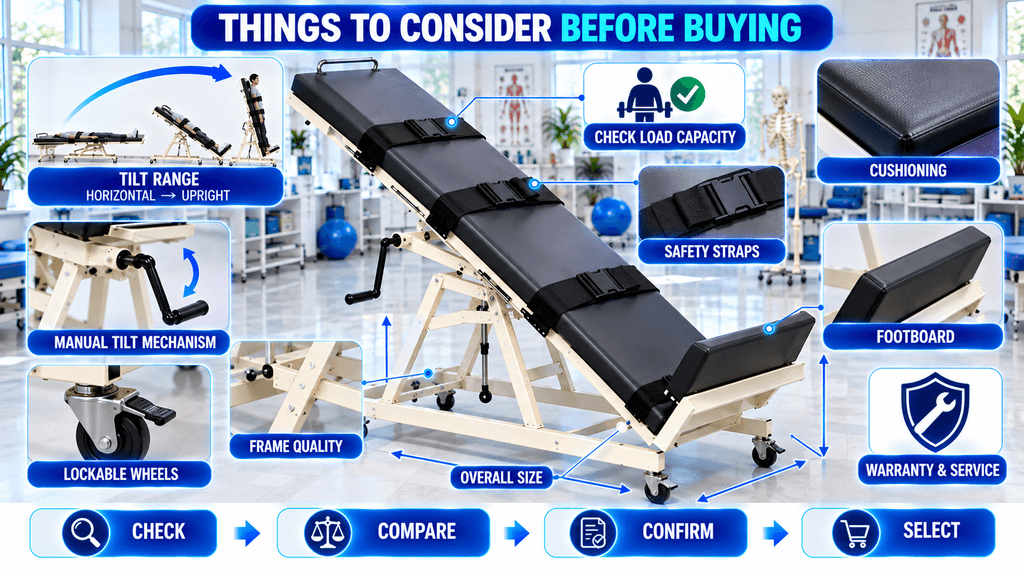
Things to Consider Before Buying
Tilt Range
Check the available tilt range. Many models provide up to 90° of adjustment.
Patient Weight Capacity
Always confirm the manufacturer’s specified working load. Different products can have substantially different capacities.
Safety Straps
Check the number, width, adjustability and positioning of the straps.
Footboard
A secure and appropriately positioned footboard is important for upright therapy.
Frame Construction
Consider a strong steel or equivalent clinical-grade frame suitable for regular use.
Cushioning
Check the thickness and quality of the tabletop padding.
Wheels
Lockable caster wheels can make the equipment easier to reposition while providing stability during therapy.
Tilt Mechanism
Check whether the mechanical system provides smooth, controlled adjustment and secure locking.
Size
Measure the available treatment area before purchasing.
Warranty and Service
Consider warranty coverage, spare parts and technical support.
Technical Specifications
| Specification | Details |
|---|---|
| Product Name | Manual Tilt Table |
| Product Type | Physiotherapy & Rehabilitation Tilt Table |
| Operation | Manual |
| Primary Function | Supported Standing & Tilt Therapy |
| Tilt Range | 0°–90° / Model Dependent |
| Tabletop | Cushioned / Padded |
| Safety Straps | Included / Model Dependent |
| Footboard | Included / Model Dependent |
| Hand Grips | Included / Model Dependent |
| Frame | Steel / Mild Steel / Model Dependent |
| Wheels | Caster Wheels / Model Dependent |
| Wheel Locks | Model Dependent |
| Electrical Power | Not Required |
| Dimensions | Model Dependent |
| Patient Weight Capacity | Model Dependent |
| Application | Physiotherapy, Rehabilitation & Standing Training |
| Suitable Environment | Clinics, Hospitals & Rehabilitation Centres |
| Brand | PHYSIOMODALITIES™ |
Note: Exact dimensions, patient weight capacity, frame material, wheel size, strap configuration and mechanical system should be confirmed from the specific product model before publishing fixed specifications. Current Indian product listings show significant variation in these specifications.
Why Choose PHYSIOMODALITIES™?
PHYSIOMODALITIES™ focuses on physiotherapy and rehabilitation equipment intended for professional clinical environments.
The Manual Tilt Table can be a practical addition to clinics offering neurological rehabilitation, standing therapy, postural training, orthopaedic rehabilitation and functional mobility programs.
When choosing a tilt table, clinics should consider construction quality, mechanical stability, patient support, safety straps, tilt range, working load, cushioning, space requirements, warranty and after-sales service.
Conclusion
The Manual Tilt Table is a specialised rehabilitation apparatus designed to provide controlled progression from horizontal positioning toward upright standing. Its manual tilting mechanism allows therapists to adjust the patient’s angle gradually while using appropriate support and safety straps.
It can be incorporated into neurological rehabilitation, orthopaedic physiotherapy, postural training, supported standing and weight-bearing programs. Features such as padded surfaces, footboards, hand grips, lockable wheels and adjustable tilt angles can make the equipment suitable for professional rehabilitation environments.
With appropriate patient assessment, secure positioning and trained supervision, a Manual Tilt Table can provide a practical solution for controlled standing and verticalisation therapy.
Frequently Asked Questions
1. What is a Manual Tilt Table?
A Manual Tilt Table is a physiotherapy rehabilitation table that can be mechanically tilted from a horizontal position toward an upright position for supported standing and rehabilitation exercises.
2. What is the main use of a Manual Tilt Table?
It is mainly used for supported standing, postural training, gradual weight-bearing and selected neurological or orthopaedic rehabilitation programs.
3. Does a Manual Tilt Table require electricity?
No. A manual tilt table uses a mechanical adjustment system and does not normally require electrical power.
4. What is the usual tilt range?
Many manual tilt tables provide a range from 0° to 90°, although the exact range depends on the particular model.
5. Who should operate a Manual Tilt Table?
It should be operated by a trained physiotherapist or appropriately qualified healthcare professional who can assess the patient and supervise the positioning and therapy session.