
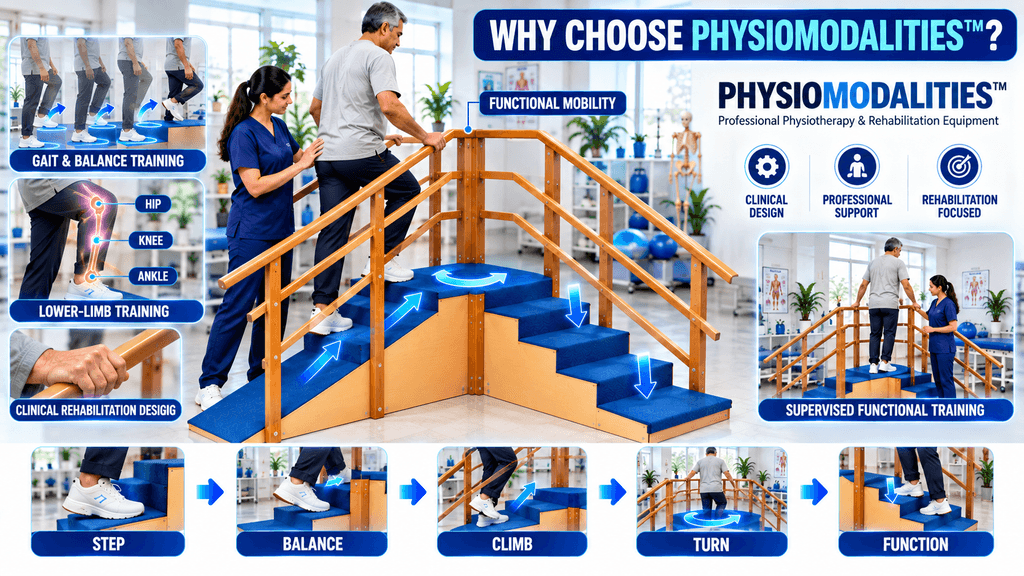
The Exercise Corner Stair Case Therapy is a specialised physiotherapy and rehabilitation equipment designed for gait training, stair-climbing practice, balance exercises, lower-limb strengthening and functional mobility training. Its corner-style configuration provides a structured area where patients can practise stepping and walking activities under professional supervision.
Exercise corner staircases are commonly used in physiotherapy clinics, rehabilitation centres, hospitals, occupational therapy departments and sports rehabilitation facilities. Depending on the configuration, the unit may include different step heights, handrails, a central platform and non-slip walking surfaces.
The Exercise Corner Stair Case Therapy provides therapists with a dedicated training station for progressive mobility exercises. It can be incorporated into rehabilitation programs for patients working on walking ability, balance, coordination, lower-limb control and functional movement.
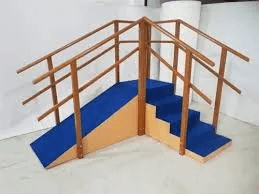
What Is Exercise Corner Stair Case Therapy?
Exercise Corner Stair Case Therapy is a manual rehabilitation system consisting of therapeutic steps arranged in a corner or L-shaped configuration. The equipment allows patients to practise stepping up and down in a controlled clinical environment.
Unlike a regular staircase, a physiotherapy exercise staircase is designed specifically for supervised therapeutic activities. Different step heights can provide progressive challenges, while handrails give the patient an additional support point during movement.
Many corner staircase designs can be configured with two stair sections meeting at an angle, allowing the equipment to fit efficiently into a therapy room. Some models also include a central platform that provides a transition point between the two sections.
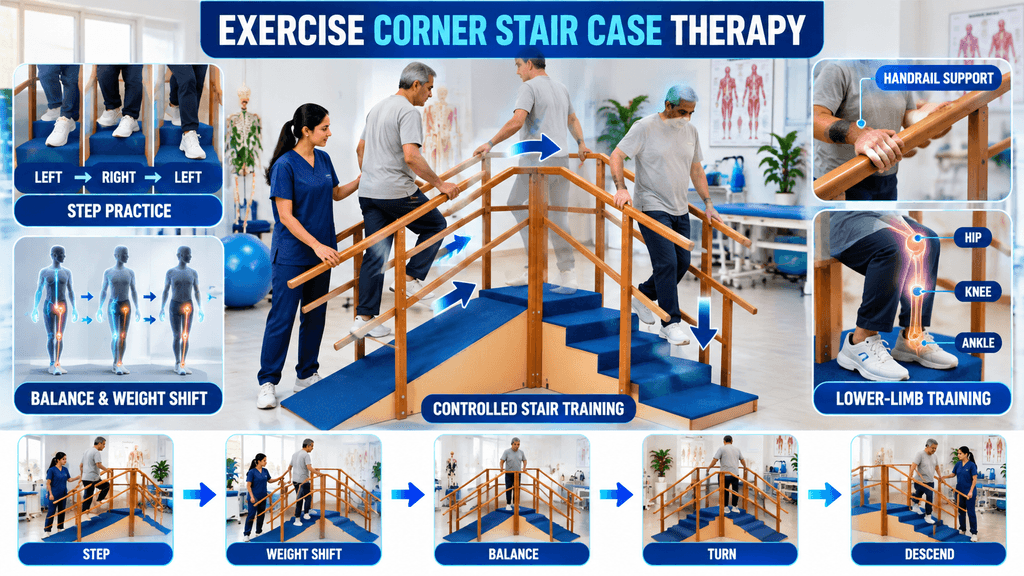
How Does an Exercise Corner Staircase Work?
The patient performs controlled stepping exercises under the guidance of a physiotherapist or trained rehabilitation professional.
The therapist can select exercises according to the patient’s current ability and rehabilitation goals. Depending on the program, activities may include:
- Stepping up and down
- Alternating step practice
- Controlled stair climbing
- Stair descent practice
- Weight-shifting exercises
- Balance activities
- Lower-limb strengthening
- Functional mobility exercises
The patient can use the handrails for appropriate support while gradually practising movement and weight transfer.
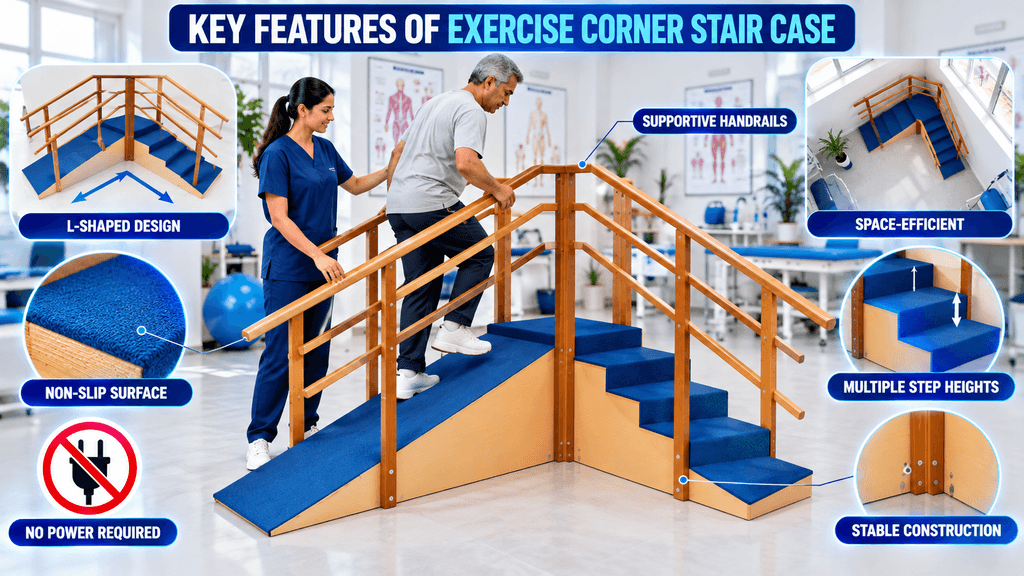
Key Features
Corner-Type Design
The L-shaped or corner configuration allows the staircase to be positioned efficiently within a physiotherapy or rehabilitation area.
Multiple Step Heights
Many exercise corner staircases incorporate different riser heights so that therapists can introduce progressive stepping challenges. One commonly listed wooden configuration uses four higher risers on one side and six lower risers on the other.
Supportive Handrails
Handrails provide a stable support point during supervised gait and stair-training exercises. Some configurations include handrails at different heights for different users.
Non-Slip Walking Surface
Non-slip matting is commonly used on therapeutic stair surfaces to provide improved foot grip during exercises.
Manual Operation
The equipment does not require an electrical power source. It is used through patient movement and therapist-guided exercises.
Stable Construction
Depending on the model, construction may use a wooden structure, tubular metal frame, commercial board or a combination of materials.
Space-Efficient Rehabilitation Setup
The corner arrangement can make the equipment practical for therapy rooms where efficient use of floor space is important.
Applications of Exercise Corner Stair Case Therapy
The Exercise Corner Stair Case Therapy can be used across different rehabilitation and functional training programs.
Gait Training
The staircase provides a controlled environment for practising stepping, walking patterns and transitional movements.
Stair-Climbing Training
Patients can practise climbing and descending steps under therapist supervision before progressing to everyday stair environments.
Balance Training
Stepping requires controlled weight transfer and postural adjustment, making the staircase useful for selected balance-training activities.
Lower-Limb Rehabilitation
Step exercises can be incorporated into programs focusing on lower-limb movement, strength and functional control.
Orthopaedic Rehabilitation
The equipment may be incorporated into rehabilitation programs following selected orthopaedic injuries or procedures, according to professional assessment.
Neurological Rehabilitation
Physiotherapists may use therapeutic stairs as part of mobility and gait programs for suitable neurological rehabilitation patients.
Geriatric Rehabilitation
Older adults may use supervised stepping exercises as part of functional mobility and balance training when clinically appropriate.
Sports Rehabilitation
Athletes returning to functional activity may use progressive step exercises as one component of a broader rehabilitation program.
Occupational Therapy
Exercise staircases can also be incorporated into occupational therapy environments where functional movement and activity practice are required.
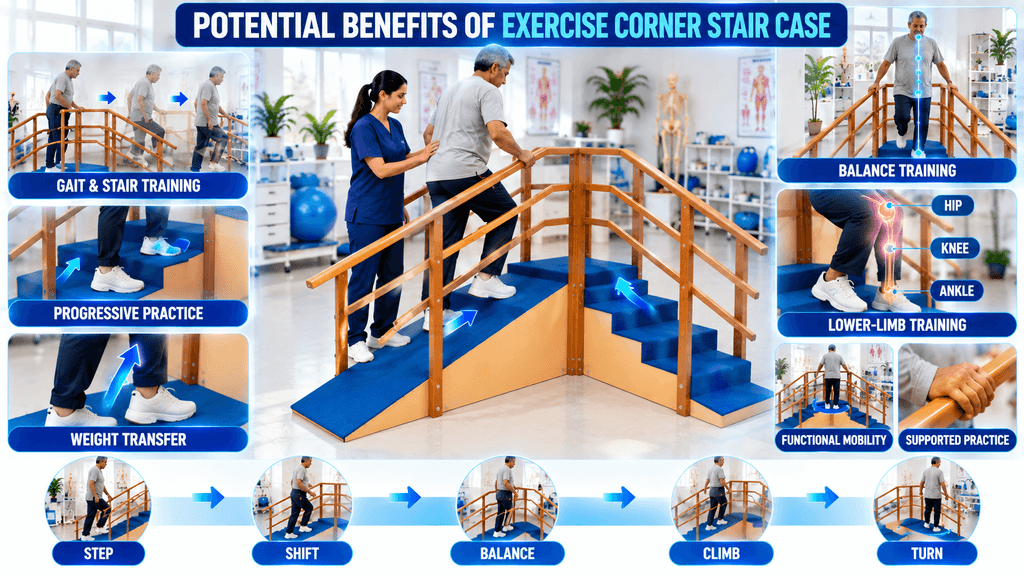
Potential Benefits
The potential benefits of Exercise Corner Stair Case Therapy depend on the patient’s condition and the exercises selected by the therapist.
- Supports supervised gait training
- Provides a dedicated environment for stair practice
- Helps therapists introduce progressive stepping exercises
- Supports lower-limb functional training
- Encourages controlled weight transfer
- Can be incorporated into balance-training programs
- Provides hand support during appropriate exercises
- Supports functional mobility practice
- Helps patients practise stair-related movement in a controlled environment
- Makes a practical addition to physiotherapy and rehabilitation clinics
The equipment should be considered a training aid rather than an independent treatment for any specific medical condition.
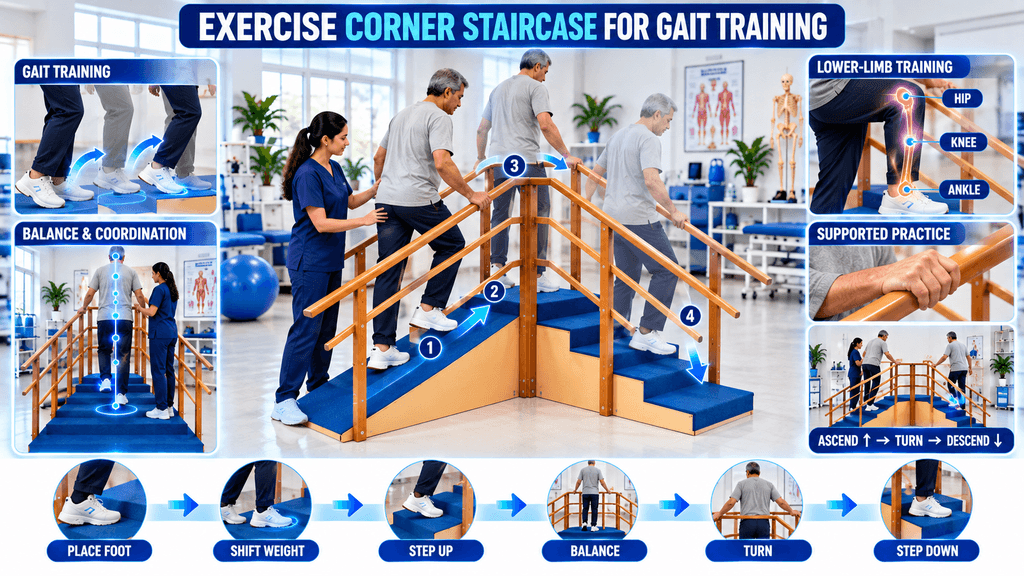
Exercise Corner Staircase for Gait Training
Gait rehabilitation often involves practising functional movements in a controlled and progressively challenging environment.
The Exercise Corner Stair Case Therapy allows the therapist to introduce step-based activities according to the patient’s ability. Lower steps may be used when beginning a program, while higher steps can provide a greater challenge when appropriate.
The therapist can observe:
- Foot placement
- Weight transfer
- Balance
- Step control
- Lower-limb coordination
- Use of hand support
- Ability to climb and descend
This makes the staircase a practical tool for functional mobility assessment and training.
Stair-Climbing Rehabilitation
Stair climbing requires coordinated movement of the lower limbs, trunk and upper body. Patients who have difficulty with stairs may benefit from practising the movement in a controlled therapy environment.
A physiotherapist can guide the patient through:
- Approaching the first step.
- Placing the foot correctly.
- Transferring weight safely.
- Stepping upward.
- Maintaining balance.
- Repeating the movement.
- Practising controlled descent.
The progression should be based on the patient’s strength, balance, coordination and clinical condition.
Balance and Coordination Training
Stepping exercises require the patient to control body weight while changing foot position.
Under professional supervision, the staircase can be used for activities involving:
- Weight shifting
- Step-to-step movement
- Alternating foot placement
- Controlled ascent
- Controlled descent
- Directional movement
- Handrail-assisted balance practice
The therapist can modify the exercise according to the patient’s functional ability.
Lower-Limb Strengthening
Step exercises can place functional demands on muscles involved in standing and stepping. Depending on the selected exercise, the therapist may incorporate the staircase into a lower-limb strengthening program.
It can be combined with other rehabilitation activities such as:
- Sit-to-stand exercises
- Resistance exercises
- Balance-board training
- Walking practice
- Functional reaching
- Mobility exercises
Exercise Corner Stair Case for Physiotherapy Clinics
A dedicated staircase can expand the functional training area of a physiotherapy clinic.
It can be used alongside:
- Parallel bars
- Gait trainers
- Standing frames
- Treatment tables
- Exercise cycles
- Shoulder rehabilitation equipment
- Balance-training equipment
- Resistance-training equipment
- Rehabilitation mats
A corner configuration can be particularly useful when a clinic wants a therapeutic staircase without dedicating an entire straight wall or corridor to the equipment.
How to Use Exercise Corner Stair Case Therapy
Step 1: Assess the Patient
The therapist should assess balance, mobility, lower-limb control and the patient’s ability to perform stepping exercises.
Step 2: Prepare the Equipment
Check the steps, platform, handrails and non-slip surfaces before starting the session.
Step 3: Position the Patient
Place the patient at the appropriate starting point and explain the selected exercise.
Step 4: Provide Appropriate Support
The patient may use the handrails when required, depending on the exercise and therapist’s instructions.
Step 5: Begin With a Suitable Step
Start with an appropriate step height and movement difficulty based on the patient’s ability.
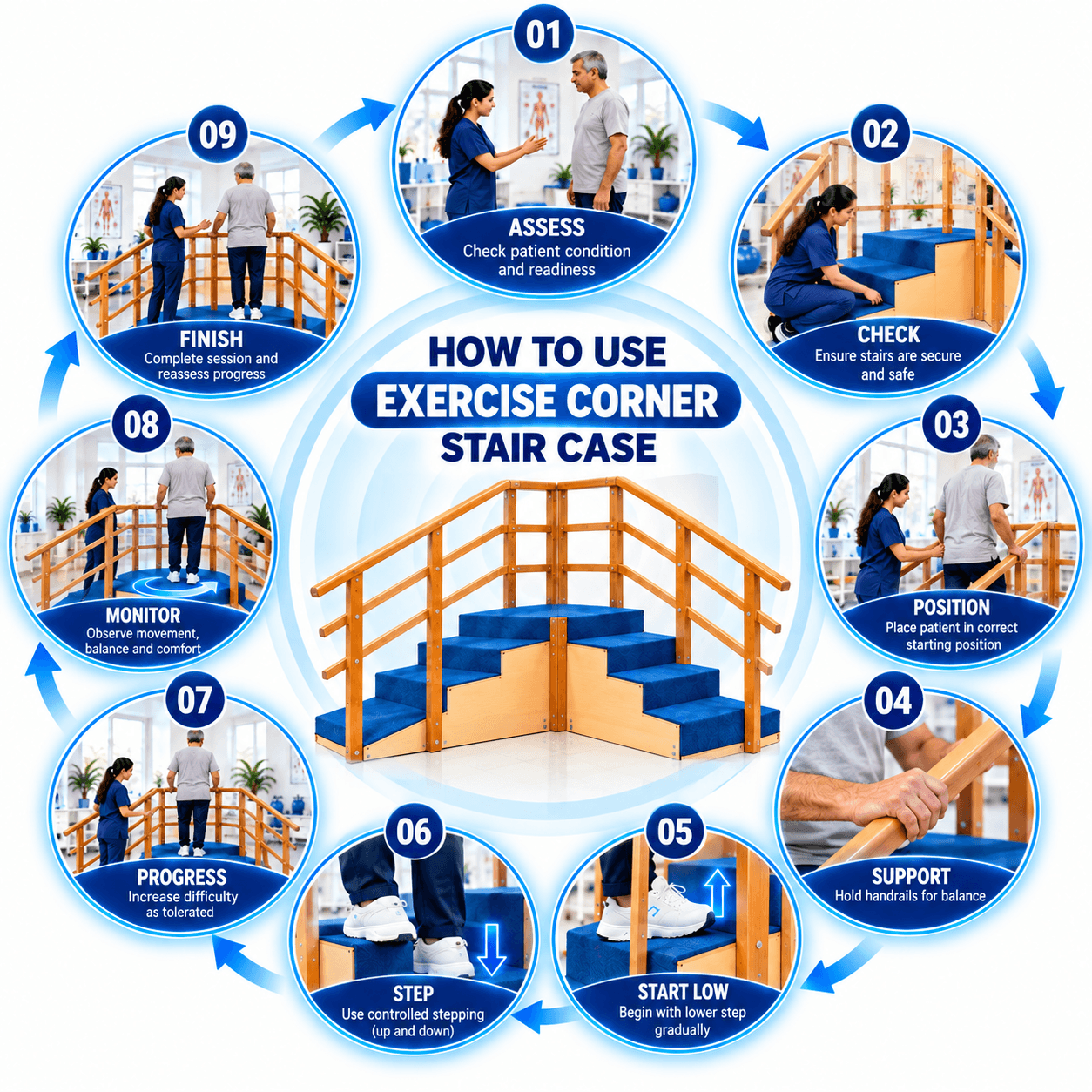
Step 6: Perform Controlled Stepping
Ask the patient to step up or down slowly while maintaining appropriate posture and control.
Step 7: Progress Gradually
As appropriate, the therapist can introduce different step heights, repetitions or movement patterns.
Step 8: Monitor the Patient
Observe balance, fatigue, foot placement and movement quality throughout the session.
Step 9: Finish Safely
Assist the patient back to a stable position and inspect the equipment after use.
Safety Precautions
The Exercise Corner Stair Case Therapy should be used under appropriate professional supervision.
Important precautions include:
- Inspect the staircase before every session.
- Ensure the equipment is positioned on a stable surface.
- Check that handrails are secure.
- Confirm that non-slip surfaces are properly attached.
- Use suitable footwear.
- Begin with an appropriate step height.
- Do not rush the patient during stair exercises.
- Provide assistance when required.
- Monitor for fatigue or loss of balance.
- Stop exercise if significant pain, dizziness or instability occurs.
- Keep the surrounding floor clear.
- Follow manufacturer-specific weight and usage limits.
Patients recovering from surgery, neurological conditions or significant injury should perform stair exercises only according to an appropriate rehabilitation plan.
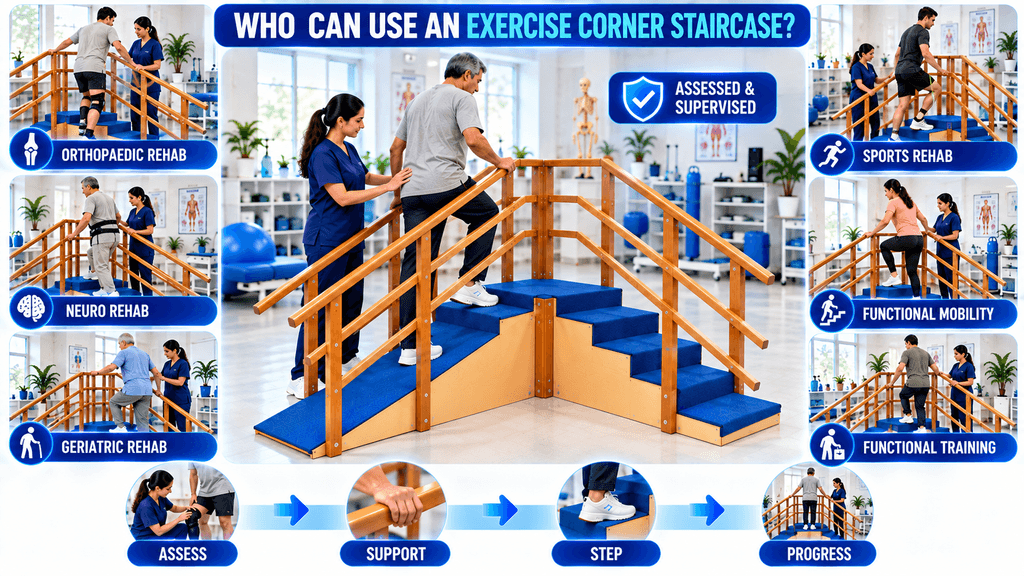
Who Can Use an Exercise Corner Staircase?
Potential users may include:
- Physiotherapy patients
- Orthopaedic rehabilitation patients
- Neurological rehabilitation patients
- Geriatric rehabilitation patients
- Sports rehabilitation patients
- Patients working on functional mobility
- Occupational therapy patients
The suitability of any particular exercise depends on the patient’s medical and functional condition.
Wooden vs Metallic Exercise Corner Staircase
Exercise corner staircases are available in different construction styles.
| Feature | Wooden Configuration | Metallic Configuration |
|---|---|---|
| Construction | Wood / ply-based structure | Tubular metal frame with board steps |
| Appearance | Traditional therapy-equipment design | Clinical / industrial design |
| Handrails | Wooden or model-dependent | Metal / model-dependent |
| Surface | Usually non-slip matting | Usually non-slip matting |
| Operation | Manual | Manual |
| Main Use | Gait & functional training | Gait & functional training |
| Installation | Indoor therapy area | Indoor therapy area |
| Exact specifications | Model dependent | Model dependent |
Both types can be suitable for professional rehabilitation when their construction and dimensions match the intended clinical requirements.
Things to Consider Before Buying
Step Height
Check the height of each riser and whether different step heights are provided.
Step Width
A sufficiently wide walking surface is important for controlled stepping practice.
Handrail Height
Check whether the handrail position is appropriate for the intended users.
Surface Grip
Non-slip stair surfaces are an important safety consideration.
Overall Dimensions
Measure the available therapy-room space before purchasing.
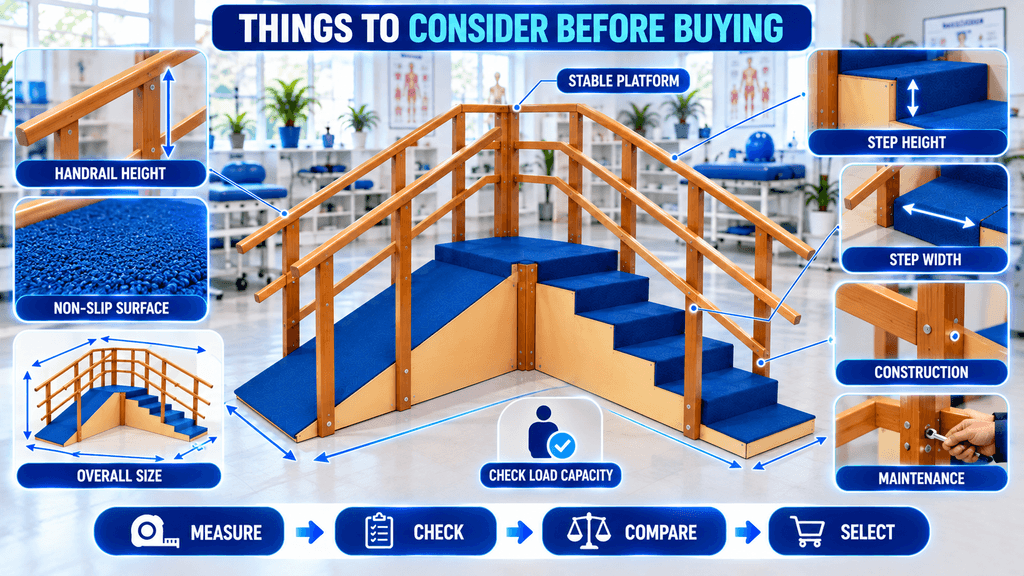
Construction
Choose a construction appropriate for the expected frequency of clinical use.
Platform Design
If the model includes a central platform, check its dimensions and stability.
Weight Capacity
Always confirm the manufacturer’s specified working load.
Maintenance
Check the availability of replacement mats, handrails and structural components.
Technical Specifications
| Specification | Details |
|---|---|
| Product Name | Exercise Corner Stair Case Therapy |
| Product Type | Physiotherapy Exercise Staircase |
| Design | Corner / L-Shaped |
| Operation | Manual |
| Primary Application | Gait & Mobility Training |
| Therapy Areas | Balance, Stair Training & Lower-Limb Exercise |
| Step Heights | Model Dependent |
| Step Width | Model Dependent |
| Platform | Model Dependent |
| Handrails | Included / Model Dependent |
| Handrail Height | Model Dependent |
| Surface | Non-Slip Matting / Model Dependent |
| Construction | Wood or Metallic Configuration |
| Power Requirement | None |
| Installation | Indoor Clinical / Rehabilitation Area |
| Suitable Users | Adults / Children Depending on Configuration |
| Brand | PHYSIOMODALITIES™ |
Note: Exact dimensions, step height, number of steps, weight, working load, material and handrail configuration should be confirmed from the specific product model before publishing fixed specifications.
Why Choose PHYSIOMODALITIES™?
PHYSIOMODALITIES™ focuses on physiotherapy, rehabilitation and clinical exercise equipment designed to support professional treatment environments.
The Exercise Corner Stair Case Therapy can be a practical addition to clinics that provide gait training, functional mobility rehabilitation, balance exercises and lower-limb therapy.
When selecting rehabilitation equipment, clinics should consider construction quality, patient safety, available space, step dimensions, handrail design, non-slip surfaces, working load, warranty and after-sales support.
Conclusion
The Exercise Corner Stair Case Therapy is a practical rehabilitation apparatus designed for supervised stair practice, gait training, balance exercises, lower-limb strengthening and functional mobility training.
Its corner-style design allows therapists to create a dedicated step-training area while making efficient use of available clinic space. Different step heights, supportive handrails and non-slip surfaces can provide a controlled environment for progressive rehabilitation exercises.
The equipment can be used in physiotherapy clinics, hospitals, rehabilitation centres, occupational therapy departments and sports rehabilitation facilities. With appropriate patient assessment and professional supervision, it can become an important part of a structured functional mobility and gait-training setup.
Frequently Asked Questions
1. What is Exercise Corner Stair Case Therapy?
It is a physiotherapy rehabilitation staircase designed for gait training, stair-climbing practice, balance exercises, lower-limb training and functional mobility exercises.
2. What is an exercise corner staircase used for?
It is primarily used for supervised stepping, stair-climbing, gait, balance and mobility training.
3. Does an exercise corner staircase require electricity?
No. It is a manually operated rehabilitation apparatus and does not normally require an electrical power source.
4. Is the staircase suitable for neurological rehabilitation?
It may be incorporated into suitable neurological rehabilitation programs for gait and functional mobility training, depending on the patient’s condition and therapist’s assessment.
5. Can children use an exercise corner staircase?
Some configurations include different handrail heights and step arrangements suitable for different users. The exact suitability should be confirmed according to the model and the child’s rehabilitation requirements.