The Robotic Elbow CPM Rehabilitation Machine is an advanced rehabilitation device designed to provide controlled and repetitive passive movement of the elbow joint. CPM stands for Continuous Passive Motion, a rehabilitation approach in which a machine guides a joint through a controlled range of movement while the patient does not need to actively generate the movement.
This type of rehabilitation equipment can be incorporated into physiotherapy and post-operative rehabilitation programs where controlled elbow movement is required. By providing consistent motion within therapist-selected limits, the machine can support structured rehabilitation and help clinicians manage repetitive range-of-motion exercises.
The Robotic Elbow CPM Rehabilitation Machine is suitable for physiotherapy clinics, rehabilitation centres, orthopaedic departments, sports rehabilitation facilities and hospitals looking for dedicated upper-limb rehabilitation equipment.
What Is a Robotic Elbow CPM Rehabilitation Machine?
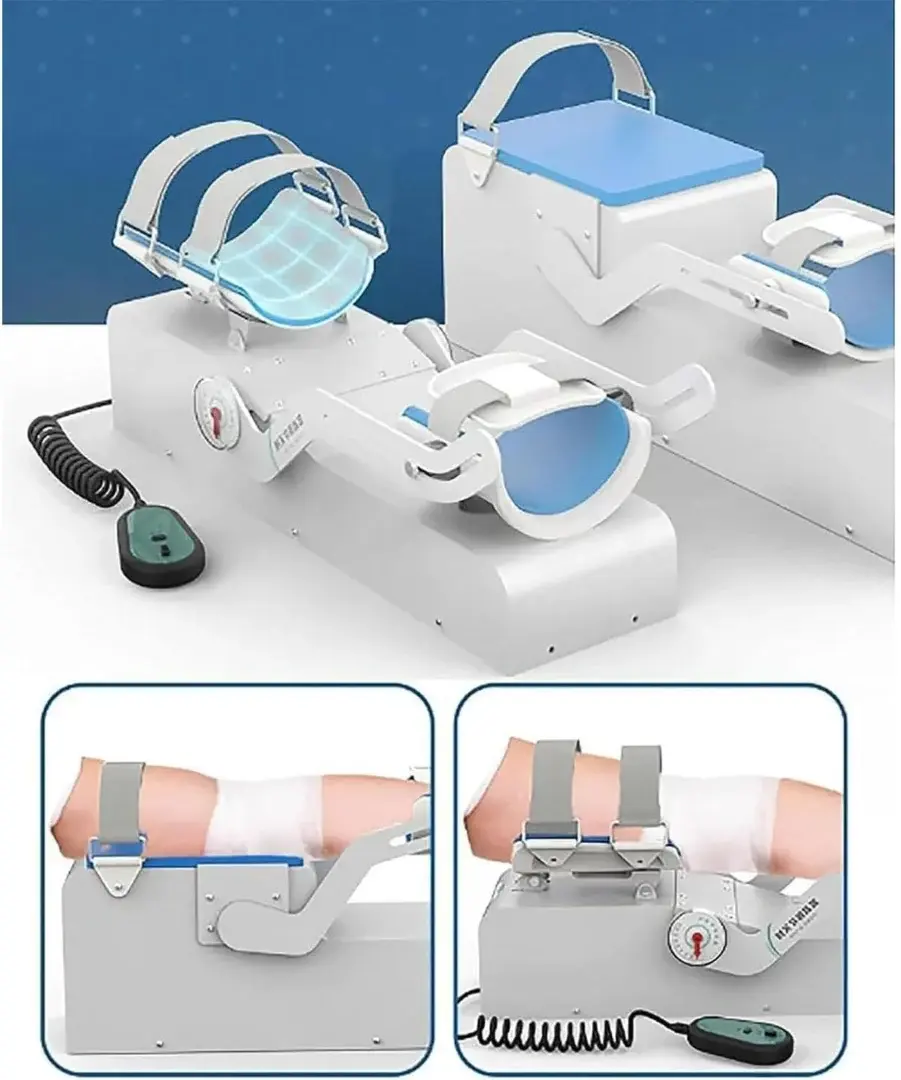
A Robotic Elbow CPM Rehabilitation Machine is an electrically operated rehabilitation system designed to move the elbow joint through a programmed or manually selected range of motion.
Unlike conventional exercises in which the patient actively moves the arm, CPM therapy allows the machine to guide the movement. This can be particularly useful when active movement is temporarily limited or when a clinician wants controlled, repeatable elbow mobilisation.
Modern elbow CPM devices may incorporate adjustable movement parameters, patient-support components and control interfaces. Exact controls and operating ranges depend on the machine configuration.
The robotic mechanism is designed to maintain a controlled movement pattern while the therapist supervises the treatment and adjusts the parameters according to the patient’s rehabilitation requirements.
How Does Robotic Elbow CPM Therapy Work?
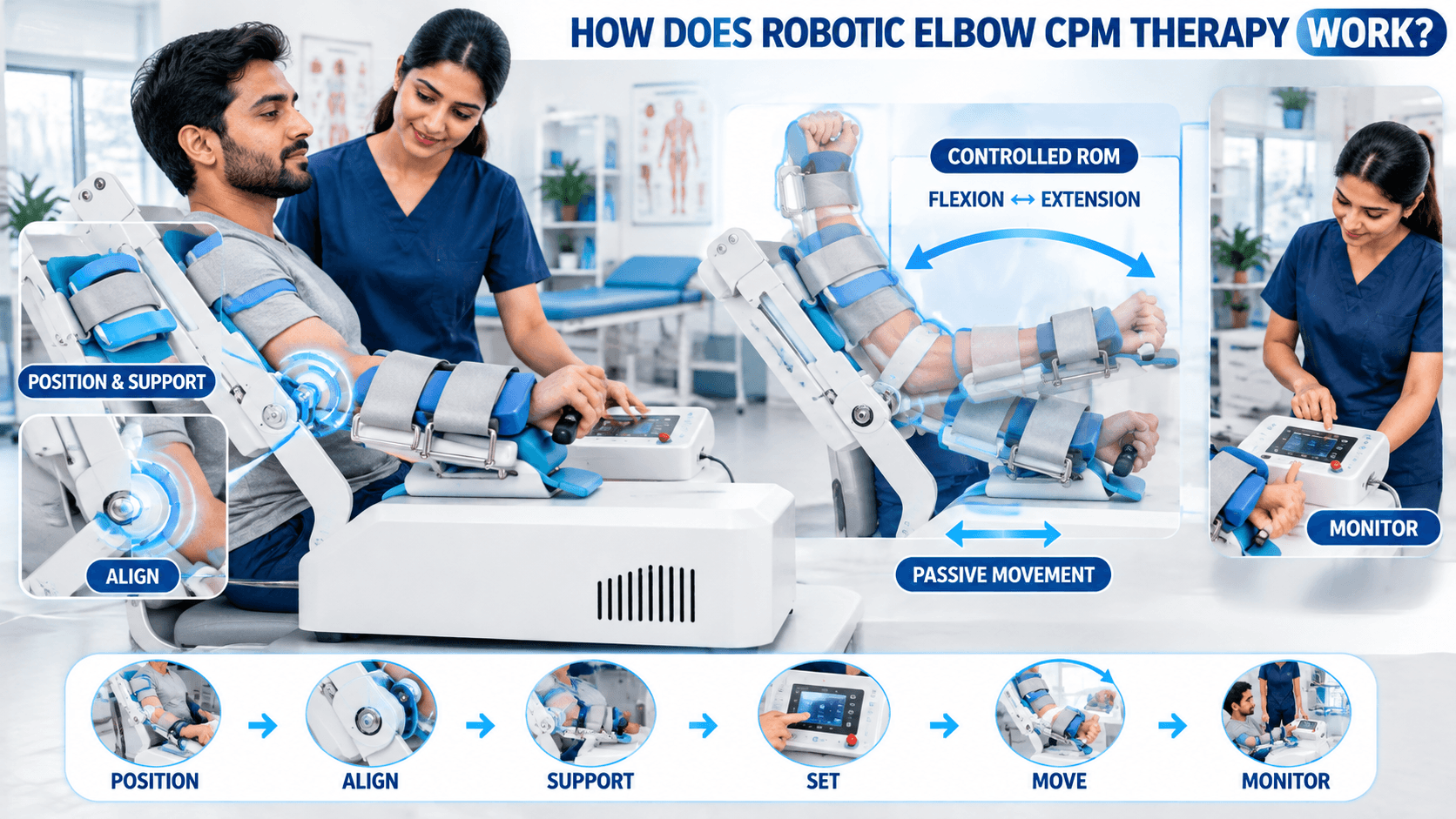
The patient’s arm is positioned and secured using the machine’s support system. The elbow is then aligned with the mechanical axis of the device.
Once the appropriate settings have been selected, the machine gently guides the elbow through the prescribed movement.
A typical therapy session may involve:
- Positioning the patient comfortably.
- Aligning the elbow joint with the machine’s movement axis.
- Securing the arm using appropriate supports.
- Selecting the required range of motion.
- Setting movement speed or other available parameters.
- Starting the passive movement cycle.
- Monitoring patient comfort and movement throughout the session.
- Adjusting or stopping the session when clinically required.
CPM is intended to provide controlled repetitive movement rather than forcing the joint beyond a patient’s prescribed limits.
Key Features
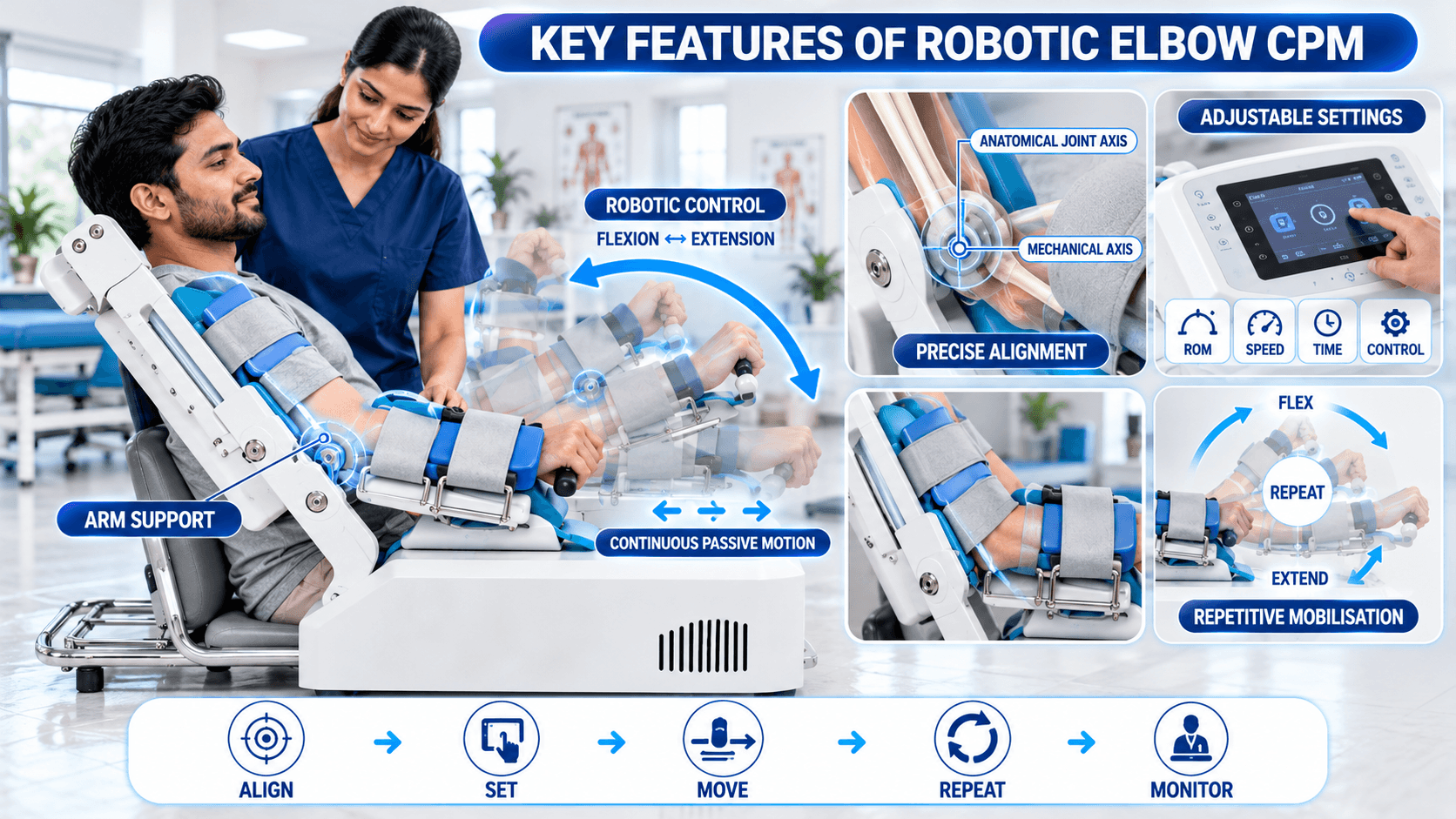
Robotic Controlled Elbow Movement
The robotic mechanism is designed to provide consistent and controlled elbow movement during rehabilitation sessions.
Continuous Passive Motion
The machine can guide repetitive elbow movement without requiring continuous active effort from the patient.
Adjustable Movement Parameters
Depending on the model, therapists may be able to adjust parameters such as range of motion, movement speed, treatment duration and other therapy settings.
Elbow Joint Alignment
Proper alignment between the patient’s anatomical elbow joint and the machine’s mechanical axis is important for comfortable and controlled operation.
Patient Support System
Arm and limb supports help maintain the appropriate position during treatment. Exact support configuration may vary by model.
Repetitive Rehabilitation
The machine can provide repeated movement cycles, helping therapists incorporate consistent passive mobilisation into a structured rehabilitation program.
Clinical Rehabilitation Design
The equipment is designed for professional rehabilitation environments where controlled elbow movement and therapist supervision are required.
User-Friendly Operation
Depending on the configuration, the control system may allow the therapist to select and monitor therapy parameters conveniently.
Applications of Robotic Elbow CPM Rehabilitation Machine
The Robotic Elbow CPM Rehabilitation Machine can be incorporated into several rehabilitation programs where controlled elbow movement is clinically appropriate.
Post-Operative Rehabilitation
Following certain elbow or upper-limb procedures, controlled passive movement may be included in a rehabilitation plan when prescribed by the treating clinician.
Elbow Mobility Training
The machine can be used as part of a structured program focused on maintaining or gradually improving elbow range of motion.
Orthopaedic Rehabilitation
Orthopaedic rehabilitation centres can use elbow CPM equipment for supervised joint mobilisation programs.
Sports Injury Rehabilitation
Athletes recovering from selected elbow-related injuries may use controlled passive movement as one component of a broader rehabilitation program.
Joint Stiffness Management
Where clinically appropriate, controlled repetitive movement may be incorporated into programs addressing reduced joint mobility.
Physiotherapy Clinics
The machine can complement manual therapy, therapeutic exercise and other rehabilitation equipment in professional physiotherapy settings.
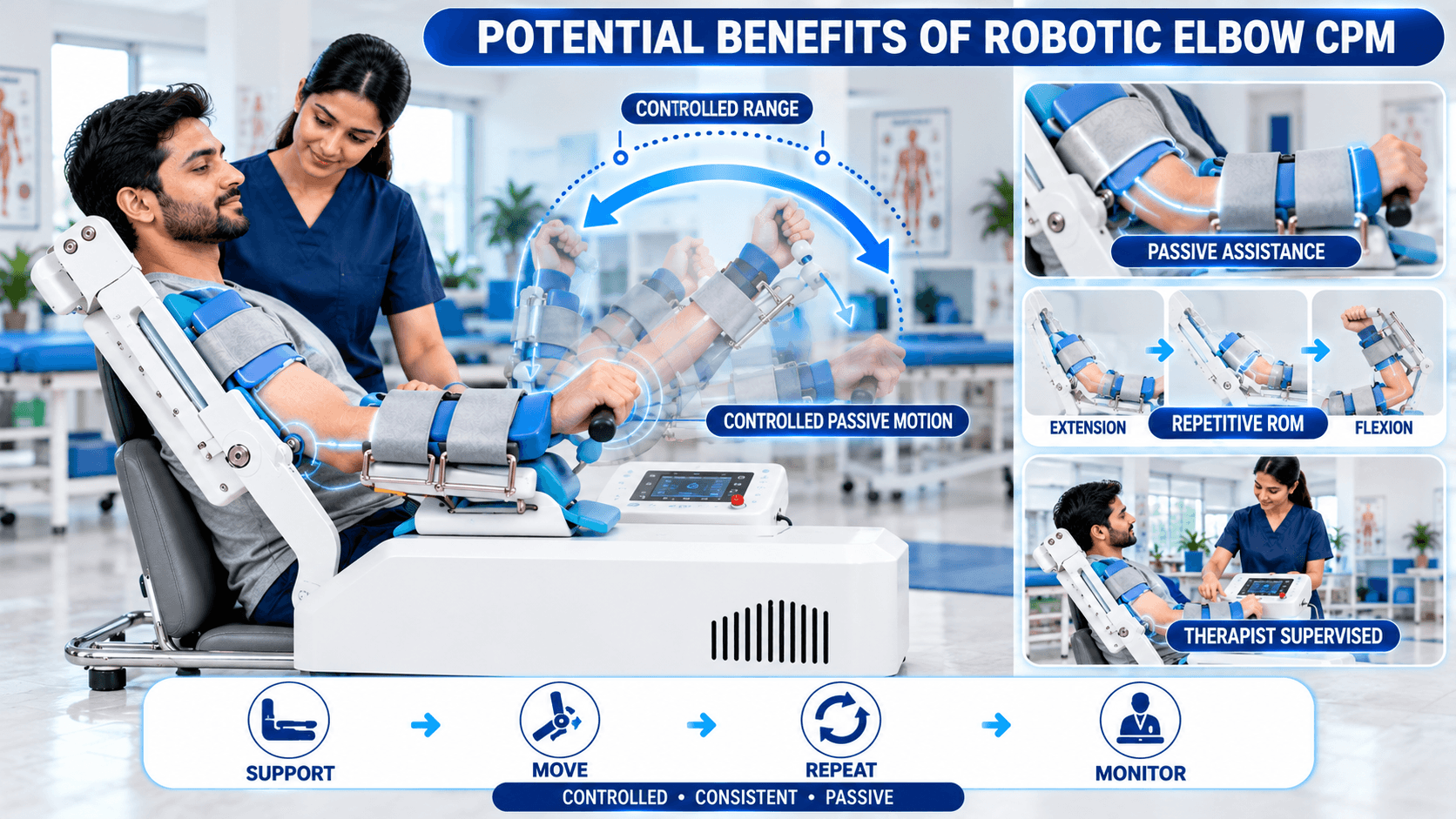
Potential Benefits
The potential benefits of incorporating an elbow CPM machine depend on the patient’s condition, treatment protocol and clinical supervision.
- Provides controlled passive elbow movement
- Supports repetitive range-of-motion exercises
- Allows consistent movement cycles
- Reduces the need for the patient to actively perform every movement repetition
- Can be incorporated into structured post-operative rehabilitation
- Supports therapist-controlled mobilisation
- May help maintain movement within a prescribed range
- Can complement other physiotherapy techniques
- Provides a dedicated solution for elbow rehabilitation
- Helps standardise repetitive passive movement sessions
CPM should be considered a component of an overall rehabilitation program rather than a replacement for clinical assessment, active exercise or other prescribed treatment.
Robotic Elbow CPM Machine in Physiotherapy
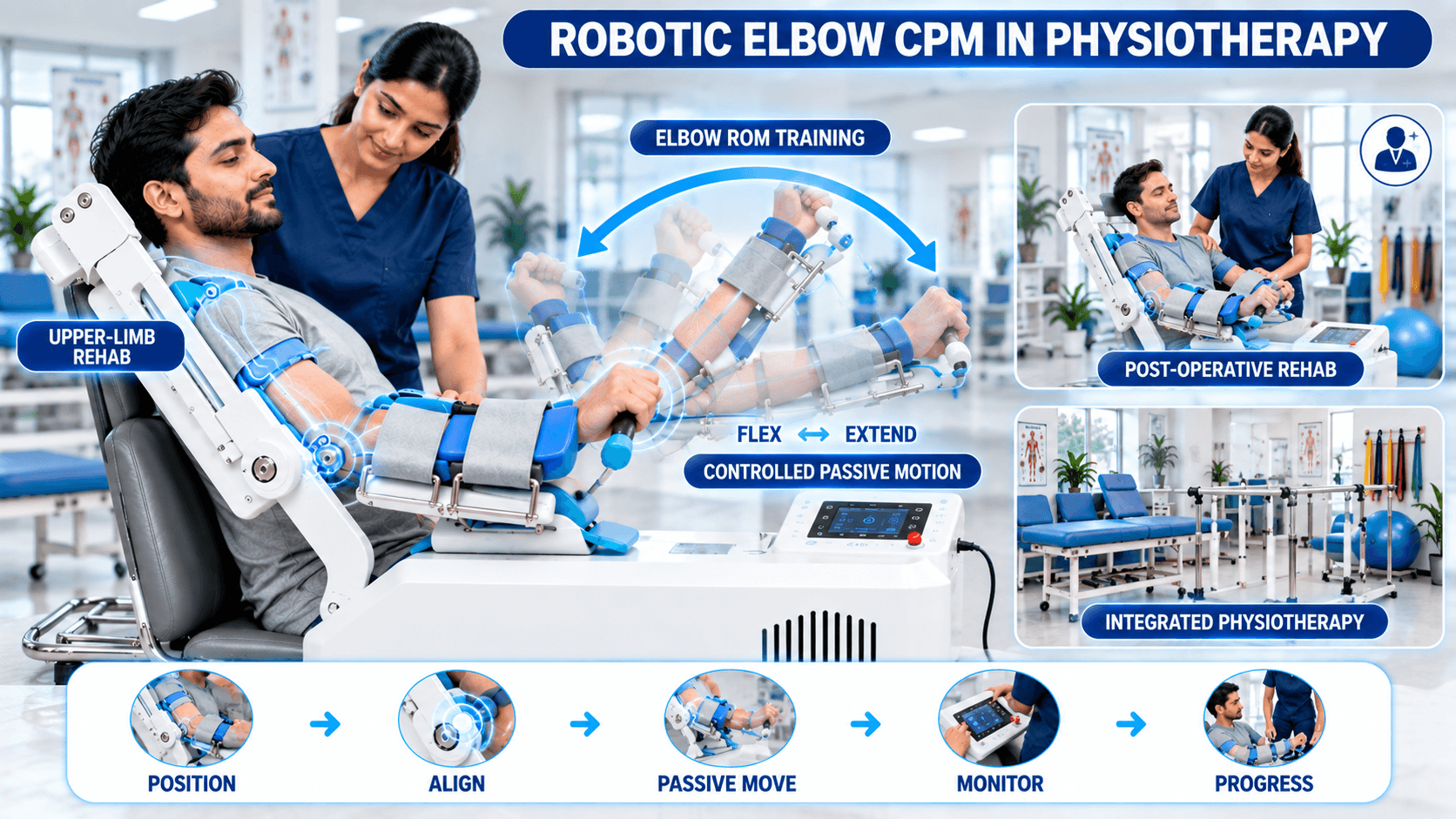
In a physiotherapy clinic, the Robotic Elbow CPM Rehabilitation Machine can be integrated with other rehabilitation techniques.
A therapist may combine controlled passive movement with:
- Active range-of-motion exercises
- Assisted exercises
- Strengthening exercises
- Manual therapy
- Functional upper-limb training
- Stretching
- Postural rehabilitation
- Patient-specific home exercise programs
The exact rehabilitation sequence should depend on the patient’s diagnosis, stage of recovery, surgical instructions and clinical assessment.
Elbow Range-of-Motion Rehabilitation
Elbow movement is important for many everyday activities, including reaching, lifting, grooming and positioning the hand.
After injury, surgery or prolonged immobilisation, elbow movement can become restricted. A controlled CPM system provides a mechanism for repetitive passive movement while allowing the therapist to establish appropriate treatment parameters.
The Robotic Elbow CPM Rehabilitation Machine can therefore be useful when a rehabilitation program requires repeated elbow movement under controlled conditions.
Post-Operative Elbow Rehabilitation
Some patients may require carefully controlled elbow mobilisation following surgery. However, the appropriate timing, movement range and intensity vary according to the procedure and the treating clinician’s instructions.
A CPM machine may be incorporated when passive movement has been prescribed.
The therapist should ensure:
- Correct patient positioning
- Appropriate joint alignment
- Suitable range-of-motion limits
- Comfortable movement
- Appropriate treatment duration
- Continuous observation when required
The machine should never be used to force movement beyond the prescribed range.
Upper-Limb Rehabilitation Applications
Although primarily designed around elbow movement, elbow rehabilitation forms part of broader upper-limb functional recovery.
The machine can be incorporated into rehabilitation programs alongside exercises targeting:
- Arm mobility
- Elbow flexibility
- Functional reaching
- Upper-limb coordination
- Muscle activation
- Progressive strengthening
The treatment plan should be individualised according to the patient’s rehabilitation goals.
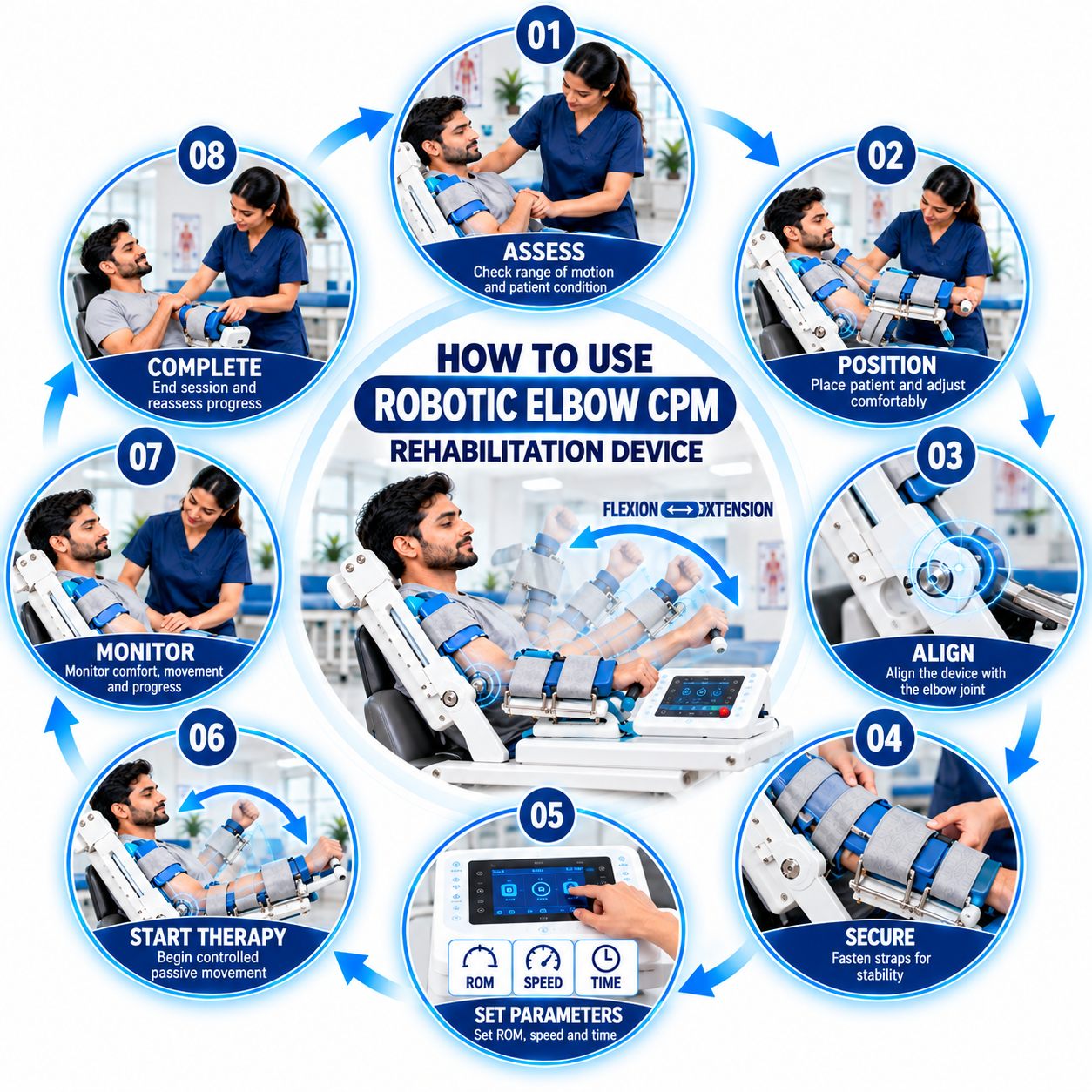
How to Use the Robotic Elbow CPM Rehabilitation Machine
Step 1: Patient Assessment
Assess the patient’s condition, available movement and contraindications before starting therapy.
Step 2: Position the Patient
Place the patient in a comfortable and stable position according to the equipment’s operating instructions.
Step 3: Align the Elbow
Carefully align the patient’s elbow joint with the mechanical axis of the machine.
Step 4: Secure the Arm
Use the supplied or compatible support components to position the arm securely without excessive pressure.
Step 5: Select Therapy Parameters
Set the appropriate range of motion, speed, duration and other available parameters according to the prescribed rehabilitation protocol.
Step 6: Start Controlled Movement
Begin the passive movement cycle and observe the patient’s response.
Step 7: Monitor Throughout Treatment
Check comfort, positioning and movement regularly. Stop the machine if unusual pain, discomfort or another concerning response occurs.
Step 8: Complete the Session
Stop the movement gradually and remove the patient’s arm carefully after the therapy session.
Safety Precautions
The Robotic Elbow CPM Rehabilitation Machine should be operated by trained healthcare or rehabilitation professionals.
Important precautions include:
- Follow the manufacturer’s operating instructions.
- Ensure correct elbow alignment before starting.
- Never force the joint through an excessive range.
- Use appropriate support straps or positioning components.
- Start with clinically appropriate settings.
- Monitor the patient throughout therapy.
- Stop treatment if significant pain or unusual discomfort develops.
- Follow post-operative restrictions where applicable.
- Inspect the machine and support components before use.
- Keep the equipment clean between patients.
- Do not modify the mechanical or electrical system without manufacturer authorisation.
Patients recovering from surgery, fracture, ligament injury or other significant conditions should use CPM only when it has been considered appropriate by their treating healthcare professional.
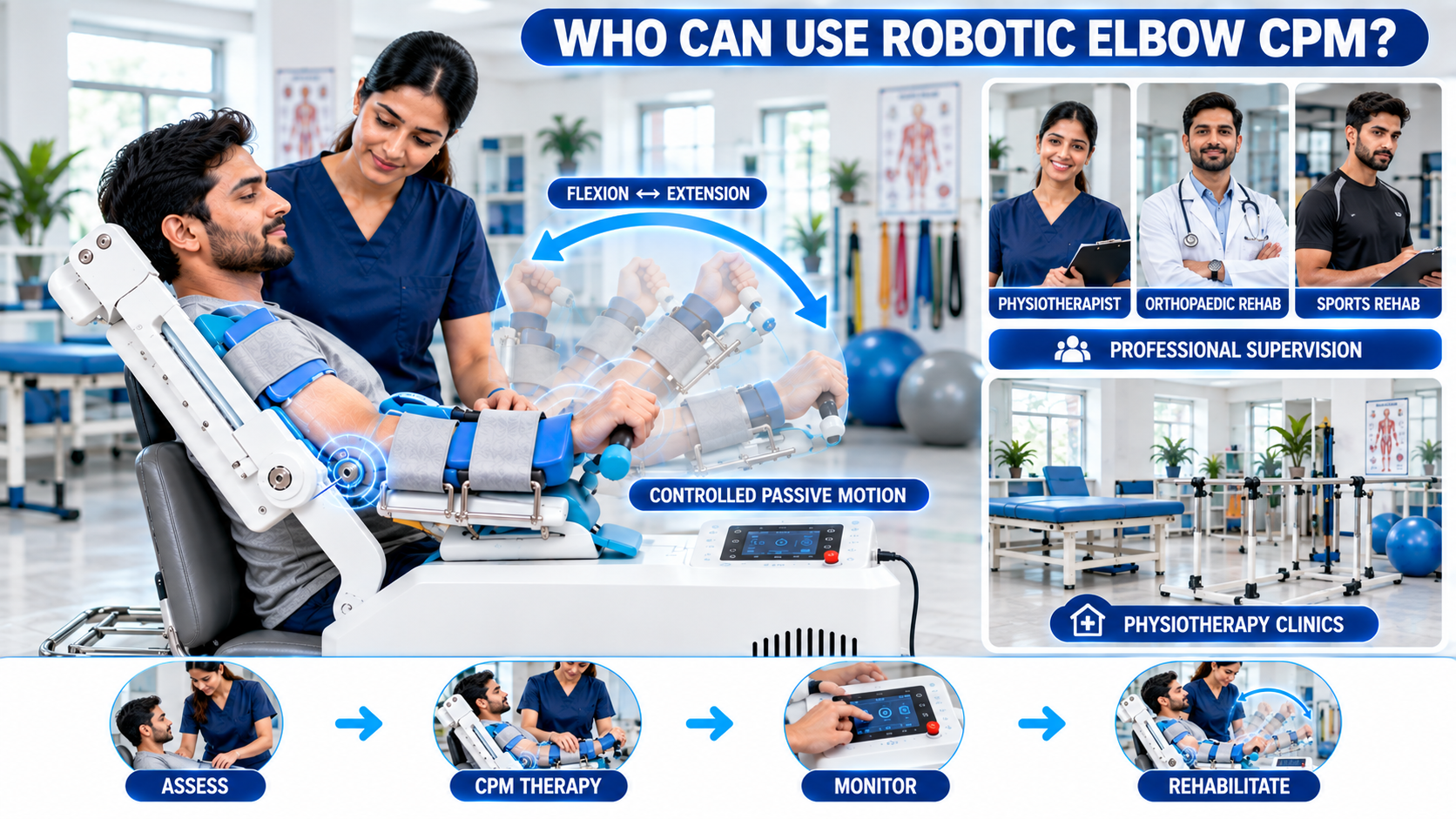
Who Can Use This Rehabilitation Equipment?
The machine is primarily intended for professional rehabilitation environments.
Potential users include:
- Physiotherapists
- Rehabilitation specialists
- Orthopaedic rehabilitation teams
- Sports rehabilitation professionals
- Hospitals
- Physiotherapy clinics
- Rehabilitation centres
- Medical training institutions
Patient suitability depends on the individual’s condition and the recommendation of the treating professional.
Robotic Elbow CPM for Physiotherapy Clinics
For clinics offering orthopaedic and upper-limb rehabilitation, a dedicated elbow CPM machine can expand the range of available rehabilitation equipment.
It can be positioned alongside:
- TENS machines
- IFT machines
- Muscle stimulators
- Ultrasonic therapy machines
- Laser therapy equipment
- Shockwave therapy machines
- Exercise and strengthening equipment
- Shoulder pulley systems
- Rehabilitation tables
This allows therapists to develop comprehensive treatment programs according to individual patient requirements.
Things to Consider Before Buying
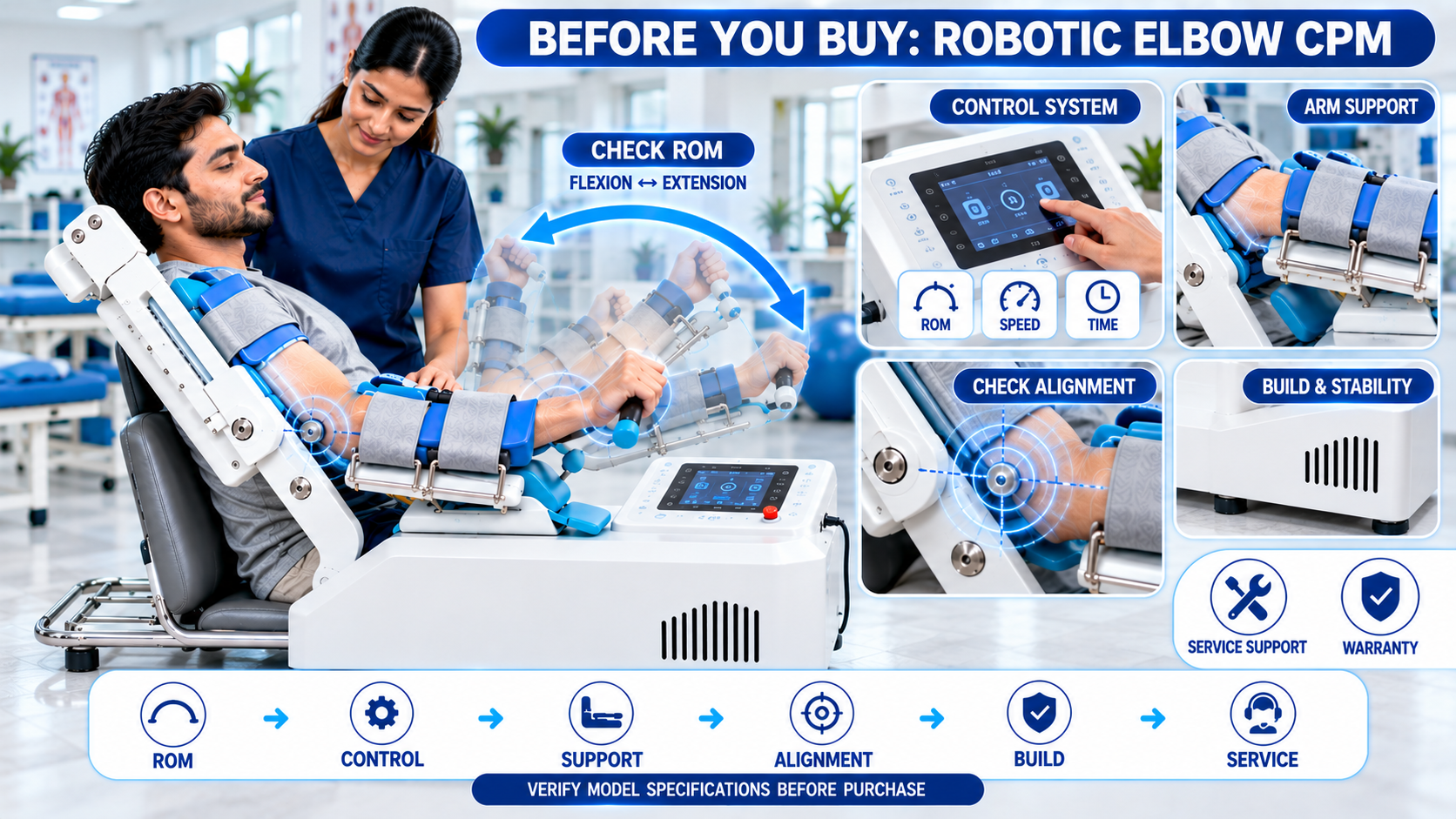
Before purchasing a Robotic Elbow CPM Rehabilitation Machine, clinics should evaluate:
Range of Motion
Check the available elbow movement range and whether it matches the intended clinical applications.
Speed Adjustment
Confirm whether movement speed can be adjusted according to different rehabilitation requirements.
Control System
Consider whether the interface provides convenient control of therapy parameters.
Patient Support
Check the quality, adjustability and comfort of the arm-support components.
Mechanical Alignment
The machine should allow appropriate alignment between the patient’s elbow and the movement mechanism.
Construction Quality
A clinic-grade machine should have a robust construction suitable for repeated professional use.
Maintenance
Check availability of technical support, spare parts and servicing.
Warranty
Review warranty coverage and after-sales support before purchasing.
Technical Specifications
| Specification | Details |
|---|---|
| Product Name | Robotic Elbow CPM Rehabilitation Machine |
| Product Type | Robotic Elbow Continuous Passive Motion Rehabilitation Equipment |
| Therapy Type | Continuous Passive Motion |
| Target Area | Elbow / Upper Limb |
| Operation | Motorised / Robotic |
| Movement | Controlled Passive Elbow Movement |
| Range of Motion | Adjustable / Model Dependent |
| Movement Speed | Adjustable / Model Dependent |
| Treatment Time | Adjustable / Model Dependent |
| Control Interface | Digital / Model Dependent |
| Arm Support | Included / Configuration Dependent |
| Patient Position | According to Machine Design |
| Application | Physiotherapy & Rehabilitation |
| Suitable Environment | Clinics, Hospitals & Rehabilitation Centres |
| Power Supply | Model Dependent |
| Construction | Clinical-Grade / Model Dependent |
| Brand | PHYSIOMODALITIES™ |
Note: Exact technical specifications, movement angles, speed ranges, dimensions, load limits, display type and electrical requirements should be confirmed from the specific machine model and manufacturer datasheet before publication or purchase.
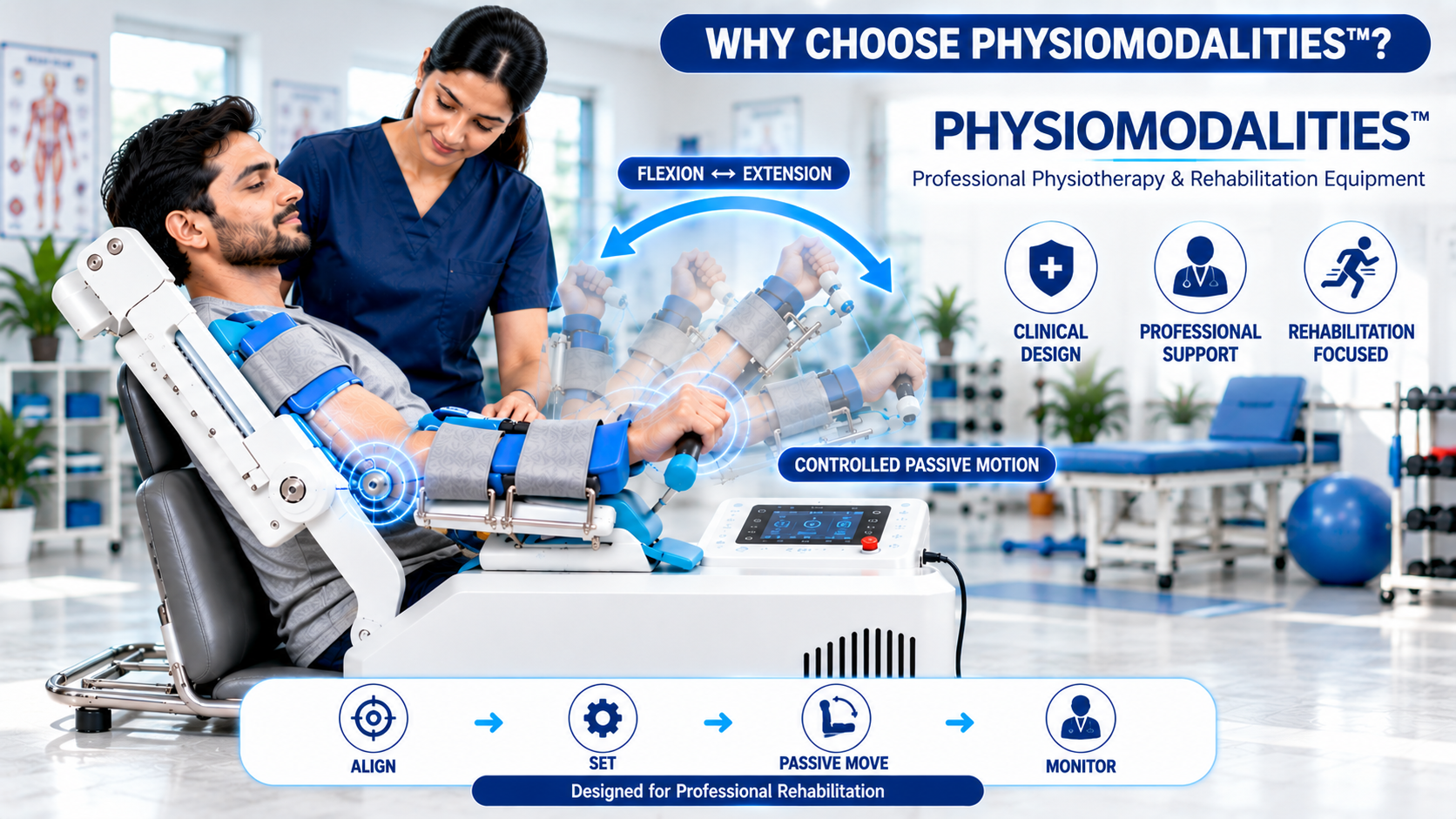
Why Choose PHYSIOMODALITIES™?
PHYSIOMODALITIES™ focuses on physiotherapy and rehabilitation equipment designed for professional clinical environments.
The Robotic Elbow CPM Rehabilitation Machine can be a useful addition to clinics looking to provide dedicated upper-limb rehabilitation equipment with controlled passive movement.
PHYSIOMODALITIES™ products are intended to support physiotherapists and rehabilitation professionals with equipment suited to structured clinical workflows.
For clinics, selecting equipment should involve consideration of build quality, usability, technical support, warranty, patient positioning and compatibility with the intended rehabilitation program.
Conclusion
The Robotic Elbow CPM Rehabilitation Machine is a specialised rehabilitation solution designed to provide controlled and repetitive passive movement of the elbow joint. Its robotic movement mechanism can help therapists incorporate consistent elbow mobilisation into appropriate rehabilitation programs.
It can be considered for physiotherapy clinics, rehabilitation centres, hospitals, orthopaedic departments and sports rehabilitation facilities where controlled elbow range-of-motion training is required.
When selecting an elbow CPM machine, clinics should consider movement range, adjustment options, patient support, control interface, construction quality, safety features, warranty and after-sales service. Proper patient assessment and professional supervision remain essential for safe and appropriate use.
Frequently Asked Questions
1. What is a Robotic Elbow CPM Rehabilitation Machine?
It is a motorised rehabilitation device designed to move the elbow joint through a controlled passive range of motion without requiring continuous active movement from the patient.
2. What does CPM stand for?
CPM stands for Continuous Passive Motion. It refers to mechanically guided repetitive movement of a joint.
3. Can an elbow CPM machine be used after surgery?
It may be incorporated into certain post-operative rehabilitation programs when passive elbow movement has been prescribed by the treating healthcare professional.
4. Can the movement range be adjusted?
Many elbow CPM machines provide adjustable movement parameters, but the exact range and controls depend on the specific model.
5. Who should operate an elbow CPM machine?
It should preferably be operated by a trained physiotherapist or other appropriately trained rehabilitation professional according to the manufacturer’s instructions and the patient’s treatment plan.