
Standing Frame Chair is a rehabilitation and physiotherapy equipment designed to provide stable support during assisted standing, posture training, balance activities, and selected rehabilitation exercises. It can help create a controlled standing environment for individuals who require additional support while practicing an upright position.
The Standing Frame Chair combines a supportive frame with a chair-like positioning concept, making it useful in physiotherapy clinics, rehabilitation centres, hospitals, special education environments, and selected home rehabilitation settings. Depending on the configuration, the equipment may include adjustable support components designed to accommodate different users.
PHYSIOMODALITIES™ provides physiotherapy and rehabilitation equipment designed for practical clinical applications. A standing frame chair can be incorporated into a broader rehabilitation setup alongside treatment tables, exercise therapy equipment, standing frames, parallel bars, and other mobility-support equipment.
What Is a Standing Frame Chair?
A Standing Frame Chair is a therapeutic rehabilitation device designed to assist a person in maintaining a supported upright position. It provides a structured platform around the user so that standing activities can be performed with greater external support than unsupported standing.
The exact design can vary between models. Some configurations are designed as wooden standing frames, while other standing-frame chairs may use metal structures, padded supports, adjustable components, wheels, or additional positioning accessories.
The PME Standing Frame Patient Chair is described as being constructed from durable wood, providing stable support for standing exercises, offering adjustable height, and having an ergonomic design for comfort and safety.
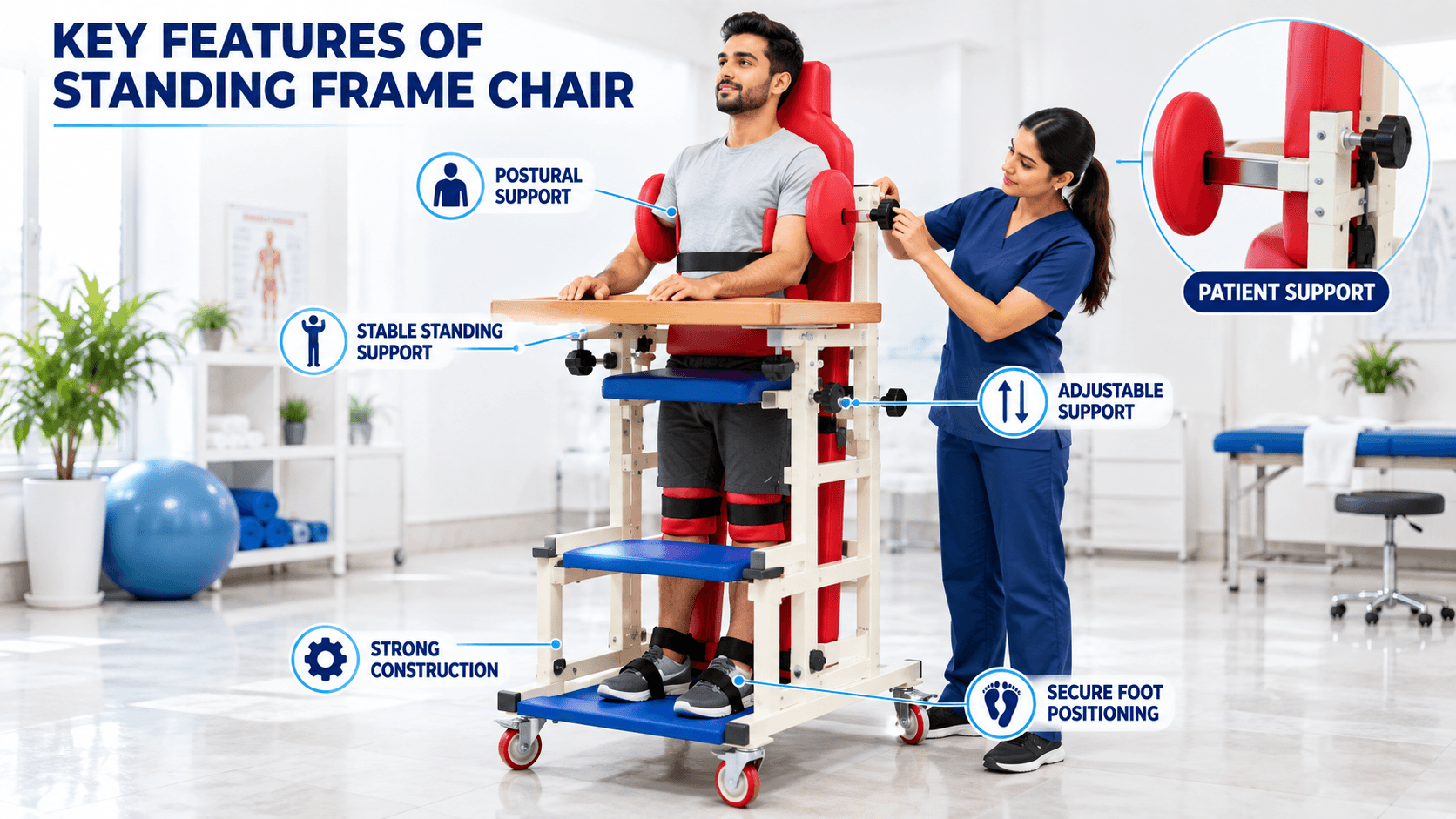
Key Features of Standing Frame Chair
Stable Standing Support
The frame provides external support while the user practices maintaining an upright position.
Adjustable Configuration
Depending on the model, support or height adjustment may be available to accommodate different users. The PME wooden configuration specifically lists adjustable height as a feature.
Ergonomic Design
A suitable standing frame chair is designed around patient positioning and support, helping the user maintain a controlled posture during supervised activities.
Durable Construction
The construction can vary by configuration. Wooden models provide a sturdy rehabilitation structure, while other versions may use mild steel or other structural materials.
Rehabilitation-Focused Design
The equipment is designed for therapeutic standing activities rather than ordinary seating.
Suitable for Clinical Use
Standing frame chairs can be incorporated into physiotherapy and rehabilitation environments where supervised standing and postural activities are part of the treatment plan.
How Does a Standing Frame Chair Work?
The basic principle is to provide external support around the user while they are positioned upright.
The patient is carefully positioned within the frame, and appropriate support components are adjusted according to the individual’s requirements. Once safely positioned, the user can participate in selected standing, balance, posture, or functional activities under professional supervision.
The level of support should be determined by the physiotherapist or rehabilitation professional. A standing frame is not intended to replace independent standing ability unless specifically prescribed as part of a rehabilitation program.
Applications of Standing Frame Chair
The Standing Frame Chair can be used in several rehabilitation environments.
Physiotherapy Clinics
Physiotherapists can use the equipment during supported standing exercises, postural training, balance-related activities, and selected functional rehabilitation programs.
Rehabilitation Centres
It can provide a structured platform for supervised standing practice for individuals with mobility limitations.
Neurological Rehabilitation
Standing activities may form part of rehabilitation programs involving posture, balance, weight-bearing, and functional movement.
Paediatric Rehabilitation
Appropriately sized standing frame configurations can be used in paediatric rehabilitation when prescribed and supervised by qualified professionals.
Orthopaedic Rehabilitation
The equipment may be incorporated into selected rehabilitation programs where supported standing is clinically appropriate.
Home Rehabilitation
Some standing frame configurations are designed for home use as well as clinical environments. PME’s wooden standing frame listing specifically identifies both clinical and home use.
Benefits of Standing Frame Chair
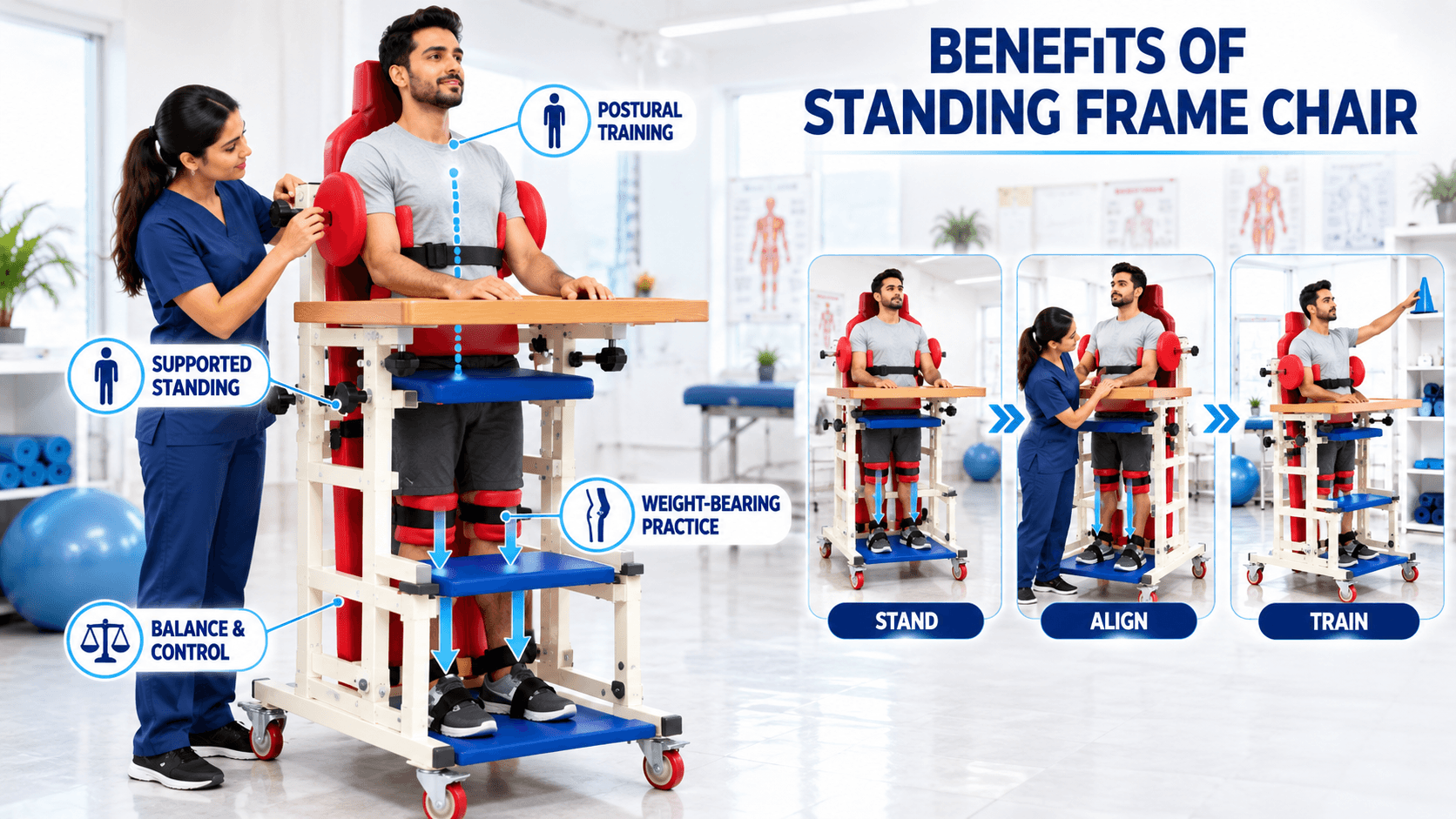
When incorporated appropriately into a professionally planned rehabilitation program, a Standing Frame Chair can offer several practical benefits:
- Provides external support during standing practice
- Helps create a controlled upright position
- Supports postural training
- Can be incorporated into balance activities
- Provides a structured environment for weight-bearing practice
- Supports selected functional rehabilitation exercises
- May assist therapists in gradually progressing standing activities
- Suitable for supervised rehabilitation sessions
- Can be useful in neurological and orthopaedic rehabilitation
- Available in configurations suitable for clinical or home environments
The exact therapeutic benefit depends on the patient’s condition, the equipment configuration, and the rehabilitation program prescribed by the healthcare professional.
Standing Frame Chair for Physiotherapy
Standing is an important component of many rehabilitation programs, but some patients may initially require substantial external support.
A standing frame chair can provide that support while allowing the physiotherapist to introduce controlled upright activities. The professional can observe posture, positioning, tolerance, and movement while determining whether the patient is ready for progression.
The equipment can therefore be positioned within an exercise therapy or rehabilitation area of a physiotherapy clinic.
Standing Frame Chair for Postural Training
Maintaining an upright posture requires coordinated control of the trunk, pelvis, hips, knees, and feet.
A standing frame provides external support so that the therapist can focus on positioning and controlled standing activities. Depending on the patient’s ability, the professional may gradually modify the level of support or introduce additional activities while the patient remains safely positioned.
Postural training should always be individualized rather than using the same standing arrangement for every patient.
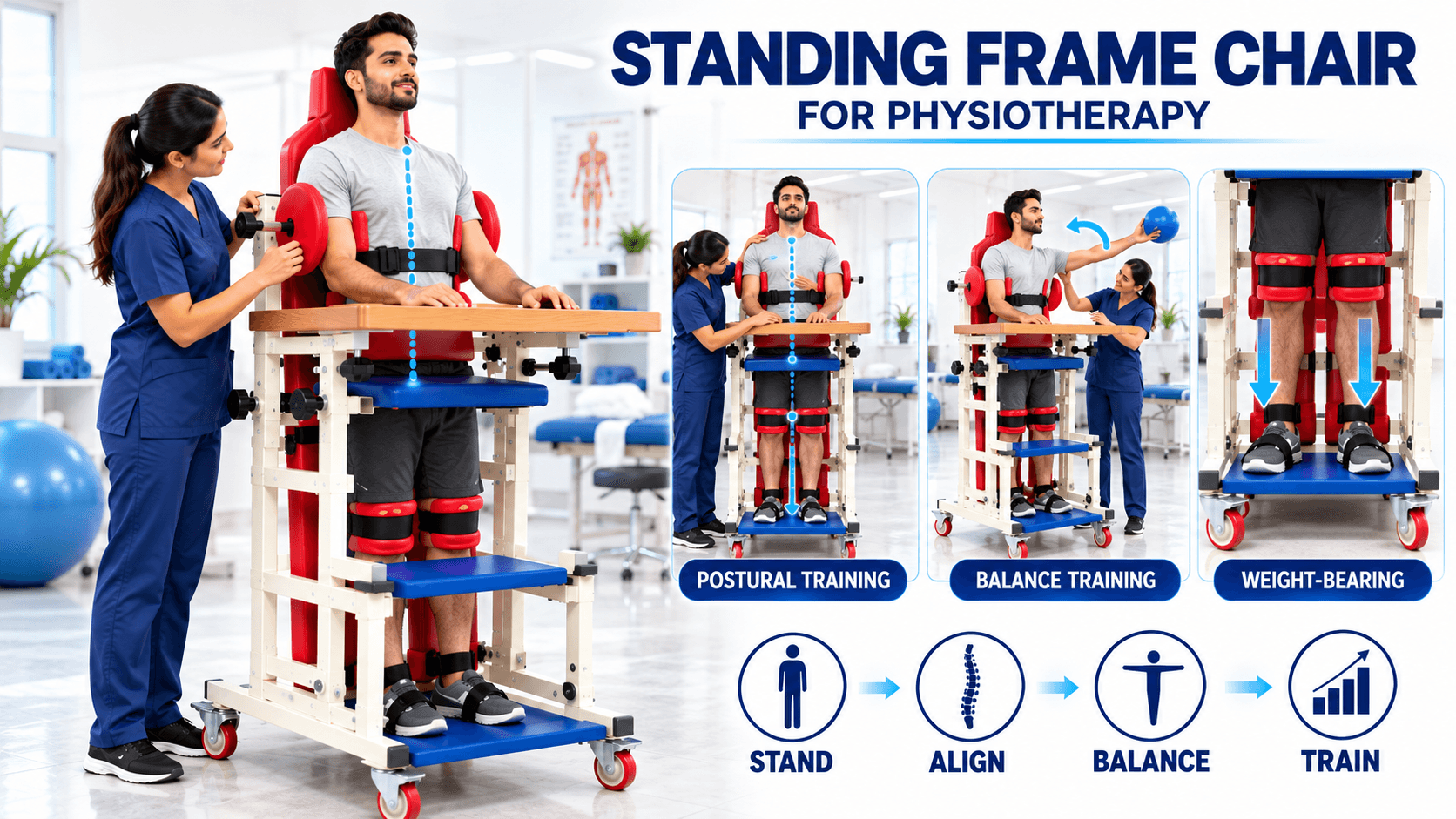
Standing Frame Chair for Balance Training
Balance activities can be challenging for individuals with reduced stability.
A supported standing frame can provide a more controlled environment for selected balance-related activities. The therapist can determine the appropriate amount of support and monitor the patient’s response throughout the exercise.
The objective is not simply to keep the patient standing but to use the supported position appropriately within the overall rehabilitation plan.
Standing Frame Chair for Weight-Bearing Activities
Supported standing may be incorporated into rehabilitation programs where controlled weight-bearing is appropriate.
The therapist determines the patient’s positioning and the degree of support required. Depending on the design, support can be provided around different areas of the body to maintain a stable standing position.
Weight-bearing activities should only be introduced when considered appropriate for the patient’s clinical condition.
Standing Frame Chair for Paediatric Rehabilitation
Some rehabilitation environments use specialized standing equipment for children who require additional support during upright activities.
A paediatric standing frame chair may include adjustable supports designed around the child’s size and positioning requirements. Child-specific equipment should always be selected according to the child’s measurements and professional assessment.
Do not use an adult standing frame for a child unless the manufacturer specifically states that the configuration is appropriate.
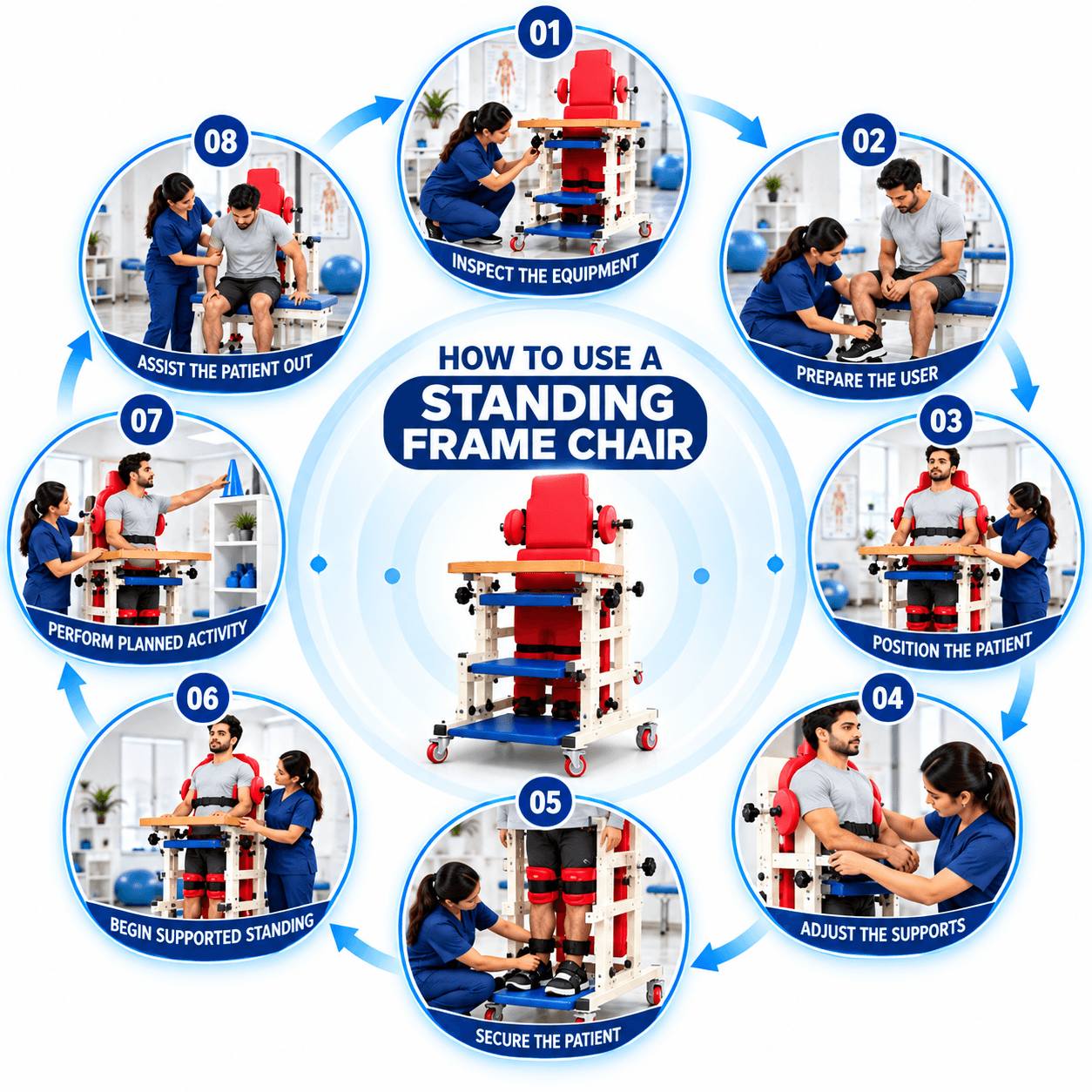
How to Use a Standing Frame Chair
Step 1: Inspect the Equipment
Check the frame, support components, seat or positioning surfaces, straps, and other relevant parts before use.
Step 2: Prepare the User
Ensure the patient is wearing appropriate clothing and footwear and is ready for the standing activity.
Step 3: Position the Patient
Assist the patient into the standing frame according to the manufacturer’s instructions and the therapist’s positioning protocol.
Step 4: Adjust the Supports
Adjust available height, positioning supports, or other components to provide appropriate assistance.
Step 5: Secure the Patient
Where the model includes belts, straps, knee supports, pelvic supports, or other positioning components, secure them appropriately.
Step 6: Begin Supported Standing
Allow the patient to assume the supported standing position gradually while the professional observes posture and tolerance.
Step 7: Perform the Planned Activity
The physiotherapist can conduct appropriate standing, posture, balance, or functional exercises.
Step 8: Assist the Patient Out
After the session, carefully assist the patient out of the standing frame.
Safety Precautions
A standing frame chair should be used carefully because patients using it may have limited balance, strength, or mobility.
- Use the equipment under appropriate professional supervision.
- Inspect the frame before every session.
- Ensure the frame is placed on a stable, level surface.
- Check all support components before positioning the patient.
- Do not exceed the manufacturer’s specified load capacity.
- Adjust supports according to the user’s body size and clinical requirements.
- Ensure the patient’s feet are positioned securely.
- Use appropriate footwear where required.
- Do not leave a patient unattended unless the professional has specifically determined that it is safe.
- Stop the session if the patient experiences unusual pain, dizziness, excessive fatigue, or other concerning symptoms.
- Do not use damaged straps, supports, or structural components.
Maintenance of Standing Frame Chair
Regular maintenance helps keep rehabilitation equipment safe and functional.
The frame should be checked periodically for loose joints, cracks, structural damage, or other signs of wear. Wooden components should be kept clean and dry, while metal components should be checked for corrosion or damage where applicable.
If the model contains straps, belts, wheels, cushions, or adjustable mechanisms, these should also be inspected regularly.
Follow the manufacturer’s cleaning and maintenance recommendations for the specific model.
Who Can Use a Standing Frame Chair?
A Standing Frame Chair is intended for use in professional rehabilitation and supervised therapeutic environments.
Potential professional users include:
- Physiotherapists
- Rehabilitation professionals
- Occupational therapists, where appropriate
- Paediatric rehabilitation professionals
- Healthcare professionals trained in supported standing
- Physiotherapy students under qualified supervision
The equipment should be selected according to the user’s size, mobility level, support requirements, and rehabilitation goals.
Things to Consider Before Buying
User Size
Check the recommended height, weight, and body dimensions for the particular model.
Frame Construction
Consider the material, structural strength, finish, and overall stability.
Adjustability
Check whether the height, supports, seat, or positioning components can be adjusted.
Patient Support
Determine whether the model includes the support components required for the intended users.
Space Requirements
Measure the available clinic or home area before purchase.
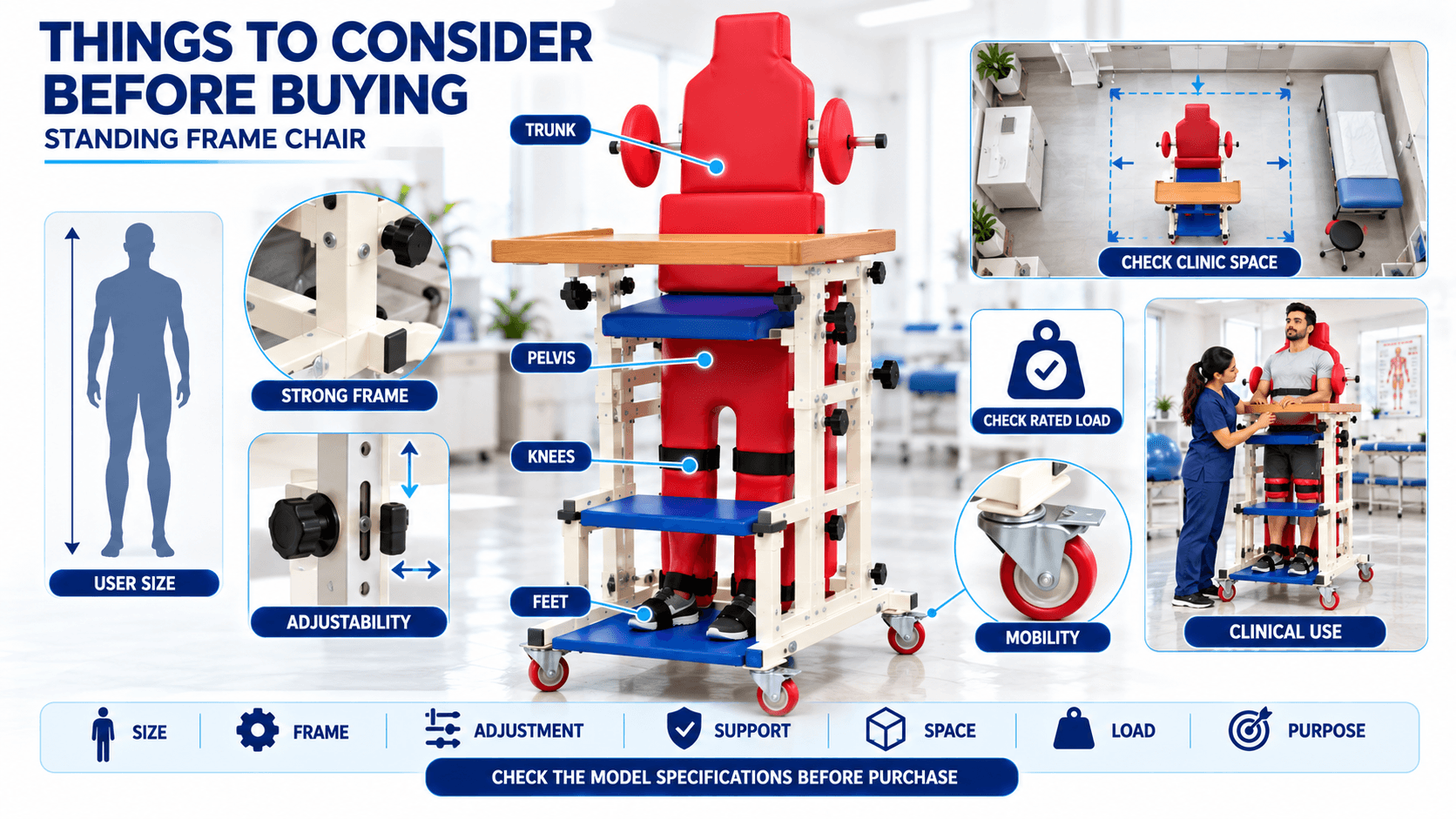
Mobility
Some configurations may include wheels, while fixed models may not. Select the design according to the intended environment.
Weight Capacity
Always confirm the manufacturer’s specified maximum user weight.
Clinical Purpose
Choose a model according to whether it will primarily be used for paediatric rehabilitation, adult rehabilitation, neurological rehabilitation, or general physiotherapy.
Technical Specifications
| Specification | Details |
|---|---|
| Product Name | Standing Frame Chair |
| Product Type | Standing & Rehabilitation Equipment |
| Primary Application | Supported Standing & Rehabilitation |
| Construction | Wooden / Model Dependent |
| Height Adjustment | Available on Supported Configuration |
| Patient Position | Supported Upright Standing |
| Support System | Model Dependent |
| Seating/Positioning | Model Dependent |
| Wheels | Model Dependent |
| User Group | Adult / Paediatric Depending on Model |
| Clinical Application | Physiotherapy & Rehabilitation |
| Home Use | Available on Suitable Configuration |
| Operation | Manual |
| Dimensions | Model Dependent |
| Load Capacity | As specified by manufacturer |
| Brand | PHYSIOMODALITIES™ |
Specifications can vary by model and configuration. Confirm dimensions, recommended user size, load capacity, support components, and included accessories before purchase.
Standing Frame Chair vs. Standard Chair
A standard chair is primarily designed for sitting, whereas a Standing Frame Chair is a rehabilitation device designed to provide structured support during upright standing activities.
| Feature | Standing Frame Chair | Standard Chair |
|---|---|---|
| Primary Purpose | Supported standing & rehabilitation | Sitting |
| Upright Position | Supported standing | Seated |
| Rehabilitation Use | Yes | Limited |
| Postural Training | Suitable for selected programs | Not specifically designed for it |
| Adjustable Supports | Model dependent | Usually limited |
| Clinical Application | Physiotherapy & rehabilitation | General seating |
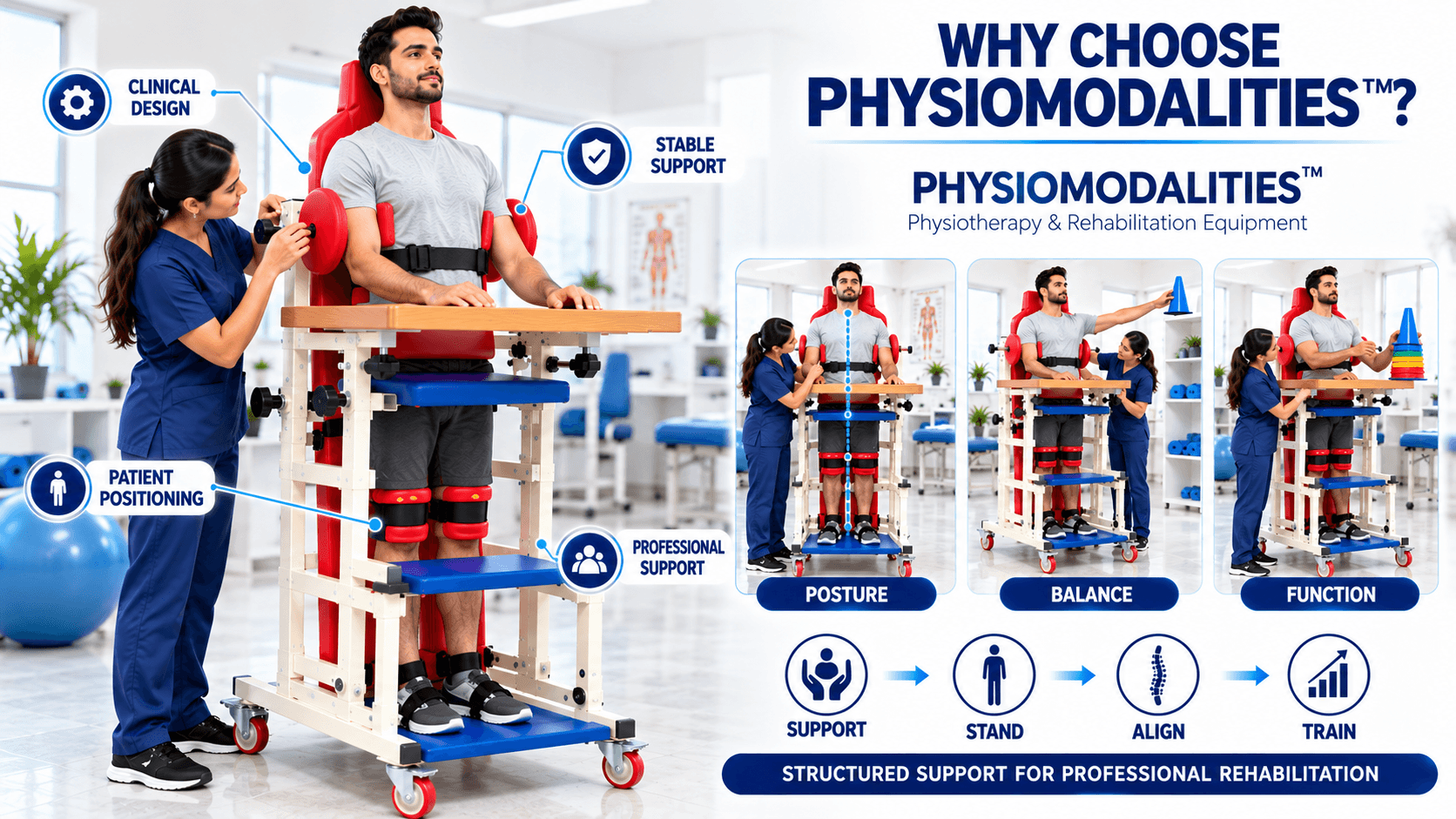
Why Choose PHYSIOMODALITIES™?
PHYSIOMODALITIES™ focuses on practical physiotherapy and rehabilitation equipment designed for clinical environments.
A Standing Frame Chair can be a useful addition to a rehabilitation setup where supervised standing, postural training, balance activities, and functional rehabilitation are required.
When selecting standing equipment, clinics should consider construction quality, patient dimensions, adjustment options, support requirements, load capacity, available space, and intended clinical application.
Conclusion
A Standing Frame Chair is a specialized rehabilitation equipment solution designed to provide structured support during assisted standing and selected therapeutic activities. It can be incorporated into physiotherapy, neurological rehabilitation, paediatric rehabilitation, orthopaedic rehabilitation, and home-based rehabilitation settings when clinically appropriate.
By providing a controlled upright position, the equipment can support supervised posture, balance, weight-bearing, and functional rehabilitation activities. The correct model should always be selected according to the patient’s size, mobility, support requirements, and professional treatment plan.
PHYSIOMODALITIES™ offers practical physiotherapy and rehabilitation equipment for clinics and healthcare environments looking to develop a complete and functional rehabilitation setup.
Frequently Asked Questions
1. What is a Standing Frame Chair?
A Standing Frame Chair is a rehabilitation device designed to provide external support while a person practices or maintains a standing position.
2. Can a Standing Frame Chair be used for physiotherapy?
Yes. It can be incorporated into physiotherapy programs involving supported standing, postural training, balance activities, and selected rehabilitation exercises.
3. Is a Standing Frame Chair suitable for children?
Some models are specifically designed for paediatric use. The correct size and configuration should be selected according to the child’s measurements and professional assessment.
4. Is the height adjustable?
Height adjustment depends on the specific model. The PHYSIOMODALITIES™ wooden standing-frame configuration lists adjustable height as a feature.
5. Can it be used at home?
Suitable configurations can be used in home rehabilitation environments. The PHYSIOMODALITIES™ Standing Frame Patient Chair is listed for both clinical and home use.