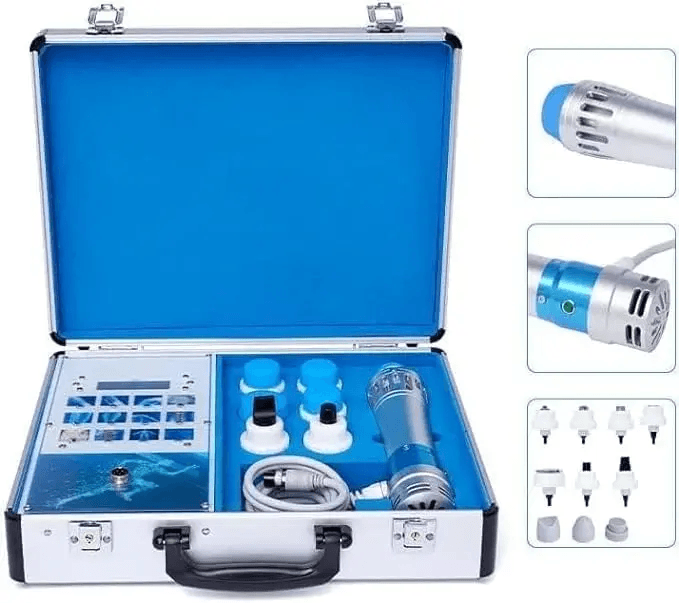
The Portable Shockwave Therapy Machine is a compact professional physiotherapy device designed to deliver controlled mechanical pressure waves for selected rehabilitation, sports therapy, orthopedic, and musculoskeletal applications. Its portable construction makes it suitable for physiotherapy clinics, rehabilitation centers, sports therapy facilities, mobile treatment setups, and other professional healthcare environments.
Unlike conventional electrotherapy equipment that delivers electrical stimulation through electrodes, a pneumatic shockwave system uses mechanical pressure pulses generated through a specialized handpiece. Portable configurations are available with adjustable pressure and frequency settings, interchangeable treatment heads, digital displays, and integrated or compact pneumatic systems.
Depending on the exact model, portable shockwave systems may provide frequency settings around 1–21 Hz, adjustable pressure ranges, touchscreen operation, multiple applicator heads, and AC power compatibility. Published portable models show that specifications vary by configuration, so the exact supplied unit should always be checked before publishing fixed technical values.
PHYSIOMODALITIES™ provides professional physiotherapy equipment designed for modern rehabilitation and clinical treatment environments.
What Is a Portable Shockwave Therapy Machine?
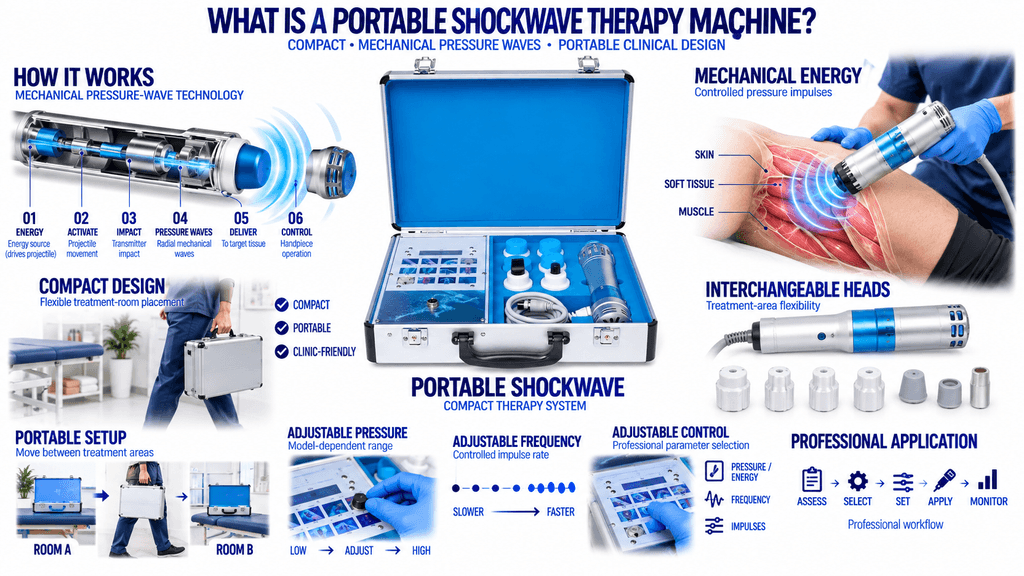
A Portable Shockwave Therapy Machine is a compact shockwave therapy system designed to generate controlled mechanical pressure impulses through a handheld applicator.
In pneumatic systems, compressed air drives a projectile inside the handpiece. The projectile strikes a transmitter, creating mechanical pressure waves that are transferred through the selected applicator to the treatment area.
Some portable systems use a built-in air compressor, while other compact designs use alternative ballistic or electromagnetic generation methods. Therefore, the technology should be confirmed according to the specific model.
The portable format is particularly useful when equipment needs to be moved between treatment rooms or used in different clinical locations.
How Portable Shockwave Therapy Works
The general operating principle of a pneumatic portable shockwave system involves controlled mechanical impulse generation.
The basic process includes:
- The machine generates or supplies the required energy.
- The internal mechanism activates the treatment handpiece.
- A projectile or applicator mechanism produces mechanical impulses.
- Pressure waves are generated.
- The selected treatment head transfers the energy to the treatment area.
- The therapist controls the treatment parameters according to the clinical protocol.
Shockwave therapy may be incorporated into selected rehabilitation programs involving tendons, fascia, muscles, and other musculoskeletal structures.
Treatment parameters should be selected by an appropriately trained professional following patient assessment.
Compact Shockwave Technology
The main advantage of a portable design is its compact form factor. A smaller system can be easier to move between treatment areas while still providing adjustable treatment controls.
Adjustable Pressure
Portable shockwave systems may offer adjustable pressure or energy settings. The available range depends on the specific machine configuration.
Some published portable pneumatic systems list pressure ranges of approximately 0.5–8 bar, while other models use different measurement ranges.
Adjustable Frequency
Frequency controls the rate at which mechanical impulses are delivered.
A number of portable systems are published with frequency ranges around 1–21 Hz, although the exact range varies by model.
Interchangeable Treatment Heads
Different applicator heads can provide flexibility for treating different anatomical areas according to the professional treatment protocol.
Key Features of Portable Shockwave Therapy Machine
Portable Clinical Design
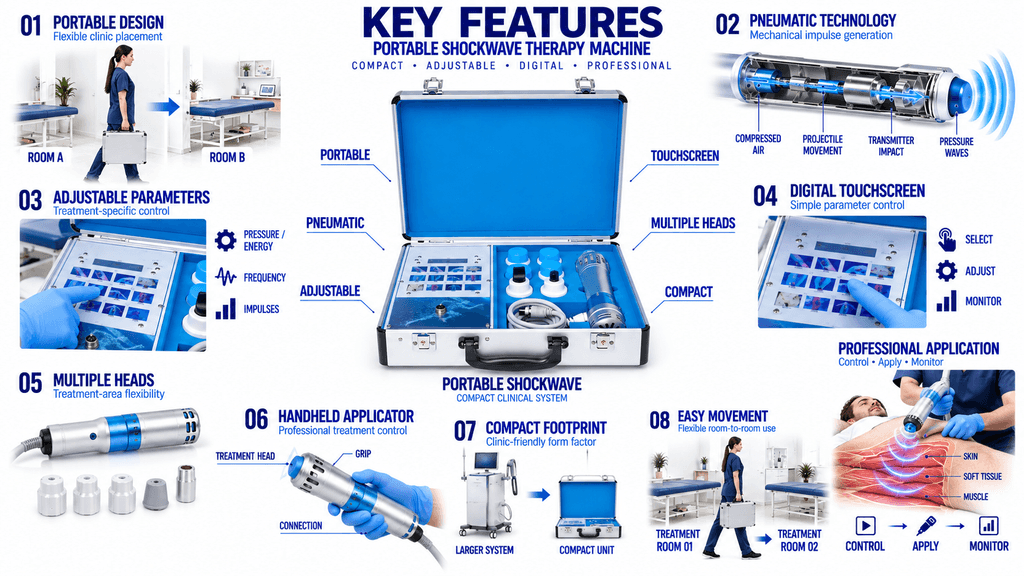
The compact construction allows the machine to be moved more easily than larger floor-standing shockwave systems.
Pneumatic Shockwave Technology
Compatible pneumatic configurations use controlled air pressure to generate mechanical impulses through the treatment handpiece.
Adjustable Treatment Parameters
Depending on the model, users can adjust parameters such as pressure, frequency, energy, or number of impulses.
Digital Touchscreen
Many current portable shockwave configurations are supplied with digital touchscreen displays for parameter selection and treatment control. Published examples include 7-inch and 8-inch touchscreen systems.
Multiple Applicator Heads
Interchangeable treatment heads allow the operator to select a suitable applicator according to the treatment area.
Handheld Applicator
The dedicated handpiece allows controlled delivery of mechanical impulses to the selected treatment area.
Compact Footprint
Portable construction can be useful for clinics with limited treatment-room space.
Easy Movement Between Rooms
The reduced size and weight of portable models can make them suitable for moving between physiotherapy treatment areas.
Professional Clinical Use
Portable shockwave systems can be incorporated into physiotherapy, rehabilitation, sports therapy, and orthopedic treatment workflows.
Applications of Portable Shockwave Therapy Machine
The Portable Shockwave Therapy Machine may be incorporated into selected professional rehabilitation programs after appropriate assessment.
Plantar Fascia-Related Conditions
Shockwave therapy may be considered as part of rehabilitation programs for selected plantar fascia and heel-related conditions.
Tennis Elbow
The machine may be incorporated into rehabilitation protocols for selected elbow and tendon-related conditions.
Achilles Tendon Applications
Shockwave therapy can be used as one component of selected tendon rehabilitation programs involving the Achilles region.
Patellar Tendon Applications
Appropriate shockwave protocols may be incorporated into rehabilitation programs involving selected patellar tendon conditions.
Shoulder Rehabilitation
The system may be used as part of selected shoulder rehabilitation programs depending on the condition and clinical assessment.
Muscle and Myofascial Applications
Mechanical pressure waves may be applied to selected muscle and myofascial areas according to the treatment protocol.
Sports Rehabilitation
Sports physiotherapy professionals may integrate shockwave treatment with strengthening, stretching, mobility, and functional rehabilitation.
Orthopedic Rehabilitation
Portable shockwave equipment can be incorporated into broader orthopedic physiotherapy programs when clinically appropriate.
Trigger Point Applications
Selected applicator heads may be used for myofascial and trigger-point applications according to professional protocols.
Potential Benefits of Portable Shockwave Therapy
Treatment response varies according to the patient’s condition, treatment parameters, treatment area, and individual factors.
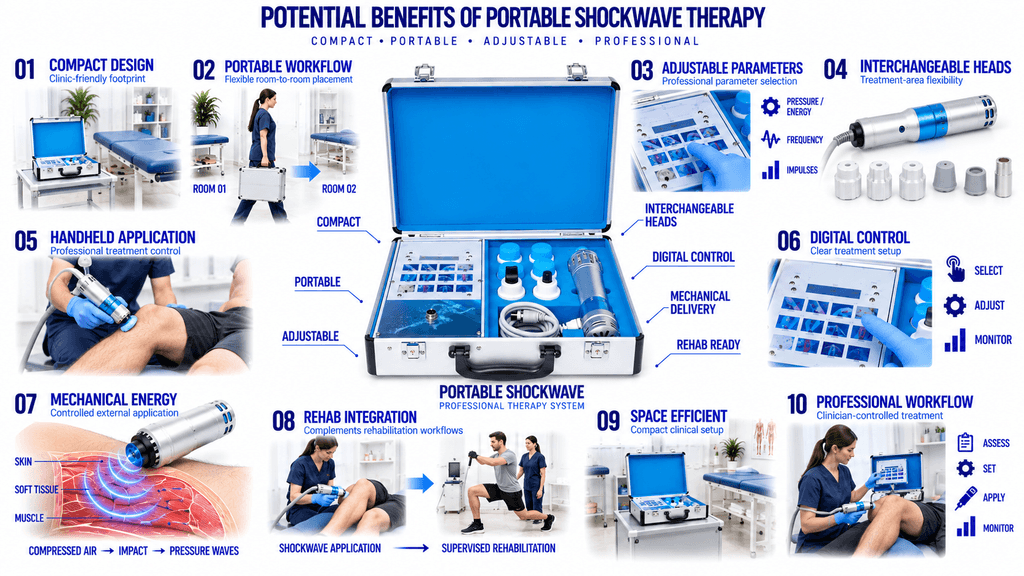
The Portable Shockwave Therapy Machine provides several equipment-level advantages:
- Compact treatment system
- Easier movement between treatment areas
- Adjustable treatment parameters
- Interchangeable applicator heads
- Handheld treatment delivery
- Digital parameter control
- Mechanical pressure-wave application
- Suitable for professional rehabilitation environments
- Can complement active rehabilitation
- Reduced space requirement compared with some larger systems
The clinical response to shockwave therapy varies between patients. It should be incorporated into an appropriate treatment plan rather than being presented as a guaranteed cure.
Portable Shockwave Therapy Machine for Physiotherapy Clinics
A portable shockwave system can be useful for clinics that need shockwave capability without dedicating a large amount of floor space to equipment.
It can be integrated alongside:
- Therapeutic exercise
- Strengthening programs
- Stretching
- Mobility training
- Manual therapy
- Functional rehabilitation
- Sports rehabilitation
- Myofascial treatment
- Other appropriate physiotherapy modalities
The portability can also make the equipment convenient when therapists need to move between different treatment rooms.
For clinics operating multiple treatment areas, a compact shockwave machine may simplify equipment placement and storage.
Portable Shockwave Treatment Parameters
Because portable shockwave machines are available in different configurations, technical specifications should be treated as model-dependent.
| Parameter | Commonly Published Portable Configuration |
|---|---|
| Therapy Type | Radial Shockwave Therapy |
| Technology | Pneumatic / Ballistic, model-dependent |
| Pressure / Energy | Model-dependent; some published systems 0.5–8 bar |
| Frequency | Commonly around 1–21 Hz |
| Display | Digital Touchscreen |
| Applicator Heads | Multiple, model-dependent |
| Power Supply | AC 100–240 V or model-specific |
| Application | Physiotherapy & Rehabilitation |
| Design | Portable |
| Intended Operator | Trained Healthcare Professional |
For example, one published portable pneumatic model lists 0.5–8 bar, 1–21 Hz, 5 applicator heads, touchscreen control and 100–240 V input, while other portable models have different configurations.
How to Use Portable Shockwave Therapy Machine
The machine should be operated by a trained physiotherapist or appropriately qualified healthcare professional.
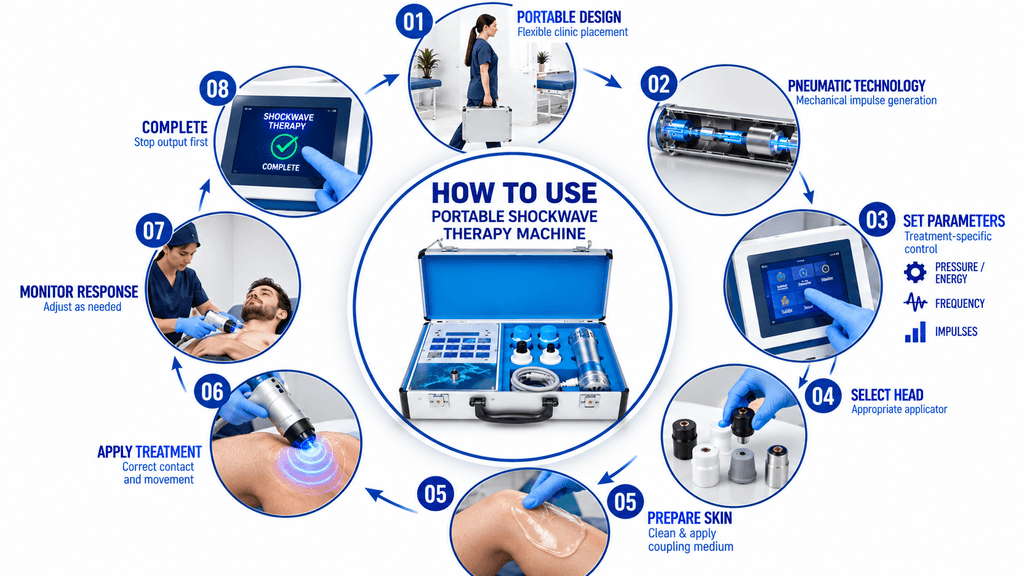
Step 1: Assess the Patient
Review the patient’s condition, medical history, treatment objective, and relevant contraindications.
Step 2: Identify the Treatment Area
Determine the appropriate anatomical area based on professional assessment.
Step 3: Position the Patient
Place the patient comfortably so the selected area can be accessed safely.
Step 4: Select the Applicator
Choose the appropriate treatment head according to the anatomical area and clinical protocol.
Step 5: Prepare the Treatment Area
Prepare the skin and use the manufacturer-recommended coupling medium where required.
Step 6: Set Treatment Parameters
Select the appropriate pressure or energy, frequency, and impulse count according to the treatment protocol.
Step 7: Position the Handpiece
Place the applicator correctly over the selected treatment area.
Step 8: Start Treatment
Begin treatment using the selected settings.
Step 9: Monitor Patient Response
Observe patient comfort and response throughout the session.
Step 10: Complete Treatment
Stop the mechanical output before removing or repositioning the handpiece.
Step 11: Clean the Equipment
Clean the handpiece and applicator heads according to the manufacturer’s instructions.
Safety Precautions
The Portable Shockwave Therapy Machine should be operated according to professional clinical protocols and manufacturer instructions.
- Only trained professionals should operate the equipment.
- Assess the patient before treatment.
- Review relevant contraindications.
- Select treatment intensity according to the professional protocol.
- Monitor patient response during treatment.
- Use the appropriate applicator head.
- Inspect the handpiece before use.
- Do not operate damaged equipment.
- Avoid treatment over medically contraindicated areas.
- Exercise appropriate caution in patients with bleeding risks.
- Follow professional guidance for patients taking anticoagulant medication or having bleeding disorders.
- Do not apply treatment over open wounds or infected skin.
- Follow manufacturer-specific anatomical precautions.
- Do not modify the pneumatic or energy-generation system.
- Maintain the equipment according to manufacturer instructions.
- Clean applicator heads after use.
- Store the machine safely when not in operation.
The complete contraindications should be checked in the specific equipment manual and considered alongside the patient’s clinical circumstances.
Technical Specifications
| Specification | Details |
|---|---|
| Product Name | Portable Shockwave Therapy Machine |
| Therapy Type | Radial Shockwave Therapy |
| Technology | Pneumatic / Ballistic, model-dependent |
| Pressure Range | Model-dependent |
| Frequency Range | Model-dependent; commonly around 1–21 Hz |
| Treatment Heads | Multiple, configuration-dependent |
| Display | Digital Touchscreen, model-dependent |
| Power Supply | Model-dependent |
| Construction | Compact Clinical Housing |
| Design | Portable |
| Application | Physiotherapy & Rehabilitation |
| Intended Operator | Trained Healthcare Professional |
Important: Since “Portable Shockwave Therapy Machine” is a product category rather than a single model number, pressure, frequency, power, weight, dimensions, probe count, and display size should be confirmed from the exact machine’s datasheet before publishing fixed specifications.
Things to Consider Before Buying
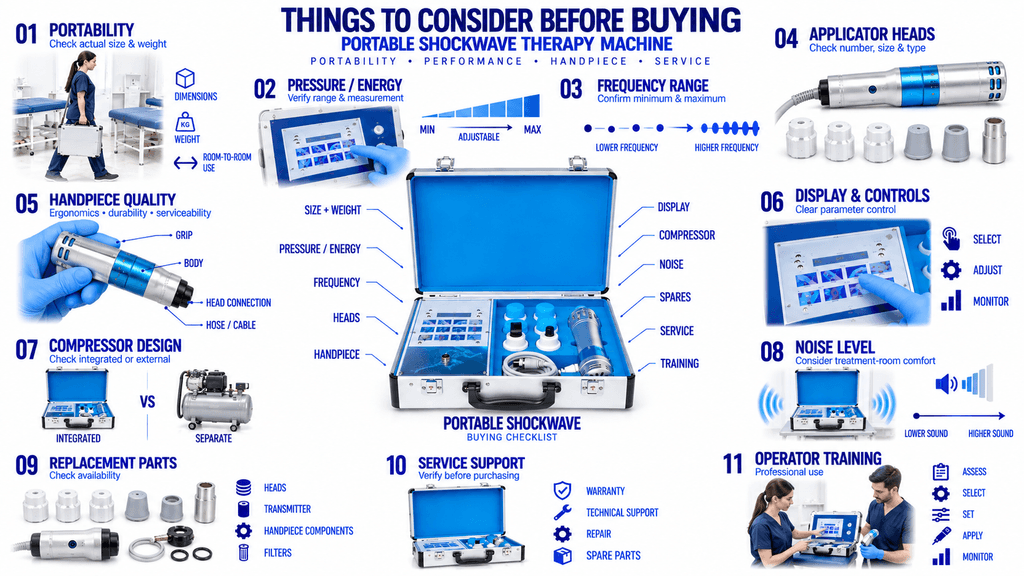
Portability
Check the machine’s actual dimensions and weight to ensure it can be comfortably moved between treatment rooms.
Pressure or Energy Range
Confirm the exact available treatment intensity and how it is measured.
Frequency Range
Check the minimum and maximum operating frequency of the specific model.
Applicator Heads
Confirm the number, sizes, and types of included treatment heads.
Handpiece Quality
The handpiece is a critical component of a shockwave system. Check its construction, ergonomics, durability, and replacement availability.
Display
A clear touchscreen or digital interface can simplify treatment parameter selection.
Compressor Design
For pneumatic models, determine whether the air compressor is integrated into the machine or requires a separate unit.
Noise Level
For clinics operating several treatment rooms, the operating noise of the compressor can be an important practical consideration.
Replacement Parts
Confirm availability of applicators, transmitters, handpiece components, filters, and other replacement parts.
Warranty and Service
Check warranty coverage, technical support, repair facilities, and service availability before purchasing.
Operator Training
Ensure that the intended users understand shockwave therapy principles, parameter selection, contraindications, and manufacturer-specific instructions.
Who Should Operate a Portable Shockwave Therapy Machine?
The Portable Shockwave Therapy Machine should be operated by appropriately trained physiotherapists or qualified healthcare professionals.
The operator should understand:
- Radial shockwave therapy
- Pneumatic or ballistic technology
- Treatment intensity
- Frequency selection
- Applicator selection
- Patient assessment
- Contraindications
- Patient monitoring
- Equipment maintenance
- Manufacturer-specific operating instructions
Professional training supports appropriate and responsible clinical use.
Why Choose PHYSIOMODALITIES™?
PHYSIOMODALITIES™ provides professional physiotherapy and rehabilitation equipment for modern clinical environments.
When selecting a Portable Shockwave Therapy Machine, clinics should consider the complete equipment package rather than focusing only on portability.
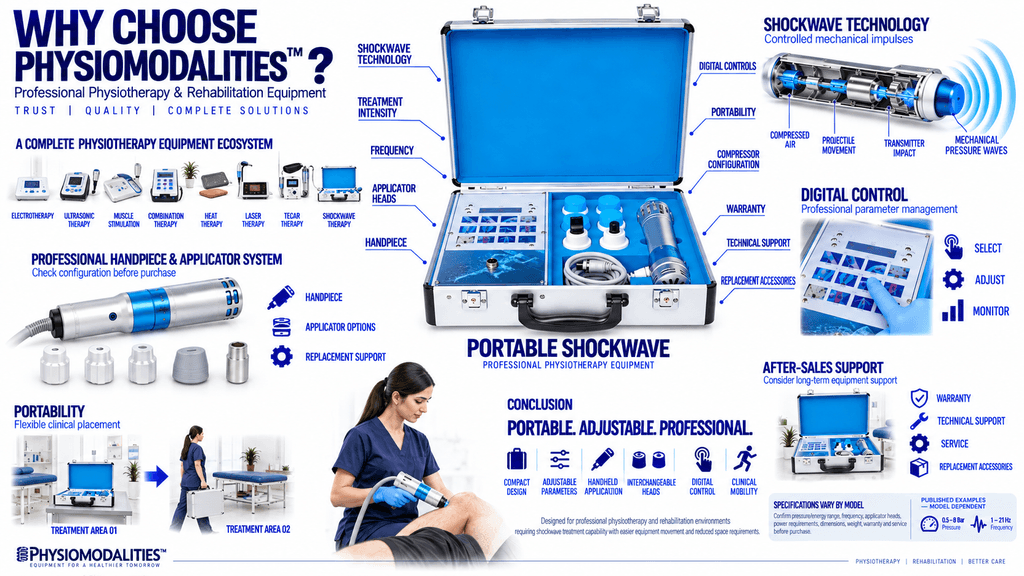
Important factors include:
- Shockwave technology
- Treatment intensity range
- Frequency range
- Applicator heads
- Handpiece quality
- Digital controls
- Portability
- Compressor configuration
- Warranty
- Technical support
- Replacement accessories
PHYSIOMODALITIES™ also provides equipment across different physiotherapy categories, including electrotherapy, Ultrasonic Therapy, muscle stimulation, combination therapy, heat therapy, laser therapy, Tecar therapy, shockwave therapy, and rehabilitation equipment.
Conclusion
The Portable Shockwave Therapy Machine is a compact professional solution for clinics and rehabilitation environments that require shockwave treatment capability with easier equipment movement and reduced space requirements.
Portable shockwave systems can provide adjustable treatment parameters, handheld application, interchangeable treatment heads, and digital controls. Current published portable configurations vary considerably, with examples offering approximately 1–21 Hz frequency and 0.5–8 bar pressure, while other models use different specifications.
Before purchasing or publishing technical specifications, it is important to confirm the exact model’s pressure or energy range, frequency, applicator heads, power requirements, dimensions, weight, warranty, and service support.
Frequently Asked Questions
1. What is a Portable Shockwave Therapy Machine?
It is a compact shockwave therapy system designed to deliver controlled mechanical pressure waves through a handheld applicator for selected physiotherapy and rehabilitation applications.
2. Is a Portable Shockwave Therapy Machine suitable for physiotherapy clinics?
Yes. Portable systems can be used in professional physiotherapy clinics, rehabilitation centers, sports therapy facilities, and other suitable clinical environments.
3. What frequency does a Portable Shockwave Therapy Machine use?
The frequency depends on the model. Many published portable configurations operate around 1–21 Hz, while other models may have different ranges.
4. Does a Portable Shockwave Therapy Machine have different treatment heads?
Many portable configurations include multiple interchangeable applicator heads, but the exact number and types depend on the model.
5. Who should operate a Portable Shockwave Therapy Machine?
It should be operated by a trained physiotherapist or appropriately qualified healthcare professional familiar with shockwave therapy and the manufacturer’s operating instructions.