
The Manual Spine Gun Chiropractic Physiotherapy Tool is a handheld mechanical instrument designed for professional chiropractic and instrument-assisted manual therapy applications. It is intended for trained practitioners who use controlled mechanical techniques as part of selected physiotherapy and musculoskeletal treatment workflows.
Unlike conventional electric massage guns, a manual spine gun uses a practitioner-operated mechanical mechanism to deliver an impulse through a contact head. Depending on the model, it may include a spring-loaded mechanism, adjustable force settings, and interchangeable contact tips.
The Manual Spine Gun Chiropractic Physiotherapy Tool can be considered for chiropractic clinics, physiotherapy centres, rehabilitation facilities, and professional manual therapy environments. Its use should always be based on appropriate patient assessment, practitioner training, and the manufacturer’s instructions.
PHYSIOMODALITIES™ provides physiotherapy and rehabilitation equipment designed for professional clinical environments.
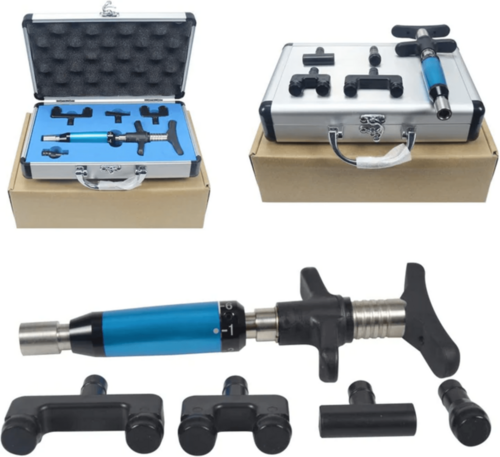
What Is a Manual Spine Gun Chiropractic Physiotherapy Tool?
A Manual Spine Gun Chiropractic Physiotherapy Tool is a handheld instrument designed to deliver controlled mechanical impulses through a contact applicator.
Manual chiropractic instruments are different from motor-driven percussion massage devices. They generally rely on a mechanical action controlled by the practitioner rather than a continuously powered motor.
Depending on the design, a manual spine gun may include:
- A handheld body and grip.
- A mechanical or spring-loaded operating mechanism.
- A force adjustment system.
- A contact head or interchangeable treatment tips.
- A mechanical release or activation mechanism.
- A storage case, depending on the package.
The actual construction and available features vary between models. For example, some commercially listed manual chiropractic instruments include multiple force levels and interchangeable heads, but these details should not be assumed for every product. <Cite refs={[“turn951728search1″,”turn951728search7”]}/>
How Does a Manual Spine Gun Work?
A manual chiropractic spine gun works through a practitioner-controlled mechanical action. When the instrument is activated according to its operating design, the internal mechanism transfers a controlled impulse through the contact head.
The practitioner selects the appropriate technique and instrument configuration based on professional assessment and training.
A general operating concept may involve:
- Assessing the patient and treatment objective.
- Inspecting the instrument and its mechanical components.
- Selecting an approved contact head, if interchangeable tips are supplied.
- Checking the force setting, if adjustment is available.
- Positioning the patient appropriately.
- Applying the instrument using the approved professional technique.
- Monitoring the patient’s response.
- Cleaning and storing the instrument after use.
The exact activation method differs between products. Always follow the manual supplied with the specific instrument.
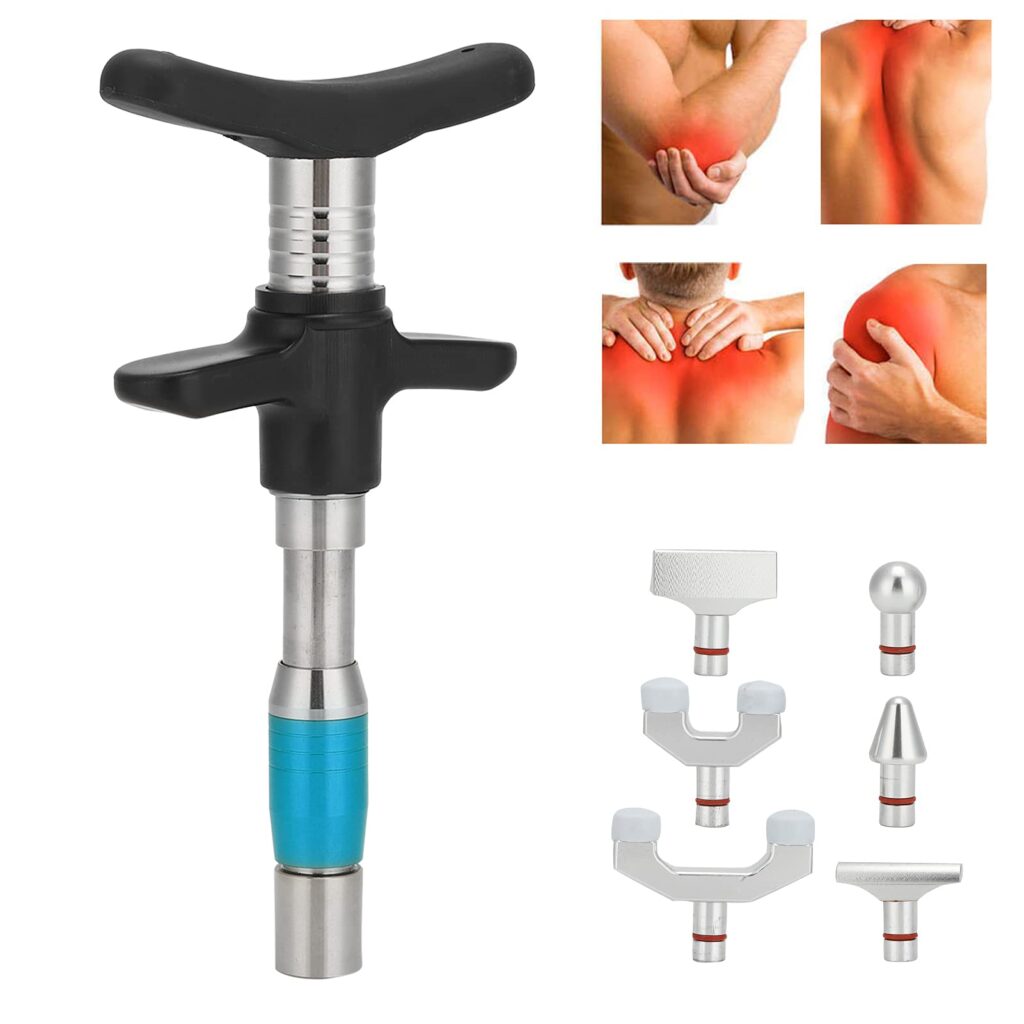
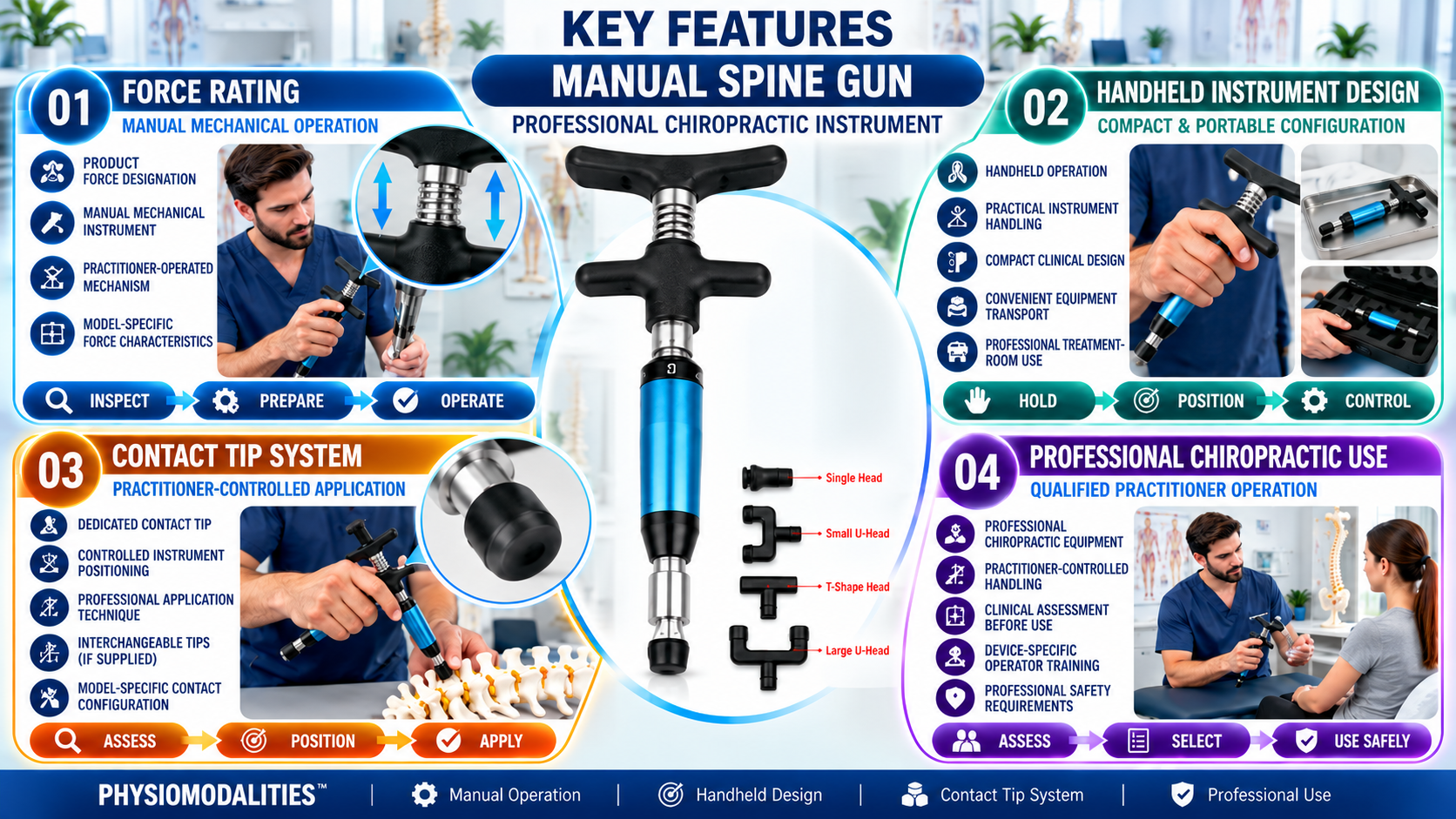
Key Features of the Manual Spine Gun Chiropractic Physiotherapy Tool
Manual Mechanical Operation
The instrument is designed for practitioner-operated mechanical application rather than conventional motor-driven percussion. Its precise internal mechanism should be confirmed from the product documentation.
Handheld Design
The handheld format allows the practitioner to control instrument placement and positioning during professional application.
Mechanical Impulse Delivery
The instrument is designed to transfer a mechanical impulse through its contact head. The impulse characteristics depend on the internal mechanism and product configuration.
Adjustable Force Settings
Some manual chiropractic instruments offer multiple force levels. Confirm whether this model has adjustable settings and verify the available force range before publishing specific values.
Interchangeable Contact Heads
Selected configurations include different contact tips for alternative contact arrangements. The number, shape, material, and quantity of supplied heads should be confirmed with the supplier.
Compact and Portable Format
A handheld instrument can be convenient to store and transport between treatment areas. Actual dimensions, weight, and carrying-case availability depend on the supplied model.
Professional Chiropractic Application
The tool is intended for trained practitioners familiar with instrument-assisted techniques and the relevant patient safety requirements.
Applications of Manual Spine Gun Chiropractic Physiotherapy Tool
The Manual Spine Gun Chiropractic Physiotherapy Tool may be considered for selected professional chiropractic and manual therapy workflows, depending on the instrument design and the practitioner’s qualifications.
Chiropractic Practice
Chiropractors may use appropriate manual instruments as part of selected instrument-assisted techniques following patient assessment.
Instrument-Assisted Manual Therapy
The tool may support selected manual therapy approaches where a mechanical instrument is appropriate.
Musculoskeletal Treatment Workflows
The instrument may be incorporated into professional treatment workflows involving selected musculoskeletal presentations, subject to clinical examination and practitioner judgment.
Physiotherapy and Rehabilitation
Physiotherapy clinics may consider the tool alongside therapeutic exercise, mobility training, manual therapy, and other suitable rehabilitation interventions.
Professional Treatment Environments
The instrument may be considered for chiropractic clinics, rehabilitation centres, and other professional facilities offering instrument-assisted treatment.
Important: These are potential professional-use contexts, not guaranteed clinical indications. The tool should not be promoted as independently correcting spinal alignment, treating disc disorders, or curing back and neck conditions.
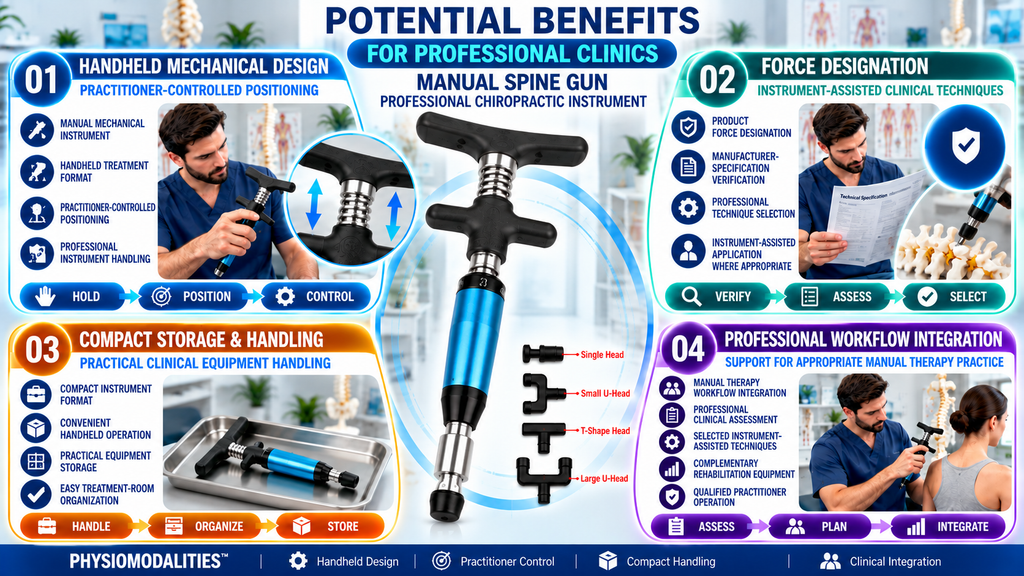
Potential Benefits for Professional Clinics
When the instrument’s design and intended use match a clinic’s requirements, it may offer practical advantages such as:
- A handheld mechanical treatment format.
- Practitioner-controlled positioning.
- No electrical connection required for genuinely manual models.
- Force adjustment on supported configurations.
- Interchangeable contact tips on selected models.
- Compact storage and handling.
- Integration into selected instrument-assisted treatment workflows.
These are equipment-related advantages, not guaranteed patient outcomes. The instrument should complement professional assessment and appropriate rehabilitation.
Manual Spine Gun vs. Electric Chiropractic Gun
Manual and electric chiropractic instruments use different operating mechanisms.
| Feature | Manual Spine Gun | Electric Chiropractic Gun |
|---|---|---|
| Operating mechanism | Practitioner-operated mechanical mechanism | Motor-driven or electrically powered |
| Energy source | Manual operation | Electrical power or rechargeable battery |
| Impulse delivery | Depends on mechanical design | Depends on motor and device settings |
| Force adjustment | Model-dependent | Model-dependent |
| Contact heads | Model-dependent | Model-dependent |
| Power connection | Not required for a genuinely manual model | Depends on power configuration |
| Intended operator | Trained professional | Trained professional |
| Clinical application | Instrument-assisted manual therapy | Model-specific chiropractic applications |
The two instruments should not be treated as interchangeable. Select equipment according to its intended use, specifications, and practitioner training.
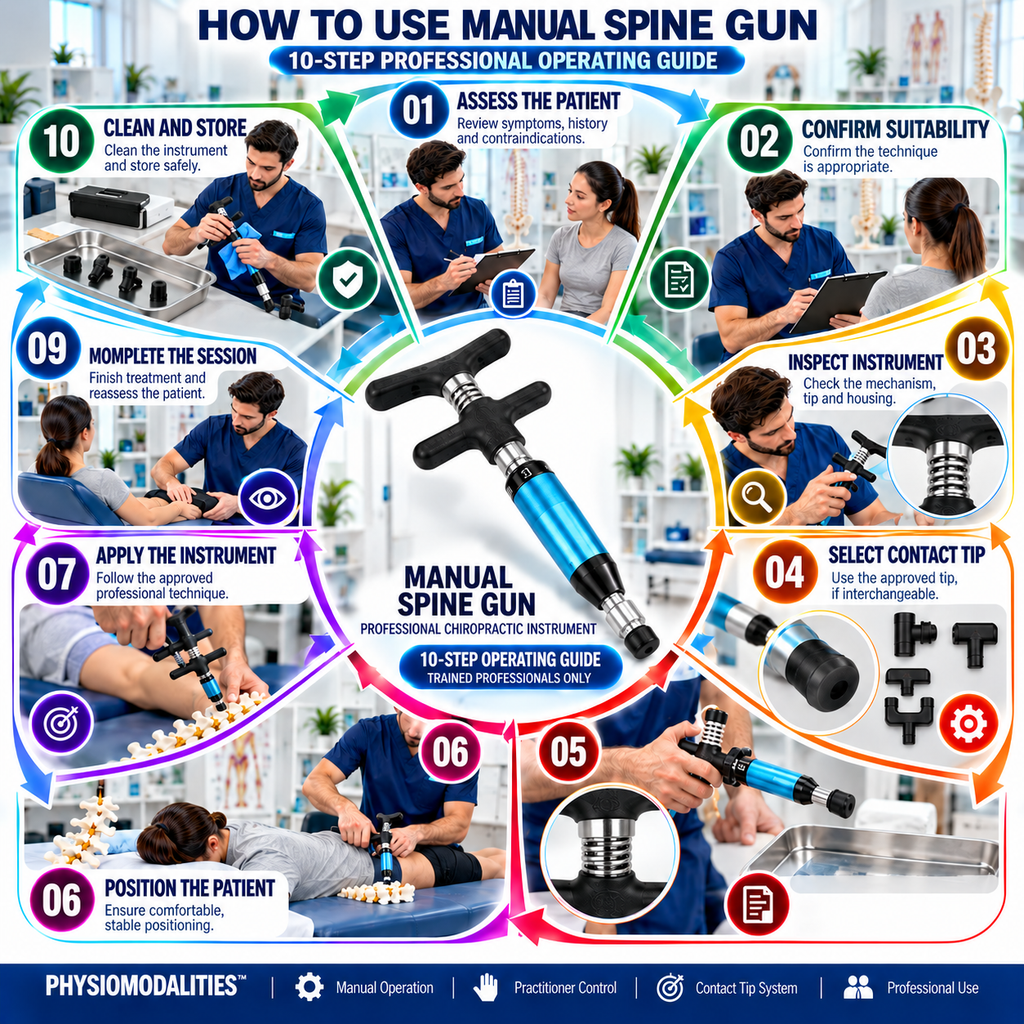
How to Use the Manual Spine Gun Chiropractic Physiotherapy Tool
The instrument should only be operated by a trained chiropractor, physiotherapist, or appropriately qualified healthcare professional familiar with the exact model.
Step 1: Assess the Patient
Review the patient’s medical history, symptoms, clinical findings, treatment objectives, and relevant contraindications.
Step 2: Confirm Suitability
Determine whether an instrument-assisted technique is appropriate. Do not use the tool simply because a patient reports neck, back, or joint discomfort.
Step 3: Inspect the Instrument
Check the body, handle, mechanical components, contact head, and adjustment mechanism for visible damage or abnormal movement.
Step 4: Select the Contact Head
If interchangeable heads are provided, select an approved attachment according to the manufacturer’s instructions and the professional technique.
Step 5: Check the Force Setting
If the instrument has adjustable force settings, select the appropriate configuration according to the product manual and professional assessment. Do not assume that the highest setting is suitable for every patient.
Step 6: Position the Patient
Place the patient in a stable and comfortable position that allows the practitioner to follow the approved technique.
Step 7: Apply the Instrument
Use the instrument only at appropriate sites and with the technique specified in professional training and the manufacturer’s manual.
Step 8: Monitor the Patient
Observe the patient’s response throughout the procedure. Stop if unexpected pain, neurological symptoms, dizziness, or another concerning reaction occurs.
Step 9: Complete the Session
Finish the procedure according to the approved technique and reassess the patient’s response where appropriate.
Step 10: Clean and Store
Clean the instrument and reusable contact heads according to the manufacturer’s instructions. Store it safely to protect its mechanical components and accessories.
Safety Precautions
The Manual Spine Gun Chiropractic Physiotherapy Tool should only be used by appropriately trained professionals.
- Perform an appropriate patient assessment before use.
- Follow the manufacturer’s operating instructions and contraindications.
- Do not use the instrument on an unassessed patient.
- Do not assume that a particular force setting is appropriate for every patient.
- Avoid application over areas where instrument-assisted treatment is contraindicated.
- Use particular caution around the cervical spine and other sensitive anatomical structures.
- Do not apply force over fractures, suspected fractures, acute injuries, or compromised tissues.
- Consider bone health, bleeding risks, medical history, and implanted devices during patient screening.
- Use only compatible contact heads and accessories.
- Do not use damaged or incorrectly assembled attachments.
- Never modify the force mechanism or use unapproved accessories.
- Monitor the patient’s response throughout the procedure.
- Stop immediately if unexpected or significant symptoms occur.
- Clean and maintain the instrument according to manufacturer guidance.
The exact contraindications depend on the instrument design, treatment technique, and individual patient’s clinical circumstances.
Technical Specifications
The following table identifies the product category and details that should be confirmed for the exact supplied model.
| Specification | Details |
|---|---|
| Product Name | Manual Spine Gun Chiropractic Physiotherapy Tool |
| Product Category | Chiropractic / Physiotherapy Instrument |
| Instrument Type | Manual Chiropractic Adjustment Tool |
| Operating Mechanism | Manual / Mechanical |
| Force Rating | Confirm from manufacturer |
| Force Adjustment | Model-dependent |
| Number of Force Levels | Confirm from manufacturer |
| Contact Heads | Confirm number and types supplied |
| Body Material | Confirm from manufacturer |
| Handle Design | Handheld |
| Dimensions | Confirm from manufacturer |
| Weight | Confirm from manufacturer |
| Carrying Case | Confirm package contents |
| Power Requirement | Not applicable to genuinely manual models |
| Intended Application | Professional chiropractic and manual therapy workflows |
| Intended Operator | Trained healthcare professional |
| Warranty | Confirm with supplier |
Important: Do not publish an assumed force rating, number of adjustment levels, contact-head quantity, dimensions, or material without confirming the exact model. Manual chiropractic instruments are available in different configurations. <Cite refs={[“turn951728search1″,”turn951728search7″,”turn951728search13”]}/>
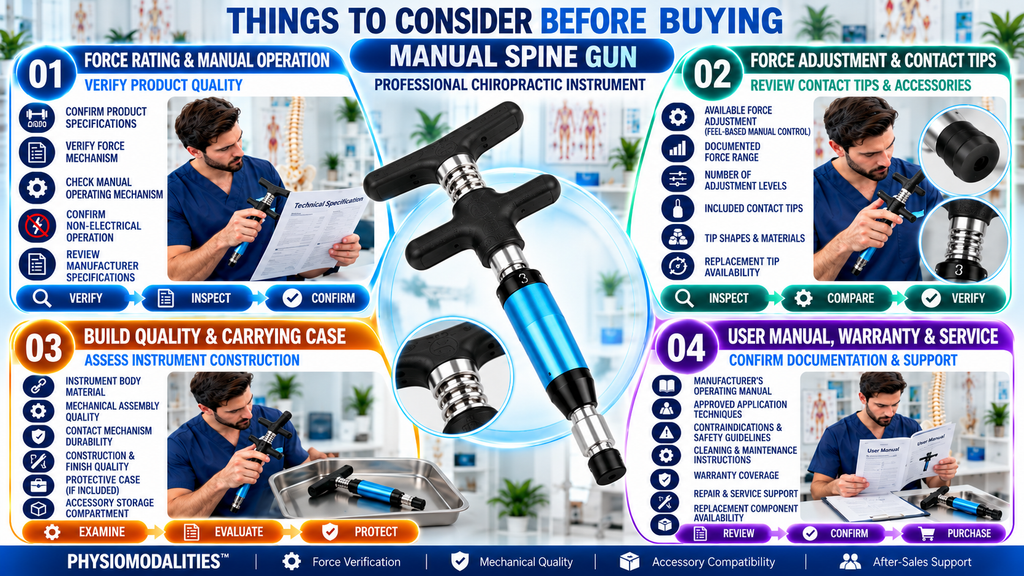
Things to Consider Before Buying
Confirm the Operating Mechanism
Check that the supplied product is genuinely manual and does not require an electrical connection.
Verify the Force Range
Ask whether the instrument has a fixed force or adjustable levels. Request the manufacturer’s exact force specifications.
Check the Contact Heads
Confirm the number, shape, material, and quantity of included heads. Also check whether replacement attachments are available.
Review Build Quality
Consider the body material, handle construction, mechanical assembly, and durability of the activation mechanism.
Check the Carrying Case
Confirm whether a protective storage case is included and whether it accommodates the instrument and all accessories.
Request the User Manual
The operating manual should explain the mechanism, approved application technique, adjustment settings, contraindications, cleaning, and maintenance.
Confirm Warranty and Service
Check warranty coverage, repair support, and replacement-component availability before purchasing.
Consider Practitioner Training
Ensure that intended operators have suitable training in instrument-assisted chiropractic techniques and patient screening.
Who Should Operate This Manual Chiropractic Tool?
The Manual Spine Gun Chiropractic Physiotherapy Tool should be used by appropriately trained chiropractors, physiotherapists, or other qualified healthcare professionals whose training and scope of practice permit the technique.
The operator should understand:
- Spinal and musculoskeletal anatomy.
- Patient assessment and screening.
- Instrument-assisted manual therapy.
- Mechanical force selection.
- Contact-head selection.
- Contraindications and precautions.
- Patient positioning and monitoring.
- Instrument cleaning and maintenance.
It is not intended for unsupervised spinal manipulation or self-treatment.
Why Choose PHYSIOMODALITIES™?
PHYSIOMODALITIES™ provides physiotherapy and rehabilitation equipment for professional clinical environments. When selecting a chiropractic instrument, clinics should consider the actual operating mechanism, force specifications, accessories, safety documentation, durability, and after-sales support.
PHYSIOMODALITIES™ offers equipment across different physiotherapy categories, including electrotherapy, Ultrasonic Therapy, muscle stimulation, combination therapy, heat therapy, diathermy, laser therapy, Tecar therapy, shockwave therapy, and rehabilitation equipment.
Selecting equipment according to the clinic’s services and the practitioner’s training helps support a suitable professional treatment setup.
Conclusion
The Manual Spine Gun Chiropractic Physiotherapy Tool is a handheld mechanical instrument designed for selected professional chiropractic and instrument-assisted manual therapy applications. Its manual operating format provides a practitioner-controlled approach to mechanical impulse delivery, depending on the exact instrument design.
Before purchasing, clinics should confirm the operating mechanism, force range, adjustment levels, contact-head configuration, construction, warranty, and service support. Appropriate patient assessment, professional training, and compliance with manufacturer instructions are essential for responsible use.
Frequently Asked Questions
1. What is a Manual Spine Gun Chiropractic Physiotherapy Tool?
It is a handheld mechanical instrument designed for selected professional chiropractic and instrument-assisted manual therapy applications.
2. Is a manual spine gun electrically powered?
A genuinely manual spine gun uses a practitioner-operated mechanical mechanism and does not require electrical power. Confirm the exact model before purchase.
3. Does the manual spine gun have adjustable force settings?
Some models offer multiple force levels, while others may have a fixed mechanical configuration. Check the manufacturer’s specifications.
4. Who can use a manual chiropractic spine gun?
It should be used by appropriately trained chiropractors, physiotherapists, or other qualified healthcare professionals working within their scope of practice.
5. What should I check before buying?
Verify the operating mechanism, force range, adjustment levels, contact heads, material, user manual, warranty, and after-sales support.