
The Digital Ultrasonic Therapy Unit 1 MHz with IFT Frequency Control is a physiotherapy equipment configuration designed to combine therapeutic ultrasonic treatment with interferential therapy (IFT) frequency control. It is intended for professional physiotherapy clinics, rehabilitation centres, and healthcare facilities where these modalities are included in appropriate treatment protocols.
The ultrasonic section operates at a specified frequency of 1 MHz and uses a dedicated applicator with a suitable coupling medium, such as ultrasonic gel, to transfer acoustic energy to the treatment area. The IFT section uses controlled electrical currents delivered through suitable electrodes, with frequency-related controls depending on the machine’s configuration.
Combining these functions in one unit can help clinics organize multiple treatment modalities within a single equipment setup. The exact IFT frequency range, electrical output, ultrasonic intensity, operating modes, and available controls should be confirmed from the manufacturer’s technical documentation.
PHYSIOMODALITIES™ provides physiotherapy and rehabilitation equipment for professional clinical environments.
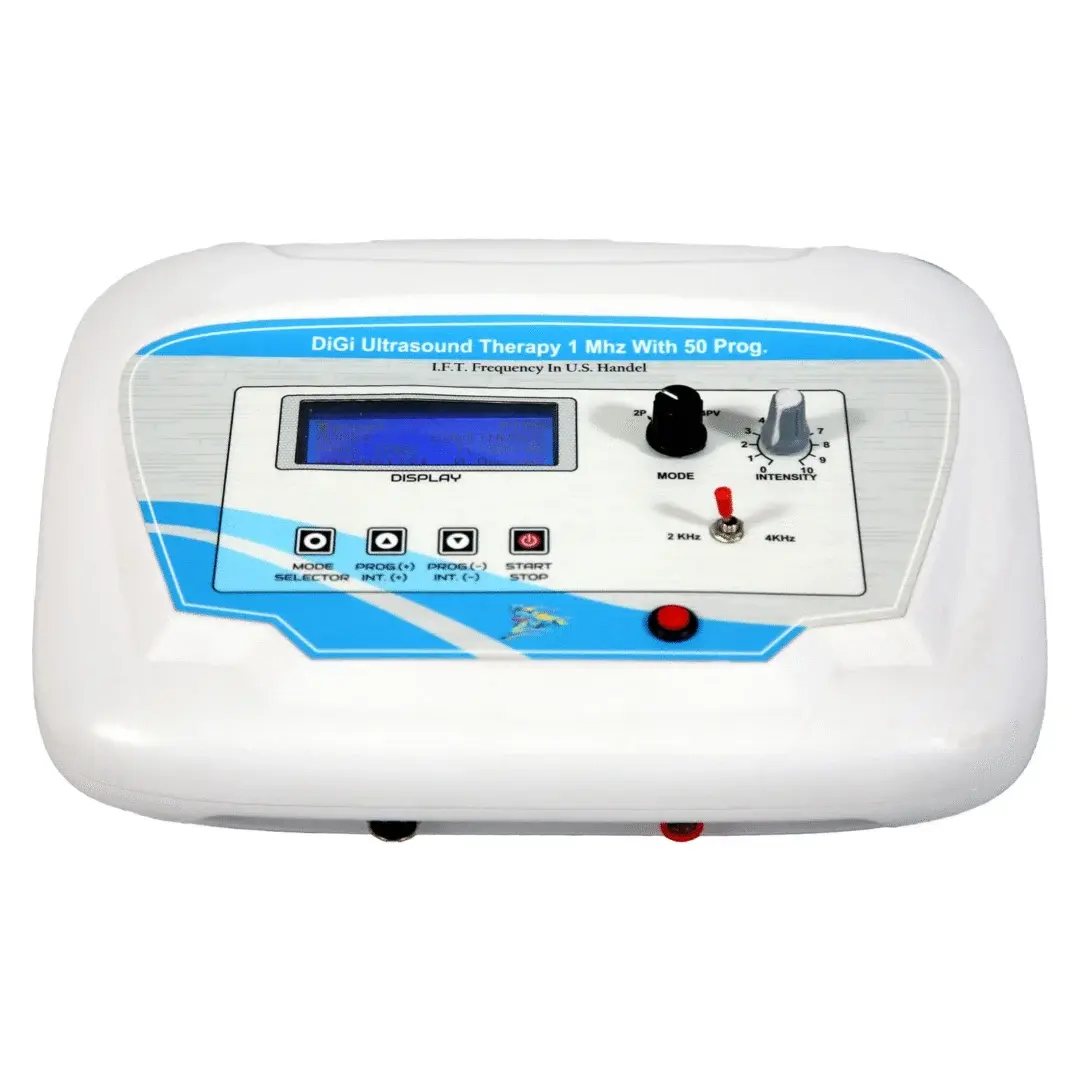
What Is a Digital Ultrasonic Therapy Unit with IFT Frequency Control?
A Digital Ultrasonic Therapy Unit 1 MHz with IFT Frequency Control is a combination physiotherapy device that integrates ultrasonic therapy with an interferential therapy function or associated frequency controls, depending on the specific model.
Ultrasonic therapy uses high-frequency acoustic energy delivered through a specialized transducer. IFT uses controlled electrical currents applied through electrodes to provide electrical stimulation.
The two modalities work differently and require separate treatment techniques, accessories, and safety considerations. The operator selects the appropriate modality according to the patient’s assessment and the intended treatment objective.
The term IFT frequency control should be interpreted according to the actual control system. It may refer to adjustable frequency parameters within the interferential therapy section. The exact meaning, available range, and supported settings must be verified from the product manual.
How Does the Combined Therapy Unit Work?
The machine brings together two distinct physiotherapy modalities.
Ultrasonic Therapy
The ultrasonic section converts electrical energy into mechanical acoustic vibrations using a transducer in the applicator. A suitable coupling gel helps transfer the energy between the applicator and the skin.
A 1 MHz operating frequency is generally associated with relatively deeper treatment areas compared with 3 MHz systems under comparable conditions. Actual energy distribution depends on tissue characteristics, intensity, applicator design, and application technique.
Interferential Therapy (IFT)
IFT delivers controlled electrical currents through surface electrodes. Depending on the device, frequency-related settings may allow the operator to select or adjust parameters used during treatment.
The precise IFT operating modes, frequency ranges, number of channels, and output controls depend on the supplied configuration.
Digital Control System
The digital interface may provide access to available treatment settings, program selection, timers, and other controls. Only features confirmed in the model’s technical documentation should be listed as standard specifications.
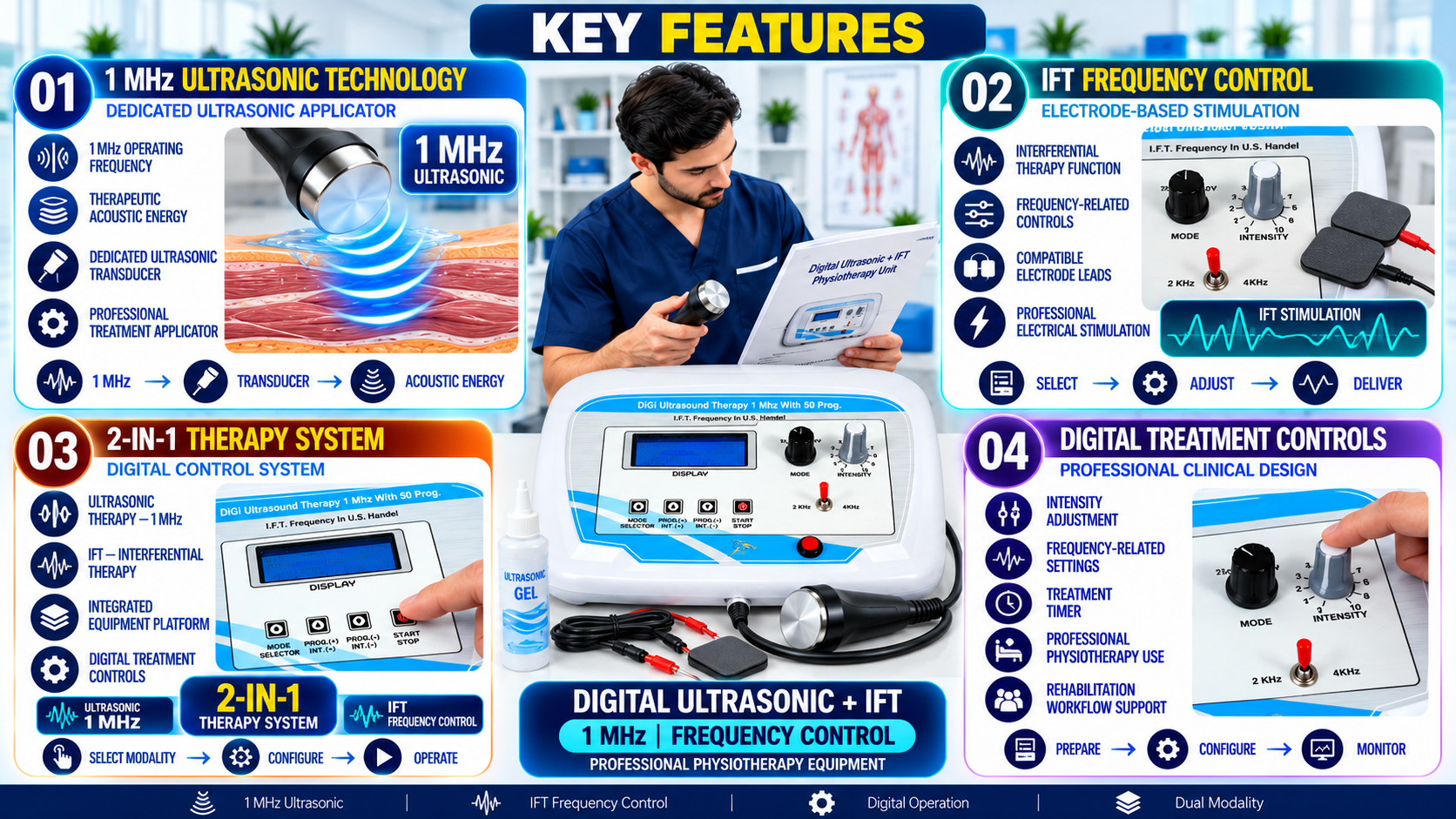
Key Features of Digital Ultrasonic Therapy Unit 1 MHz with IFT Frequency Control
1 MHz Ultrasonic Output
The ultrasonic section is specified for operation at 1 MHz. This frequency is commonly associated with relatively deeper treatment areas compared with higher-frequency therapeutic ultrasonic systems.
IFT Frequency Control
The IFT section includes frequency-related control functionality as indicated by the product configuration. The exact adjustable range and available parameters should be confirmed from the manufacturer’s documentation.
Two Treatment Modalities
The unit combines ultrasonic therapy and IFT functionality, providing access to two different modalities within one equipment setup.
Digital Operation
The digital control system is designed to support selection and adjustment of available treatment settings. Display type and control functions depend on the model.
Dedicated Ultrasonic Applicator
The ultrasonic section uses an applicator containing a transducer. Applicator size, effective radiating area, and replacement availability should be checked before purchase.
Electrical Stimulation Accessories
The IFT section requires compatible electrodes and leads. The number of channels and included accessories depend on the machine configuration.
Treatment Parameter Controls
Depending on the model, the machine may provide intensity adjustment, frequency controls, operating modes, and a treatment timer.
Professional Clinical Design
The unit is intended for use by trained professionals in appropriate physiotherapy and rehabilitation environments.
Applications of Digital Ultrasonic Therapy Unit with IFT Frequency Control
The Digital Ultrasonic Therapy Unit 1 MHz with IFT Frequency Control may be incorporated into selected physiotherapy programs when the relevant modality is appropriate following clinical assessment.
Musculoskeletal Rehabilitation
IFT or ultrasonic therapy may be considered for selected musculoskeletal conditions as part of an individualized treatment plan.
Pain-Management Programs
IFT may be incorporated into selected pain-management protocols when electrical stimulation is clinically appropriate.
Soft-Tissue Rehabilitation
Ultrasonic therapy may be considered for certain soft-tissue rehabilitation applications, depending on the condition and available clinical evidence.
Sports Physiotherapy
Sports rehabilitation clinics may incorporate suitable modalities alongside exercise therapy, strengthening, mobility training, and other interventions.
Joint-Related Rehabilitation
A qualified professional may consider either modality for selected joint-related rehabilitation applications after assessing the patient and treatment area.
Multi-Modality Physiotherapy Clinics
The combination configuration can be useful for clinics that require both ultrasonic and electrical stimulation capabilities within one treatment setup.
Important: These are potential clinical applications, not guaranteed outcomes. The appropriate modality must be selected according to the patient’s condition, professional assessment, device instructions, and relevant contraindications.
Benefits of a Combined Ultrasonic and IFT Unit
The potential operational advantages of a combination unit depend on its exact configuration and the clinic’s treatment requirements.
- Combines ultrasonic and IFT functions in one system.
- Provides a specified 1 MHz ultrasonic output.
- Includes IFT frequency-related controls, as supported by the model.
- May reduce the need for separate units when both functions meet the clinic’s requirements.
- Provides a centralized equipment setup.
- Can support different treatment workflows when used by trained professionals.
- Allows clinics to select the appropriate modality for each patient.
A combination machine does not mean that both modalities should automatically be used during the same session. Treatment selection and parameters must be determined by a qualified professional.
Difference Between Ultrasonic Therapy and IFT
| Feature | Ultrasonic Therapy | Interferential Therapy (IFT) |
|---|---|---|
| Energy Type | Acoustic energy | Controlled electrical currents |
| Delivery Method | Dedicated ultrasonic applicator | Surface electrodes |
| Main Equipment Accessory | Ultrasonic transducer and coupling gel | Compatible electrodes and leads |
| Frequency | 1 MHz for the specified ultrasonic section | IFT frequency parameters are model-dependent |
| Treatment Settings | Intensity, mode, and duration where supported | Frequency-related controls, intensity, and other settings where supported |
| Clinical Selection | Based on patient assessment and protocol | Based on patient assessment and protocol |
These modalities are different and are not interchangeable. The clinician should select the appropriate option according to the treatment objective.
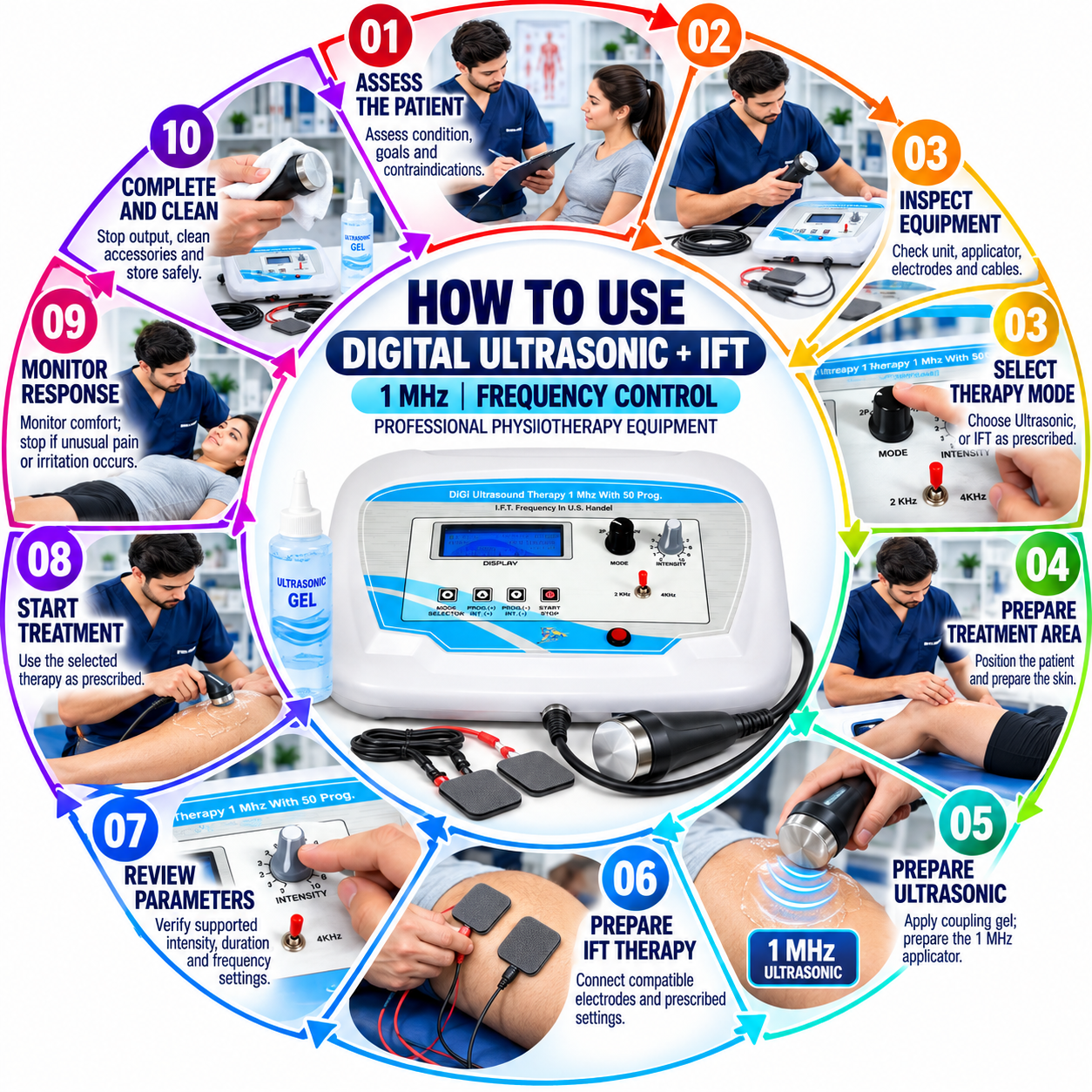
How to Use the Digital Ultrasonic Therapy Unit 1 MHz with IFT Frequency Control
The unit should only be operated by a trained physiotherapist or appropriately qualified healthcare professional.
Step 1: Assess the Patient
Review the patient’s condition, medical history, treatment objective, skin condition, and contraindications for the intended modality.
Step 2: Inspect the Equipment
Check the main unit, power cable, ultrasonic applicator, IFT leads, electrodes, and connectors for damage.
Step 3: Select the Required Modality
Choose the ultrasonic or IFT function according to the clinical treatment plan. Do not assume that both functions must be used together.
Step 4: Prepare the Treatment Area
Position the patient comfortably. Prepare the skin and accessories according to the requirements of the selected modality.
Step 5: For Ultrasonic Therapy
Apply a suitable ultrasonic coupling gel. Select the prescribed settings and use the applicator according to the manufacturer’s instructions.
Step 6: For IFT
Connect compatible electrode leads, position the electrodes according to the treatment protocol, and select the appropriate available frequency-related settings and intensity.
Step 7: Review the Parameters
Confirm the treatment duration, intensity, frequency-related settings, and operating mode. Use only settings supported by the device and prescribed by the treating professional.
Step 8: Start Treatment
Begin treatment according to the operating manual and the selected clinical protocol.
Step 9: Monitor the Patient
Monitor patient comfort and response throughout the session. Stop treatment if unexpected pain, excessive heat, unusual sensations, skin irritation, or other concerning symptoms occur.
Step 10: Complete and Clean
Stop the output before removing the applicator or electrodes. Clean reusable accessories and store the equipment according to the manufacturer’s instructions.
Safety Precautions
The Digital Ultrasonic Therapy Unit 1 MHz with IFT Frequency Control should be used according to the manufacturer’s operating instructions and appropriate clinical protocols.
- Use the equipment only for its intended purpose.
- Ensure that the operator is appropriately trained.
- Assess the patient before selecting a modality.
- Follow the contraindications for both ultrasonic therapy and IFT.
- Use suitable coupling gel for ultrasonic treatment.
- Use only compatible electrodes, leads, and accessories.
- Inspect the applicator, cables, and connectors before use.
- Follow the recommended electrode placement and applicator technique.
- Avoid excessive intensity or treatment duration.
- Monitor patient response throughout treatment.
- Follow specific precautions for patients with implanted electronic devices or relevant medical conditions.
- Avoid treatment over contraindicated areas.
- Do not use damaged equipment.
- Clean and maintain the device according to the manufacturer’s instructions.
The safety requirements for ultrasonic therapy and electrical stimulation differ. The operator must review the precautions for the selected modality rather than applying one general protocol to both.
Technical Specifications
The following table reflects the product name and stated configuration. Details not confirmed for the exact model are marked as model-dependent.
| Specification | Details |
|---|---|
| Product Name | Digital Ultrasonic Therapy Unit 1 MHz with IFT Frequency Control |
| Product Category | Combination Physiotherapy Equipment |
| Ultrasonic Frequency | 1 MHz |
| Ultrasonic Therapy | Included, as specified |
| IFT Function | Included, as specified by product configuration |
| IFT Frequency Control | Available; exact range to be confirmed |
| Control System | Digital |
| Ultrasonic Applicator | Dedicated transducer, model-dependent |
| Ultrasonic Intensity Range | Confirm from manufacturer |
| Ultrasonic Operating Modes | Confirm from manufacturer |
| IFT Channels | Confirm from manufacturer |
| IFT Output Parameters | Confirm from manufacturer |
| Treatment Timer | Model-dependent |
| Display Type | Confirm from manufacturer |
| Power Supply | Confirm from manufacturer |
| Included Accessories | Confirm package configuration |
| Intended Application | Physiotherapy and Rehabilitation |
| Intended Operator | Trained Healthcare Professional |
| Warranty | Confirm with supplier |
Specification note: Confirm the exact IFT frequency-control function, available frequency range, number of channels, output parameters, ultrasonic intensity, operating modes, applicator specifications, power requirements, included accessories, and warranty from the supplied model’s datasheet.
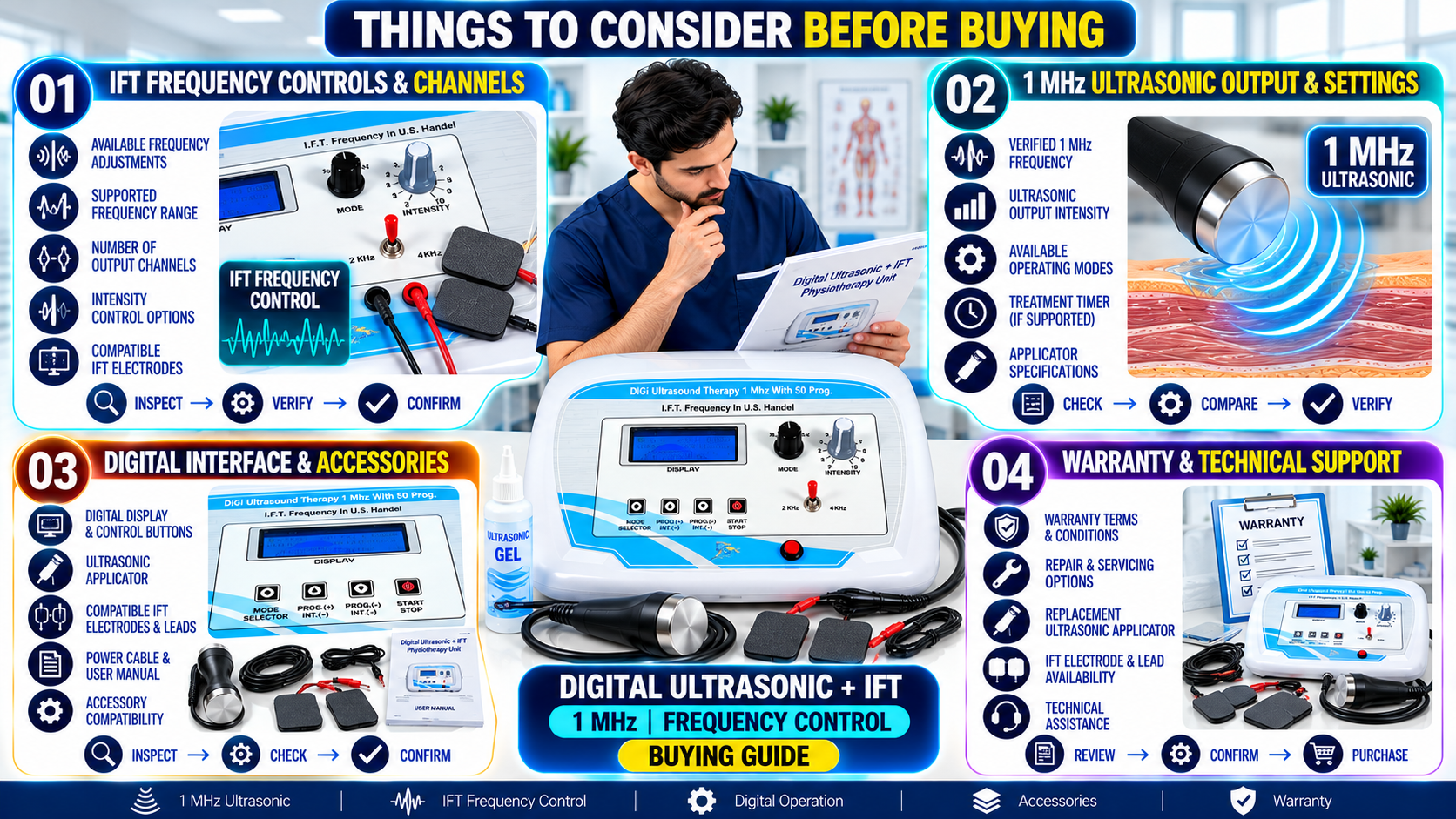
What to Consider Before Buying
Confirm the IFT Frequency Controls
Ask the supplier what the frequency control adjusts, which settings are available, and the supported range.
Verify the 1 MHz Ultrasonic Output
Confirm the ultrasonic operating frequency from the manufacturer’s technical documentation.
Check the Ultrasonic Output Settings
Review the intensity range, operating modes, timer, and applicator specifications.
Review IFT Channels and Controls
Check the number of channels, available frequency-related settings, intensity adjustment, and compatible electrodes.
Check the Digital Interface
Confirm that the display and controls provide the functions required by your clinic.
Verify Accessories
Confirm that the package includes the required ultrasonic applicator, electrodes, leads, power cable, and user manual.
Confirm Warranty and Technical Support
Review warranty coverage, servicing options, repair availability, and replacement accessories before purchasing.
Who Should Operate This Machine?
The unit should be operated by an appropriately trained physiotherapist or qualified healthcare professional with knowledge of ultrasonic therapy, IFT, treatment parameters, patient assessment, and contraindications.
The operator should understand the different accessories and operating procedures required for each modality and should use the machine according to its technical documentation.
Why Choose PHYSIOMODALITIES™?
PHYSIOMODALITIES™ provides physiotherapy and rehabilitation equipment for professional clinical environments.
When selecting a combined ultrasonic and IFT unit, clinics should assess the verified specifications for both modalities, including the 1 MHz ultrasonic output, IFT frequency controls, electrical channels, treatment settings, accessories, warranty, and technical support.
Choosing equipment according to confirmed specifications helps ensure that the device matches the clinic’s actual requirements and treatment workflow.
Conclusion
The Digital Ultrasonic Therapy Unit 1 MHz with IFT Frequency Control combines a 1 MHz ultrasonic therapy section with IFT frequency-related controls in one physiotherapy equipment configuration. It is designed for professional settings where both modalities may be required for appropriate treatment protocols.
Before purchasing, confirm the IFT frequency-control function, available frequency range, number of channels, ultrasonic intensity and modes, applicator specifications, accessories, power requirements, and warranty. Appropriate patient assessment, professional training, and adherence to manufacturer instructions are essential for responsible use.
Frequently Asked Questions
1. What is a Digital Ultrasonic Therapy Unit with IFT Frequency Control?
It is a combination physiotherapy device that includes a 1 MHz ultrasonic section and IFT functionality with frequency-related controls, depending on the model.
2. What does the 1 MHz setting refer to?
It refers to the operating frequency of the ultrasonic therapy section.
3. What does IFT frequency control do?
It allows adjustment of supported frequency-related settings within the IFT section. The exact function and range depend on the device.
4. Can ultrasonic therapy and IFT be used together?
The machine may contain both modalities, but whether they should be used during the same session depends on the patient’s assessment and clinical protocol.
5. What should I verify before buying this unit?
Check the 1 MHz ultrasonic output, IFT frequency controls, channel count, output settings, applicators, accessories, warranty, and technical support.