The Digital Ultrasonic Physiotherapy Machine – 1 MHz, 50 Programs is a professional physiotherapy device designed to deliver therapeutic acoustic energy for selected rehabilitation and musculoskeletal treatment applications. It combines a 1 MHz operating frequency with a digital control system and 50 preset programs, providing trained professionals with convenient access to predefined treatment settings.
The machine uses a dedicated ultrasonic applicator and a suitable coupling medium, such as ultrasonic gel, to transfer acoustic energy to the treatment area. A 1 MHz frequency is generally associated with relatively deeper treatment areas compared with 3 MHz systems, although actual energy distribution depends on tissue characteristics, applicator specifications, and treatment parameters.
The Digital Ultrasonic Physiotherapy Machine – 1 MHz, 50 Programs is intended for professional physiotherapy clinics, rehabilitation centres, sports therapy facilities, and other healthcare environments where therapeutic ultrasonic treatment is considered appropriate.
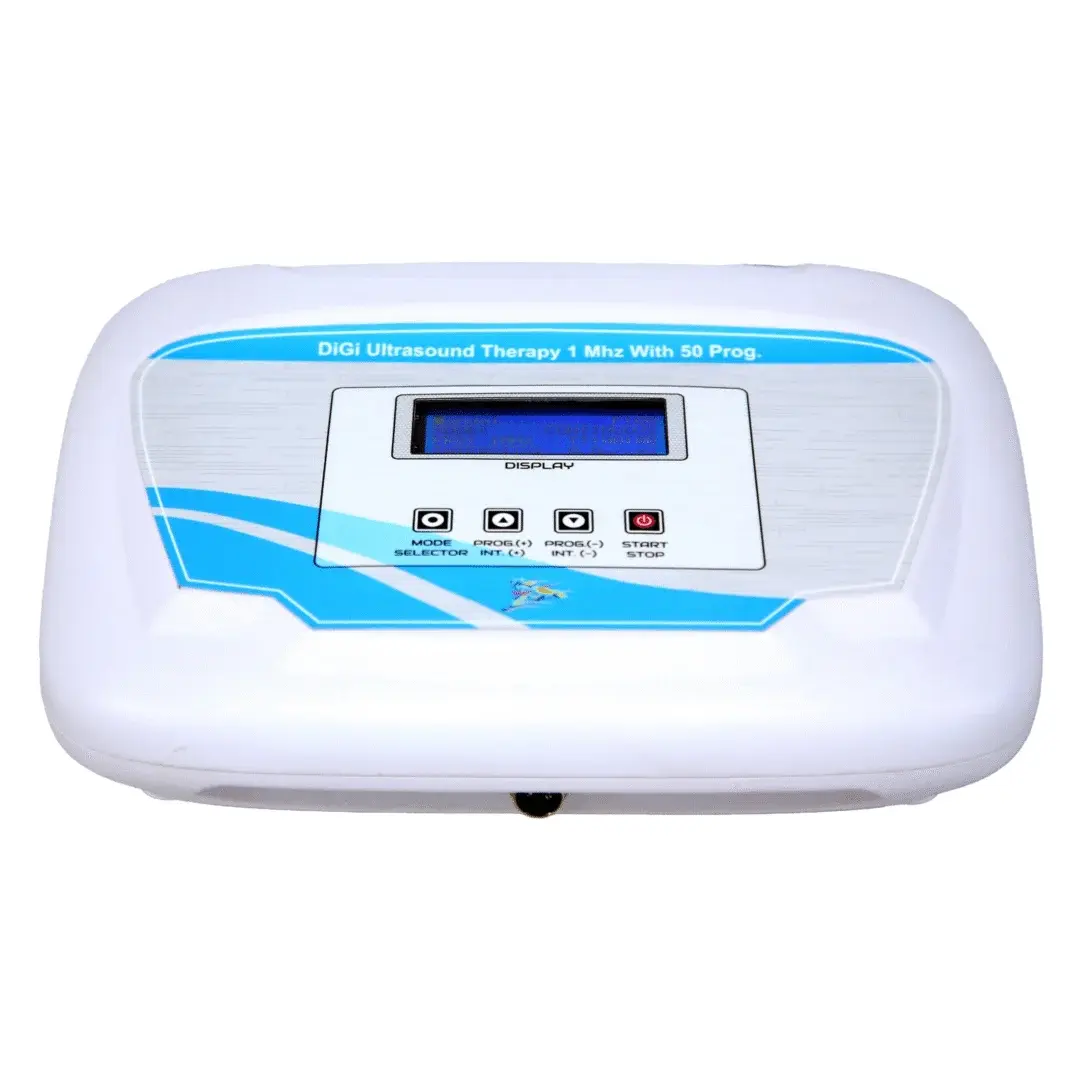
What Is a Digital Ultrasonic Physiotherapy Machine?
A Digital Ultrasonic Physiotherapy Machine is an electronic device that generates therapeutic acoustic vibrations through a specialized transducer housed inside its applicator.
The digital control system allows the operator to select available programs and adjust supported treatment parameters. In this configuration, the machine is specified with a 1 MHz operating frequency and 50 preset programs.
Preset programs can make treatment selection more convenient, but they do not replace patient assessment or professional judgment. The suitability of each program depends on the patient’s condition, the intended treatment area, and the manufacturer’s instructions.
The exact intensity range, operating modes, pulse settings, timer, display type, and applicator specifications should be confirmed from the technical documentation for the supplied model.
How Does Digital Ultrasonic Therapy Work?
Therapeutic ultrasonic equipment converts electrical energy into mechanical acoustic vibrations using a transducer.
During treatment, a suitable coupling medium is applied between the applicator and the skin to support efficient transmission of acoustic energy.
The general process involves:
- Selecting the appropriate program or treatment settings.
- Preparing the treatment area.
- Applying a suitable ultrasonic coupling gel.
- Positioning the applicator according to the recommended technique.
- Delivering the selected treatment under professional supervision.
- Monitoring the patient’s response throughout the session.
The 1 MHz frequency is commonly associated with relatively deeper treatment areas than 3 MHz under comparable conditions. However, treatment depth and energy distribution are also influenced by tissue properties, intensity, applicator characteristics, and application technique.
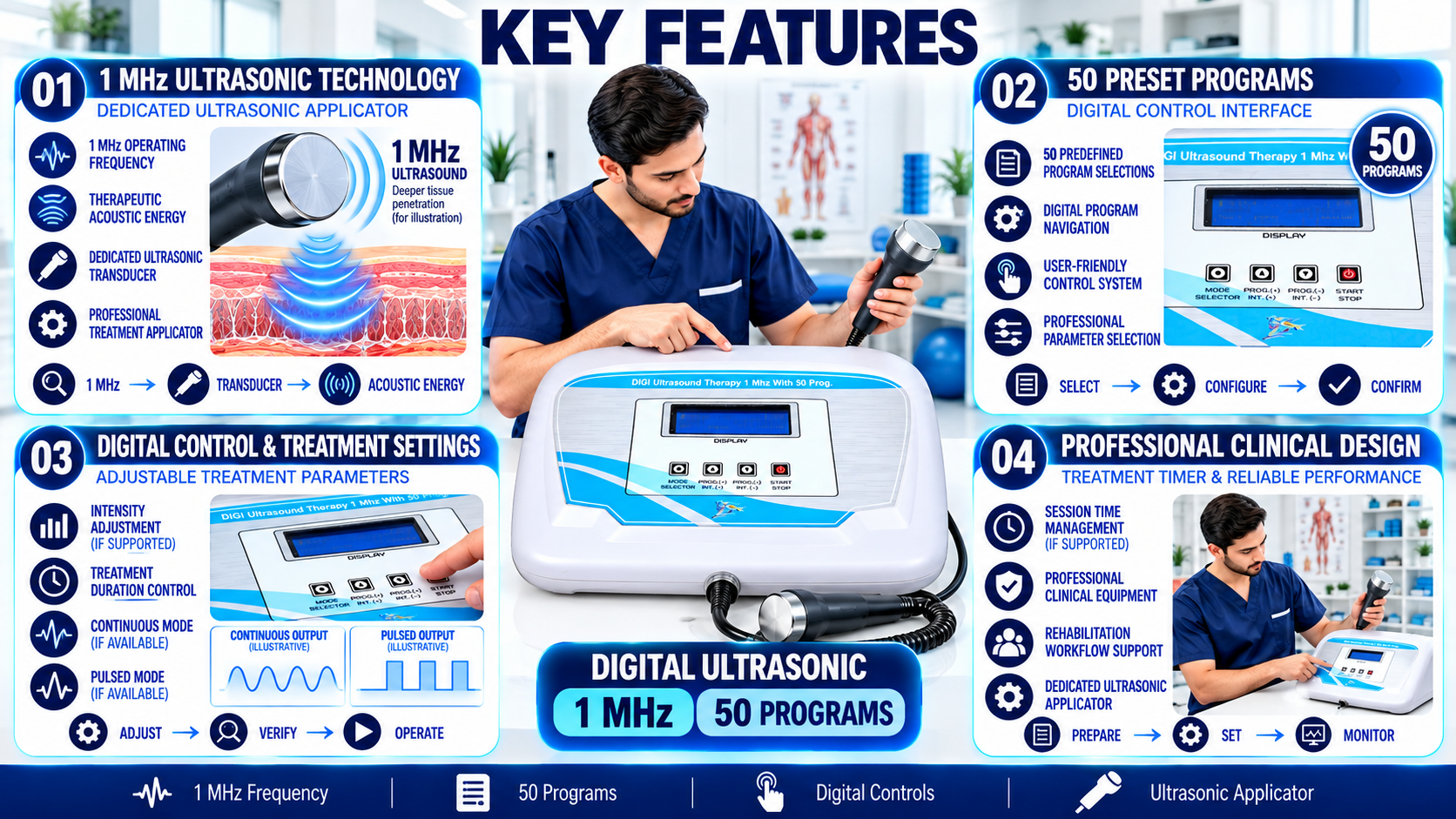
Key Features of Digital Ultrasonic Physiotherapy Machine – 1 MHz, 50 Programs
1 MHz Operating Frequency
The machine is specified with a 1 MHz operating frequency, generally associated with therapeutic applications involving relatively deeper treatment areas compared with higher-frequency systems.
50 Preset Programs
The 50-program system provides predefined treatment selections intended to simplify program navigation. The exact purpose and parameters of each preset should be verified from the manufacturer’s program list.
Digital Control System
The digital interface allows the operator to select available programs and manage the treatment settings supported by the machine.
Dedicated Ultrasonic Applicator
The applicator contains the transducer that generates acoustic energy. Its size, effective radiating area, and other specifications depend on the supplied model.
Adjustable Treatment Parameters
Depending on the configuration, the machine may support adjustments to intensity, treatment duration, operating mode, or other parameters.
Continuous and Pulsed Operation
Some digital ultrasonic machines offer continuous and pulsed modes. Confirm which modes are available on the exact model before listing them as standard features.
Treatment Timer
A timer may help the operator manage the prescribed treatment duration. Timer functionality and adjustment options are model-dependent.
Professional Clinical Design
The machine is designed for use in appropriate physiotherapy and rehabilitation environments by trained healthcare professionals.
Applications of Digital Ultrasonic Physiotherapy Machine
The Digital Ultrasonic Physiotherapy Machine – 1 MHz, 50 Programs may be incorporated into selected physiotherapy protocols following appropriate clinical assessment.
Musculoskeletal Rehabilitation
Therapeutic ultrasonic treatment may be considered for selected musculoskeletal conditions when appropriate to the patient’s treatment plan.
Soft-Tissue Rehabilitation
The modality may be incorporated into certain soft-tissue rehabilitation programs, depending on the condition and available clinical evidence.
Sports Physiotherapy
Sports rehabilitation clinics may use therapeutic ultrasonic treatment as one component of a wider program that includes exercise, mobility training, and strengthening.
Joint-Related Rehabilitation
A qualified professional may consider ultrasonic treatment for selected joint-related rehabilitation applications after reviewing the treatment area and relevant contraindications.
Physiotherapy Clinics
The machine can form part of a clinical equipment setup where therapeutic ultrasonic treatment is required and appropriate.
Important: Ultrasonic therapy is not suitable for every injury or pain condition. A trained professional should determine whether it is appropriate for the individual patient.
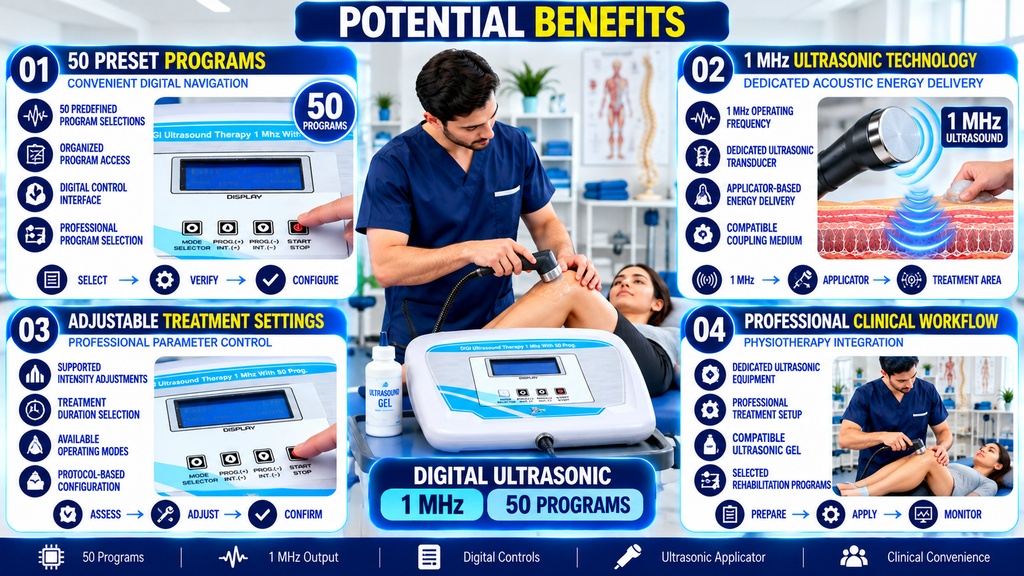
Benefits of a 50-Program Digital Ultrasonic Machine
The 50-program configuration offers convenient access to predefined settings. Its practical value depends on the accuracy of the preset programs, available controls, and the clinic’s treatment requirements.
Potential equipment-related advantages include:
- 50 preset program selections.
- A dedicated 1 MHz ultrasonic output.
- Digital program navigation.
- Applicator-based treatment delivery.
- Compatibility with an appropriate coupling medium.
- Adjustable settings where supported by the model.
- Integration into selected physiotherapy workflows.
Preset programs should only be used when appropriate for the patient’s assessment and the manufacturer’s instructions. They do not guarantee a particular clinical outcome.
1 MHz vs 3 MHz Ultrasonic Therapy
Ultrasonic treatment frequencies differ in how energy is absorbed and distributed in tissue.
| Feature | 1 MHz Ultrasonic Therapy | 3 MHz Ultrasonic Therapy |
|---|---|---|
| Operating Frequency | 1 MHz | 3 MHz |
| General Treatment Consideration | Relatively deeper treatment areas | Relatively more superficial treatment areas |
| Energy Absorption | Generally lower absorption per unit distance in comparable tissue | Generally higher absorption per unit distance in comparable tissue |
| Treatment Parameters | Selected according to the clinical protocol | Selected according to the clinical protocol |
| Applicator | Model-dependent | Model-dependent |
Frequency alone does not determine the correct treatment. The operator must also consider the tissue, intensity, duty cycle, applicator characteristics, treatment duration, and the patient’s condition.
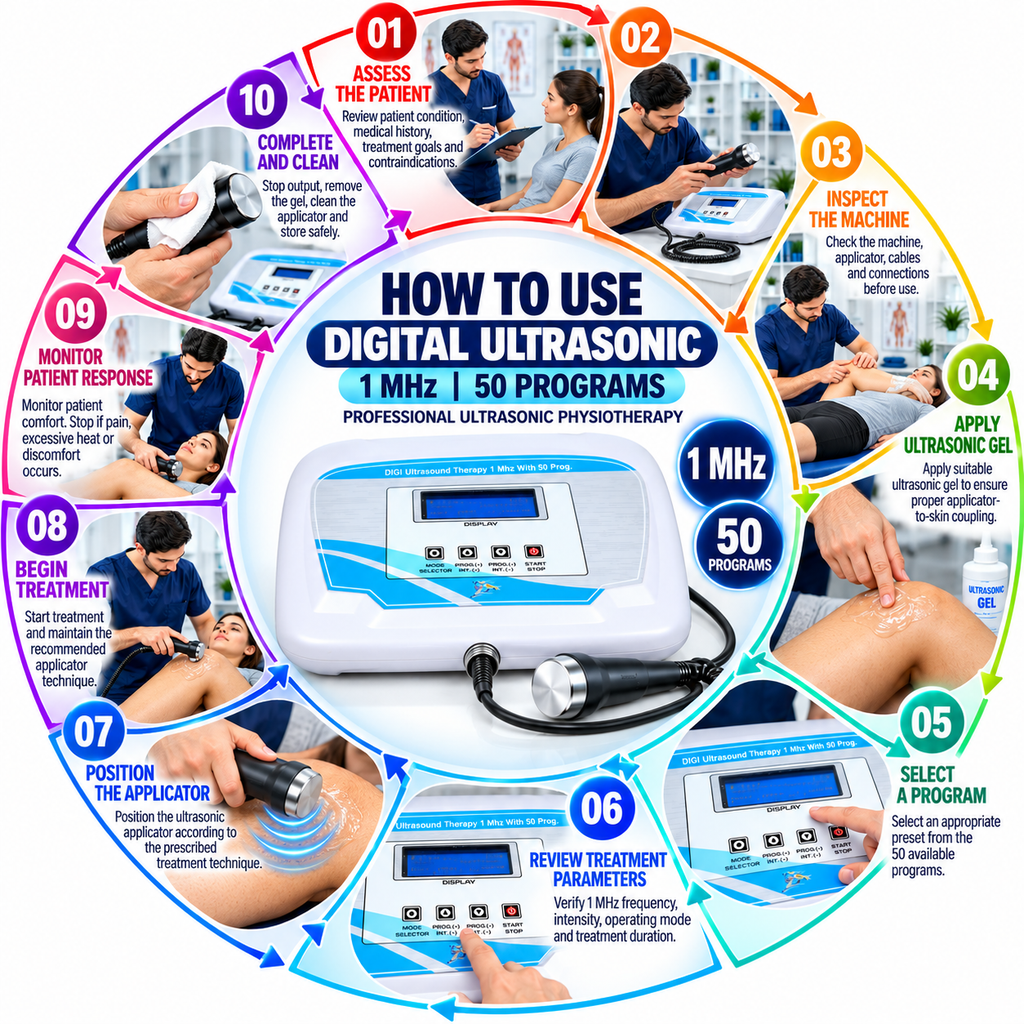
How to Use Digital Ultrasonic Physiotherapy Machine – 1 MHz, 50 Programs
The machine should be operated by an appropriately trained physiotherapist or qualified healthcare professional.
Step 1: Assess the Patient
Review the patient’s condition, treatment objective, medical history, skin condition, and relevant contraindications.
Step 2: Inspect the Machine
Check the main unit, applicator, cable, connectors, and power supply for visible damage. Do not operate damaged equipment.
Step 3: Prepare the Treatment Area
Position the patient comfortably and expose the intended treatment area according to the treatment protocol.
Step 4: Apply Ultrasonic Gel
Apply a suitable ultrasonic coupling gel as recommended by the manufacturer. Ensure appropriate coupling between the applicator and the skin.
Step 5: Select a Program
Choose a suitable preset from the 50 available programs only when its settings are appropriate for the patient’s assessment and the manufacturer’s instructions.
Step 6: Review Treatment Parameters
Confirm the selected frequency, intensity, operating mode, and duration. Adjust the settings only within the machine’s supported range and the prescribed clinical protocol.
Step 7: Position the Applicator
Place the applicator on the treatment area and follow the application technique described in the operating manual.
Step 8: Begin Treatment
Start the treatment according to the manufacturer’s instructions. Maintain the recommended applicator movement or positioning technique.
Step 9: Monitor Patient Response
Monitor patient comfort and the treatment area throughout the session. Stop treatment if unexpected pain, excessive heat, or another concerning response occurs.
Step 10: Complete and Clean
Reduce or stop the output before lifting the applicator. Remove the coupling gel and clean the applicator according to the manufacturer’s instructions.
Safety Precautions
The Digital Ultrasonic Physiotherapy Machine – 1 MHz, 50 Programs must be used according to the manufacturer’s instructions and appropriate clinical protocols.
- Use the device only for its intended purpose.
- Ensure that the operator has appropriate training.
- Assess the patient before treatment.
- Review the manufacturer’s contraindications.
- Use the recommended coupling gel.
- Inspect the applicator and cable before each session.
- Avoid excessive intensity or treatment duration.
- Follow the recommended applicator technique.
- Monitor patient comfort throughout treatment.
- Avoid treatment over contraindicated areas.
- Follow specific precautions for sensitive anatomical areas and relevant medical conditions.
- Do not use damaged equipment.
- Clean and maintain the applicator according to the operating manual.
Treatment over the eyes, reproductive organs, suspected malignancies, or other contraindicated areas should be avoided in accordance with the manufacturer’s instructions and relevant clinical guidance. This list is not exhaustive.
Technical Specifications
The following table reflects the stated product configuration. Any detail not confirmed for the exact model is marked as model-dependent.
| Specification | Details |
|---|---|
| Product Name | Digital Ultrasonic Physiotherapy Machine – 1 MHz, 50 Programs |
| Product Category | Ultrasonic Physiotherapy Equipment |
| Operating Frequency | 1 MHz |
| Preset Programs | 50 |
| Control System | Digital |
| Therapy Type | Therapeutic Ultrasonic Therapy |
| Applicator | Dedicated ultrasonic transducer |
| Operating Modes | Continuous / Pulsed, if supported |
| Intensity Range | Confirm from manufacturer |
| Pulse Settings | Model-dependent |
| Treatment Timer | Model-dependent |
| Display | Digital, exact type to be confirmed |
| Power Supply | Confirm from manufacturer |
| Applicator Size | Confirm from manufacturer |
| Accessories | Confirm package configuration |
| Intended Application | Physiotherapy and Rehabilitation |
| Intended Operator | Trained Healthcare Professional |
| Warranty | Confirm with supplier |
Specification note: Confirm the maximum output intensity, operating modes, pulse settings, effective radiating area, timer, power requirements, included accessories, and warranty from the exact model datasheet.
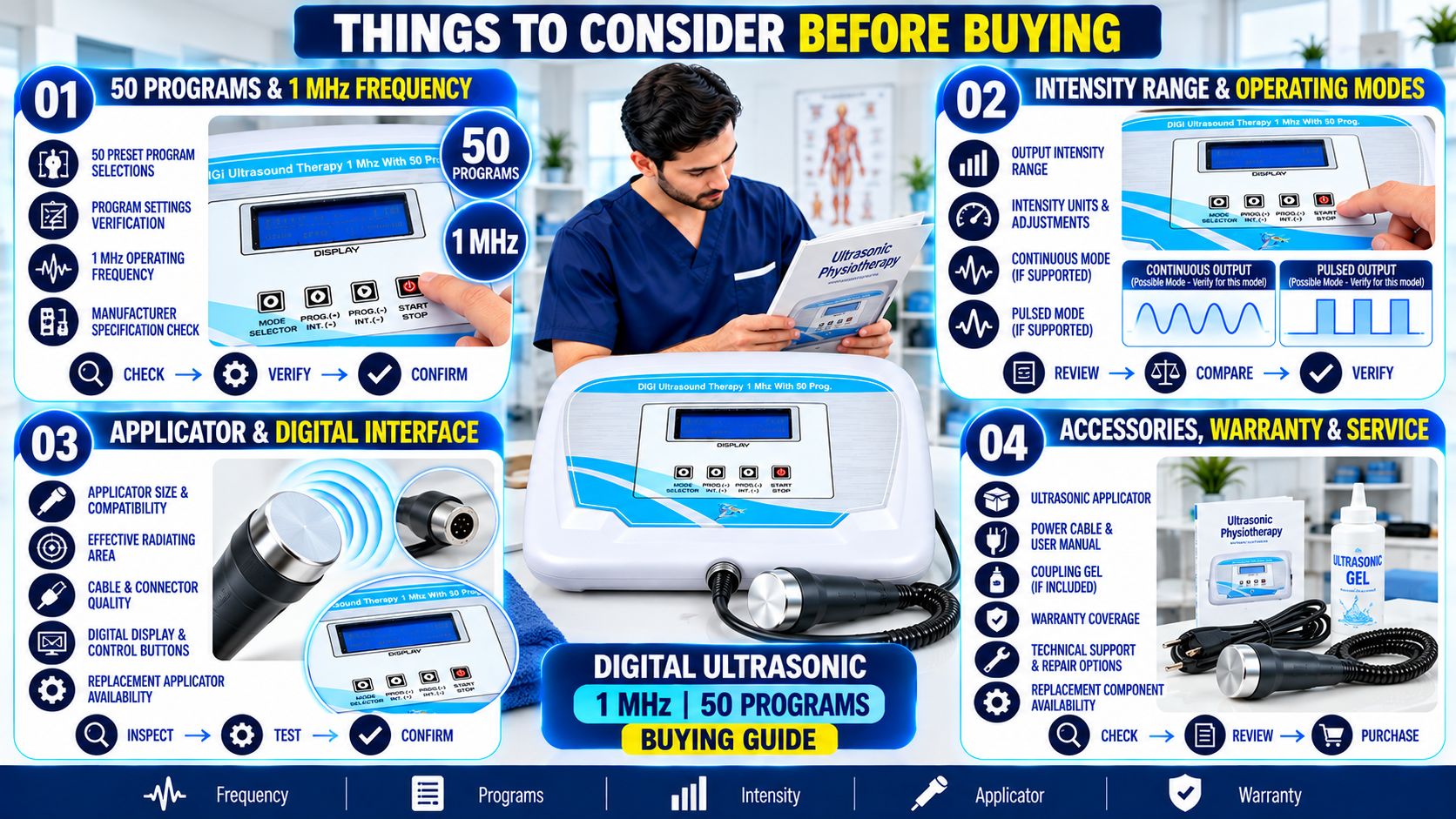
What to Consider Before Buying
Verify the 50 Programs
Ask the supplier for the program list and confirm which treatment settings are included. Preset names alone do not establish clinical suitability.
Confirm the 1 MHz Output
Verify the operating frequency from the manufacturer’s documentation.
Check the Intensity Range
Review the output intensity range and the units used in the technical specifications.
Review the Operating Modes
Confirm whether continuous operation, pulsed operation, or both are available.
Check the Applicator
Review applicator size, effective radiating area, construction, cable quality, and replacement availability.
Examine the Digital Interface
Confirm that the display and controls provide the functions required for daily clinical use.
Verify Included Accessories
Check whether the applicator, power cable, user manual, and other required accessories are included.
Confirm Warranty and Service
Review warranty coverage, technical support, repair options, and availability of replacement components.
Who Should Operate This Machine?
The Digital Ultrasonic Physiotherapy Machine – 1 MHz, 50 Programs should be operated by an appropriately trained physiotherapist or qualified healthcare professional.
The operator should understand:
- Therapeutic ultrasonic principles.
- Program selection and treatment parameters.
- Coupling gel application.
- Applicator handling.
- Patient assessment.
- Contraindications and safety precautions.
- Patient monitoring.
- Equipment cleaning and maintenance.
Professional judgment is essential when choosing a preset program or adjusting treatment parameters.
Why Choose PHYSIOMODALITIES™?
PHYSIOMODALITIES™ provides physiotherapy and rehabilitation equipment for professional clinical environments.
When selecting a digital ultrasonic machine, clinics should consider the actual operating frequency, number of preset programs, output specifications, available modes, applicator design, digital controls, accessories, warranty, and technical support.
Choosing equipment according to verified technical information helps ensure that the device meets the clinic’s requirements and supports its intended workflow.
Conclusion
The Digital Ultrasonic Physiotherapy Machine – 1 MHz, 50 Programs is designed to deliver therapeutic acoustic energy through a dedicated applicator, with a digital interface and 50 preset program selections. Its 1 MHz frequency is generally associated with relatively deeper treatment areas than 3 MHz systems, although the actual energy distribution depends on tissue characteristics and treatment parameters.
Before purchasing, confirm the program list, intensity range, operating modes, applicator specifications, timer, accessories, power requirements, and warranty. Appropriate patient assessment, professional training, and adherence to manufacturer instructions are essential for responsible use.
Frequently Asked Questions
1. What is a Digital Ultrasonic Physiotherapy Machine?
It is a physiotherapy device that generates therapeutic acoustic energy through a dedicated applicator and provides digital controls for supported treatment settings.
2. What does 1 MHz mean?
It refers to the machine’s operating frequency. A 1 MHz frequency is generally associated with relatively deeper treatment areas compared with 3 MHz.
3. What do the 50 programs provide?
They provide preset treatment selections. Their exact settings and intended applications should be confirmed from the manufacturer’s program list.
4. Is ultrasonic gel required?
Yes, a suitable coupling medium such as ultrasonic gel is generally required to transfer acoustic energy effectively from the applicator to the skin.
5. What should I check before purchasing this machine?
Check the 1 MHz output, 50-program list, intensity range, operating modes, applicator specifications, timer, accessories, warranty, and technical support.