
The DVT Pump 4 Chambers Compression Therapy Device is a medical compression system designed to deliver intermittent pneumatic compression through compatible inflatable garments. It is intended for use in appropriate clinical settings where mechanical compression forms part of a prescribed venous thromboembolism prevention protocol.
DVT stands for Deep Vein Thrombosis, a condition involving blood clot formation in a deep vein, commonly in the leg. Intermittent pneumatic compression devices apply controlled air pressure through specially designed garments to support venous blood flow in selected patients.
The four-chamber configuration allows the device to inflate and deflate separate sections of a compatible garment according to its programmed sequence. The exact pressure range, cycle timing, garment configuration, and operating modes depend on the specific model.
The DVT Pump 4 Chambers Compression Therapy Device may be considered for hospitals, patient-care facilities, and rehabilitation environments where pneumatic compression is clinically appropriate. Patient suitability and treatment settings must be determined by a qualified healthcare professional.
PHYSIOMODALITIES™ provides professional physiotherapy, rehabilitation, and healthcare equipment for clinical environments.
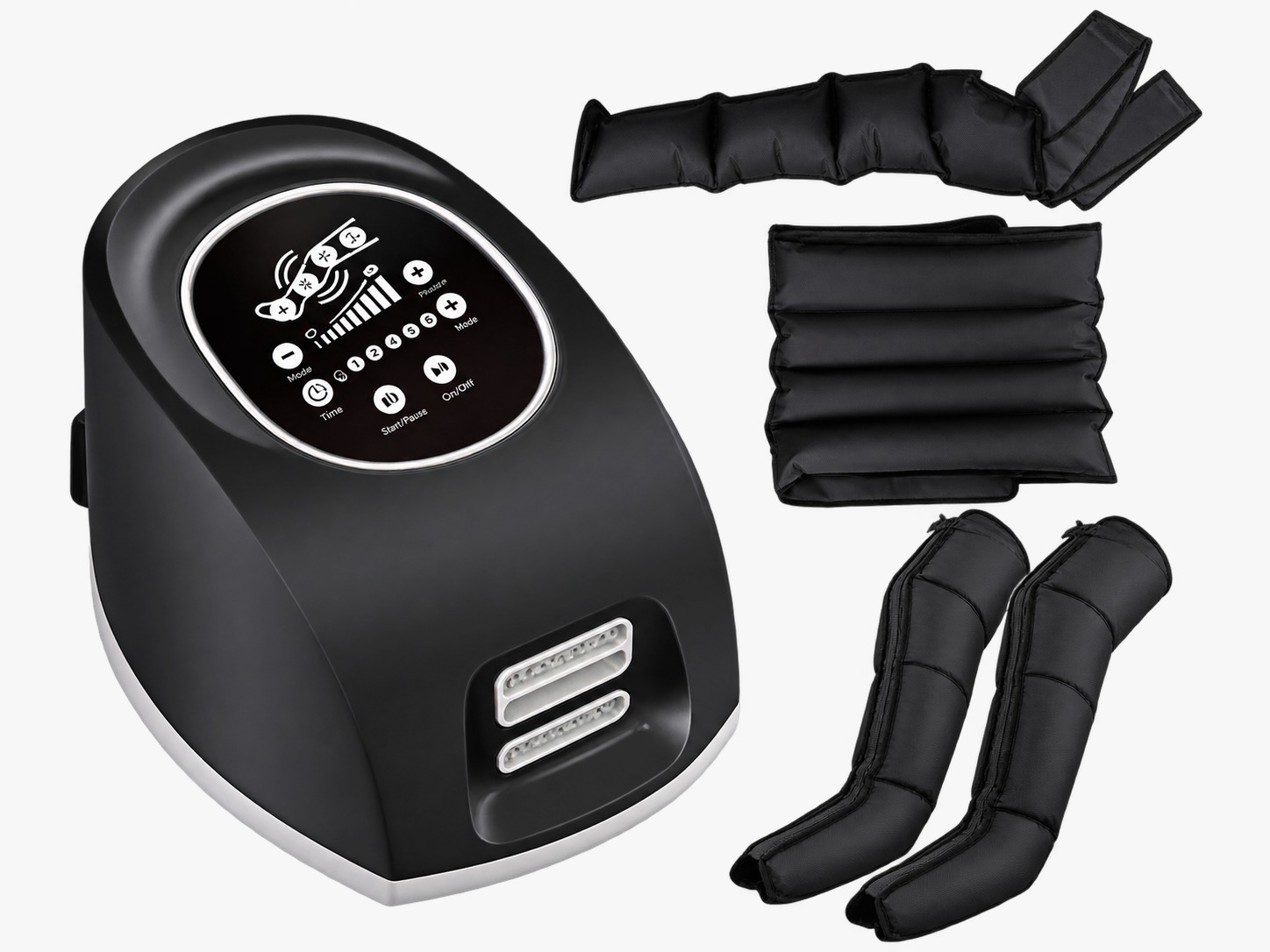
What Is a DVT Pump 4 Chambers Compression Therapy Device?
A DVT pump is a type of intermittent pneumatic compression (IPC) device that uses controlled air pressure to inflate and deflate compatible compression garments.
The garment contains inflatable sections that apply external pressure to the limb. In a four-chamber system, four separate chambers are controlled by the pump. Depending on the model, the device may inflate the chambers sequentially or according to another manufacturer-defined cycle.
These devices are used in selected clinical protocols to help reduce the risk of venous thromboembolism in appropriate patients. They may be particularly relevant in care pathways involving reduced mobility or certain postoperative situations.
A DVT pump is not a general-purpose massage device, and it should not be assumed that every compression therapy machine is suitable for DVT prevention. The exact device must be appropriate for the intended clinical application.
How Does Four-Chamber Compression Therapy Work?
Intermittent pneumatic compression uses repeated cycles of air inflation and deflation to apply controlled pressure through a garment.
A typical four-chamber system includes:
- A pump that generates and controls air pressure.
- A compatible garment with four inflatable chambers.
- Tubing that connects the garment to the pump.
- Controls that regulate the available compression settings.
- A programmed inflation and deflation sequence.
In some systems, the chambers inflate in sequence from the distal part of the limb toward the proximal part. The precise sequence and timing depend on the device’s design.
The intended effect is to support venous blood movement in selected patients. The device forms part of a broader clinical prevention plan rather than replacing patient assessment, appropriate mobilization, prescribed medication, or other recommended preventive measures.
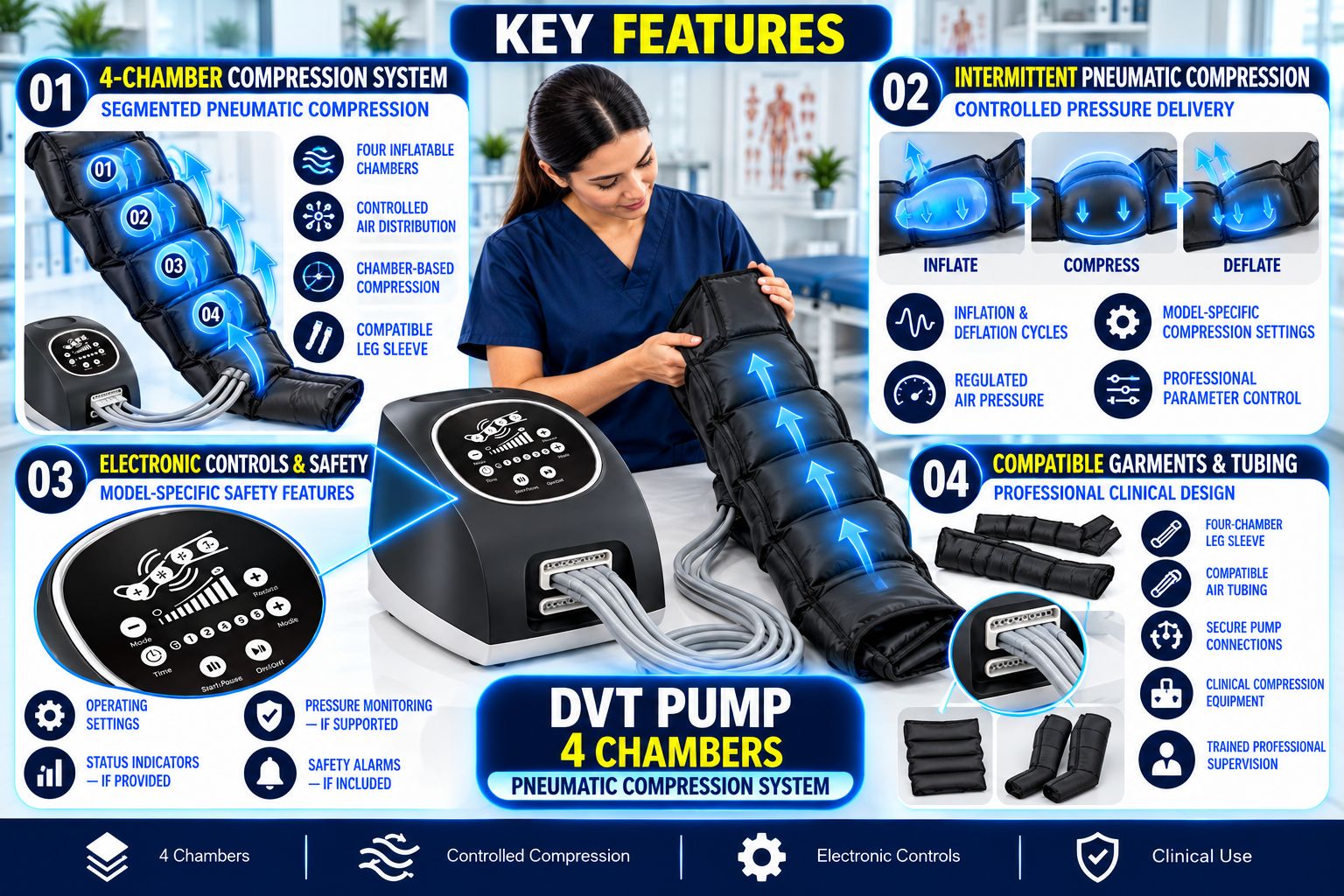
Key Features of DVT Pump 4 Chambers
Four-Chamber Compression System
The device is designed around a four-chamber garment configuration. Separate chambers allow the pump to deliver pressure according to its supported compression sequence.
Intermittent Pneumatic Compression
The pump applies pressure through repeated inflation and deflation cycles. The cycle pattern and timing are model-dependent.
Controlled Pressure Delivery
The device regulates pressure according to its technical design and available controls. The pressure range should be confirmed using the manufacturer’s specifications.
Compatible Compression Garments
The pump operates with compatible sleeves, cuffs, or other approved garments. Garment size, chamber arrangement, and treatment-area compatibility vary by model.
Electronic Controls
Depending on the configuration, the unit may provide electronic controls for selecting operating settings and monitoring its status.
Clinical Equipment Design
The device is intended for use in suitable healthcare environments where pneumatic compression is prescribed and supervised by trained professionals.
Model-Specific Safety Features
Certain models may include indicators, alarms, pressure monitoring, or automatic shutoff functions. These features should only be advertised when confirmed for the exact device.
Accessories and Tubing
The pump requires compatible tubing and compression garments. Confirm the number of garments, connectors, and other included accessories before purchasing.
Applications of DVT Pump 4 Chambers Compression Therapy Device
The DVT Pump 4 Chambers Compression Therapy Device may be incorporated into selected clinical protocols when intermittent pneumatic compression is appropriate.
Venous Thromboembolism Prevention
IPC devices may be used as part of a prevention strategy for selected patients who are at risk of venous thromboembolism. Patient selection should follow clinical assessment and relevant protocols.
Postoperative Care
Some patients may be prescribed intermittent pneumatic compression following surgery, depending on their risk factors, mobility, procedure, and clinical plan.
Reduced-Mobility Care
Patients with limited mobility may be assessed for mechanical compression as part of an individualized prevention plan.
Hospital and Patient-Care Settings
Hospitals and other suitable healthcare facilities may use pneumatic compression devices where the device’s intended use matches the patient’s needs.
Rehabilitation Environments
In rehabilitation settings, some patients with reduced mobility may be considered for compression therapy under clinical supervision. The device should only be used for its approved purpose and when clinically appropriate.
Important: A DVT pump does not diagnose or treat every cause of leg swelling or pain. Suspected acute DVT requires prompt medical assessment. The treating clinician must determine whether compression is appropriate.
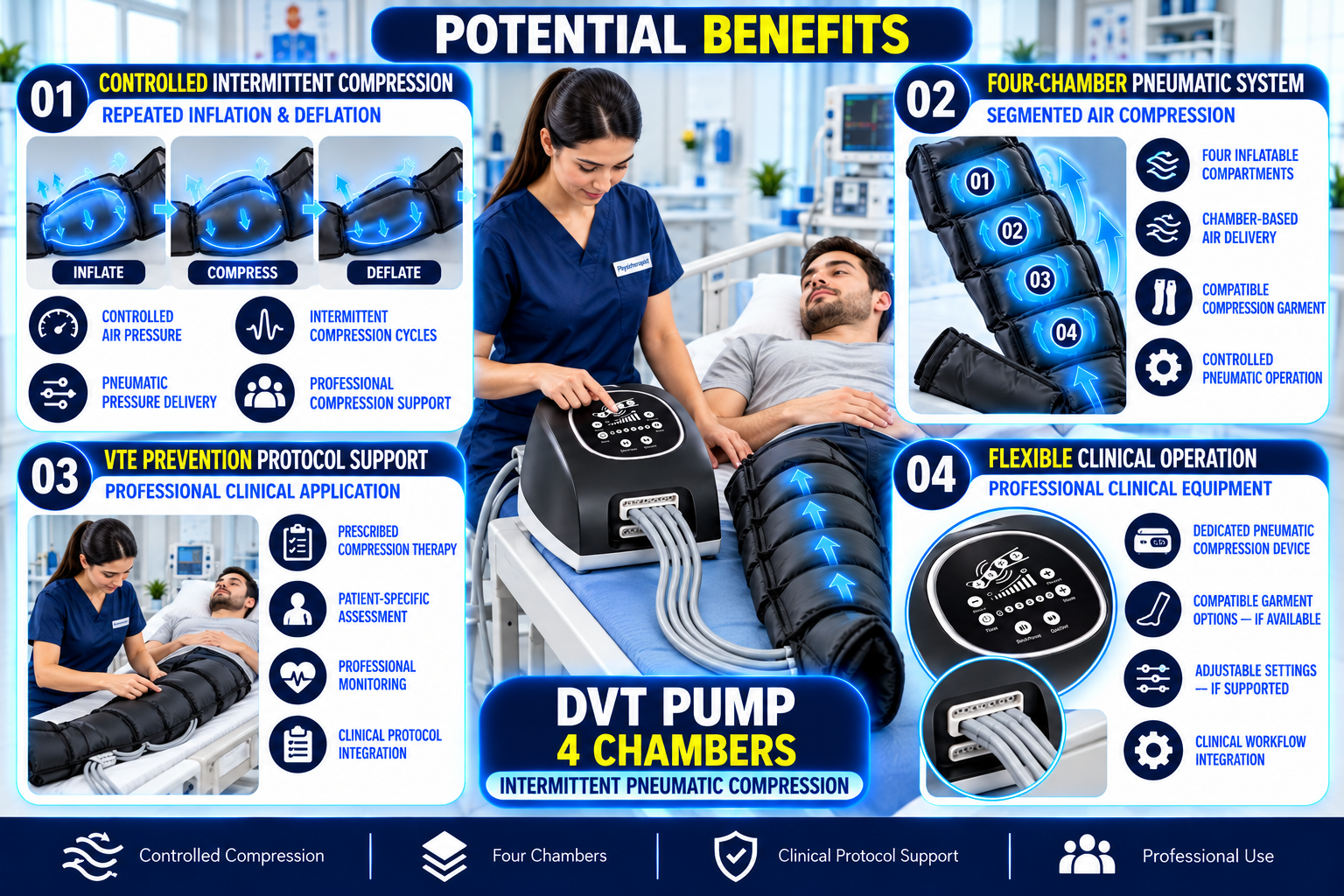
Potential Benefits of a Four-Chamber DVT Pump
The potential value of a DVT pump depends on the device configuration, the patient’s condition, and the prescribed clinical protocol.
Equipment-related advantages may include:
- Controlled intermittent air compression.
- Four separate inflatable chambers in the compatible garment.
- Repeated inflation and deflation cycles.
- Integration into selected venous thromboembolism prevention protocols.
- Dedicated compression equipment for clinical environments.
- Compatible garment options, depending on the model.
- Adjustable settings where supported by the device.
These features do not guarantee that a blood clot will be prevented. Clinical effectiveness depends on appropriate patient selection, correct use, adherence to the prescribed protocol, and the broader prevention strategy.
DVT Pump vs General Compression Therapy Device
DVT prevention pumps and other pneumatic compression devices may look similar but can have different intended uses.
| Feature | DVT Pump | Other Compression Therapy Devices |
|---|---|---|
| Intended Purpose | May support DVT prevention in selected patients | May support other approved compression applications |
| Compression Pattern | Model-specific intermittent cycles | May use different compression patterns |
| Garment Design | Compatible with the approved DVT protocol | Depends on the device’s intended use |
| Clinical Selection | Based on patient risk assessment and contraindications | Based on the intended treatment and patient assessment |
| Operating Settings | Model-dependent | Model-dependent |
| Appropriate Use | Follow prescribed clinical protocol | Follow the relevant clinical protocol |
A general compression pump should not be marketed as a DVT prevention device unless its intended use and supporting documentation confirm that application.
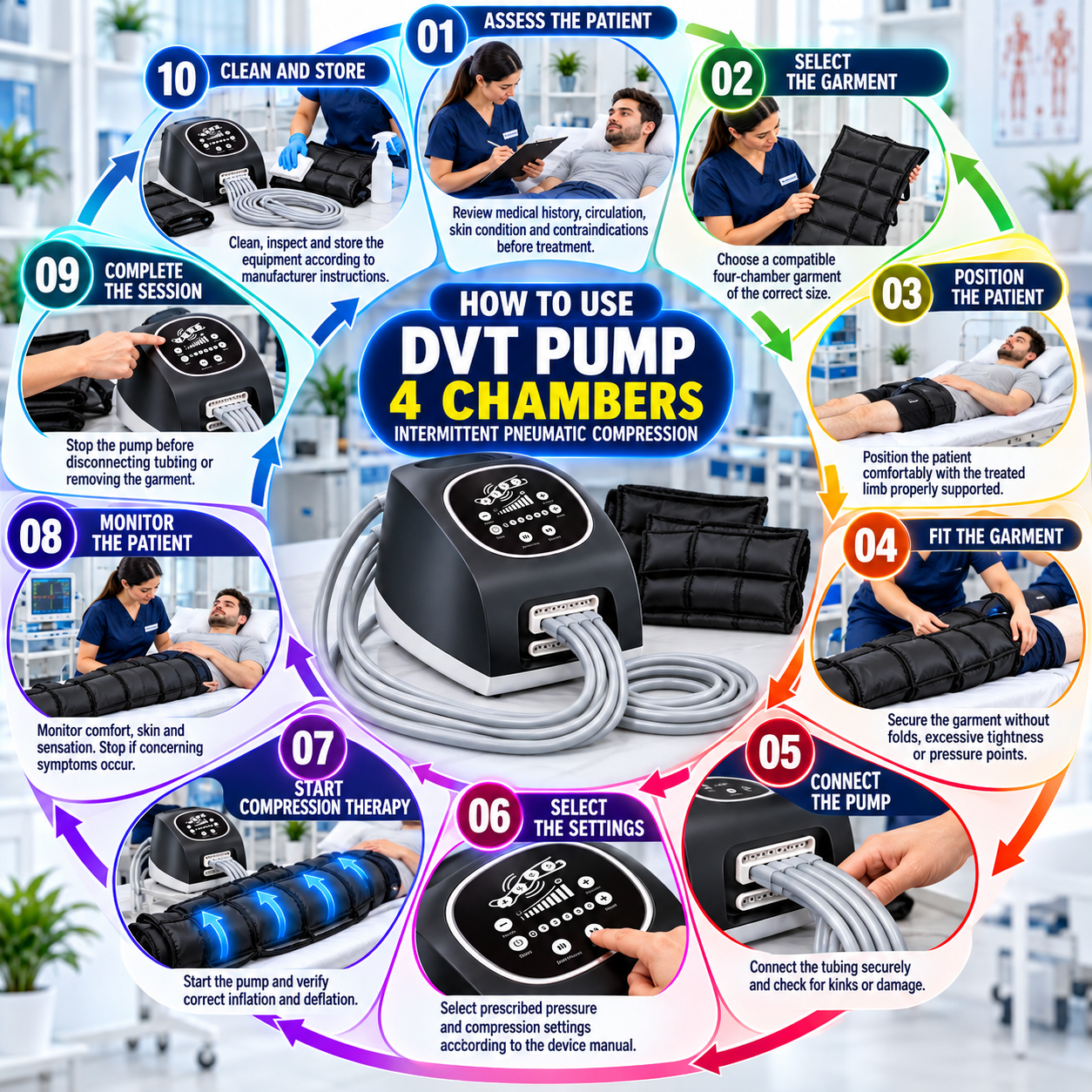
How to Use a DVT Pump 4 Chambers Compression Therapy Device
The DVT Pump 4 Chambers Compression Therapy Device should be used under the guidance of a qualified healthcare professional and according to the manufacturer’s instructions.
Step 1: Assess the Patient
Review the patient’s medical history, circulation, skin condition, mobility, and suitability for intermittent pneumatic compression. Check relevant contraindications before treatment.
Step 2: Select the Appropriate Garment
Choose a compatible four-chamber compression garment designed for the intended treatment area. Confirm the correct size and garment type for the specific device.
Step 3: Position the Patient
Place the patient in a comfortable, supported position that allows the garment to be fitted correctly and the treated limb to be assessed.
Step 4: Fit the Compression Garment
Apply the garment according to the manufacturer’s instructions. Ensure it fits correctly without inappropriate tightness, folds, or pressure points.
Step 5: Connect the Pump
Connect the garment tubing to the designated pump outlets. Check that the connections are secure and that the tubing is not kinked or damaged.
Step 6: Select the Prescribed Settings
Set the pressure, compression cycle, and other available parameters according to the prescribed clinical protocol and the device specifications. Do not use assumed settings from another machine model.
Step 7: Start Compression Therapy
Start the device and confirm that the chambers inflate and deflate as intended. Check for leakage, abnormal operation, or error indicators.
Step 8: Monitor the Patient
Monitor patient comfort, skin condition, sensation, and the treated limb throughout the session. Stop treatment and seek clinical review if unexpected pain, numbness, skin changes, or other concerning symptoms occur.
Step 9: Complete the Session
Stop the pump before disconnecting the tubing or removing the garment. Follow the treatment duration prescribed by the clinical team.
Step 10: Clean and Store the Equipment
Clean reusable garments and accessories according to the manufacturer’s instructions. Inspect the tubing, connectors, and pump before storing the device.
Safety note: Do not begin compression if acute DVT is suspected or if the patient’s suitability is uncertain until the treating clinician has assessed the situation. Always follow device-specific instructions and the prescribed treatment protocol.
Safety Precautions
Appropriate patient selection and monitoring are essential when using intermittent pneumatic compression.
- Use the device only for its intended and documented clinical purpose.
- Ensure that treatment is prescribed or supervised by an appropriately qualified professional.
- Review relevant contraindications before use.
- Seek clinical assessment if acute DVT is suspected.
- Follow the manufacturer’s guidance for patients with vascular disease or other relevant medical conditions.
- Inspect the skin before and during treatment.
- Use the correct garment size and compatible accessories.
- Avoid folds, twisting, or incorrect garment positioning.
- Check the tubing and connectors before starting the pump.
- Stop treatment if unexpected pain, numbness, skin discoloration, or other concerning symptoms occur.
- Do not use damaged garments, tubing, or pump components.
- Clean and maintain the device according to the manufacturer’s instructions.
- Do not change prescribed treatment settings without appropriate clinical guidance.
Sudden shortness of breath, chest pain, coughing up blood, or collapse may indicate a medical emergency and requires immediate emergency assessment.
Technical Specifications
The following table outlines the key specification categories for a four-chamber DVT pump. Exact values must be confirmed from the datasheet of the supplied model.
| Specification | Details |
|---|---|
| Product Name | DVT Pump 4 Chambers |
| Product Category | Compression Therapy Device |
| Technology | Intermittent Pneumatic Compression |
| Chamber Configuration | Four chambers |
| Pressure Range | Model-dependent |
| Compression Sequence | Model-dependent |
| Cycle Duration | Model-dependent |
| Operating Modes | Model-dependent |
| Compatible Garment | Four-chamber compression garment, model-dependent |
| Garment Sizes | Confirm with supplier |
| Display and Controls | Model-dependent |
| Alarm Features | Confirm manufacturer specifications |
| Power Supply | Confirm manufacturer specifications |
| Battery Operation | Confirm whether supported |
| Accessories | Confirm package configuration |
| Intended Application | As specified by the manufacturer |
| Intended Operator | Qualified healthcare professional |
| Warranty | Confirm with supplier |
Specification note: Confirm the pressure range, cycle timing, compression sequence, garment compatibility, alarm features, power requirements, accessories, and warranty before publishing fixed values.
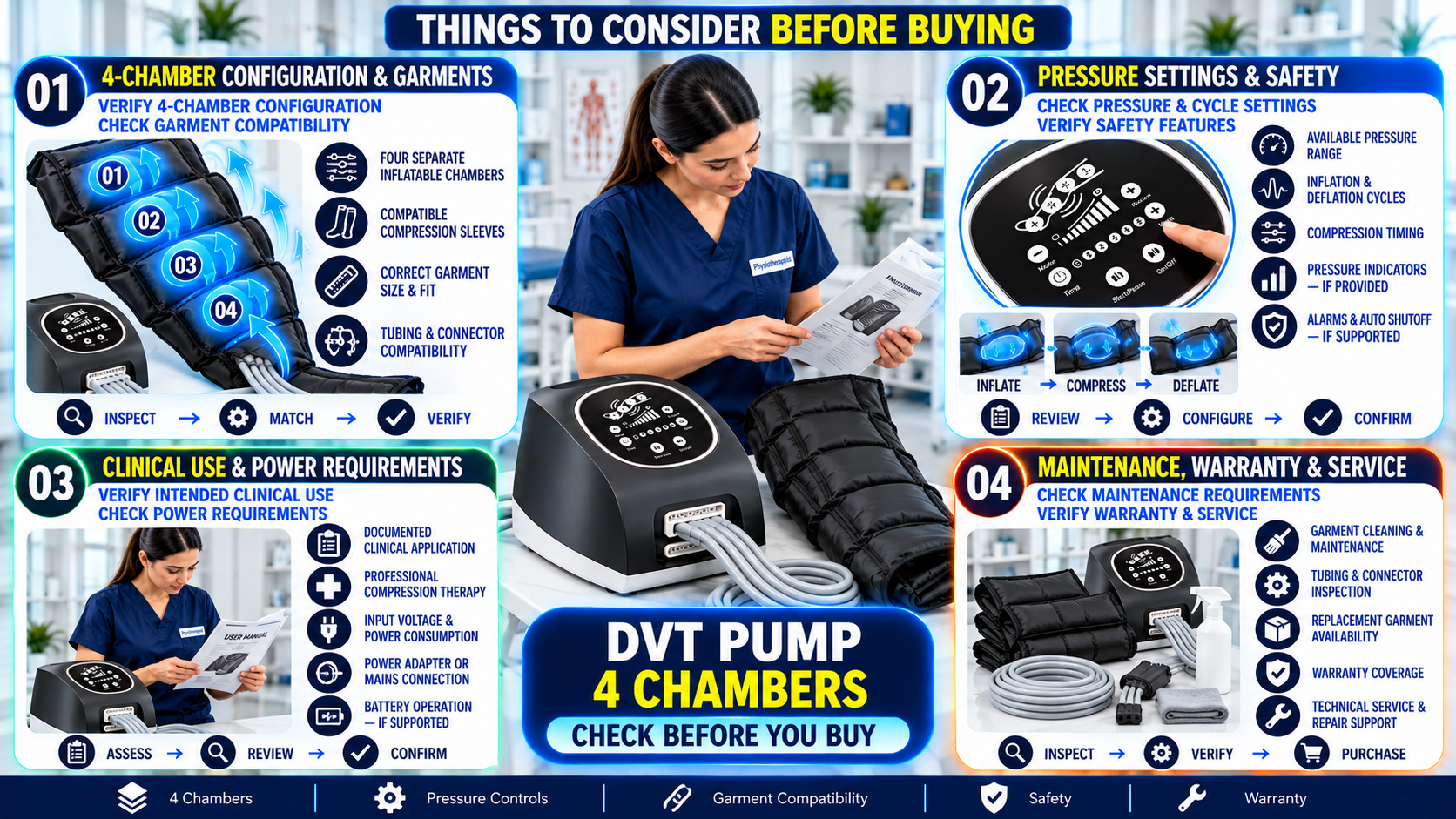
What to Consider Before Buying a DVT Pump
Four-Chamber Configuration
Confirm that the supplied pump and garment use the required four-chamber arrangement.
Pressure Range and Cycle Settings
Review the available pressure range, inflation sequence, and cycle timing. Ensure that the specifications meet the requirements of the intended clinical protocol.
Garment Compatibility
Check the garment size, chamber layout, fit, connectors, and replacement availability.
Safety and Monitoring Features
Confirm which alarms, indicators, pressure controls, or automatic shutoff functions are included in the actual model.
Intended Clinical Use
Verify that the device is documented for the application required by the healthcare facility.
Power Requirements
Check the input voltage, power consumption, and whether the device supports battery operation.
Maintenance Requirements
Review the cleaning instructions, routine inspection requirements, and availability of replacement components.
Warranty and After-Sales Support
Confirm warranty coverage, technical service, repair options, and availability of compatible garments and accessories.
Who Should Operate a DVT Pump?
A DVT pump should be used under the direction of an appropriately qualified healthcare professional who understands intermittent pneumatic compression and the patient’s clinical needs.
The responsible professional should understand:
- Patient suitability and contraindications
- Appropriate garment selection and fitting
- The device’s operating settings
- Patient monitoring
- Device-specific safety precautions
- Cleaning and maintenance requirements
- The manufacturer’s instructions
The equipment does not replace clinical assessment or the broader prevention plan prescribed for the patient.
Why Choose PHYSIOMODALITIES™?
PHYSIOMODALITIES™ provides professional physiotherapy, rehabilitation, and healthcare equipment for clinical environments.
When selecting a DVT Pump 4 Chambers Compression Therapy Device, healthcare facilities should evaluate the complete equipment configuration rather than relying only on the product name or chamber count.
Important purchasing considerations include:
- Confirmed intended use
- Four-chamber garment configuration
- Pressure and cycle specifications
- Compatible garment sizes
- Safety features
- Power requirements
- Warranty and technical support
- Availability of replacement accessories
Accurate product information and suitable technical documentation help healthcare providers make informed equipment decisions.
Conclusion
The DVT Pump 4 Chambers | Compression Therapy Device is an intermittent pneumatic compression system designed to apply controlled air pressure through a four-chamber garment. Devices of this type may form part of venous thromboembolism prevention protocols for appropriately selected patients under clinical supervision.
Before purchasing, verify the intended use, pressure range, compression sequence, cycle settings, garment compatibility, safety features, power requirements, and warranty. Correct patient selection, professional guidance, and adherence to manufacturer instructions are essential for appropriate use.
Frequently Asked Questions
1. What is a DVT Pump 4 Chambers Compression Therapy Device?
It is an intermittent pneumatic compression device that uses four inflatable chambers to apply controlled pressure through a compatible garment.
2. What is a DVT pump used for?
It may be used as part of a venous thromboembolism prevention protocol for selected patients when mechanical compression is clinically appropriate.
3. What does four-chamber compression mean?
It refers to a garment with four separate inflatable sections controlled by the pump. The inflation sequence depends on the specific device.
4. Can every patient use a DVT pump?
No. A healthcare professional must assess the patient’s condition, risk factors, and contraindications before use.
5. What should hospitals check before purchasing a DVT pump?
They should verify the intended use, pressure range, cycle settings, garment configuration, safety features, power requirements, warranty, and after-sales support.