
The Professional Chiropractic Treatment Table is designed for chiropractic clinics, physiotherapy centres, rehabilitation facilities, and manual therapy practices. It provides a stable treatment surface for professional assessments, spinal positioning, manual therapy, and selected musculoskeletal treatment procedures.
A professional chiropractic table is an important part of a well-organized treatment environment. Depending on the model, it may feature adjustable sections, a padded treatment surface, a sturdy frame, adjustable height, and specialized positioning components to support different clinical techniques.
The Professional Chiropractic Treatment Table can help healthcare professionals position patients appropriately during treatment sessions. Its exact configuration, adjustment mechanism, weight capacity, dimensions, and accessories vary by model and should be confirmed before purchase.
PHYSIOMODALITIES™ provides physiotherapy and rehabilitation equipment designed for professional clinical environments.
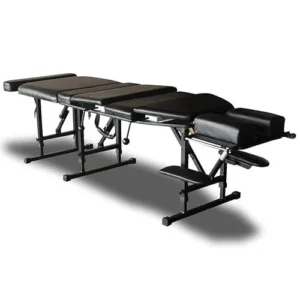
What Is a Professional Chiropractic Treatment Table?
A Professional Chiropractic Treatment Table is a treatment platform designed to support patients during chiropractic assessments, manual therapy, spinal positioning, and selected rehabilitation procedures.
Unlike a basic examination couch, a chiropractic table may include specialized features that support particular treatment techniques. Depending on its design, these may include adjustable head sections, movable body sections, height adjustment, or other positioning mechanisms.
The table should provide appropriate stability, patient comfort, and accessibility for the practitioner. The best configuration depends on the treatment methods used in the clinic and the needs of the patients being treated.
Key Features of Professional Chiropractic Treatment Table
Stable Treatment Surface
A stable treatment surface supports patient positioning during examinations and manual therapy. Frame construction and maximum load capacity should be checked in the manufacturer’s specifications.
Comfortable Padding
Suitable cushioning can improve comfort during treatment sessions. Upholstery material, padding thickness, and cleaning requirements may vary by model.
Adjustable Sections
Some chiropractic tables feature adjustable head, back, or other body sections. These adjustments can help practitioners position patients according to the treatment technique.
Height Adjustment
Depending on the model, height may be fixed or adjustable. Height-adjustable tables can help practitioners establish a more suitable working position.
Durable Frame
A robust frame is important for routine clinical use. Confirm the frame material, construction, stability, and maintenance requirements before purchasing.
Patient Positioning Support
Specialized sections and positioning components, where provided, can support different patient positions during treatment.
Professional Clinic Design
A dedicated chiropractic table can help organize treatment areas in chiropractic clinics, physiotherapy centres, rehabilitation facilities, and manual therapy practices.
Easy-Clean Upholstery
Medical-grade or clinic-suitable upholstery may simplify routine cleaning. Follow the manufacturer’s instructions for approved cleaning products and disinfection procedures.
Applications of Professional Chiropractic Treatment Table
The Professional Chiropractic Treatment Table may be used in professional settings for a variety of assessment and treatment activities.
Chiropractic Assessments
The table provides a platform for patient positioning during physical assessments and examination procedures.
Manual Therapy
Practitioners may use the table to support patient positioning during appropriate manual therapy techniques.
Spinal Positioning
A suitable treatment table can help practitioners position patients for selected spinal assessment and treatment procedures.
Musculoskeletal Rehabilitation
The table can be used during rehabilitation sessions involving selected musculoskeletal conditions, according to professional assessment.
Physiotherapy Clinics
Physiotherapists may use a chiropractic-style treatment table for appropriate examination, positioning, and manual treatment activities.
Sports Rehabilitation
Sports rehabilitation facilities may use the table for selected assessment and hands-on treatment procedures.
Orthopaedic and Rehabilitation Facilities
The table may support patient positioning during appropriate clinical examinations and rehabilitation procedures.
The suitability of a particular table depends on its design, intended use, adjustment features, and the practitioner’s clinical requirements.
Benefits of a Professional Chiropractic Treatment Table
A well-selected chiropractic table can provide practical benefits for a professional treatment environment.
- Patient positioning: Supports positioning for appropriate examination and treatment procedures.
- Practitioner access: The table’s dimensions and height can influence access to the treatment area.
- Treatment flexibility: Adjustable sections, where available, can support different clinical positions.
- Patient comfort: Suitable padding and upholstery can improve comfort during sessions.
- Clinic organization: A dedicated treatment table can help establish a consistent treatment area.
- Routine maintenance: Appropriate upholstery and construction can support regular cleaning and upkeep.
- Professional setup: A purpose-designed table can complement the equipment requirements of chiropractic and manual therapy practices.
These benefits depend on the table’s actual design, build quality, and suitability for the intended clinical workflow.
Professional Chiropractic Treatment Table for Clinics
A professional treatment table is a long-term equipment choice for clinics that regularly perform manual therapy, physical assessment, or rehabilitation procedures.
When choosing a Professional Chiropractic Treatment Table, practitioners should consider the type of techniques performed, the range of patient sizes accommodated, the available adjustment features, and the space available in the treatment room.
The table should be selected according to its intended use rather than appearance alone. Features such as height adjustment, section movement, head support, load capacity, and upholstery can affect daily usability.
A chiropractic treatment table may be used alongside other appropriate clinical equipment, including:
- Physiotherapy treatment tables
- Rehabilitation exercise equipment
- Electrotherapy equipment
- Ultrasonic Therapy equipment
- Massage therapy equipment
- Patient positioning accessories
Each piece of equipment should be appropriate for the intended procedure and used according to its manufacturer’s instructions.
Types of Chiropractic Treatment Tables
Chiropractic tables are available in different configurations. The exact features depend on the manufacturer and model.
Fixed-Height Chiropractic Table
A fixed-height table has a set working height. It may be suitable for clinics where the selected height matches the practitioner’s requirements.
Height-Adjustable Chiropractic Table
A height-adjustable table allows the working height to be changed. Adjustment may be manual, hydraulic, or electric, depending on the model.
Multi-Section Treatment Table
A multi-section table has separate sections that may be positioned independently. The number of sections and available movements vary by model.
Specialized Chiropractic Table
Some tables are designed with specialized positioning or movement mechanisms for particular chiropractic techniques. Such functions should only be described or relied upon when confirmed in the product documentation.
Technical Specifications
The following table provides a product specification framework. Confirm the exact specifications of the supplied model before publishing them as fixed values.
| Specification | Details |
|---|---|
| Product Name | Professional Chiropractic Treatment Table |
| Equipment Type | Chiropractic and Manual Therapy Table |
| Frame Material | Model-dependent |
| Treatment Surface | Padded surface, configuration-dependent |
| Upholstery | Model-dependent |
| Height Adjustment | Fixed / Manual / Hydraulic / Electric, model-dependent |
| Number of Sections | Model-dependent |
| Head Section | Model-dependent |
| Back Section Adjustment | Model-dependent |
| Maximum Load Capacity | Confirm manufacturer specification |
| Overall Dimensions | Model-dependent |
| Weight | Model-dependent |
| Colour Options | Confirm with supplier |
| Accessories | Model-dependent |
| Intended Use | Professional clinical treatment |
| Warranty | Confirm with supplier |
Important: Do not publish an assumed load capacity, table dimensions, adjustment range, number of sections, or movement mechanism. Obtain these details from the exact product datasheet.
How to Choose a Professional Chiropractic Treatment Table
Check the Intended Treatment Techniques
Choose a table designed for the clinical procedures and positioning methods used in your practice.
Review the Adjustment Mechanism
Confirm whether the table is fixed-height, manually adjustable, hydraulic, or electrically adjustable.
Check the Number of Sections
Review which sections move, their adjustment range, and whether the available movements meet your requirements.
Verify Load Capacity
Confirm the manufacturer’s rated load capacity and any restrictions on dynamic or manual-therapy loading.
Evaluate Padding and Upholstery
Check patient comfort, upholstery durability, and cleaning requirements.
Consider Table Dimensions
Ensure that the table fits the treatment room while leaving sufficient space for practitioners to move around it safely.
Check Stability and Construction
Review the frame, base design, stability, and overall construction quality.
Confirm Accessories
Ask whether head supports, cushions, positioning components, or other accessories are included or sold separately.
Review Warranty and Service
Confirm warranty coverage, repair options, spare-part availability, and after-sales support before purchasing.
How to Use a Professional Chiropractic Treatment Table
The table should be used by trained practitioners who understand the intended clinical procedure and the manufacturer’s operating instructions.
Step 1: Inspect the Table
Check the frame, upholstery, adjustment mechanisms, locking components, and any accessories before use.
Step 2: Prepare the Treatment Area
Ensure that the table is positioned securely and that there is adequate space around it.
Step 3: Adjust the Table
Set the height and movable sections, if available, according to the procedure and practitioner requirements. Lock or secure the adjustments as instructed by the manufacturer.
Step 4: Assist the Patient
Help the patient onto the table where needed. Use appropriate assistance for patients with limited mobility.
Step 5: Position the Patient
Position the patient according to the assessment or treatment protocol. Confirm comfort and stability before proceeding.
Step 6: Perform the Procedure
Carry out only procedures for which the practitioner is appropriately trained and which are compatible with the table’s intended use.
Step 7: Monitor Patient Comfort
Observe the patient’s comfort and response during the session. Reposition or stop the procedure if required.
Step 8: Assist the Patient Off the Table
Help the patient dismount safely, particularly if the table is elevated or the patient has mobility limitations.
Step 9: Clean and Inspect
Clean the treatment surface according to the manufacturer’s instructions and inspect the table regularly for wear or damage.
Safety and Maintenance Precautions
- Use the table only for its intended purpose.
- Check the manufacturer’s maximum load capacity before use.
- Inspect the frame, fasteners, hinges, locks, and adjustment mechanisms regularly.
- Ensure movable sections are securely locked before positioning the patient.
- Keep the surrounding floor clear and dry.
- Assist patients who need help getting onto or off the table.
- Do not allow patients to stand on the table unless the manufacturer explicitly permits it.
- Avoid sudden loading or movements beyond the table’s rated capabilities.
- Do not use a table with damaged structural components or faulty adjustments.
- Use only manufacturer-approved accessories.
- Clean and disinfect the upholstery with compatible products.
- Follow the manufacturer’s maintenance schedule.
- Ensure that clinical procedures are performed only by appropriately trained professionals.
Who Should Use a Professional Chiropractic Treatment Table?
A Professional Chiropractic Treatment Table is intended for use by qualified chiropractors, physiotherapists, and other appropriately trained healthcare professionals, depending on the table’s intended use and local professional requirements.
The practitioner should understand patient positioning, safe transfer techniques, table adjustments, load limitations, and the clinical procedures being performed.
A suitable table does not replace clinical judgment, professional training, or patient assessment.
Why Choose PHYSIOMODALITIES™?
PHYSIOMODALITIES™ provides physiotherapy and rehabilitation equipment for professional clinical environments.
When selecting a Professional Chiropractic Treatment Table, clinics should review the exact model configuration, construction quality, adjustment options, load capacity, dimensions, accessories, warranty, and after-sales support.
Important purchasing considerations include:
- Suitability for intended treatment techniques
- Stability and construction
- Patient comfort
- Height and section adjustments
- Cleaning and maintenance requirements
- Accessory availability
- Warranty and technical support
Selecting a table according to the needs of the clinic can help support a practical and well-organized treatment environment.
Conclusion
The Professional Chiropractic Treatment Table is designed to support patient positioning during chiropractic assessment, manual therapy, and selected rehabilitation procedures. Depending on the model, features may include padded surfaces, adjustable sections, height adjustment, and specialized positioning components.
Before purchasing, confirm the exact construction, dimensions, adjustment mechanism, number of sections, load capacity, accessories, warranty, and maintenance requirements. The table should be used according to its intended purpose and the manufacturer’s instructions by appropriately trained professionals.
Frequently Asked Questions
1. What is a Professional Chiropractic Treatment Table?
It is a treatment table designed to support patient positioning during chiropractic assessments, manual therapy, and selected rehabilitation procedures.
2. Are chiropractic treatment tables height-adjustable?
Some models are height-adjustable, while others have a fixed height. Confirm the adjustment mechanism of the specific model.
3. Can a chiropractic table be used in a physiotherapy clinic?
Yes, if the table’s design and intended use are suitable for the clinic’s procedures and patient-positioning requirements.
4. What should I check before buying a chiropractic treatment table?
Check the load capacity, dimensions, adjustment mechanism, movable sections, upholstery, accessories, warranty, and service support.
5. Who should operate a chiropractic treatment table?
Qualified chiropractors, physiotherapists, and other appropriately trained healthcare professionals should use the table according to its intended purpose and manufacturer instructions.