
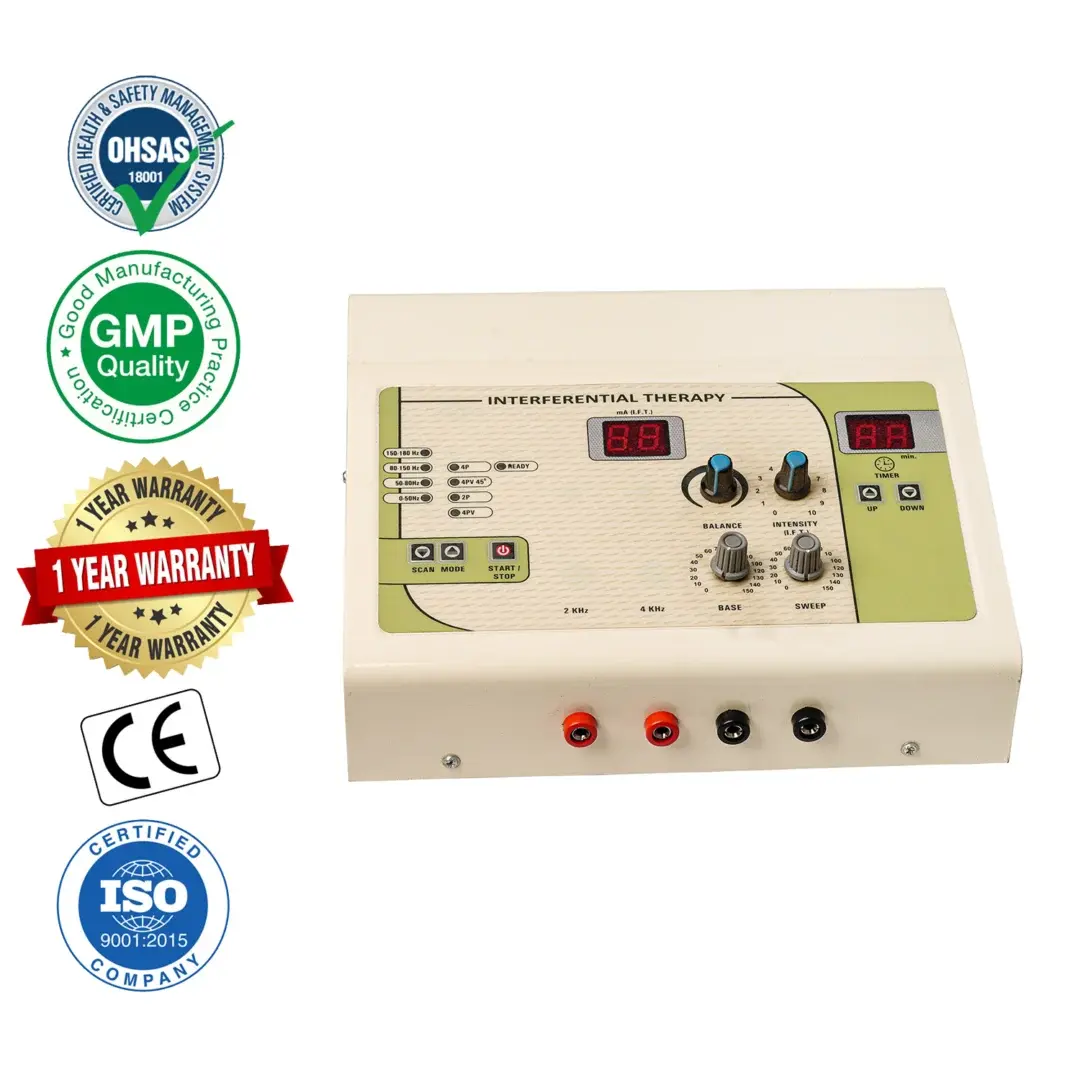
The Portable Manual IFT Physiotherapy Machine is a compact electrotherapy device designed for professional physiotherapy, rehabilitation, and selected pain-management applications. It uses Interferential Therapy (IFT), a form of electrical stimulation that delivers controlled currents through surface electrodes according to the selected treatment settings.
The portable design can be convenient for physiotherapy clinics, rehabilitation centres, sports therapy facilities, and treatment environments where compact equipment and manual parameter control are preferred. Depending on the specific model, the machine may offer adjustable intensity, treatment time, frequency settings, and other operating controls.
The Portable Manual IFT Physiotherapy Machine is intended to support professional treatment workflows by providing access to IFT through a compact unit. The exact output specifications, channel configuration, controls, and accessories should be verified against the manufacturer’s datasheet before purchase.
PHYSIOMODALITIES™ offers physiotherapy and rehabilitation equipment designed for professional clinical environments.
What Is a Portable Manual IFT Physiotherapy Machine?
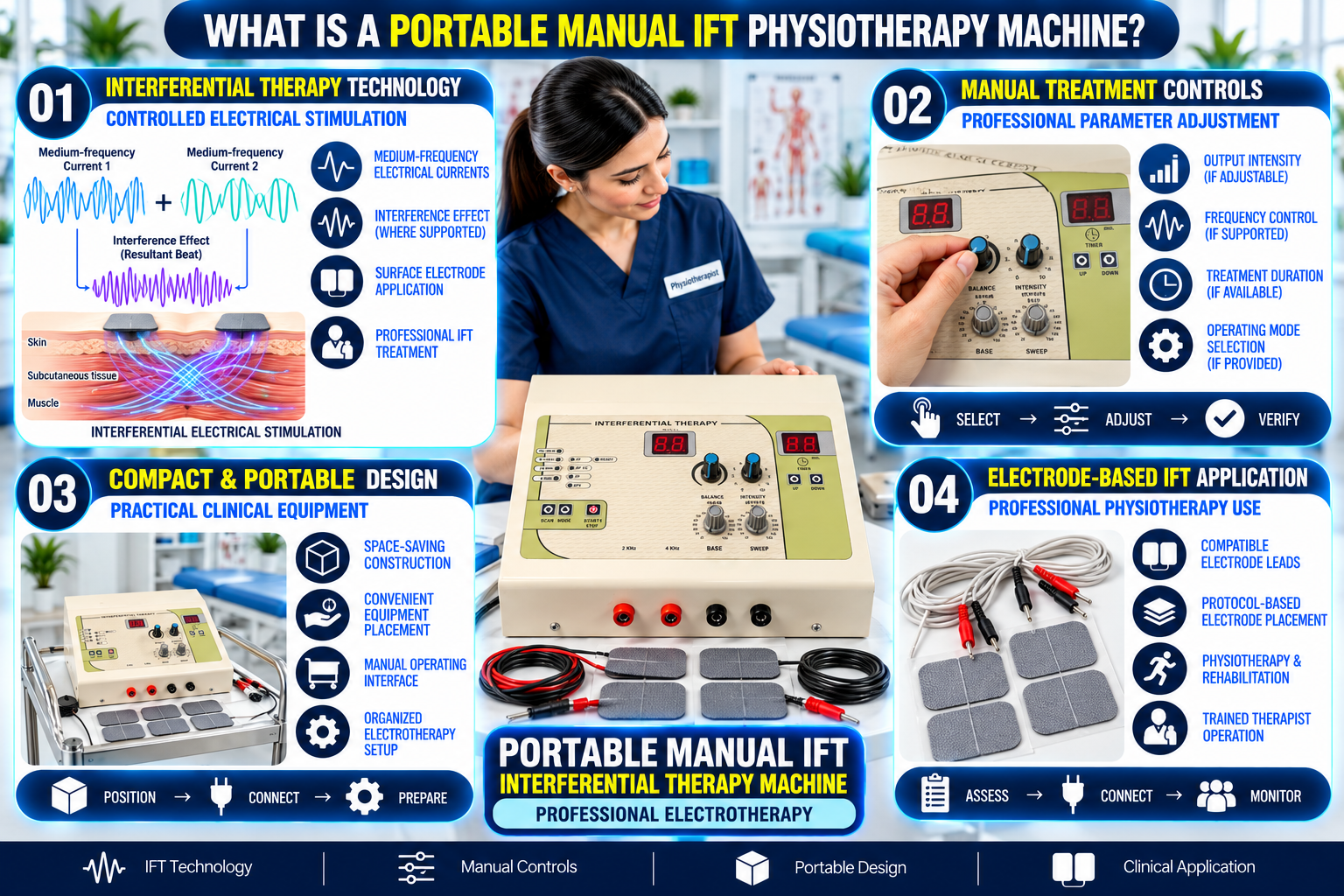
A Portable Manual IFT Physiotherapy Machine is an electrotherapy device that delivers interferential electrical currents through electrodes placed on the skin. The therapist manually selects the available treatment parameters according to the patient’s assessment and the machine’s operating instructions.
IFT is commonly incorporated into selected physiotherapy programs where electrical stimulation is considered appropriate. Treatment settings are selected according to the treatment objective, the area being treated, patient tolerance, and professional protocol.
The portable format can make the device suitable for clinics that need a compact electrotherapy unit. Manual controls allow the operator to adjust available settings rather than relying exclusively on automatic preset programs.
The exact operation depends on the machine’s design. Users should confirm the number of channels, available modes, output range, frequency controls, and electrode accessories for the specific model.
How Interferential Therapy Works
Interferential Therapy uses controlled electrical currents delivered through surface electrodes. Depending on the device configuration, intersecting currents may produce an interference effect within the treatment area.
The physiotherapist positions the electrodes according to the selected protocol and gradually adjusts the output to an appropriate level. Treatment duration and other parameters are selected based on professional assessment and manufacturer instructions.
IFT may be incorporated into selected rehabilitation plans for musculoskeletal conditions. It should not be considered a substitute for a complete assessment or an individualized rehabilitation program.
Manual Treatment Control
The manual control system allows the operator to select and adjust the parameters available on the machine. Depending on the model, these may include:
- Output intensity
- Treatment duration
- Frequency settings
- Operating mode
- Channel selection
- Other model-specific controls
Not every Portable Manual IFT Physiotherapy Machine provides all these adjustments. The actual controls should be confirmed from the product specification sheet.
Portable Design
A compact unit can be useful where treatment space is limited or equipment needs to be moved between suitable clinical areas. Portability does not remove the need for correct electrical setup, safe electrode placement, and professional supervision.
Key Features of Portable Manual IFT Physiotherapy Machine
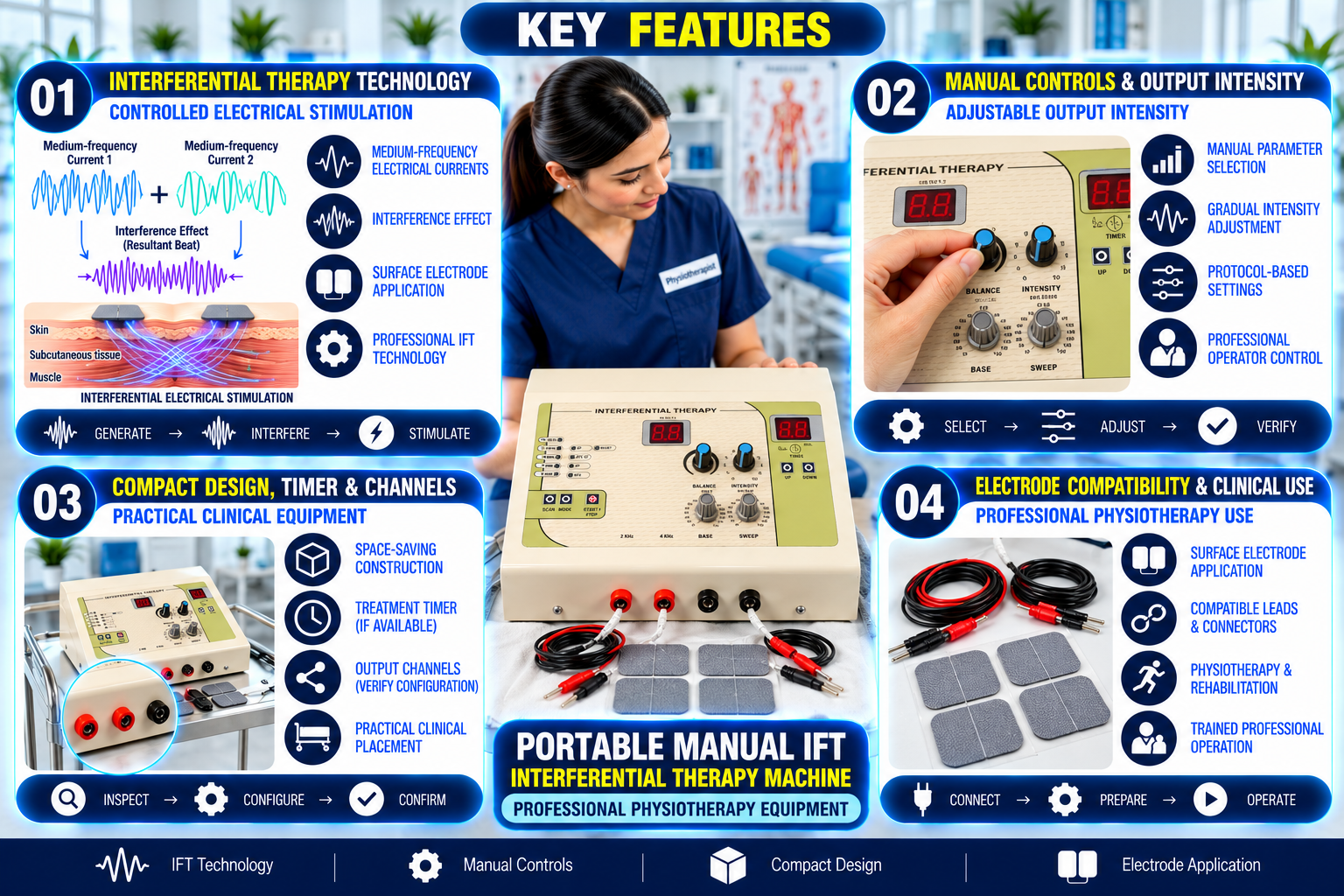
Interferential Therapy Function
The machine is designed to deliver IFT through compatible surface electrodes for selected physiotherapy applications.
Manual Parameter Adjustment
Manual controls allow trained operators to adjust available settings according to the treatment plan and the machine’s capabilities.
Compact Construction
The portable format may help clinics organize their treatment rooms and manage equipment where space is limited.
Adjustable Output Intensity
Where supported, the intensity control allows the therapist to adjust stimulation gradually according to patient tolerance and the prescribed protocol.
Treatment Timer
Some configurations include a timer to help control session duration. Confirm the timer function and available range for the exact model.
Channel Configuration
The number of output channels can vary by model. Check the manufacturer’s specifications before assuming the machine is single-channel or dual-channel.
Electrode Compatibility
The unit uses compatible electrodes and lead wires to deliver electrical stimulation. Confirm the included accessories and connector type before use.
Professional Clinical Use
The machine is intended for use by appropriately trained physiotherapists or qualified healthcare professionals who understand IFT application and contraindications.
Applications of Portable Manual IFT Physiotherapy Machine
The Portable Manual IFT Physiotherapy Machine may be incorporated into selected physiotherapy and rehabilitation programs when IFT is considered appropriate.
Musculoskeletal Rehabilitation
IFT may be used as one component of rehabilitation programs involving selected musculoskeletal conditions.
Pain-Management Programs
A physiotherapist may consider IFT as part of an individualized pain-management plan, depending on the patient’s assessment and treatment needs.
Back and Neck Rehabilitation
The modality may be incorporated into selected back or neck rehabilitation programs when clinically appropriate and when electrode placement is safe.
Shoulder and Joint Rehabilitation
IFT may be used as an adjunct in selected shoulder and joint-related physiotherapy programs.
Sports Rehabilitation
Sports physiotherapy professionals may include electrical stimulation alongside exercise, mobility work, strengthening, and other rehabilitation approaches.
General Physiotherapy Practice
The portable unit may be suitable for clinical environments where a compact IFT device is needed for routine professional use.
Important: Suitability depends on the patient’s condition, the device’s approved intended use, and professional assessment. These applications should not be interpreted as a guarantee of treatment outcomes.
Potential Benefits of a Portable Manual IFT Physiotherapy Machine
The practical value of the machine depends on its actual configuration and how it fits the clinic’s workflow.
Potential equipment advantages include:
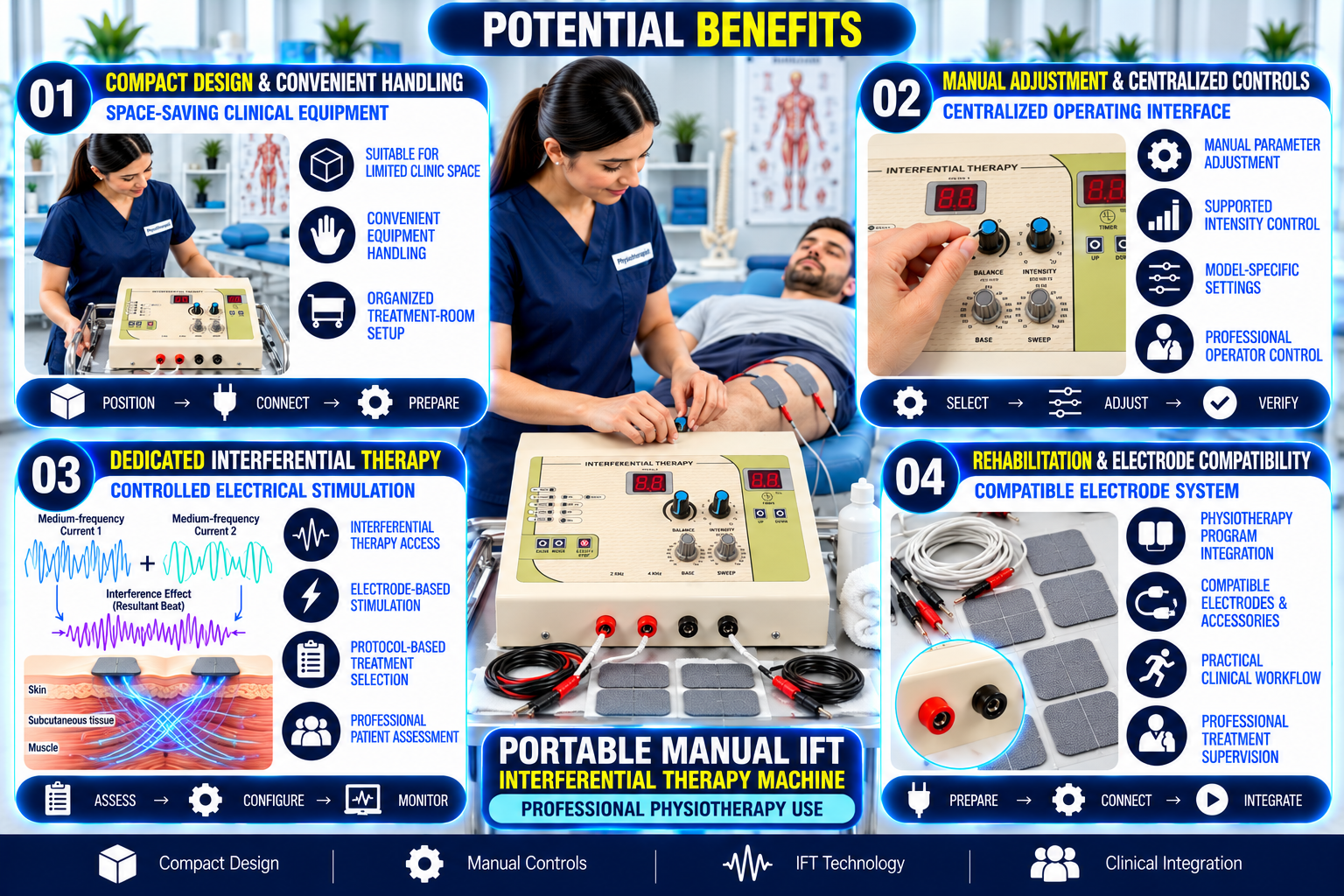
- Compact format for treatment environments with limited space
- Manual adjustment of supported treatment parameters
- Access to IFT in a dedicated unit
- Convenient equipment handling
- Integration with broader rehabilitation programs
- A centralized control interface for the available settings
- Use with compatible electrodes and accessories
The machine does not guarantee pain relief or recovery. Clinical outcomes depend on the condition, treatment protocol, patient factors, and the broader rehabilitation plan.
Portable Manual IFT Machine for Physiotherapy Clinics
A portable IFT device can be a practical addition to a physiotherapy clinic that requires a compact electrotherapy option. Before purchasing, clinics should evaluate whether the machine’s controls, channel configuration, output range, and accessories meet their intended clinical requirements.
IFT may be incorporated into a broader program that includes:
- Therapeutic exercise
- Strengthening exercises
- Mobility training
- Stretching
- Manual therapy
- Functional rehabilitation
- Other appropriate physiotherapy modalities
The selection of treatment methods should be based on patient assessment rather than the availability of a particular machine.
Technical Specifications
The following table outlines the product category. Specifications not confirmed for the exact model are marked as model-dependent.
| Specification | Details |
|---|---|
| Product Name | Portable Manual IFT Physiotherapy Machine |
| Therapy Type | Interferential Therapy (IFT) |
| Equipment Category | Electrotherapy |
| Control System | Manual |
| Design | Portable |
| Output Channels | Model-dependent |
| Intensity Control | Model-dependent |
| Frequency Settings | Model-dependent |
| Treatment Timer | Model-dependent |
| Operating Modes | Model-dependent |
| Electrodes | Confirm package configuration |
| Lead Wires | Confirm package configuration |
| Display | Model-dependent |
| Power Supply | Confirm manufacturer’s datasheet |
| Intended Application | Physiotherapy and rehabilitation |
| Intended Operator | Trained physiotherapist or qualified healthcare professional |
| Warranty | Confirm with supplier |
Specification note: Confirm the exact channel count, electrical output, frequency range, timer, power supply, included accessories, dimensions, and warranty before publishing them as fixed product specifications.
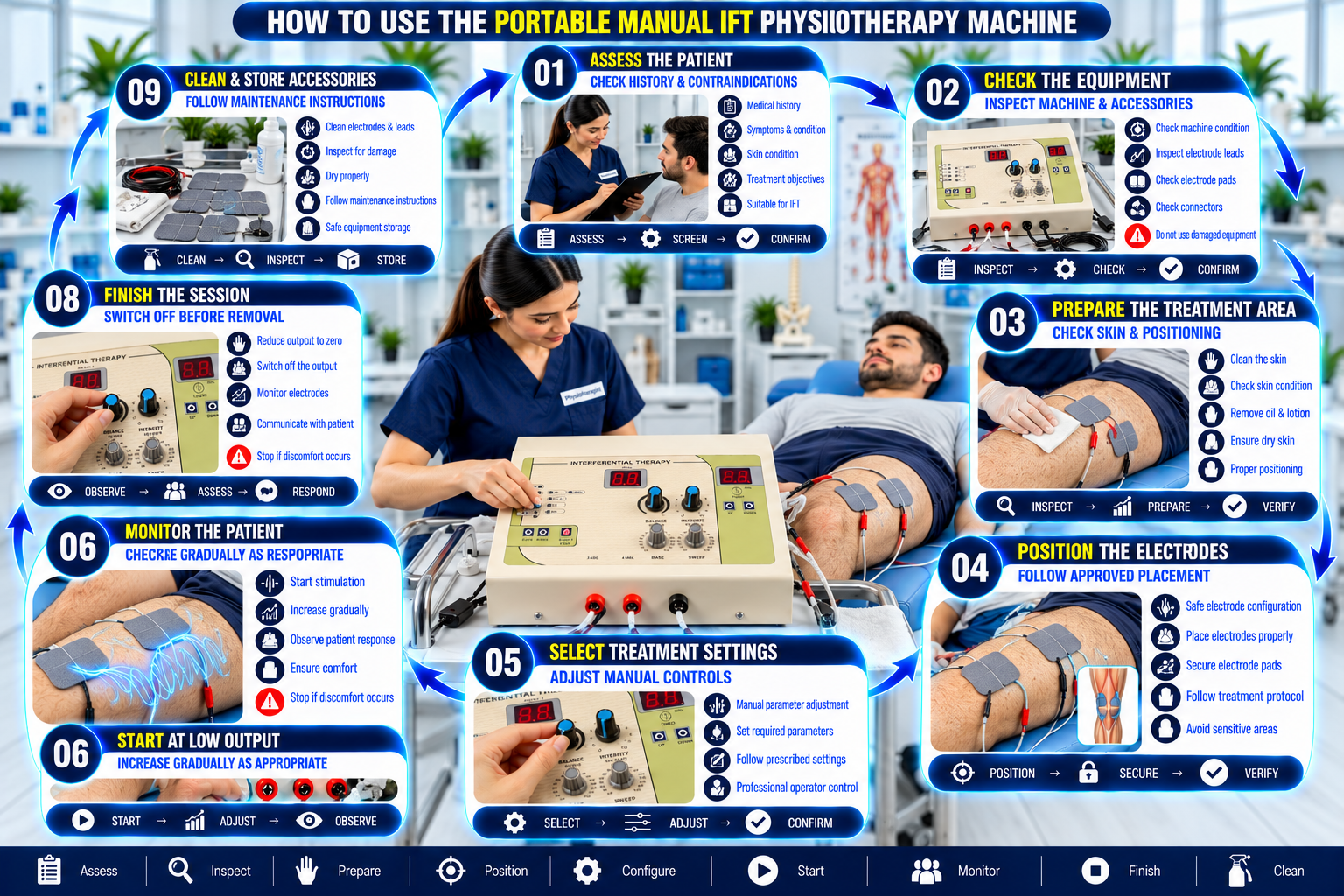
How to Use a Portable Manual IFT Physiotherapy Machine
The machine should only be operated by a trained professional who understands IFT procedures and the manufacturer’s instructions.
Step 1: Assess the Patient
Review the patient’s condition, treatment objective, relevant medical history, skin condition, and contraindications before selecting IFT.
Step 2: Check the Equipment
Inspect the machine, lead wires, connectors, and electrodes. Do not use damaged accessories or equipment.
Step 3: Prepare the Treatment Area
Prepare the skin and position the patient comfortably according to the selected treatment protocol.
Step 4: Position the Electrodes
Place the electrodes according to professional guidance and the machine’s instructions. Avoid unsafe electrode arrangements, including placements across the chest or the front of the neck.
Step 5: Select the Treatment Settings
Adjust the available manual controls according to the clinical protocol and the manufacturer’s guidance.
Step 6: Begin at an Appropriate Output
Start at a low output and increase gradually when clinically appropriate, while checking patient comfort and response.
Step 7: Monitor the Patient
Observe the patient throughout the session. Stop treatment if unusual pain, burning, excessive discomfort, skin irritation, or another concerning response occurs.
Step 8: Finish the Session
Reduce the output to zero or switch off the relevant channel before removing electrodes.
Step 9: Clean and Store the Accessories
Clean reusable electrodes and accessories according to the manufacturer’s instructions, then store the machine safely.
Safety Precautions
Follow the manufacturer’s instructions and professional clinical protocols whenever operating the Portable Manual IFT Physiotherapy Machine.
- Use the device only for its intended purpose.
- Ensure that the operator has appropriate training.
- Assess the patient before treatment.
- Follow the machine’s contraindications and electrode-placement instructions.
- Do not place electrodes across the chest or on the front of the neck.
- Obtain appropriate medical guidance for patients with implanted electronic devices.
- Use caution in areas with reduced sensation or compromised skin.
- Inspect lead wires, electrodes, and connectors before use.
- Do not operate damaged equipment.
- Do not adjust or remove electrodes while electrical output is active.
- Monitor patient comfort and skin response throughout treatment.
- Stop treatment if an unexpected reaction occurs.
- Keep the equipment away from water and excessive moisture.
- Use only the specified power supply and compatible accessories.
The exact contraindications depend on the patient’s circumstances and the manufacturer’s instructions.
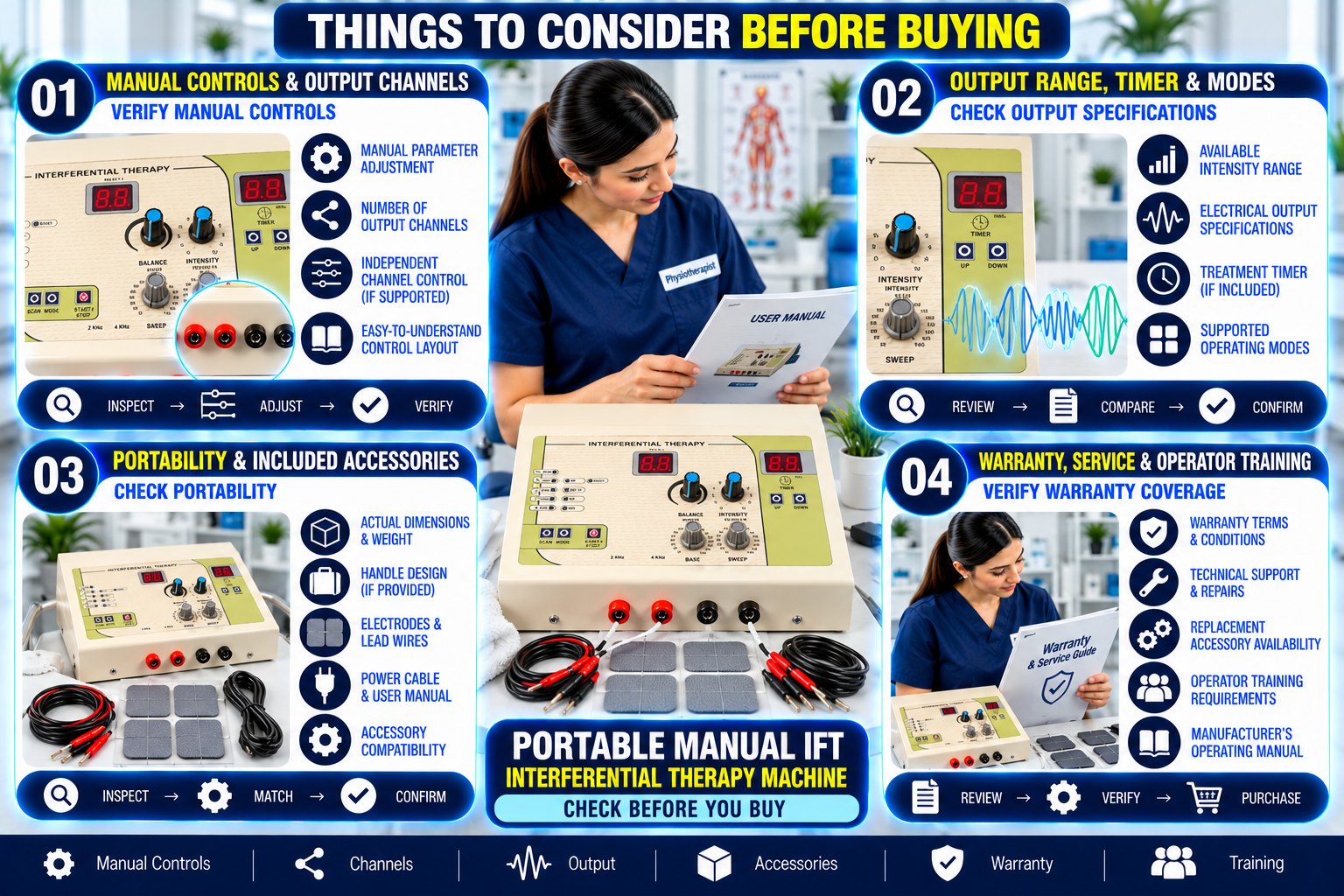
What to Consider Before Buying
Manual Controls
Check which parameters can be adjusted manually and whether the controls are straightforward for trained operators to use.
Channel Configuration
Confirm the number of channels and whether the outputs can be adjusted independently.
Output Range
Review the available intensity range and other electrical specifications in the manufacturer’s datasheet.
Timer and Modes
Confirm whether the unit includes a treatment timer and which operating modes are supported.
Portability
Consider the machine’s dimensions, weight, handle design, and suitability for your clinical setup.
Included Accessories
Ask the supplier to confirm whether the package includes electrodes, lead wires, power cable, and a user manual.
Warranty and After-Sales Service
Check the warranty terms, technical support, repair availability, and access to replacement accessories.
Operator Training
Ensure that staff understand IFT operation, electrode placement, contraindications, and safe treatment procedures.
Who Should Operate This Machine?
The Portable Manual IFT Physiotherapy Machine should be used by appropriately trained physiotherapists or qualified healthcare professionals.
The operator should understand:
- IFT principles and operation
- Patient assessment
- Electrode placement
- Manual parameter adjustment
- Contraindications
- Patient monitoring
- Equipment inspection and maintenance
- Manufacturer-specific instructions
Preset guidance or manual controls do not replace professional judgment.
Why Choose PHYSIOMODALITIES™?
PHYSIOMODALITIES™ provides physiotherapy and rehabilitation equipment for professional clinical environments.
When selecting a Portable Manual IFT Physiotherapy Machine, clinics should compare the exact model specifications, control options, channel configuration, accessories, warranty, and after-sales support.
Important considerations include:
- Suitability for the intended clinical workflow
- Available IFT settings
- Build quality
- Compatible accessories
- Power requirements
- Ease of operation
- Warranty and technical support
Choosing equipment according to the clinic’s actual requirements helps support practical equipment planning.
Conclusion
The Portable Manual IFT Physiotherapy Machine is a compact electrotherapy device designed to deliver Interferential Therapy for selected professional physiotherapy and rehabilitation applications. Its portable format and manual controls may be useful for clinics that need a dedicated IFT unit with adjustable settings.
Before purchasing, confirm the exact model, channel configuration, intensity range, frequency settings, timer, accessories, power requirements, and warranty. Safe operation depends on professional assessment, appropriate training, and compliance with manufacturer instructions.
Frequently Asked Questions
1. What is a Portable Manual IFT Physiotherapy Machine?
It is a portable electrotherapy device that delivers Interferential Therapy through compatible surface electrodes using manually selected settings.
2. What does IFT stand for?
IFT stands for Interferential Therapy, an electrical stimulation modality used in selected physiotherapy and rehabilitation programs.
3. Is this machine suitable for physiotherapy clinics?
It may be suitable for professional clinics that require a portable IFT device, provided the exact model meets their clinical and technical requirements.
4. Are the treatment settings adjustable?
The machine has manual controls, but the available intensity, frequency, timer, and channel settings should be confirmed for the exact model.
5. What should I check before buying?
Confirm the channel count, electrical output specifications, controls, timer, accessories, power supply, warranty, and after-sales support.