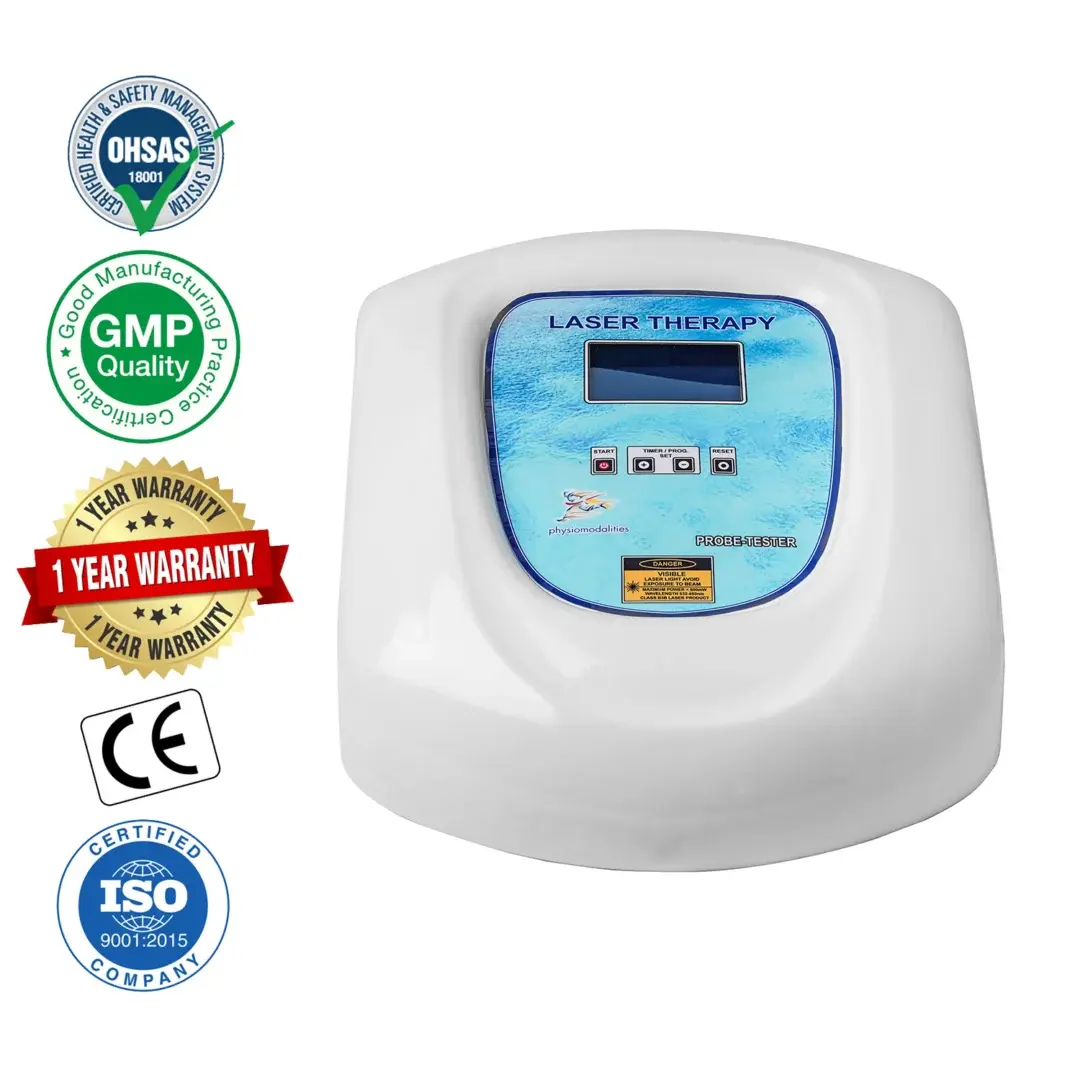
The ABS Laser Therapy Device is a professional physiotherapy and rehabilitation equipment solution designed to deliver controlled laser light for selected therapeutic applications. With a practical ABS body and a treatment-focused design, this device can be used in physiotherapy clinics, rehabilitation centres, sports therapy facilities, hospitals, and other professional healthcare environments.
Laser Therapy uses controlled light energy delivered to a selected treatment area through an appropriate applicator. Depending on the device’s wavelength, output power, operating mode, and treatment parameters, it may be incorporated into professionally supervised rehabilitation and physiotherapy protocols.
The compact ABS construction provides a practical housing for regular clinical operation while allowing the device to be integrated into treatment rooms where efficient equipment placement is important.
What Is an ABS Laser Therapy Device?
An ABS Laser Therapy Device is a physiotherapy equipment system that uses controlled laser light as part of professionally supervised therapeutic protocols.
The device delivers laser energy through an appropriate treatment applicator to the selected area. The wavelength and output characteristics determine how the light interacts with the treatment area.
Laser Therapy may be incorporated into treatment programs involving musculoskeletal rehabilitation, soft-tissue conditions, sports recovery, and other clinically appropriate applications.
The exact therapeutic application depends on the device specifications and professional assessment.
How Does Laser Therapy Work?
Laser Therapy delivers controlled light energy to the selected treatment area. Depending on the wavelength and device configuration, the emitted light can interact with biological tissues and may be incorporated into rehabilitation and therapeutic protocols.
The therapist selects the appropriate treatment parameters based on the patient’s condition, treatment area, device specifications, and clinical objectives.
Important parameters can include wavelength, output power, energy density, treatment duration, operating mode, and applicator technique. These specifications vary between laser therapy devices.
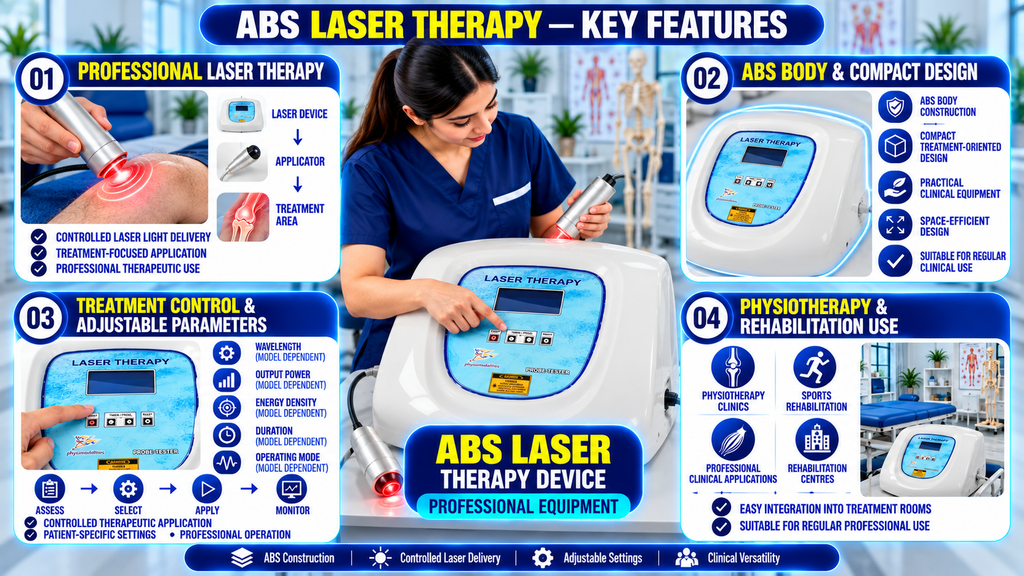
Key Features
- Professional Laser Therapy functionality
- ABS body construction
- Compact treatment-oriented design
- Controlled laser light delivery
- Suitable for physiotherapy and rehabilitation
- Useful for sports rehabilitation environments
- Suitable for professional clinical applications
- Adjustable treatment parameters, model dependent
- Treatment applicator, model dependent
- Designed for controlled therapeutic applications
- Suitable for regular clinical use
- Easy integration into physiotherapy treatment rooms
Applications of the ABS Laser Therapy Device
The ABS Laser Therapy Device can be incorporated into different professional physiotherapy and rehabilitation programs when Laser Therapy is considered appropriate.
Musculoskeletal Rehabilitation
Laser Therapy may be incorporated into selected rehabilitation programs involving muscles, joints, and surrounding soft tissues.
Sports Rehabilitation
The device can be used as part of professionally supervised sports recovery and rehabilitation protocols.
Soft-Tissue Therapy
Laser Therapy may be considered within selected treatment programs involving soft-tissue rehabilitation.
Joint-Related Physiotherapy
Depending on the device specifications and clinical assessment, Laser Therapy may be incorporated into treatment protocols involving joints and surrounding tissues.
Post-Injury Rehabilitation
The device may form part of a broader rehabilitation program following selected injuries when considered clinically appropriate.
Physiotherapy Clinics
Its compact ABS design makes it suitable for professional treatment rooms requiring dedicated Laser Therapy equipment.
Potential Benefits
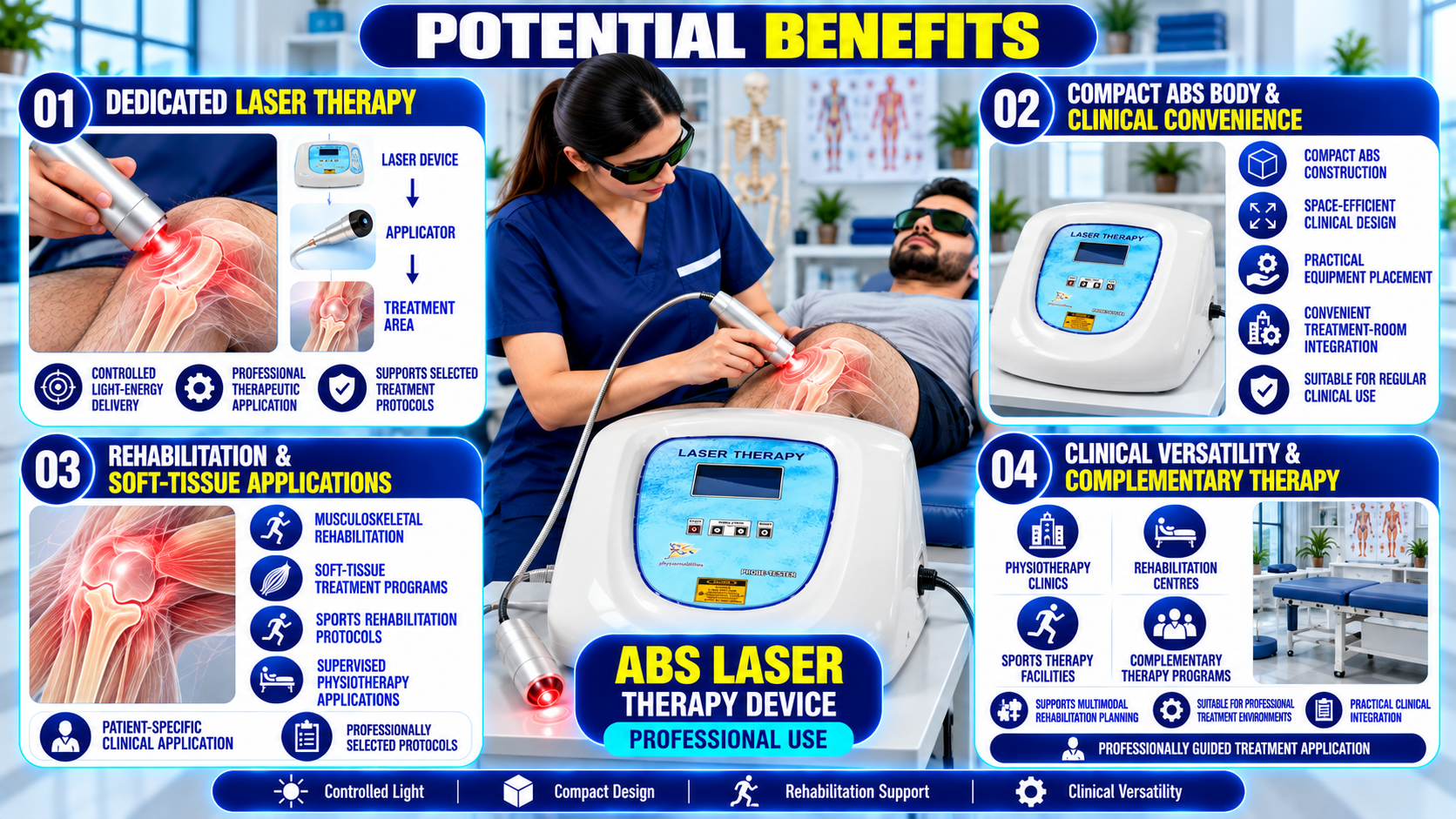
The ABS Laser Therapy Device offers several practical advantages for professional physiotherapy environments.
- Provides dedicated Laser Therapy functionality
- Compact ABS construction
- Suitable for professional clinical use
- Can be incorporated into rehabilitation programs
- Useful for selected sports rehabilitation protocols
- Suitable for soft-tissue treatment programs
- Provides controlled light-energy delivery
- Can complement other physiotherapy modalities
- Space-efficient equipment design
- Suitable for clinics and rehabilitation centres
The actual therapeutic response depends on the patient’s condition, laser specifications, treatment parameters, and professional assessment.
Laser Therapy and Physiotherapy
Laser Therapy can be incorporated into a broader physiotherapy treatment plan rather than necessarily being used as a standalone approach.
A physiotherapist may combine appropriate modalities with therapeutic exercise, manual techniques, rehabilitation exercises, or other interventions depending on the patient’s requirements.
The suitability of Laser Therapy depends on factors such as:
- Treatment objective
- Patient condition
- Treatment area
- Laser wavelength
- Output power
- Energy delivered
- Treatment duration
- Clinical assessment
Common Treatment Applications
Depending on the device specifications and professional treatment protocol, Laser Therapy may be incorporated into programs involving:
- Musculoskeletal rehabilitation
- Sports rehabilitation
- Soft-tissue rehabilitation
- Joint-related physiotherapy
- Post-injury rehabilitation
- Muscle-related treatment programs
- Localized physiotherapy applications
- Mobility-focused rehabilitation
- Rehabilitation exercise programs
- General physiotherapy treatment
The exact application should be determined by a qualified healthcare professional.
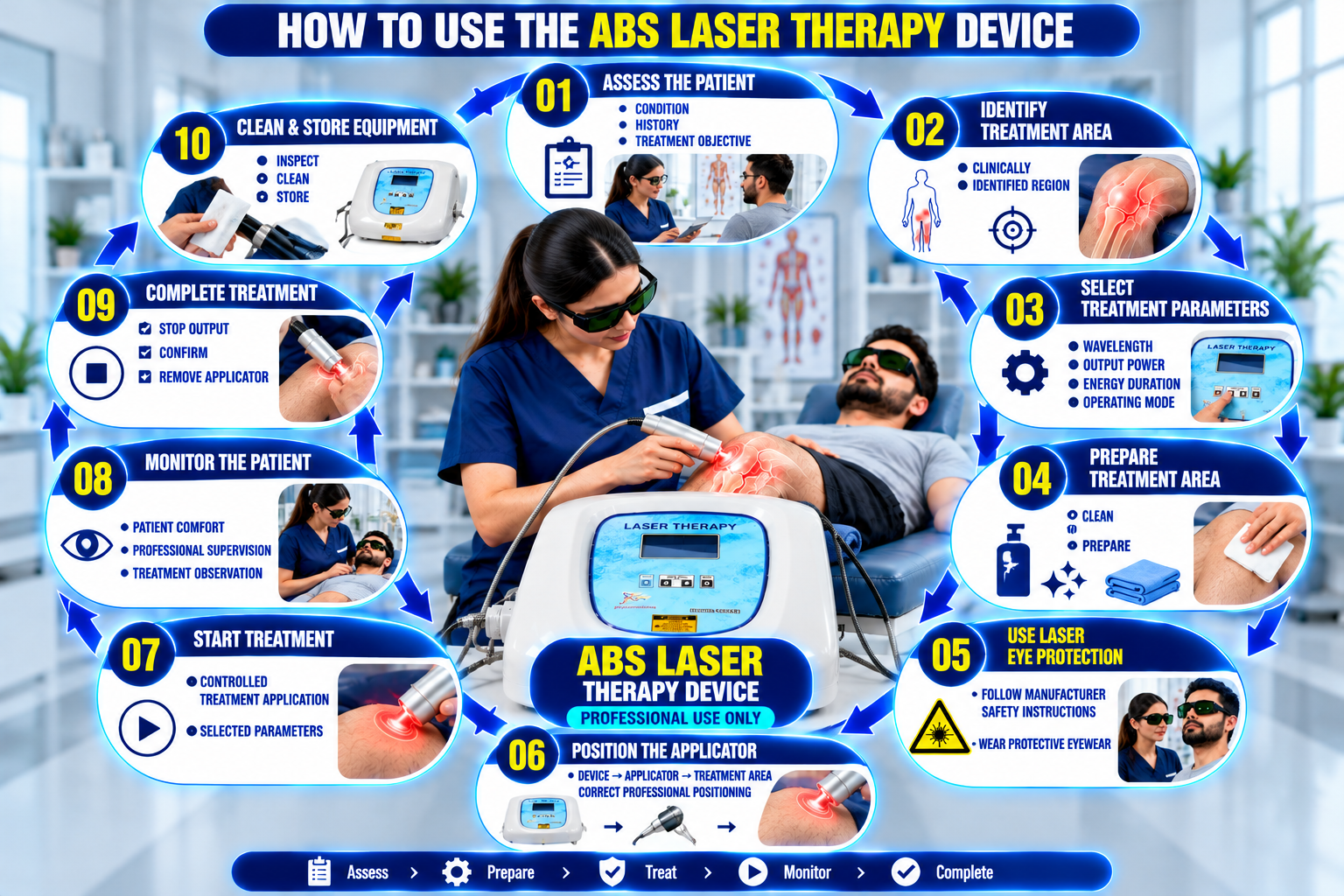
How to Use the ABS Laser Therapy Device
1. Assess the Patient
Evaluate the patient’s condition, treatment objective, medical history, and suitability for Laser Therapy.
2. Identify the Treatment Area
Determine the appropriate treatment area according to the professional treatment plan.
3. Select the Treatment Parameters
Choose the appropriate wavelength, output power, energy, treatment duration, and operating mode according to the device specifications and clinical protocol.
4. Prepare the Treatment Area
Prepare the skin and treatment area according to standard clinical practice.
5. Use Appropriate Eye Protection
Follow the manufacturer’s laser safety instructions and use appropriate protective eyewear whenever required.
6. Position the Applicator
Position the laser applicator according to the manufacturer’s instructions and selected treatment technique.
7. Start Treatment
Begin the treatment using the selected parameters.
8. Monitor the Patient
Observe patient comfort and response throughout the session.
9. Complete the Treatment
Stop the laser output according to the recommended operating procedure before removing the applicator.
10. Clean and Store the Device
Clean the applicable accessories according to manufacturer instructions and store the device safely after use.
Safety Precautions
Laser equipment should only be operated by appropriately trained professionals.
- Follow the manufacturer’s operating instructions.
- Use appropriate laser safety eyewear.
- Never look directly into the laser output.
- Avoid directing the laser toward the eyes.
- Follow the specified treatment distance and technique.
- Do not use over areas where Laser Therapy is contraindicated.
- Perform appropriate patient screening before treatment.
- Monitor patient response during treatment.
- Inspect the applicator and cable before use.
- Keep the laser output away from reflective surfaces when applicable.
- Do not allow untrained users to operate the device.
- Follow the specific safety classification and precautions of the selected laser model.
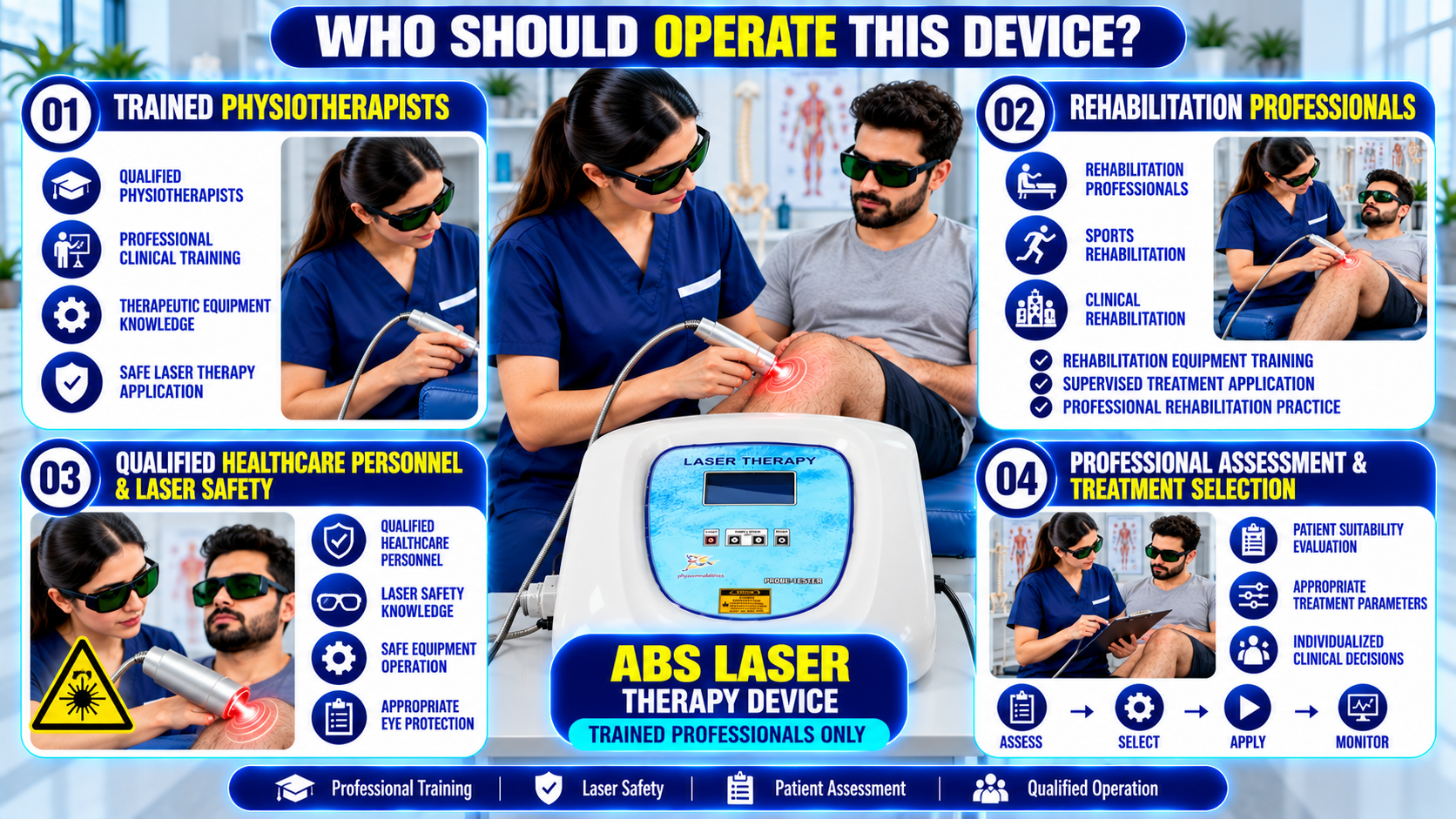
Who Should Operate This Device?
The ABS Laser Therapy Device should be operated by trained physiotherapists, rehabilitation professionals, or appropriately qualified healthcare personnel who understand laser safety and therapeutic equipment operation.
Professional assessment is essential for selecting appropriate treatment parameters and determining whether Laser Therapy is suitable for the patient.
ABS Laser Therapy Device vs Conventional Physiotherapy Equipment
| Feature | ABS Laser Therapy Device | Conventional Physiotherapy Equipment |
|---|---|---|
| Technology | Controlled laser light | Depends on modality |
| Energy Delivery | Light energy | Electrical, mechanical, thermal, etc. |
| Treatment Type | Laser-based therapy | Modality dependent |
| ABS Construction | Yes | Model dependent |
| Professional Operation | Required | Depends on equipment |
| Rehabilitation Use | Yes | Yes |
| Treatment Parameters | Model dependent | Equipment dependent |
Laser Therapy and other physiotherapy modalities serve different purposes and should be selected according to patient assessment and clinical treatment objectives.
Technical Specifications
| Specification | Details |
|---|---|
| Product Name | ABS Laser Therapy Device |
| Therapy | Laser Therapy |
| Body Material | ABS |
| Technology | Controlled Laser Light |
| Applicator | Model dependent |
| Wavelength | Model dependent |
| Output Power | Model dependent |
| Operating Modes | Model dependent |
| Treatment Timer | Model dependent |
| Energy Settings | Model dependent |
| Applications | Physiotherapy & Rehabilitation |
| Usage | Professional Clinical Use |
| Brand | PHYSIOMODALITIES™ |
Exact wavelength, laser class, output power, energy density, treatment modes, applicator type, dimensions, power supply, accessories, and other technical specifications may vary according to the selected model. Confirm the manufacturer’s technical specification sheet before purchase.
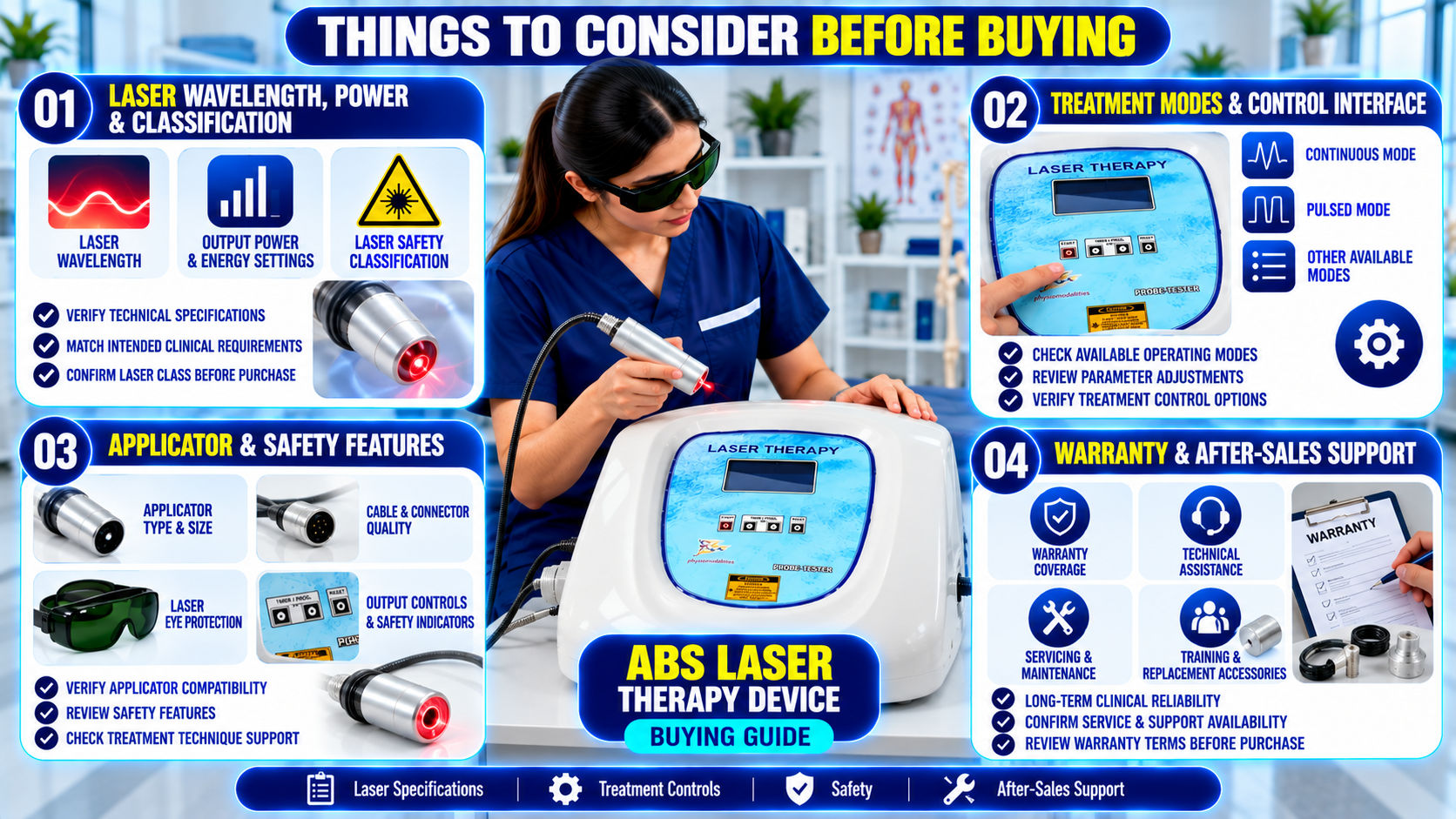
Things to Consider Before Buying
Check the Laser Wavelength
The wavelength is an important specification because it influences how the laser light interacts with tissue. Confirm the exact wavelength before purchasing.
Review Output Power
Check the device’s output power and available energy settings to ensure they meet the intended clinical requirements.
Check Laser Classification
Review the laser safety classification and ensure the equipment is operated according to the applicable safety requirements.
Review Treatment Modes
Check whether the device offers continuous, pulsed, or other operating modes, if required for your intended applications.
Check the Applicator
Review the applicator type, size, cable, and treatment technique supported by the device.
Consider Safety Features
Eye protection, output controls, treatment timers, warning indicators, and other safety features should be reviewed before purchase.
Consider Warranty & After-Sales Support
Warranty coverage, technical assistance, servicing, training, and replacement accessories are important considerations for long-term clinical use.
Why Choose PHYSIOMODALITIES™?
PHYSIOMODALITIES™ provides professional physiotherapy and rehabilitation equipment designed for modern clinical environments.
The ABS Laser Therapy Device provides a dedicated Laser Therapy solution with a practical ABS housing and a compact design suitable for professional treatment settings.
PHYSIOMODALITIES ENTERPRISES focuses on practical clinical equipment for physiotherapy clinics, rehabilitation centres, hospitals, sports therapy facilities, and other professional healthcare environments.
Conclusion
The ABS Laser Therapy Device is a professional physiotherapy equipment solution designed to provide controlled laser light for selected therapeutic and rehabilitation applications.
Its ABS construction and compact treatment-oriented design make it a practical option for clinics and rehabilitation facilities requiring dedicated Laser Therapy equipment. The appropriate wavelength, power, treatment duration, and operating technique should always be selected according to the device specifications and professional clinical assessment.
Frequently Asked Questions
1. What is an ABS Laser Therapy Device?
It is a professional physiotherapy device that delivers controlled laser light for selected therapeutic and rehabilitation applications.
2. What is Laser Therapy used for?
Laser Therapy may be incorporated into selected physiotherapy, musculoskeletal, soft-tissue, sports rehabilitation, and post-injury treatment programs.
3. Is eye protection required during Laser Therapy?
Appropriate eye protection should be used according to the laser’s safety classification and manufacturer’s instructions.
4. Who can operate a Laser Therapy Device?
It should be operated by trained physiotherapists, rehabilitation professionals, or appropriately qualified healthcare personnel.
5. What should be checked before buying a Laser Therapy Device?
Check the wavelength, laser classification, output power, operating modes, applicator, safety features, treatment timer, warranty, and technical specifications.