
The Elbow Shoulder Wheel is a physiotherapy and rehabilitation exercise device designed to support controlled movement of the shoulder and upper limb. It is commonly used for shoulder mobility, elbow movement, range-of-motion exercises, coordination training, and progressive upper-limb rehabilitation.
The wheel mechanism provides a circular movement pattern that allows patients to perform repetitive exercises in a controlled manner. Depending on the equipment configuration, the wheel may include adjustable height, resistance, or positioning features to accommodate different patients and therapy requirements.
For physiotherapy clinics, orthopedic rehabilitation centres, hospitals, sports rehabilitation facilities, and occupational therapy departments, an Elbow Shoulder Wheel can provide a practical solution for structured upper-limb exercise.
PHYSIOMODALITIES™ provides physiotherapy and rehabilitation equipment designed for professional clinical environments.
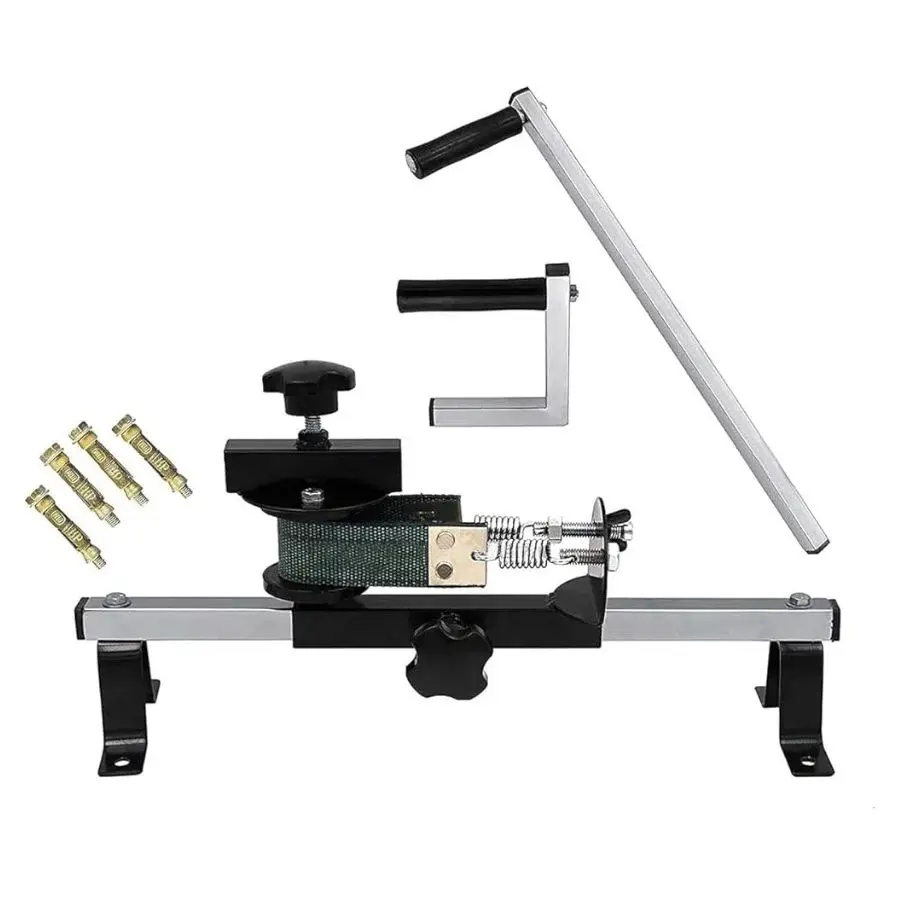
What Is an Elbow Shoulder Wheel?
An Elbow Shoulder Wheel is a manually operated rehabilitation device consisting of a rotating wheel with a hand grip. The patient holds the handle and moves the wheel through a circular motion to perform controlled shoulder and upper-limb exercises.
The equipment can be incorporated into rehabilitation programs involving:
- Shoulder mobility
- Shoulder range-of-motion exercises
- Elbow movement
- Forearm coordination
- Upper-limb strengthening
- Controlled rotational exercises
- Functional movement training
- Post-injury rehabilitation
- Sports rehabilitation
The exact wheel size, frame construction, mounting arrangement, resistance mechanism, and adjustment options depend on the selected model.
How Does an Elbow Shoulder Wheel Work?
The wheel provides a continuous circular movement path. The patient holds the handle and rotates the wheel using the affected or recovering upper limb.
Depending on the exercise position, the movement may involve the shoulder, elbow, forearm, wrist, and hand.
A therapist can modify the exercise by changing:
- Patient position
- Wheel height
- Movement direction
- Exercise duration
- Number of repetitions
- Resistance, where available
- Range of movement
The movement should remain controlled and within the range appropriate for the individual’s rehabilitation program.
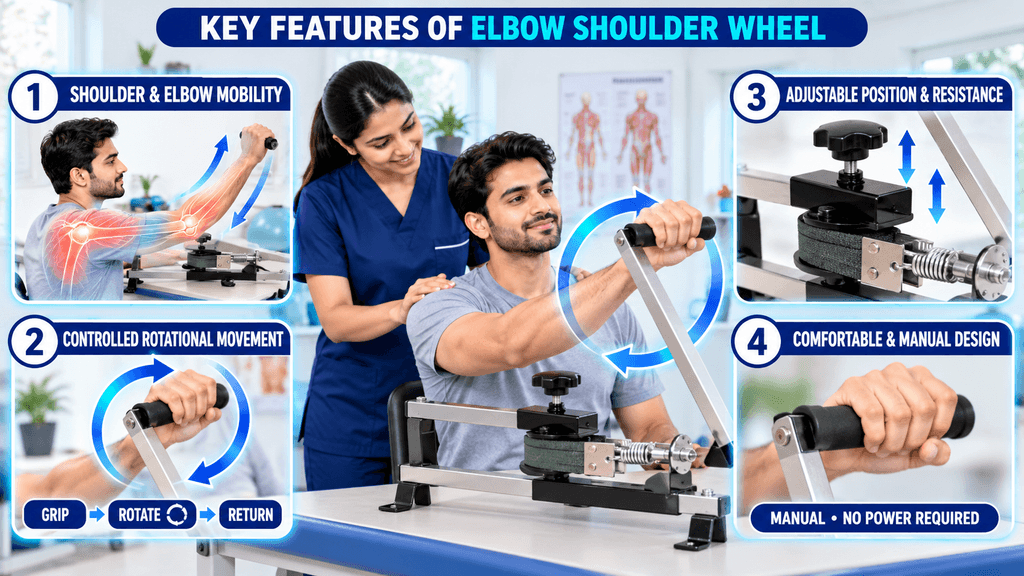
Key Features of Elbow Shoulder Wheel
Rotational Exercise Mechanism
The rotating wheel provides a consistent circular movement pattern for upper-limb rehabilitation.
Shoulder Mobility Training
It can be incorporated into controlled shoulder movement and range-of-motion exercises.
Elbow Movement
The equipment can support selected exercises involving coordinated elbow movement.
Adjustable Positioning
Depending on the model, the wheel may provide height or positional adjustments for different users.
Resistance Adjustment
Some models may include adjustable resistance for progressive strengthening exercises.
Comfortable Hand Grip
The handle provides a stable gripping point during repetitive rotational movements.
Manual Operation
The equipment normally operates mechanically without electricity.
Compact Design
Its relatively simple construction makes it suitable for many physiotherapy and rehabilitation environments.
Applications of Elbow Shoulder Wheel
The Elbow Shoulder Wheel can be incorporated into several rehabilitation and exercise programs.
Shoulder Rehabilitation
The wheel can be used for controlled shoulder mobility and range-of-motion activities.
Elbow Rehabilitation
Selected exercises can involve elbow movement and coordination as part of an upper-limb rehabilitation program.
Forearm and Wrist Coordination
Depending on the movement pattern, the equipment can also involve forearm and wrist control.
Post-Injury Rehabilitation
Appropriate wheel exercises may be introduced during rehabilitation following selected upper-limb injuries.
Post-Operative Rehabilitation
When cleared by the treating professional, controlled movement may be incorporated at the appropriate stage of rehabilitation.
Sports Rehabilitation
Athletes recovering from shoulder or upper-limb problems may use the equipment as part of a supervised rehabilitation program.
Occupational Therapy
The circular movement can be incorporated into upper-limb coordination and functional exercise activities.
General Upper-Limb Exercise
The equipment can also be used for controlled movement and conditioning programs.
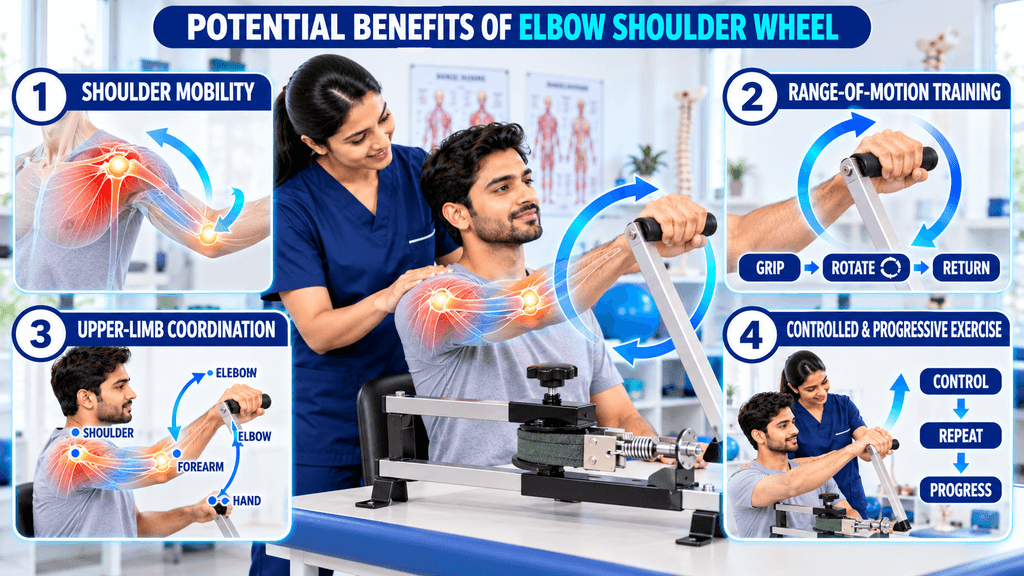
Potential Benefits
The potential benefits of an Elbow Shoulder Wheel depend on the patient’s condition, exercise technique, movement range, and rehabilitation program.
Supports Shoulder Mobility
Controlled circular movement can be incorporated into programs focused on shoulder mobility.
Supports Range-of-Motion Training
The wheel provides a repeatable movement path for selected upper-limb range-of-motion exercises.
Encourages Controlled Movement
The fixed rotational path can help patients practice slow and coordinated movement.
Supports Upper-Limb Coordination
Repeated wheel movements require coordination between the hand, wrist, forearm, elbow, and shoulder.
Allows Progressive Exercise
Where resistance or positioning adjustments are available, exercise difficulty can be modified as appropriate.
Useful for Functional Rehabilitation
Upper-limb rotational movement can relate to everyday activities involving reaching, turning, handling, and manipulation.
Simple Clinical Setup
The mechanical design provides a straightforward exercise option for physiotherapy and rehabilitation settings.
Common Elbow Shoulder Wheel Exercises
| Exercise | Primary Focus |
|---|---|
| Forward rotation | Shoulder and upper-limb mobility |
| Reverse rotation | Controlled movement |
| Slow circular rotation | Coordination |
| Assisted rotation | Mobility training |
| Progressive resistance rotation | Strength development |
| Short-range rotation | Controlled movement |
| Full-range rotation | Mobility progression |
| Repeated circular movement | Movement endurance |
The therapist should determine the appropriate movement, range, resistance, and repetitions according to the patient’s requirements.
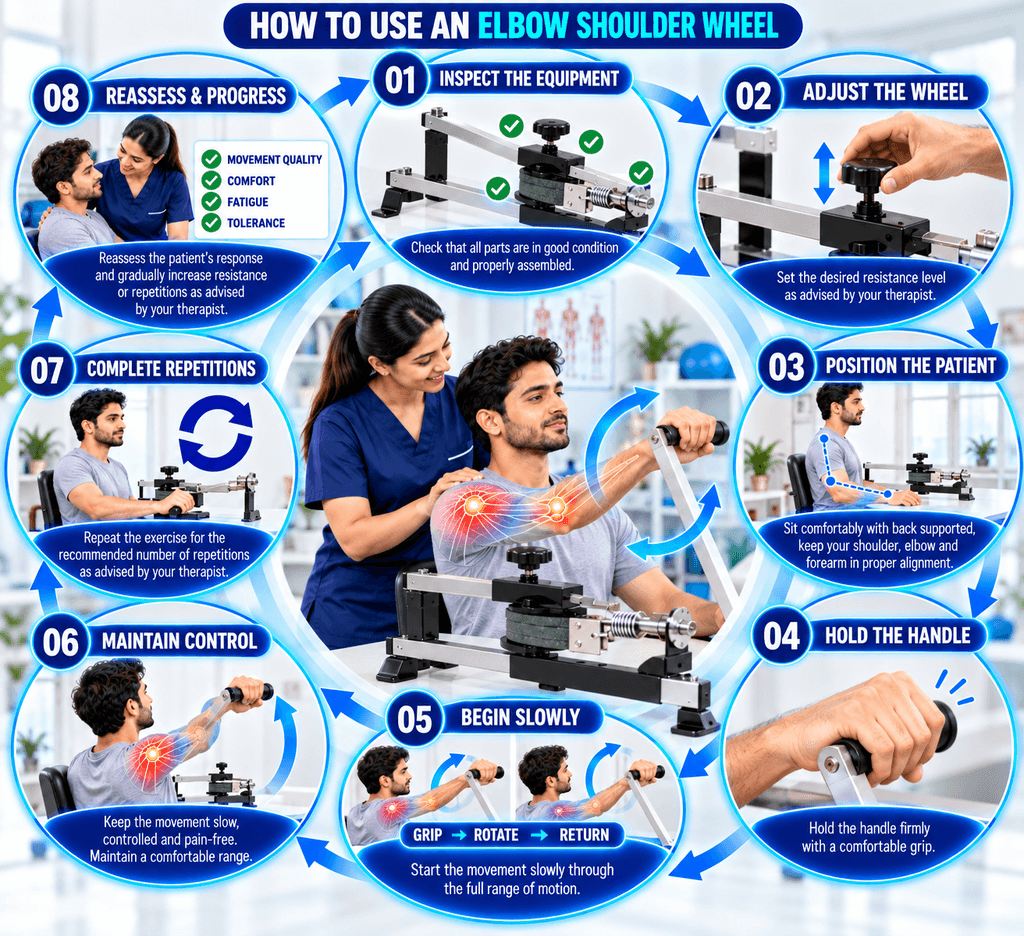
How to Use an Elbow Shoulder Wheel
Step 1: Inspect the Equipment
Check the wheel, handle, frame, mounting points, and resistance mechanism before use.
Step 2: Adjust the Wheel
If the model provides height or positioning adjustment, set it according to the patient’s requirements.
Step 3: Position the Patient
Seat or stand the patient comfortably in the position recommended for the selected exercise.
Step 4: Hold the Handle
The patient should grip the handle securely without excessive force.
Step 5: Begin Slowly
Start rotating the wheel through a comfortable range of movement.
Step 6: Maintain Controlled Movement
Avoid sudden or jerky movements. Maintain a steady pace throughout the exercise.
Step 7: Complete the Prescribed Repetitions
Perform the required repetitions or exercise duration according to the rehabilitation program.
Step 8: Reassess
The therapist should monitor movement quality, comfort, fatigue, and tolerance before progressing the exercise.
Safety Precautions
- Inspect the equipment before every session.
- Ensure the frame and mounting system are secure.
- Start with gentle movement when appropriate.
- Do not force the shoulder or elbow beyond the prescribed range.
- Avoid sudden or jerky rotational movements.
- Do not apply excessive resistance.
- Stop the exercise if significant pain or discomfort develops.
- Follow any post-operative movement restrictions.
- Use the equipment under professional supervision when required.
- Keep fingers away from moving mechanical components.
- Check the handle and wheel mechanism regularly.
- Follow the manufacturer’s maintenance instructions.
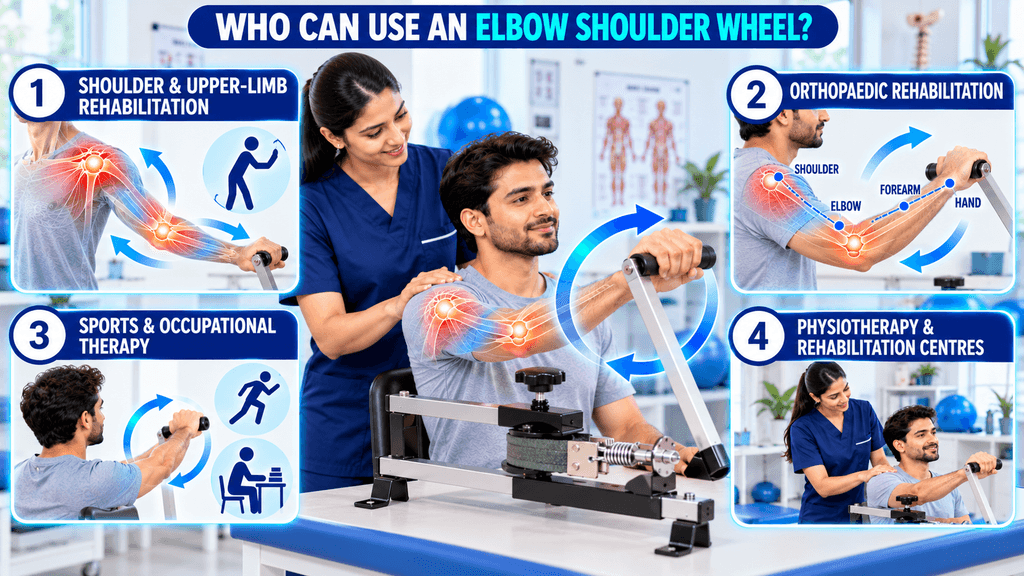
Who Can Use an Elbow Shoulder Wheel?
An Elbow Shoulder Wheel may be used in:
- Physiotherapy clinics
- Orthopedic rehabilitation centres
- Sports rehabilitation clinics
- Hospitals
- Occupational therapy departments
- Upper-limb rehabilitation centres
- Pediatric therapy centres
- Neurological rehabilitation facilities
- Physiotherapy teaching institutions
The suitability of a specific exercise should be determined by a qualified physiotherapist or rehabilitation professional.
Elbow Shoulder Wheel vs Shoulder T-Pulley
| Feature | Elbow Shoulder Wheel | Shoulder T-Pulley |
|---|---|---|
| Main movement | Circular rotation | Assisted pulling |
| Shoulder mobility | Yes | Yes |
| Elbow involvement | Can be incorporated | Usually secondary |
| Movement pattern | Circular | Linear/alternating |
| Assistance | Active or resistance-based | Pulley-assisted |
| Resistance | Model dependent | Generally mechanical/assisted |
| Exercise focus | Upper-limb mobility and coordination | Shoulder range-of-motion |
| Operation | Manual | Manual |
Both devices can be useful in rehabilitation, but they provide different movement patterns and exercise methods.
Technical Specifications
| Specification | Details |
|---|---|
| Product Name | Elbow Shoulder Wheel |
| Equipment Type | Upper-Limb Rehabilitation Equipment |
| Primary Application | Shoulder & Elbow Exercise |
| Exercise Mechanism | Rotational Wheel |
| Operation | Manual |
| Wheel | Model dependent |
| Handle | Ergonomic grip, model dependent |
| Resistance | Model dependent |
| Resistance Adjustment | Model dependent |
| Height Adjustment | Model dependent |
| Mounting | Model dependent |
| Power Requirement | None |
| Target Areas | Shoulder, Elbow, Forearm & Wrist |
| Suitable Environment | Physiotherapy & Rehabilitation Clinics |
| Patient Capacity | Model dependent |
| Manufacturer | PHYSIOMODALITIES™ |
Exact dimensions, wheel diameter, resistance range, materials, mounting configuration, and adjustment options should be confirmed for the specific model.
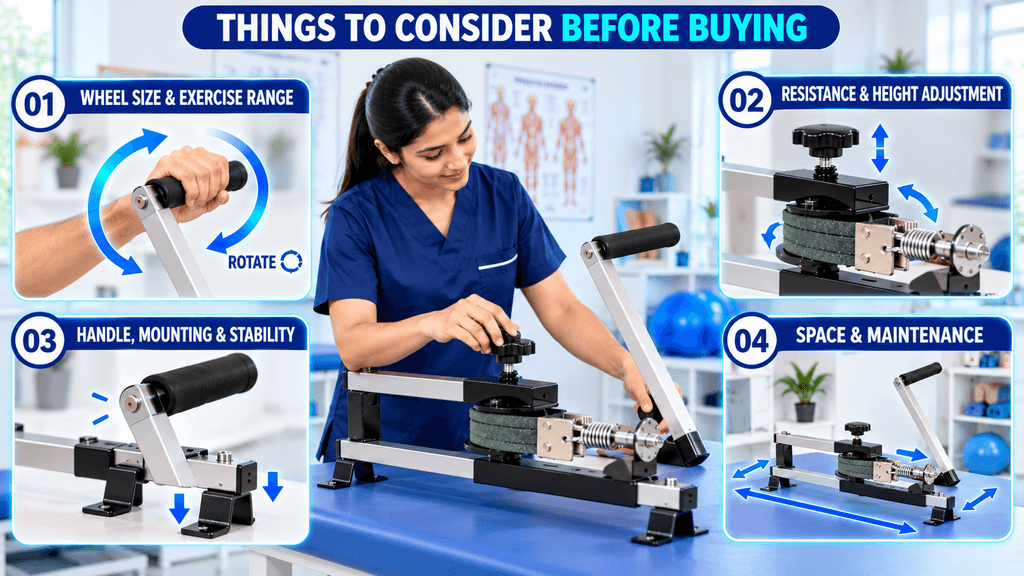
Things to Consider Before Buying
Wheel Size
Consider the wheel diameter and movement range required for the intended rehabilitation exercises.
Mounting Arrangement
Check whether the model is wall-mounted, stand-mounted, or supplied with another installation configuration.
Resistance
If progressive strengthening is required, verify whether the wheel provides adjustable resistance.
Handle Design
A comfortable handle can improve control during repeated rotational movements.
Height Adjustment
Adjustable height can make the equipment more versatile for different patients.
Frame Stability
For clinical use, the equipment should provide adequate stability during exercise.
Available Space
Measure the intended installation area before purchasing.
Maintenance
Regularly inspect the wheel, handle, mounting hardware, and resistance mechanism.
Why Choose PHYSIOMODALITIES™?
PHYSIOMODALITIES™ provides physiotherapy and rehabilitation equipment for professional clinical environments.
The Elbow Shoulder Wheel can be incorporated into shoulder rehabilitation, elbow mobility training, upper-limb coordination, sports rehabilitation, and occupational therapy programs.
Its simple mechanical design gives therapists a practical option for controlled rotational exercise while allowing movement and progression to be adapted to individual patient requirements.
Conclusion
The Elbow Shoulder Wheel is a practical rehabilitation device for controlled rotational movement of the shoulder and upper limb. Depending on the exercise position, it can also involve the elbow, forearm, wrist, and hand.
Its circular movement pattern can be incorporated into mobility, range-of-motion, coordination, and progressive upper-limb exercise programs. The equipment is suitable for physiotherapy and rehabilitation environments where structured manual exercise is required.
The appropriate exercise intensity, movement range, repetitions, and progression should always be selected according to the individual’s condition and professional rehabilitation assessment.
Frequently Asked Questions
1. What is an Elbow Shoulder Wheel?
An Elbow Shoulder Wheel is a manual rehabilitation device with a rotating wheel used for controlled shoulder and upper-limb exercises.
2. What exercises can be performed with an Elbow Shoulder Wheel?
It can be used for forward and reverse rotation, shoulder mobility, range-of-motion exercises, coordination, and selected strengthening activities.
3. Can an Elbow Shoulder Wheel be used for elbow rehabilitation?
Yes. Depending on the exercise position, it can be incorporated into selected elbow and upper-limb rehabilitation activities.
4. Does an Elbow Shoulder Wheel require electricity?
Most manual Elbow Shoulder Wheel systems do not require electricity.
5. Where can an Elbow Shoulder Wheel be used?
It can be used in physiotherapy clinics, hospitals, orthopedic rehabilitation centres, sports rehabilitation facilities, and occupational herapy departments.