
The Quadriceps Exercise Board is a physiotherapy and rehabilitation exercise device designed to support controlled quadriceps strengthening, knee-extension exercises, lower-limb conditioning, and muscle rehabilitation. It provides a simple platform for performing targeted exercises in a lying or seated position, depending on the board’s design and the prescribed exercise.
Quadriceps exercise boards are commonly used in physiotherapy clinics, rehabilitation centres, hospitals, orthopedic departments, sports rehabilitation facilities, and home-based rehabilitation programs under professional guidance. The equipment can be particularly useful when a patient needs a simple and controlled method of performing quadriceps-focused exercises.
Unlike a large exercise machine, a Quadriceps Exercise Board generally has a compact design and can be incorporated into different rehabilitation setups without requiring electrical power. The exact construction, dimensions, padding, resistance mechanism, and exercise configuration vary according to the model.
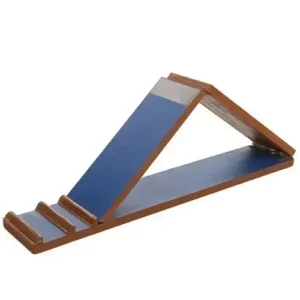
What Is a Quadriceps Exercise Board?
A Quadriceps Exercise Board is a therapeutic exercise device used to facilitate controlled exercises for the quadriceps and surrounding lower-limb muscles.
The board provides a stable surface or support arrangement that helps position the patient’s leg during exercise. Depending on the design, it may incorporate a padded support, adjustable components, resistance attachments, straps, or other exercise accessories.
It can be incorporated into programs involving:
- Quadriceps strengthening
- Knee-extension exercises
- Lower-limb conditioning
- Muscle activation exercises
- Knee rehabilitation
- Post-injury rehabilitation
- Post-operative exercise programs
- Range-of-motion exercises
- Progressive resistance training
- Functional lower-limb rehabilitation
The exercise should be selected according to the patient’s condition, movement ability, and rehabilitation plan.
How Does a Quadriceps Exercise Board Work?
The Quadriceps Exercise Board provides a stable exercise surface that helps position the lower limb for controlled quadriceps-focused movement.
Depending on the configuration, the patient may perform exercises by tightening the quadriceps, extending the knee, lifting the leg, or working against an appropriate resistance mechanism.
Supported Leg Position
The board helps maintain a consistent position while the patient performs the prescribed exercise.
Quadriceps Activation
Exercises can involve deliberate contraction of the quadriceps muscle group while the leg remains appropriately positioned.
Controlled Knee Movement
Where the board is designed for active knee movement, the patient can perform controlled extension or related exercises.
Progressive Exercise
The difficulty can be modified through repetitions, hold duration, resistance, or exercise position when appropriate.
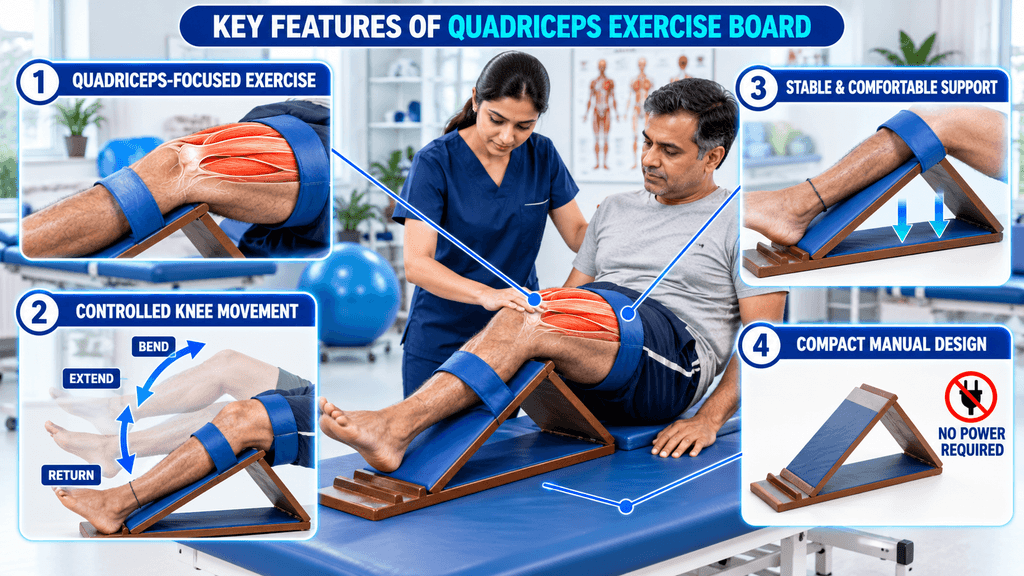
Key Features of Quadriceps Exercise Board
- Compact rehabilitation exercise design
- Stable exercise surface
- Quadriceps-focused exercise application
- Suitable for lower-limb rehabilitation
- Supports controlled knee exercises
- Comfortable patient positioning
- Manual operation
- No electrical power normally required
- Easy to use in clinical environments
- Suitable for supervised rehabilitation
- Easy to store and reposition
- Suitable for physiotherapy and exercise therapy programs
- Model-dependent resistance and adjustment options
Applications of Quadriceps Exercise Board
The Quadriceps Exercise Board can be used as part of different lower-limb rehabilitation programs.
Quadriceps Strengthening
The primary application is controlled exercise designed to engage and strengthen the quadriceps muscle group.
Knee Rehabilitation
The board can support selected knee exercises during rehabilitation following injury, reduced activity, or other conditions where strengthening is appropriate.
Muscle Activation
Quadriceps-focused exercises may be incorporated when a patient requires structured practice of muscle activation and controlled contraction.
Lower-Limb Conditioning
The equipment can form part of a broader lower-limb conditioning program involving controlled repetitions and progressive exercise.
Post-Operative Rehabilitation
Following appropriate medical clearance, quadriceps exercises may be introduced as part of rehabilitation after selected orthopedic procedures.
Sports Rehabilitation
Athletes recovering from lower-limb injuries may use quadriceps-focused exercises as one component of a professionally supervised rehabilitation program.
Functional Rehabilitation
Quadriceps strength contributes to many functional activities, including standing, walking, stepping, and transfers. Targeted strengthening can therefore complement broader functional training.
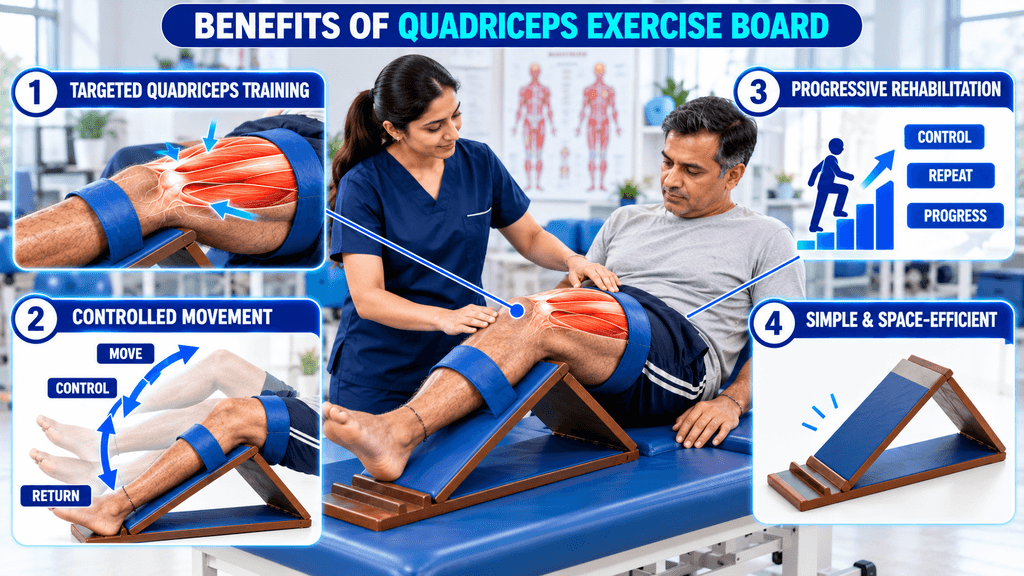
Benefits of Quadriceps Exercise Board
A Quadriceps Exercise Board offers a simple and practical method for incorporating targeted lower-limb exercises into rehabilitation.
Targeted Quadriceps Training
The equipment is designed around exercises that can specifically engage the quadriceps.
Simple Exercise Setup
Its compact design makes it straightforward to position within a physiotherapy or rehabilitation area.
Controlled Movement
The stable exercise surface can help patients perform movements in a more consistent position.
Progressive Rehabilitation
Exercise difficulty can be increased gradually through repetitions, hold time, resistance, or movement variation as clinically appropriate.
Space Efficient
A compact board generally requires considerably less space than large lower-limb exercise machines.
Suitable for Different Rehabilitation Stages
The exercise can be adapted according to the patient’s movement ability and rehabilitation stage.
Exercises Using a Quadriceps Exercise Board
Depending on the specific board design and the patient’s rehabilitation plan, exercises may include:
| Exercise | Main Focus |
|---|---|
| Quadriceps setting | Isometric quadriceps activation |
| Straight-leg raise | Quadriceps and lower-limb control |
| Supported knee extension | Controlled knee movement |
| Leg lifting exercise | Lower-limb strengthening |
| Isometric hold | Muscle activation and endurance |
| Repeated knee movement | Controlled mobility |
| Resistance exercise | Progressive strengthening |
| Static contraction | Quadriceps activation |
The exact exercise selection, repetitions, resistance, and range of motion should be determined by a qualified physiotherapist or treating professional.
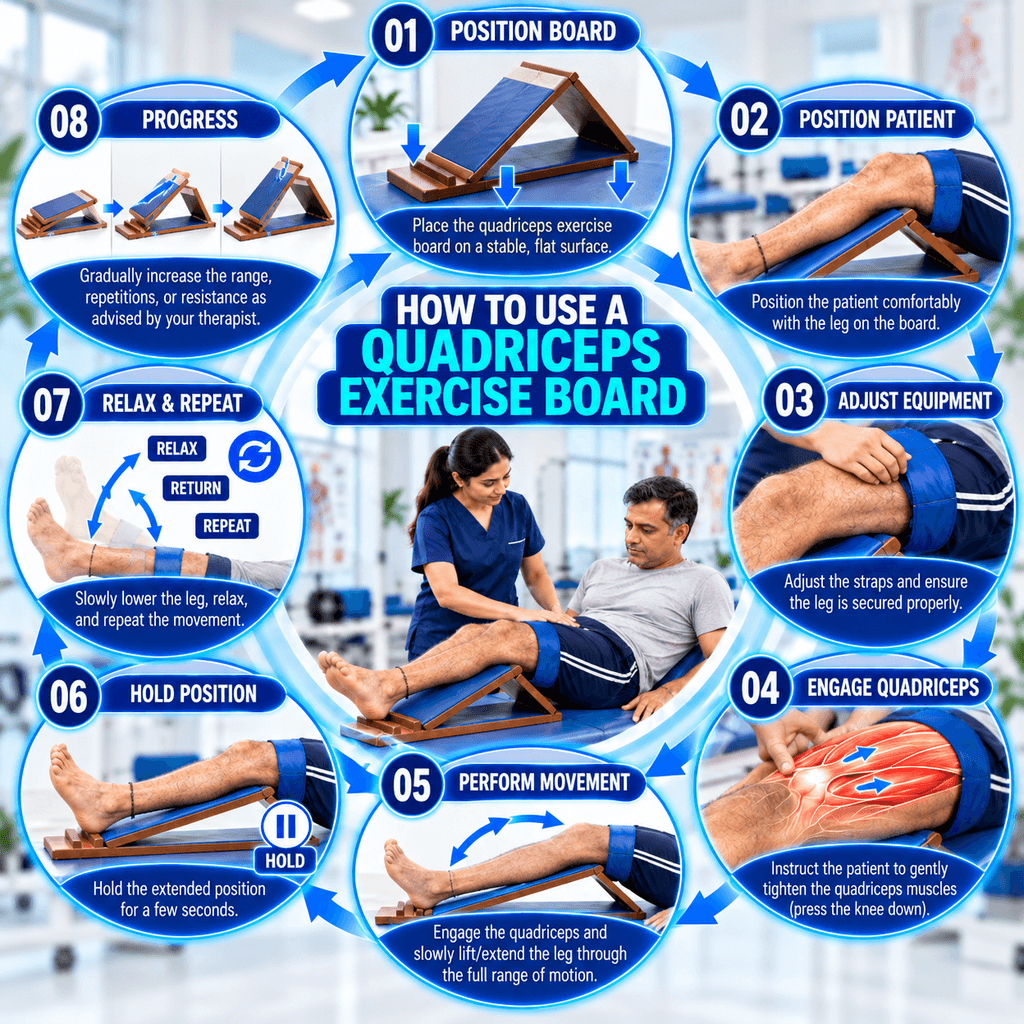
How to Use a Quadriceps Exercise Board
Step 1: Position the Board
Place the Quadriceps Exercise Board securely on a stable, level surface.
Step 2: Position the Patient
Place the patient in the position recommended for the selected exercise. Ensure that the body and lower limb are comfortably aligned.
Step 3: Adjust the Equipment
If the model includes adjustable supports, straps, or resistance components, set them according to the prescribed exercise.
Step 4: Begin Quadriceps Activation
Ask the patient to contract the quadriceps while maintaining the required leg position.
Step 5: Perform the Movement
If active movement is prescribed, perform the required knee or lower-limb movement slowly and in a controlled manner.
Step 6: Hold the Position
For isometric exercises, maintain the contraction for the duration specified by the therapist.
Step 7: Relax and Repeat
Return to the starting position and repeat the exercise for the prescribed number of repetitions.
Step 8: Progress Gradually
The therapist may increase repetitions, hold duration, resistance, or exercise complexity according to the patient’s progress.
Safety Precautions
- Use the board according to professional guidance when treating an injury or medical condition.
- Check the board and all accessories before each session.
- Place the equipment on a stable surface.
- Maintain appropriate lower-limb alignment.
- Avoid excessive resistance.
- Do not force the knee through an uncomfortable range.
- Perform movements slowly rather than using sudden or jerky motion.
- Stop the exercise if significant pain, swelling, dizziness, or unusual discomfort develops.
- Keep straps and moving components properly adjusted.
- Follow the manufacturer’s cleaning and maintenance recommendations.
Patients recovering from surgery or significant knee injury should use the equipment only according to the rehabilitation instructions provided by their treating professional.
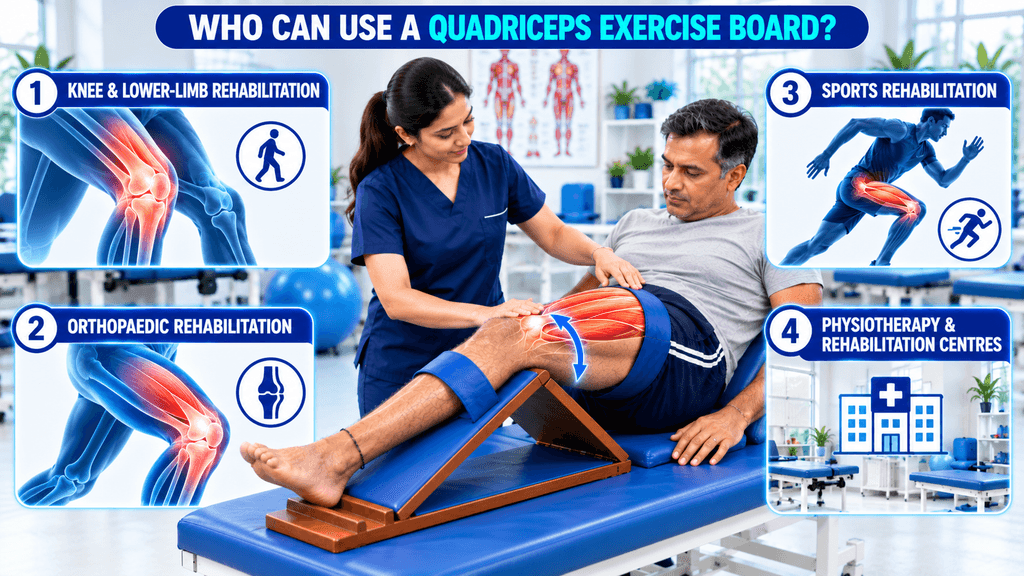
Who Can Use a Quadriceps Exercise Board?
The Quadriceps Exercise Board can be incorporated into professional rehabilitation settings such as:
- Physiotherapy clinics
- Rehabilitation centres
- Hospitals
- Orthopedic departments
- Sports rehabilitation centres
- Knee rehabilitation units
- Physical therapy departments
- Physiotherapy teaching institutions
- Home rehabilitation programs under professional guidance
The appropriate exercise and intensity depend on the patient’s condition and functional ability.
Quadriceps Exercise Board for Knee Rehabilitation
Quadriceps strengthening is commonly incorporated into many knee rehabilitation programs because the quadriceps contribute to knee extension and functional lower-limb activities.
A Quadriceps Exercise Board provides a dedicated surface for practicing controlled quadriceps exercises. Depending on the design, the patient may perform static contractions, leg raises, controlled knee movements, or resistance-based exercises.
The therapist can monitor:
- Quadriceps activation
- Knee alignment
- Movement control
- Exercise tolerance
- Repetition quality
- Range of motion
- Progress over time
The board should be considered one component of a complete rehabilitation program rather than a standalone treatment.
Quadriceps Exercise Board vs Quadriceps Exercise Chair
| Feature | Quadriceps Exercise Board | Quadriceps Exercise Chair |
|---|---|---|
| Design | Compact exercise board | Seated exercise unit |
| Patient position | Model-dependent, often lying or supported | Primarily seated |
| Space requirement | Low | Higher |
| Main application | Quadriceps and lower-limb exercises | Controlled knee-extension exercise |
| Electrical power | Normally not required | Normally not required |
| Portability | Generally easier to reposition | Less portable |
| Resistance | Model-dependent | Model-dependent |
| Clinic application | Rehabilitation exercise | Lower-limb rehabilitation |
Technical Specifications
Specifications can vary according to the exact product design and manufacturer.
| Specification | Details |
|---|---|
| Product Name | Quadriceps Exercise Board |
| Equipment Type | Physiotherapy & Rehabilitation Exercise Equipment |
| Primary Application | Quadriceps and lower-limb exercise |
| Exercise Focus | Knee and quadriceps |
| Operation | Manual |
| Construction | Model-dependent |
| Surface | Supportive/padded, model-dependent |
| Resistance | Model-dependent |
| Adjustments | Model-dependent |
| Power Requirement | Normally none |
| Suitable Settings | Physiotherapy, rehabilitation and hospitals |
| Patient Capacity | Manufacturer-specific |
| Country of Origin | Model/manufacturer dependent |
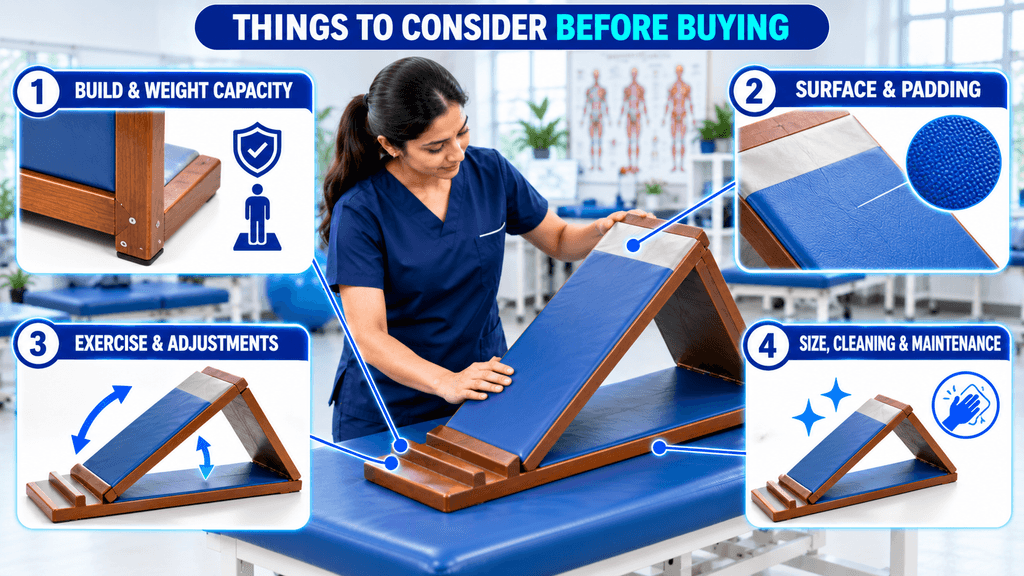
Things to Consider Before Buying
Board Construction
Choose a durable board capable of handling repeated clinical use.
Surface and Padding
Check whether the board provides sufficient support and comfortable padding for the intended exercises.
Exercise Configuration
Confirm whether the board is designed for static quadriceps exercises, active knee movements, resistance exercises, or a combination.
Adjustment Options
If the model includes straps, supports, or resistance adjustments, check their available range.
Size and Storage
A compact design can be particularly useful for clinics with limited rehabilitation space.
Weight Capacity
Always confirm the manufacturer’s specified patient weight capacity before use.
Cleaning and Maintenance
For clinical environments, select equipment with surfaces that can be cleaned and maintained easily.
Why Choose PHYSIOMODALITIES™
PHYSIOMODALITIES™ provides physiotherapy and rehabilitation equipment for professional clinical environments. A Quadriceps Exercise Board can complement a wider lower-limb rehabilitation setup alongside quadriceps chairs, ankle exercisers, exercise stairs, standing frames, treatment tables, parallel bars, and other therapeutic exercise equipment.
Its compact format makes it suitable for rehabilitation areas where targeted lower-limb exercise is required without adding a large powered machine.
Conclusion
The Quadriceps Exercise Board is a compact physiotherapy and rehabilitation device designed to support controlled quadriceps activation, knee exercises, lower-limb strengthening, and progressive rehabilitation.
Its simple exercise format can make it useful in physiotherapy clinics, rehabilitation centres, hospitals, sports therapy facilities, and supervised home rehabilitation programs. Depending on the model, it can support static contractions, active movements, resistance exercises, and other quadriceps-focused activities.
Frequently Asked Questions
1. What is a Quadriceps Exercise Board?
A Quadriceps Exercise Board is a rehabilitation exercise device designed to support controlled quadriceps and lower-limb exercises.
2. What is a Quadriceps Exercise Board used for?
It can be used for quadriceps activation, knee exercises, lower-limb strengthening, muscle conditioning, and selected rehabilitation programs.
3. Can it be used after knee surgery?
It may be incorporated into rehabilitation after appropriate medical clearance and according to the treating professional’s exercise plan.
4. Does a Quadriceps Exercise Board require electricity?
Most basic configurations are manually operated and do not require electricity.
5. Can the exercise difficulty be increased?
Yes. Depending on the model and exercise, difficulty may be progressed through repetitions, hold duration, resistance, or exercise variation under professional guidance.