
Suspension Frame Physiotherapy Equipment is a professional rehabilitation apparatus designed to support controlled therapeutic movement, positioning, stretching, strengthening, mobility training, and functional rehabilitation. The frame provides multiple suspension points where appropriate slings, ropes, straps, springs, and other suspension accessories can be attached according to the patient’s rehabilitation requirements.
Suspension therapy can help physiotherapists reduce the effect of gravity during selected exercises, allowing controlled movement of specific body regions. This makes the suspension frame a useful addition to physiotherapy clinics, rehabilitation centres, hospitals, sports rehabilitation facilities, and exercise therapy departments.
PHYSIOMODALITIES™ provides physiotherapy and rehabilitation equipment designed for professional clinical environments. A Suspension Frame Physiotherapy Equipment setup can be incorporated into a broader rehabilitation area alongside treatment couches, exercise equipment, parallel bars, standing frames, electrotherapy machines, and other therapeutic devices.
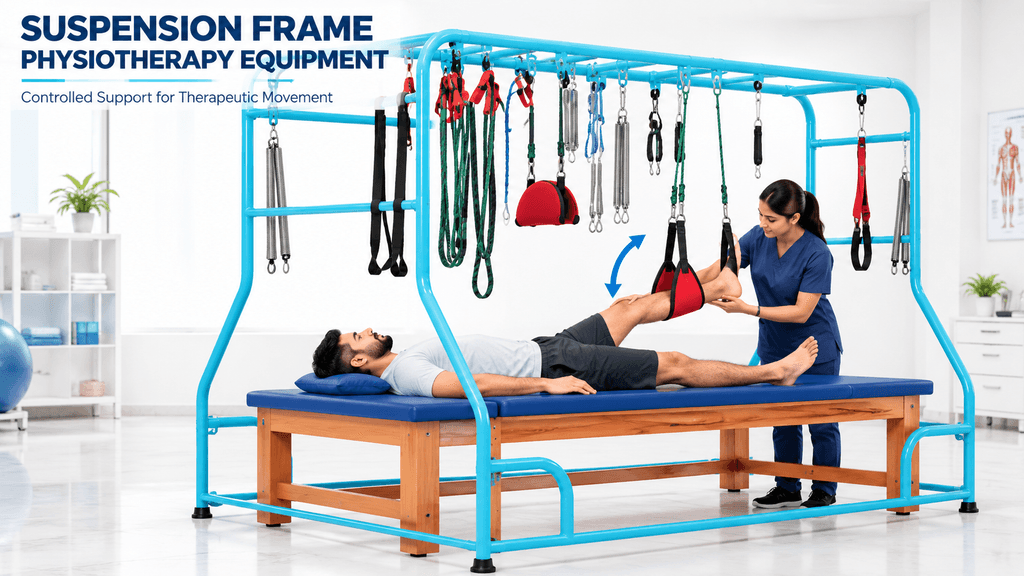
What Is Suspension Frame Physiotherapy Equipment?
A Suspension Frame Physiotherapy Equipment system is a structural frame designed to provide overhead suspension points for therapeutic equipment such as slings, ropes, straps, and springs.
The patient or a specific body part can be supported using the appropriate suspension accessory while the physiotherapist guides controlled therapeutic movements. By changing the attachment position and selecting suitable accessories, the therapist can adapt the setup to different rehabilitation exercises.
Professional suspension frames are commonly constructed from tubular steel or mild-steel components for stability and durability. Some configurations also include an integrated therapy couch or bed.
Key Features of Suspension Frame
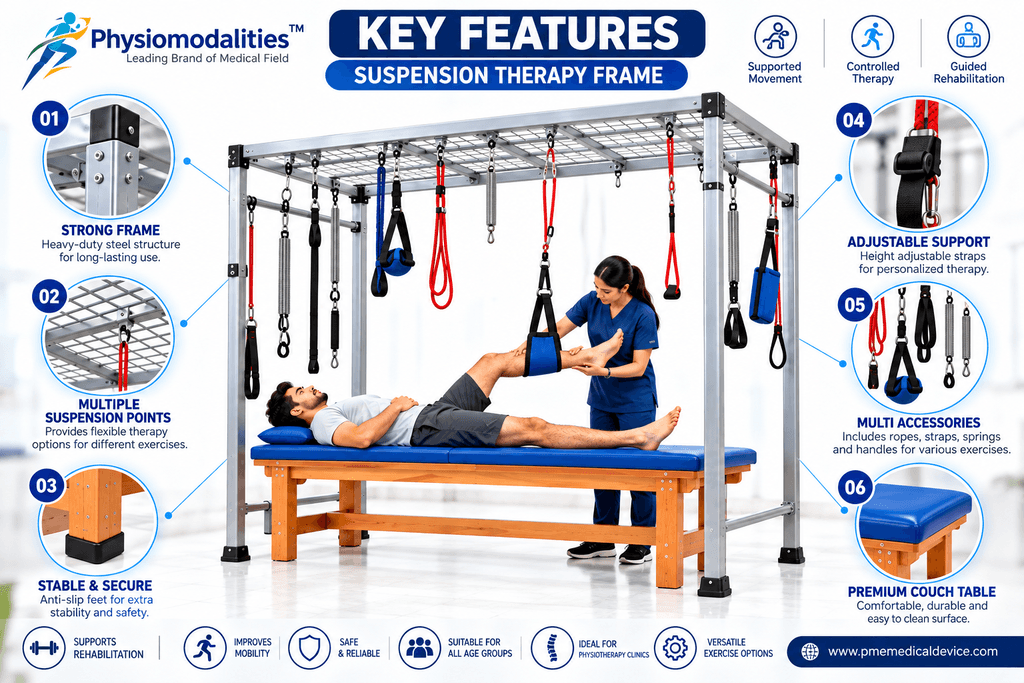
Strong Structural Frame
A robust metal frame provides a stable structure for suspension-based physiotherapy activities. Tubular steel and MS-pipe constructions are commonly used for this type of equipment.
Multiple Suspension Points
The upper structure can provide multiple attachment positions, allowing suspension accessories to be positioned according to the patient’s treatment requirements.
Some professional designs use a welded steel mesh across the upper section with multiple hooks on each side.
Compatible with Suspension Accessories
Depending on the configuration, the frame may be used with:
- Suspension slings
- Ropes
- Straps
- Springs
- Hooks
- Pulley systems
- Ankle straps
- Limb supports
- Trunk supports
- Head supports
The accessories supplied with a particular model should always be checked before purchase.
Suitable for Controlled Movement
Suspension support allows therapists to guide selected movements while reducing or modifying the effect of gravity on the supported body part.
Clinical Rehabilitation Design
The equipment is intended for professional physiotherapy and rehabilitation environments where therapists can select exercises according to individual patient requirements.
How Suspension Therapy Works
Suspension therapy uses external support to partially suspend or assist a body segment during movement. Instead of requiring the patient to move completely against gravity, the therapist can use appropriate suspension equipment to modify the mechanical demands of an exercise.
For example, a limb can be supported through a sling while the patient performs a controlled movement. This can allow the therapist to work on mobility, movement control, stretching, or strengthening within an appropriately selected rehabilitation program.
The exact suspension technique depends on the patient’s condition, treatment goals, body position, and the professional’s clinical assessment.
Applications of Suspension Frame Physiotherapy Equipment
A Suspension Frame Physiotherapy Equipment system can be used across different areas of therapeutic exercise and rehabilitation.
Neurological Rehabilitation
Suspension equipment can be incorporated into rehabilitation programs where controlled positioning, movement practice, balance training, or functional movement exercises are required.
Orthopaedic Rehabilitation
The frame can support selected rehabilitation exercises following musculoskeletal injuries or other orthopaedic conditions.
Lower Limb Rehabilitation
Suspension systems may be used to support the lower limb during selected mobility, strengthening, stretching, and movement-control exercises.
Upper Limb Rehabilitation
Appropriately positioned slings and suspension accessories can be used during selected upper-limb exercises involving the shoulder, elbow, or wrist.
Gait and Functional Training
Suspension-based support may be incorporated into functional rehabilitation and gait-related exercise programs when clinically appropriate.
Sports Rehabilitation
Sports rehabilitation professionals may use suspension equipment as part of controlled exercise programs for mobility, strength, and movement retraining.
Balance and Movement Training
A suspension setup can provide external support during selected exercises where controlled body positioning and movement are required.
Benefits of Suspension Frame Physiotherapy Equipment
When used appropriately as part of a professionally designed rehabilitation program, suspension equipment can provide several practical advantages.
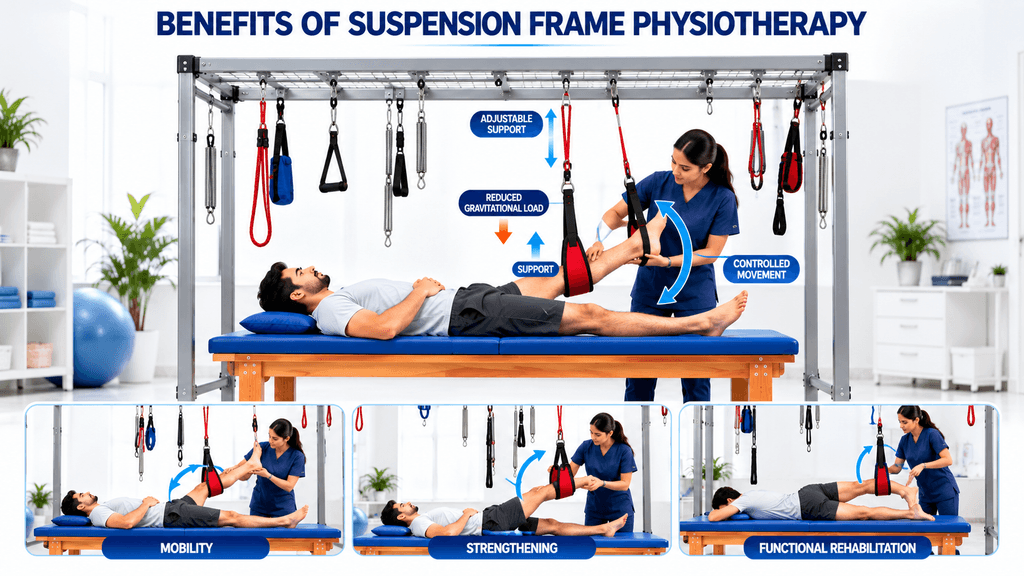
- Provides adjustable support during therapeutic movement
- Allows selected exercises with reduced gravitational loading
- Supports controlled limb movement
- Helps therapists modify exercise difficulty
- Can assist with mobility and flexibility exercises
- Suitable for strengthening-oriented rehabilitation
- Supports functional movement training
- Useful for selected neurological rehabilitation programs
- Can be incorporated into orthopaedic rehabilitation
- Provides multiple suspension attachment options
- Suitable for professional physiotherapy environments
These benefits depend on the exercise technique, suspension accessories, patient condition, and professional assessment. Suspension therapy should not be considered a replacement for individualized clinical evaluation.
Suspension Frame for Physiotherapy Clinics
A physiotherapy clinic may require different equipment for assessment, electrotherapy, exercise therapy, and functional rehabilitation. A suspension frame can form part of the exercise therapy section of the clinic.
It can be positioned in a dedicated rehabilitation area where sufficient floor space is available around the frame. The therapist can then attach the required suspension accessories and adjust the patient’s position according to the planned exercise.
Government of India’s physiotherapy education handbook includes a suspension frame with apparatus among exercise therapy/kinesiotherapy equipment, reflecting its use within physiotherapy training and clinical exercise environments.
Suspension Frame for Neurological Rehabilitation
Neurological rehabilitation may involve carefully controlled movement, positioning, balance work, and functional retraining.
A suspension frame can provide external support during selected exercises, allowing the physiotherapist to control the amount and direction of assistance. The therapist can modify the suspension arrangement according to the patient’s movement ability and rehabilitation goals.
The frame should always be used under professional supervision, particularly when working with patients who have reduced balance, coordination, strength, or postural control.
Suspension Frame for Orthopaedic Rehabilitation
Orthopaedic rehabilitation often involves progressive mobility and strengthening exercises. Suspension equipment can be incorporated when the therapist wants to modify the effect of gravity or provide additional support during movement.
The therapist can select appropriate suspension accessories and exercise positions based on the patient’s stage of rehabilitation.
Suspension Frame for Lower Limb Exercises
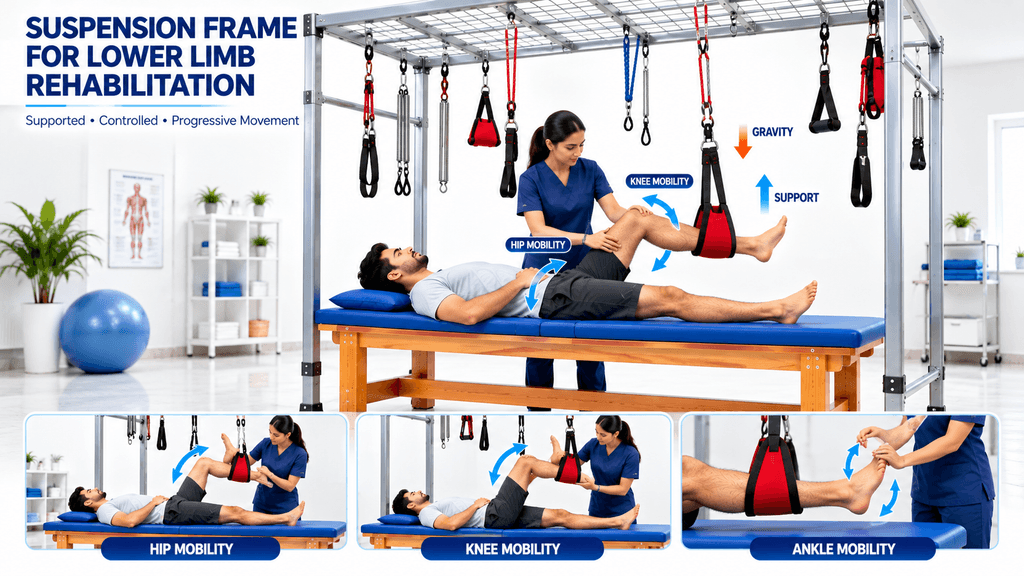
The lower limbs can be supported using suitable slings or straps during selected rehabilitation exercises.
Depending on the treatment plan, suspension may be incorporated into:
- Hip mobility exercises
- Knee movement exercises
- Ankle mobility exercises
- Lower-limb strengthening
- Stretching exercises
- Controlled leg movements
- Functional movement training
The exercise selection should always be determined by a qualified physiotherapist.
Suspension Frame for Upper Limb Exercises
A suspension frame can also support selected upper-limb rehabilitation activities.
With suitable accessories, therapists may use suspension support during exercises involving:
- Shoulder movement
- Elbow movement
- Wrist movement
- Controlled arm mobility
- Stretching
- Movement coordination
- Strengthening exercises
The suspension configuration should be adjusted according to the patient’s clinical requirements.
Suspension Accessories
The effectiveness and versatility of a suspension frame depend partly on the accessories used with it.
Depending on the model, a complete suspension system may include multiple slings, ropes, hooks, pulley ropes, springs, S-hooks, and ankle straps. For example, one professional configuration lists limb, trunk, and head slings along with ropes, pulley ropes, graduated springs, hooks, and ankle straps.
Always confirm the exact accessory package before purchasing because configurations differ between manufacturers and models.
How to Use Suspension Frame Physiotherapy Equipment
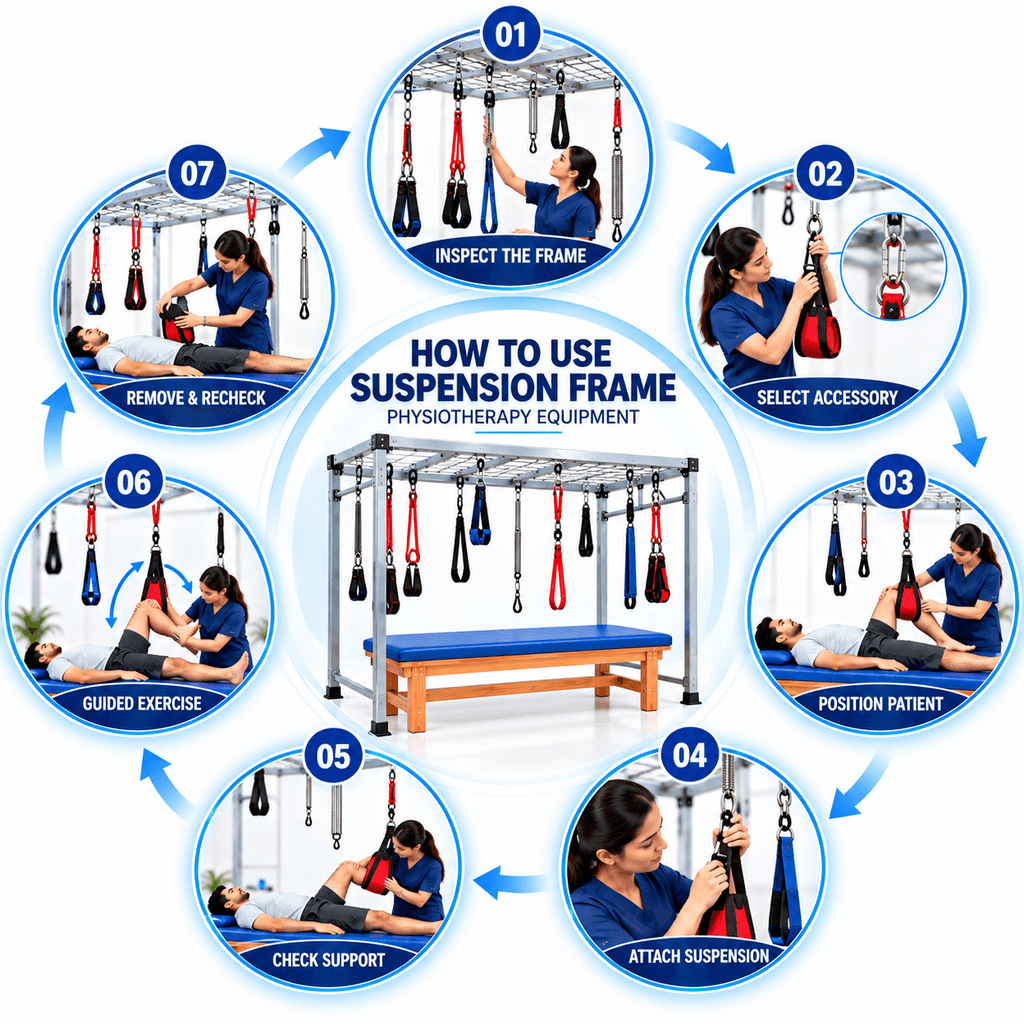
Step 1: Inspect the Frame
Check the frame, joints, hooks, suspension points, and accessories before beginning the session.
Step 2: Select the Appropriate Accessories
Choose the sling, rope, strap, spring, or other accessory appropriate for the planned exercise.
Step 3: Position the Patient
Place the patient on the treatment couch or in the required standing/seated position according to the exercise.
Step 4: Attach the Suspension Equipment
Secure the selected accessories to the appropriate suspension points.
Step 5: Check the Support
Before starting movement, verify that the suspension arrangement is secure and that the patient is comfortably supported.
Step 6: Perform the Exercise
The physiotherapist guides the patient through the prescribed movement while controlling the amount of support and resistance.
Step 7: Recheck After the Session
Remove the suspension accessories carefully and inspect them for signs of wear or damage.
Safety Precautions
Suspension equipment should be used carefully because incorrect positioning or poorly secured accessories can create unnecessary risk.
- Use the frame only on a stable and level floor.
- Inspect hooks, ropes, slings, springs, and straps before use.
- Never use damaged suspension accessories.
- Confirm that all attachment points are properly secured.
- Follow the manufacturer’s specified load limits.
- Do not improvise suspension accessories.
- Provide appropriate patient assistance during transfers.
- Maintain adequate clearance around the frame.
- Use suitable support for patients with reduced balance or mobility.
- Keep children and untrained individuals away from the equipment during clinical use.
- Follow professional physiotherapy protocols for each exercise.
- Stop an exercise if the patient experiences unusual pain, dizziness, or discomfort.
Maintenance of Suspension Frame
Regular maintenance is important for equipment that uses mechanical suspension components.
The metal frame should be checked periodically for loose joints, damaged welds, corrosion, or other structural problems. Hooks and attachment points should also be inspected regularly.
Ropes, slings, straps, springs, and pulley components can experience wear over time and should be replaced when damaged or when the manufacturer recommends replacement.
The frame should be kept clean and dry, while moving or mechanical components should be maintained according to the manufacturer’s instructions.
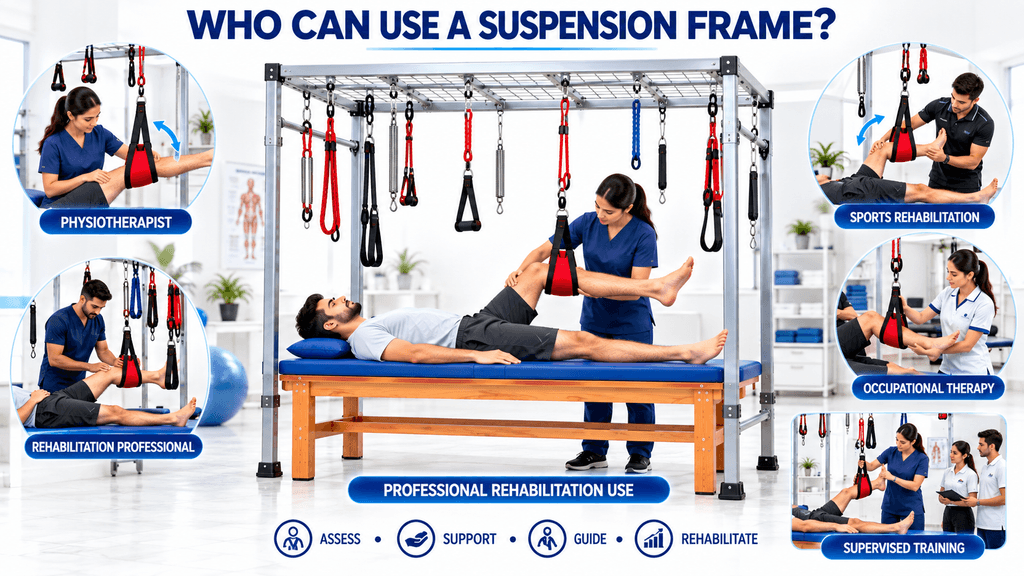
Who Can Use a Suspension Frame?
Suspension Frame Physiotherapy Equipment is intended for professional rehabilitation environments.
It may be used by:
- Physiotherapists
- Rehabilitation professionals
- Sports rehabilitation professionals
- Occupational therapy professionals, where appropriate
- Physiotherapy students under qualified supervision
- Healthcare professionals trained in therapeutic exercise
Patients should not independently operate suspension equipment without appropriate professional instruction and supervision.
Things to Consider Before Buying
Frame Construction
Look for a strong and stable structure designed for regular clinical use.
Suspension Points
Check the number and arrangement of hooks or attachment points to ensure they meet the intended rehabilitation requirements.
Accessories
Confirm whether slings, ropes, springs, pulleys, hooks, and straps are included or need to be purchased separately.
Dimensions
Measure the available treatment area and compare it with the frame’s overall dimensions.
Load Capacity
Verify the manufacturer’s stated load limits for the frame and individual accessories.
Couch Configuration
Some suspension systems are supplied with an integrated couch, while others are frame-only systems. Choose according to the clinic’s requirements.
Installation
Confirm the installation requirements and ensure the equipment is assembled correctly before clinical use.
Technical Specifications
| Specification | Details |
|---|---|
| Product Name | Suspension Frame Physiotherapy Equipment |
| Product Type | Suspension Therapy & Rehabilitation Equipment |
| Primary Application | Therapeutic Exercise & Rehabilitation |
| Frame Construction | Tubular Steel / MS Pipe, Model Dependent |
| Suspension Structure | Upper Mesh / Multiple Attachment Points, Model Dependent |
| Suspension Accessories | Slings, Ropes, Straps, Springs & Hooks, Model Dependent |
| Couch | Available on Selected Configurations |
| Operation | Manual |
| Therapy Type | Suspension-Based Exercise & Rehabilitation |
| Applications | Physiotherapy, Neurological, Orthopaedic & Sports Rehabilitation |
| Installation | Floor Standing |
| Dimensions | Model Dependent |
| Load Capacity | As specified by manufacturer |
| Brand | PHYSIOMODALITIES™ |
Specifications and accessory packages vary between configurations. Confirm the final frame dimensions, load capacity, couch dimensions, and included accessories before purchase.
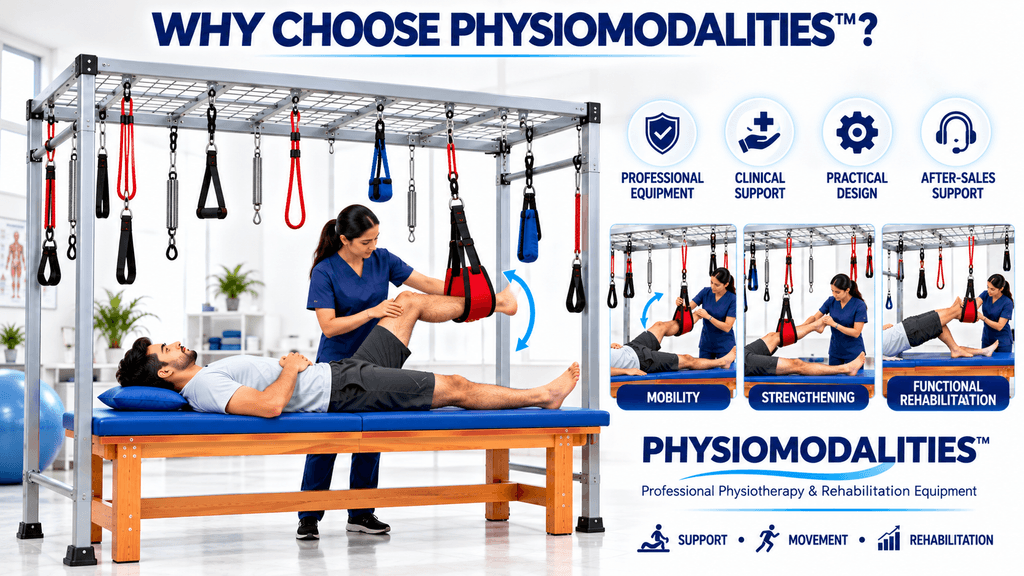
Why Choose PHYSIOMODALITIES™?
PHYSIOMODALITIES™ focuses on practical physiotherapy, rehabilitation, and exercise therapy equipment for professional clinical environments.
A Suspension Frame Physiotherapy Equipment system can be a useful addition to clinics that provide therapeutic exercise and functional rehabilitation. Its multiple suspension points and accessory compatibility allow trained professionals to create different support arrangements according to individual rehabilitation requirements.
When selecting a suspension frame, clinics should consider construction quality, stability, available accessories, dimensions, load capacity, available treatment space, and after-sales support.
Conclusion
A Suspension Frame Physiotherapy Equipment system is designed to provide controlled suspension support during therapeutic exercise and rehabilitation. By using appropriate slings, ropes, straps, springs, and other accessories, physiotherapists can modify the effect of gravity and guide selected movements according to the patient’s rehabilitation program.
It can be used in physiotherapy clinics, hospitals, rehabilitation centres, sports rehabilitation facilities, and physiotherapy training environments. With a stable frame and suitable suspension accessories, it can support a wide range of professionally supervised mobility, strengthening, stretching, positioning, and functional exercises.
PHYSIOMODALITIES™ offers practical rehabilitation equipment intended to help clinics develop organized and functional physiotherapy treatment environments.
Frequently Asked Questions
1. What is a Suspension Frame used for?
A Suspension Frame is used to support controlled therapeutic movements, exercise, positioning, stretching, and rehabilitation activities using suspension accessories.
2. Can a Suspension Frame be used for neurological rehabilitation?
Yes. It can be incorporated into selected neurological rehabilitation exercises involving controlled movement, positioning, balance, and functional training under professional supervision.
3. What accessories are used with a Suspension Frame?
Depending on the model, accessories can include slings, ropes, straps, springs, hooks, pulleys, and ankle supports.
4. Can it be used for lower-limb rehabilitation?
Yes. Suitable suspension accessories can be used to support selected lower-limb mobility, stretching, strengthening, and movement exercises.
5. Who should operate Suspension Frame Physiotherapy Equipment?
It should be used by trained physiotherapists or appropriately qualified rehabilitation professionals who understand suspension-based therapeutic exercise techniques.