
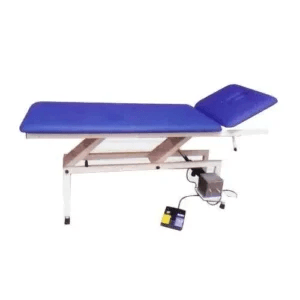
The 2-Section High-Low Treatment Table is a professional physiotherapy and rehabilitation table designed to provide a stable, comfortable, and height-adjustable platform for patient examination, manual therapy, exercise therapy, rehabilitation, and other clinical procedures.
Its two-section construction provides a dedicated main treatment surface and an adjustable head section, allowing the therapist to position the patient according to the requirements of the treatment. The high-low mechanism allows the overall working height of the table to be adjusted, helping therapists maintain a more comfortable working posture during clinical procedures.
A height-adjustable treatment table can also make patient transfers and positioning easier because the table can be lowered or raised according to the patient’s requirements and the therapist’s working position. Electric high-low tables commonly use foot or hand controls for height adjustment, although the exact control system depends on the model.
The 2-Section High-Low Treatment Table is suitable for physiotherapy clinics, rehabilitation centres, orthopedic practices, hospitals, chiropractic clinics, sports rehabilitation centres, and other professional healthcare environments.
What Is a 2-Section High-Low Treatment Table?
A 2-Section High-Low Treatment Table is a clinical treatment couch consisting of two main sections, generally including a fixed or main body section and an adjustable head or back section.
The high-low function allows the complete table platform to move vertically. Depending on the design, this adjustment may be electrically powered or hydraulically operated.
The two-section design provides flexibility for different treatment positions. The head section can often be raised or lowered to support different clinical techniques, including seated, semi-reclined, supine, or prone positioning.
Modern treatment tables may include features such as:
- Electrically adjustable height
- Adjustable head section
- Foot switch or hand control
- High-density cushioning
- Durable upholstery
- Heavy-duty steel frame
- Non-slip feet
- Optional castors
- Face or breathing hole
- Patient positioning support
- Easy-to-clean surface
The exact combination of features varies by manufacturer and model.
How Does a 2-Section High-Low Treatment Table Work?
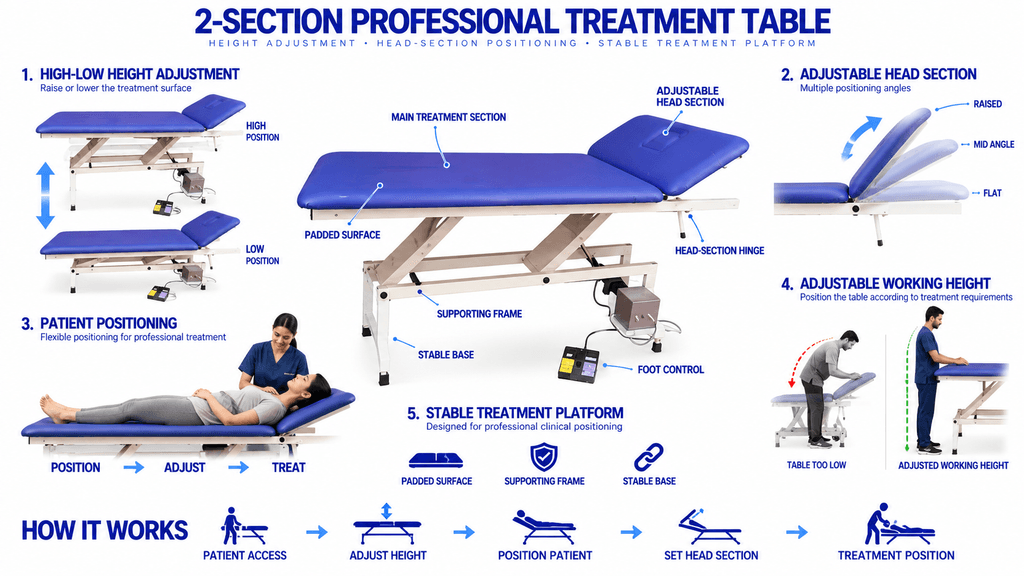
The table is designed around two primary adjustment functions: height adjustment and section adjustment.
High-Low Height Adjustment
The complete treatment surface can be raised or lowered to achieve a suitable working height.
For example, the therapist may lower the table to make it easier for a patient with limited mobility to get onto the treatment surface. After positioning the patient, the table can be raised to a more suitable working height.
This can also reduce the need for the therapist to repeatedly bend over during treatment.
Adjustable Head Section
The second section can be adjusted to different angles depending on the table configuration.
An adjustable head section can support different treatment positions and may be useful during:
- Manual therapy
- Assessment
- Exercise therapy
- Postural positioning
- Mobilization techniques
- Relaxation and comfort positioning
Some commercially available two-section tables provide substantial head-section adjustment using gas springs or other mechanisms.
Stable Treatment Platform
A stable frame and appropriately designed base help provide a secure surface during patient treatment.
The table should remain properly level and stable during use, particularly when therapists apply manual pressure or perform movement-based techniques.
Key Features of 2-Section High-Low Treatment Table
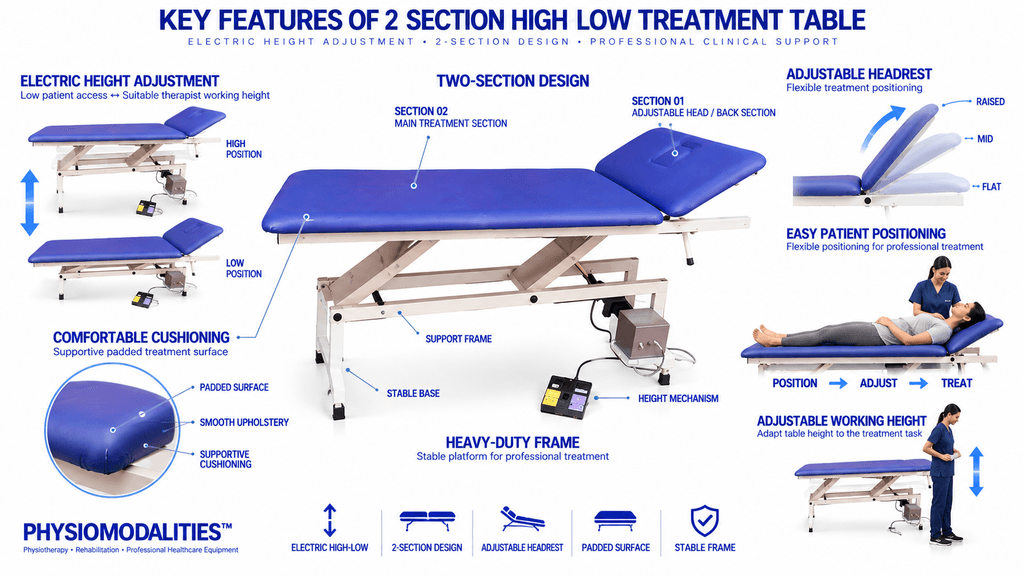
Electric Height Adjustment
The high-low mechanism allows the table height to be adjusted according to the therapist’s working position and patient requirements.
Electric models may use a foot switch, hand control, or an all-around control system.
Two-Section Design
The two-section construction provides an adjustable head or back area while maintaining a dedicated main treatment section.
Adjustable Headrest
The head section can be positioned at different angles according to the treatment technique and patient’s comfort.
Comfortable Cushioning
A properly padded treatment surface provides support during longer treatment sessions.
Durable Upholstery
Clinical treatment tables generally use upholstery designed to withstand frequent cleaning and regular professional use.
Heavy-Duty Frame
A strong frame helps provide stability during physiotherapy, manual therapy, examination, and rehabilitation procedures.
Easy Patient Positioning
The adjustable height and head section allow therapists to position patients more conveniently for different procedures.
Therapist-Friendly Working Height
The high-low mechanism allows therapists to adjust the working height instead of working at one fixed level.
Easy Cleaning
The smooth upholstered surface can be cleaned between patients using appropriate cleaning procedures recommended for the upholstery material.
Optional Mobility
Some configurations are available with castors or retractable wheel systems, while other models use fixed feet.
Benefits of 2-Section High-Low Treatment Table
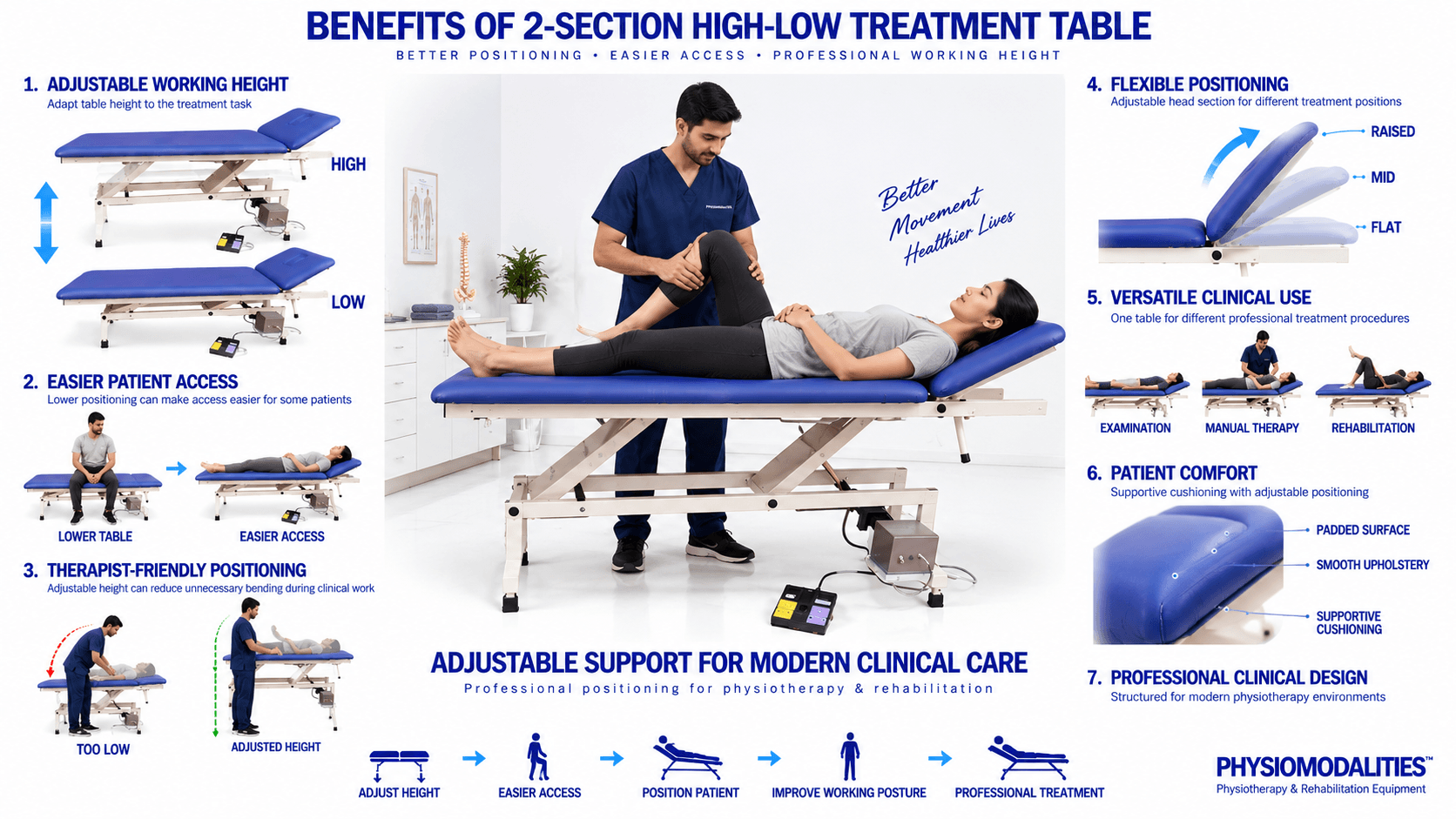
Adjustable Working Height
The ability to change table height helps therapists create a more suitable working position for different treatment techniques.
Easier Patient Transfer
Lowering the table can make getting onto and off the treatment surface easier for some patients.
Better Treatment Positioning
The adjustable head section provides more flexibility than a completely fixed treatment surface.
Supports Multiple Therapies
The table can be used for different physiotherapy and rehabilitation procedures without requiring a separate couch for every treatment.
Improved Therapist Ergonomics
A suitable working height may help reduce unnecessary bending and awkward positioning during clinical work.
Patient Comfort
Proper cushioning and adjustable positioning can help create a more comfortable treatment environment.
Professional Clinical Appearance
A dedicated high-low treatment table provides a structured setup for modern physiotherapy and rehabilitation clinics.
Applications of 2-Section High-Low Treatment Table
The 2-Section High-Low Treatment Table can be used for a wide range of professional healthcare applications.
Physiotherapy
The table can support routine physiotherapy assessment, treatment, manual techniques, and rehabilitation exercises.
Manual Therapy
The adjustable height allows therapists to position the table according to the technique being performed.
Orthopedic Rehabilitation
It can be used for patient assessment and selected rehabilitation procedures in orthopedic settings.
Sports Rehabilitation
Sports therapists can use the table for assessment, recovery-oriented treatment, stretching, and rehabilitation activities.
Chiropractic Practice
The adjustable working height and stable surface can support selected chiropractic procedures.
Massage Therapy
The padded treatment surface can be used for professional massage and bodywork where the table configuration is suitable.
Examination
The table can provide a stable surface for routine physical examination and assessment.
Rehabilitation Centres
The table can form part of a broader rehabilitation setup for patients with different mobility requirements.
Patient Positioning
One of the major advantages of a two-section treatment table is the ability to adjust patient positioning.
Supine Position
The patient lies on their back while the therapist performs assessment, exercise, manual therapy, or other suitable procedures.
Prone Position
The patient lies face down when the treatment requires access to the posterior side of the body.
A face or breathing hole may be included in some configurations for improved comfort during prone positioning.
Semi-Reclined Position
The head section can be raised to create a more upright position where supported by the table design.
Seated or Partially Supported Position
Certain treatment procedures may benefit from an elevated head section, depending on the available adjustment range.
The therapist should always confirm that the selected position is appropriate for the patient’s condition and the treatment being performed.
Why High-Low Adjustment Is Important
A fixed-height treatment table forces the therapist to work at one predetermined level.
A high-low table provides greater flexibility.
For example, during manual therapy, the therapist may prefer a lower working position. During examination or certain exercise procedures, a different height may be more comfortable.
The ability to adjust height can also be useful when treating patients of different body sizes.
This flexibility makes the 2-Section High-Low Treatment Table particularly practical for clinics where multiple therapists may use the same treatment equipment.
How to Use the 2-Section High-Low Treatment Table
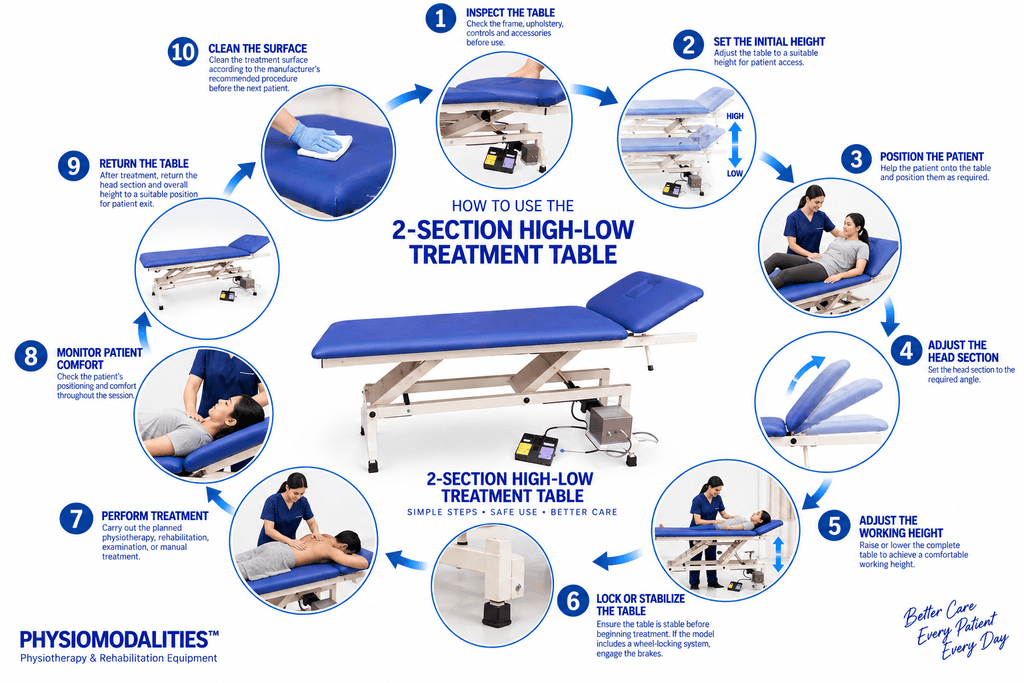
Step 1: Inspect the Table
Check the frame, upholstery, controls, adjustment mechanism, and accessories before use.
Step 2: Set the Initial Height
Adjust the table to a suitable height for patient access.
Step 3: Position the Patient
Help the patient onto the table and position them according to the treatment requirement.
Step 4: Adjust the Head Section
Set the head section to the required angle if the treatment requires an elevated or lowered position.
Step 5: Adjust the Working Height
Raise or lower the complete table to achieve a comfortable working height.
Step 6: Lock or Stabilize the Table
Ensure that the table is stable before beginning treatment. If the model includes a wheel-locking system, engage the appropriate brakes.
Step 7: Perform Treatment
Carry out the planned physiotherapy, rehabilitation, examination, or manual treatment.
Step 8: Monitor Patient Comfort
Check the patient’s positioning and comfort throughout the session.
Step 9: Return the Table
After treatment, return the head section and overall height to a suitable position for patient exit.
Step 10: Clean the Surface
Clean the treatment surface according to the manufacturer’s recommended procedure before the next patient.
Safety Precautions
The 2-Section High-Low Treatment Table should be operated according to the manufacturer’s instructions.
Important precautions include:
- Check the table before every session.
- Do not exceed the manufacturer’s specified load capacity.
- Ensure the table is stable before treatment.
- Lock castors where applicable.
- Keep fingers and loose clothing away from moving mechanisms.
- Do not adjust the table while the patient is entering or leaving unless the procedure specifically requires controlled adjustment.
- Use the appropriate patient positioning technique.
- Check the head-section locking or support mechanism.
- Keep electrical controls away from liquids.
- Do not use a table with damaged cables or controls.
- Perform regular maintenance.
- Inspect moving components periodically.
- Follow the manufacturer’s servicing recommendations.
The therapist should also consider the patient’s mobility, balance, weight, medical condition, and ability to safely transfer onto and off the table.
2-Section High-Low Treatment Table for Physiotherapy Clinics
A professional physiotherapy clinic requires equipment that can accommodate different treatment techniques and patient requirements.
The 2-Section High-Low Treatment Table provides a flexible working platform for therapists because both the overall table height and head-section position can be adjusted.
A typical clinical workflow may involve:
Patient Assessment → Table Height Adjustment → Patient Positioning → Head Section Adjustment → Treatment → Repositioning → Patient Transfer
This makes the table useful for both routine treatment and more specialized manual therapy procedures.
2-Section High-Low Treatment Table vs Fixed Treatment Table
| Feature | 2-Section High-Low Table | Fixed Treatment Table |
|---|---|---|
| Height Adjustment | Available | Fixed |
| Head Section | Adjustable | Fixed or limited |
| Therapist Working Height | Adjustable | One fixed height |
| Patient Positioning | More flexible | More limited |
| Patient Transfer | Height can be lowered | Fixed height |
| Manual Therapy | Flexible positioning | Depends on table height |
| Clinical Applications | Multiple | Multiple |
The main difference is adjustability. A fixed table can be suitable for straightforward applications, while a high-low design provides more flexibility for therapists and patients.
Choosing the Right Treatment Table
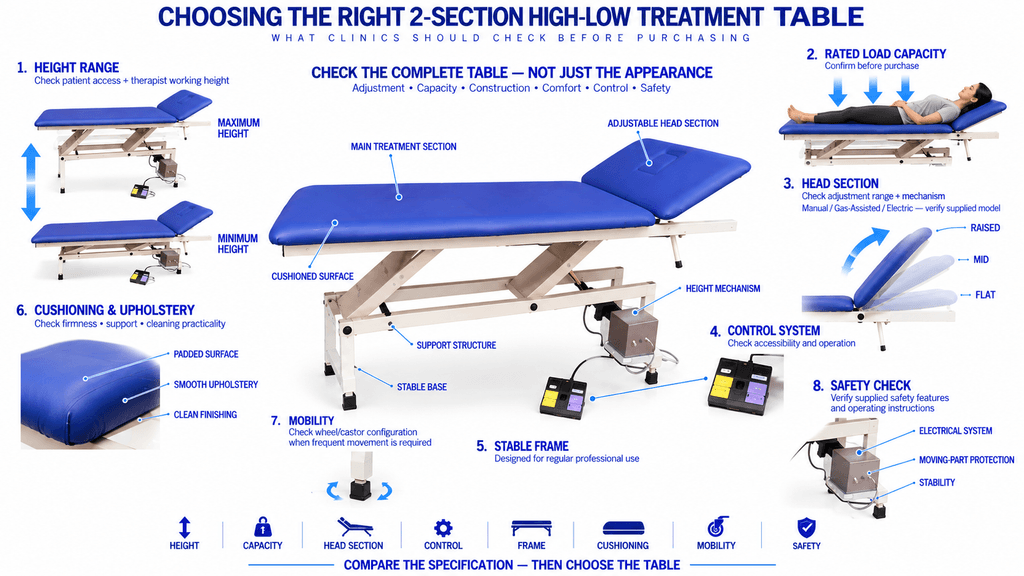
Before purchasing a 2-Section High-Low Treatment Table, clinics should consider several factors.
Height Range
Check the minimum and maximum working height to ensure that it suits both patient access and therapist requirements.
Load Capacity
Confirm that the table’s rated capacity is appropriate for the intended patient population.
Head Section Adjustment
Check the available angle range and whether the adjustment is manual, gas-assisted, electric, or another mechanism.
Control System
Electric tables may use hand controls, foot switches, or controls positioned around the frame.
Frame Construction
A strong and stable frame is important for regular professional use.
Cushioning
Check the thickness and firmness of the padding according to the clinic’s treatment requirements.
Upholstery
The material should be durable and practical to clean between patients.
Mobility
If the table needs to be moved frequently, consider a model with suitable castors or a retractable wheel system.
Safety Features
Check the stability system, brakes, electrical safety, and moving-part protection before purchase.
Technical Specifications
| Specification | 2-Section High-Low Treatment Table |
|---|---|
| Product Name | 2-Section High-Low Treatment Table |
| Table Type | Physiotherapy Treatment Table |
| Sections | 2 Sections |
| Height Adjustment | High-Low Adjustable |
| Height Operation | Electric / Hydraulic Depending on Model |
| Head Section | Adjustable |
| Control | Hand Control / Foot Switch Depending on Model |
| Frame | Heavy-Duty Clinical Frame |
| Cushioning | Padded Treatment Surface |
| Upholstery | Durable Easy-Clean Upholstery |
| Patient Positioning | Supine / Prone / Semi-Reclined |
| Castors | Optional / Model Dependent |
| Usage | Physiotherapy, Rehabilitation & Examination |
| Application | Clinical & Professional Use |
Exact dimensions, height range, lifting capacity, head-section angle, motor specifications, electrical requirements, weight, and warranty should be confirmed for the specific PHYSIOMODALITIES™ model before publishing final specifications. Comparable commercial 2-section high-low tables show substantially different configurations—for example, published models range from approximately 51–96 cm or 52–102 cm in height and around 200–250 kg in stated capacity.
Maintenance of 2-Section High-Low Treatment Table
Regular maintenance helps keep the table suitable for professional use.
Daily Cleaning
Clean the patient-contact surface after each session using a cleaning method compatible with the upholstery.
Frame Inspection
Check the frame periodically for loose fasteners, unusual movement, or visible damage.
Moving Mechanism
Inspect the height-adjustment mechanism and head-section mechanism for unusual noise or movement.
Electrical Components
For electrically operated models, inspect the power cable, control switch, and connections regularly.
Castor and Brake Inspection
If the table has castors, check their movement and locking function.
Upholstery Inspection
Look for tears, cracks, loose stitching, or other damage that could affect hygiene or patient comfort.
Who Should Use the Treatment Table?
The 2-Section High-Low Treatment Table is intended for professional environments and may be used by:
- Physiotherapists
- Rehabilitation professionals
- Orthopedic professionals
- Chiropractors
- Sports therapists
- Massage professionals
- Other appropriately trained healthcare practitioners
The table itself does not determine the treatment. The qualified professional selects the appropriate patient position and treatment technique.
Why Choose PHYSIOMODALITIES™?
PHYSIOMODALITIES™ provides professional physiotherapy and rehabilitation equipment designed for clinical environments.
The 2-Section High-Low Treatment Table can be used as a foundational component of a physiotherapy clinic, supporting examination, manual therapy, rehabilitation, positioning, and other treatment procedures.
PHYSIOMODALITIES ENTERPRISES offers equipment across multiple physiotherapy categories, including electrotherapy, Ultrasonic therapy, traction, laser therapy, shockwave therapy, TECAR therapy, robotic spine therapy, rehabilitation equipment, and treatment furniture.
Conclusion
The 2-Section High-Low Treatment Table is a versatile professional treatment couch designed to provide adjustable working height, flexible patient positioning, and a stable platform for physiotherapy and rehabilitation procedures.
Its two-section construction allows the head section to be adjusted according to the treatment requirement, while the high-low mechanism allows therapists to select a more suitable working height.
This combination can be useful for physiotherapy, manual therapy, orthopedic rehabilitation, sports rehabilitation, chiropractic procedures, examination, massage, and other professional applications.
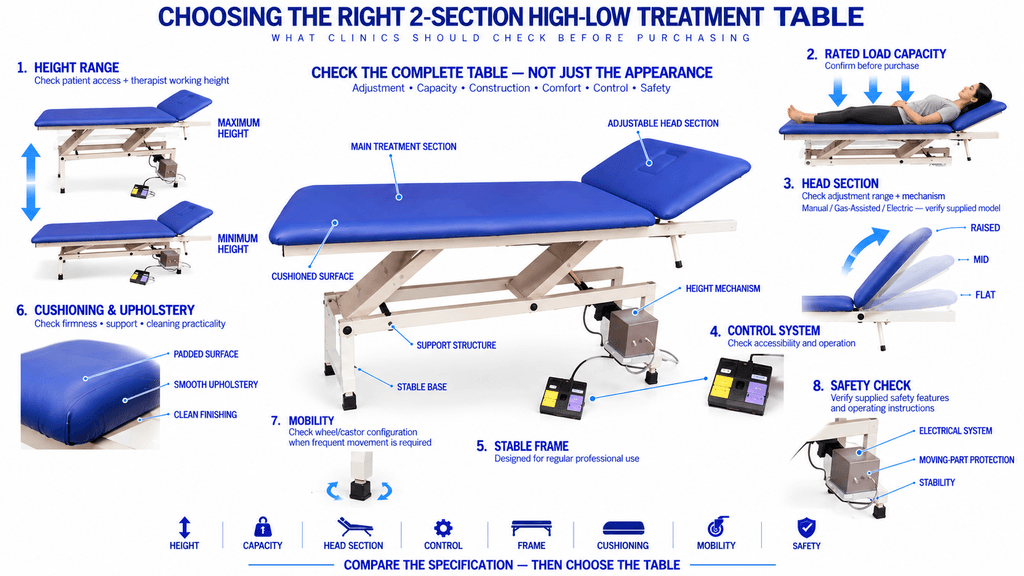
When selecting a table, clinics should evaluate the height range, load capacity, head-section adjustment, control system, frame construction, cushioning, upholstery, mobility options, and safety features rather than choosing based on appearance alone.
Frequently Asked Questions
1. What is a 2-Section High-Low Treatment Table?
It is a professional treatment couch with two sections and an adjustable overall height, designed for physiotherapy, rehabilitation, examination, and related clinical procedures.
2. Can the height of the treatment table be adjusted?
Yes. High-low models are designed to raise and lower the treatment surface. Depending on the model, adjustment may be electric or hydraulic.
3. What is the purpose of the adjustable head section?
The adjustable head section allows the patient to be positioned at different angles for manual therapy, examination, rehabilitation, and other treatment procedures.
4. Is a 2-section high-low table suitable for physiotherapy clinics?
Yes. It can support a wide range of physiotherapy, rehabilitation, manual therapy, and examination applications.
5. What should be checked before purchasing a high-low treatment table?
Check the height range, load capacity, head-section adjustment, frame strength, cushioning, upholstery, control system, safety features, mobility options, and warranty.