The Pneumatic Shockwave Therapy Machine is a professional physiotherapy device designed to deliver controlled radial pressure waves for musculoskeletal rehabilitation, sports physiotherapy, and targeted pain-management applications. The system uses pneumatic energy to generate mechanical impulses through a specialized handpiece and applicator.
Pneumatic shockwave technology is commonly used in professional physiotherapy and rehabilitation environments for selected tendon, muscle, fascia, and soft-tissue treatment programs. Depending on the machine configuration, therapists can adjust treatment pressure, frequency, pulse count, and applicator selection according to the clinical protocol.
The Pneumatic Shockwave Therapy Machine can be incorporated into physiotherapy clinics, orthopedic rehabilitation centers, sports rehabilitation facilities, and professional pain-management practices.
PHYSIOMODALITIES™ provides professional physiotherapy equipment designed to support modern clinical treatment and rehabilitation environments.
What Is a Pneumatic Shockwave Therapy Machine?
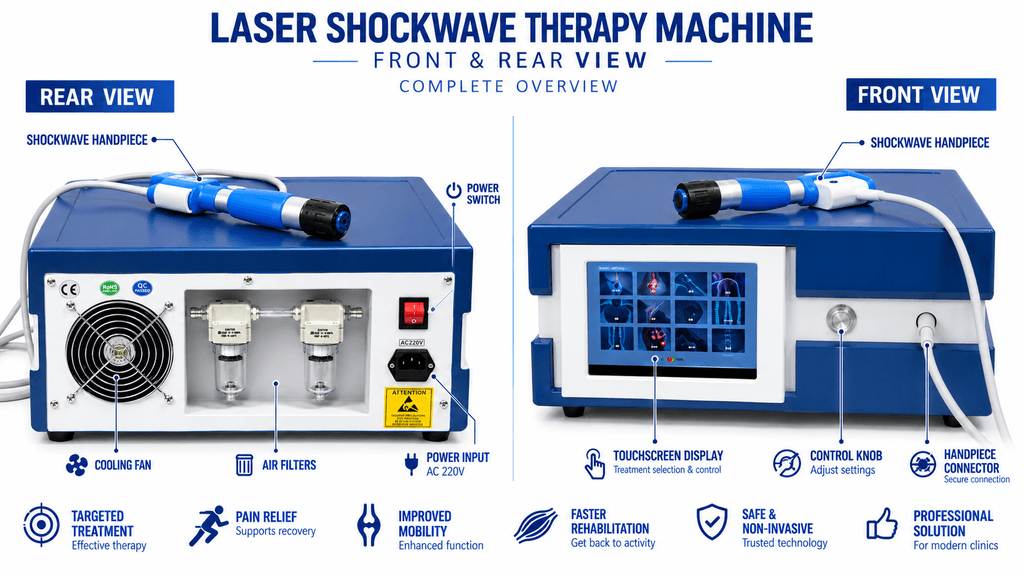
A Pneumatic Shockwave Therapy Machine is a radial shockwave system that uses compressed air to generate mechanical pressure waves.
In a typical pneumatic system, compressed air accelerates a projectile inside the applicator handpiece. The projectile strikes a transmitter, producing mechanical pressure waves that are transferred through the treatment applicator to the selected area. This type of radial shockwave system is also commonly described as radial pressure wave therapy.
Unlike electrical stimulation devices such as TENS or IFT, pneumatic shockwave equipment delivers mechanical energy rather than electrical pulses through surface electrodes.
The exact pressure range, frequency range, energy output, number of applicators, and treatment modes depend on the particular machine.
How Pneumatic Shockwave Therapy Works
The Pneumatic Shockwave Therapy Machine uses compressed air to create repeated mechanical impulses.
The basic treatment process involves:
- Compressed air drives the projectile inside the handpiece.
- The projectile impacts the transmitter.
- Mechanical pressure waves are generated.
- The applicator transfers the waves to the selected treatment area.
- The therapist controls the treatment parameters according to the clinical protocol.
The mechanical stimulus can be incorporated into rehabilitation programs where shockwave therapy is considered appropriate.
Treatment parameters should always be selected by a trained professional according to the patient’s condition, treatment area, tolerance, and manufacturer instructions.
Radial Shockwave Technology
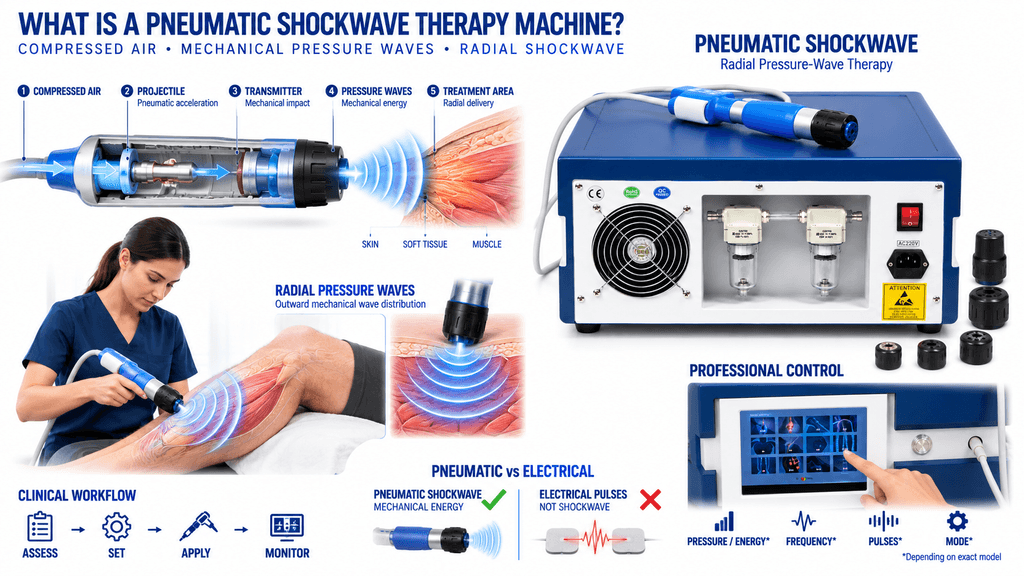
Pneumatic systems generally produce radial pressure waves that spread outward from the applicator into the treatment area.
This makes radial shockwave systems suitable for a variety of superficial and medium-depth musculoskeletal applications, depending on the machine’s output and clinical protocol.
Adjustable Pressure
Many pneumatic systems allow the operator to adjust treatment pressure. Current product examples range from approximately 3 bar to 10 bar, demonstrating that specifications vary considerably between models.
Adjustable Frequency
Shockwave frequency is another important parameter. Available systems commonly offer ranges such as 1–15 Hz or 1–22 Hz, depending on the model.
Key Features of Pneumatic Shockwave Therapy Machine
Pneumatic Shockwave Generation
The system uses pneumatic technology to generate controlled mechanical pressure waves through the treatment handpiece.
Adjustable Treatment Pressure
Depending on the model, therapists can adjust pressure intensity to suit the treatment protocol and patient tolerance.
Variable Frequency
Adjustable frequency allows professionals to control the number of shockwave impulses delivered per second.
Multiple Applicator Heads
Many professional systems are supplied with interchangeable applicator heads of different sizes. For example, some current systems provide five applicators ranging from approximately 6 mm to 25 mm.
Digital or Touchscreen Control
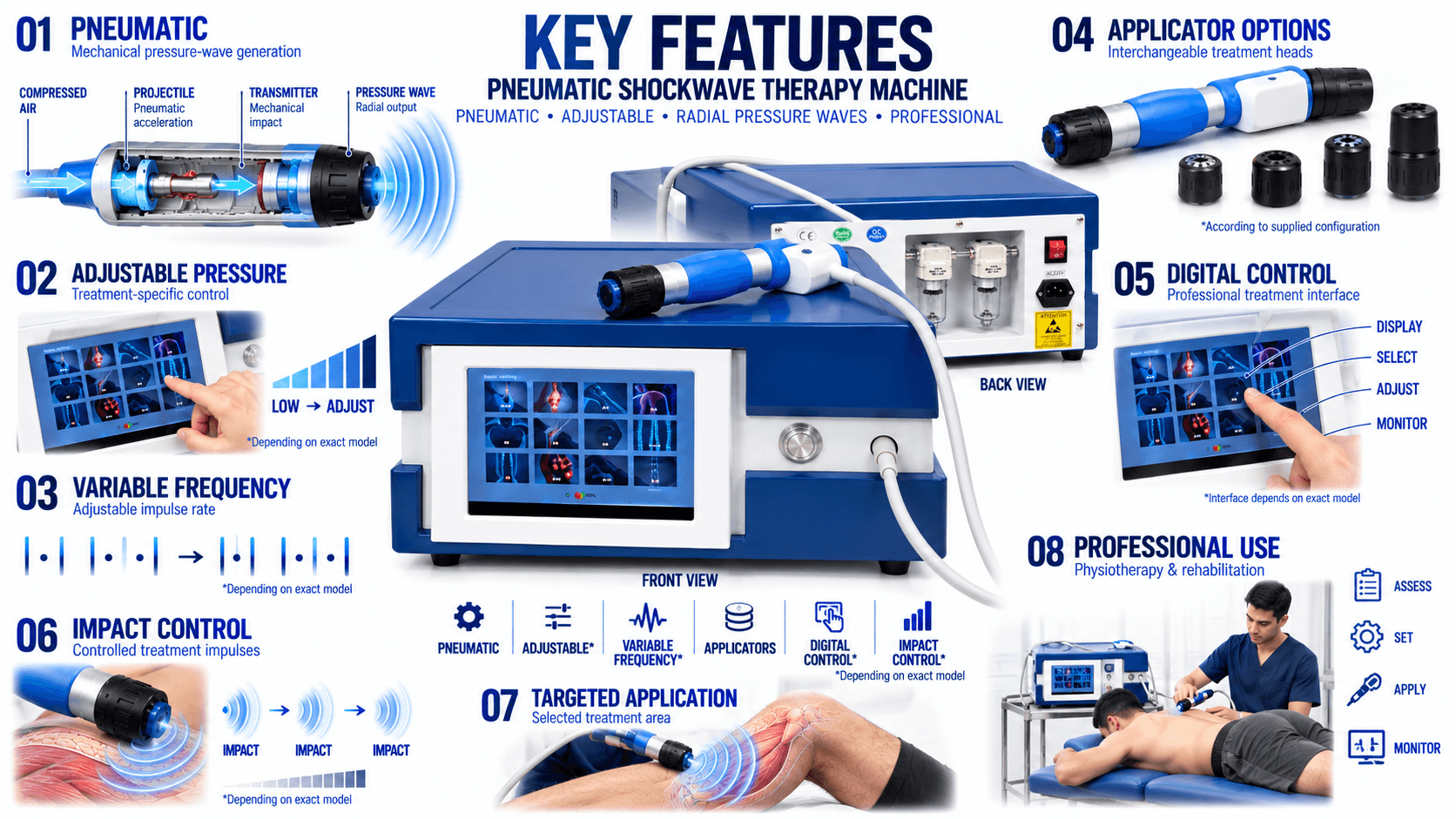
Depending on the model, treatment settings may be managed through a digital control panel or touchscreen interface.
Pulse / Impact Control
Some systems allow the therapist to select a defined number of impacts for a treatment session. Certain systems provide ranges such as 500–3000 impacts.
Targeted Treatment Delivery
The handpiece and applicator system allows mechanical pressure waves to be applied to a selected anatomical area.
Professional Clinical Design
The machine can be integrated into physiotherapy clinics, rehabilitation centers, orthopedic practices, and sports therapy environments.
Applications of Pneumatic Shockwave Therapy Machine
The Pneumatic Shockwave Therapy Machine may be incorporated into professional rehabilitation programs for selected musculoskeletal and soft-tissue conditions.
Plantar Fascia-Related Conditions
Radial shockwave therapy is commonly incorporated into physiotherapy programs addressing plantar fascia-related pain and heel conditions.
Tendon-Related Conditions
Shockwave therapy may be considered for selected tendinopathies and tendon rehabilitation programs under professional assessment.
Tennis Elbow
Radial shockwave therapy may be incorporated into rehabilitation programs for appropriate elbow and tendon-related conditions.
Shoulder Rehabilitation
Depending on clinical assessment, shockwave therapy can be used as one component of selected shoulder rehabilitation programs.
Muscle and Myofascial Applications
The mechanical stimulus can be applied to selected muscle and myofascial areas according to professional treatment protocols.
Sports Rehabilitation
Sports physiotherapy clinics may incorporate pneumatic shockwave therapy into rehabilitation programs for selected overuse and soft-tissue conditions.
Orthopedic Rehabilitation
Orthopedic rehabilitation centers can use shockwave therapy as one modality within a broader rehabilitation plan.
Trigger Point Applications
Certain radial shockwave systems are used for targeted treatment of myofascial areas and trigger points, depending on clinical protocol.
Potential Benefits of Pneumatic Shockwave Therapy
The response to shockwave therapy varies according to the condition, treatment parameters, treatment area, and individual patient factors.
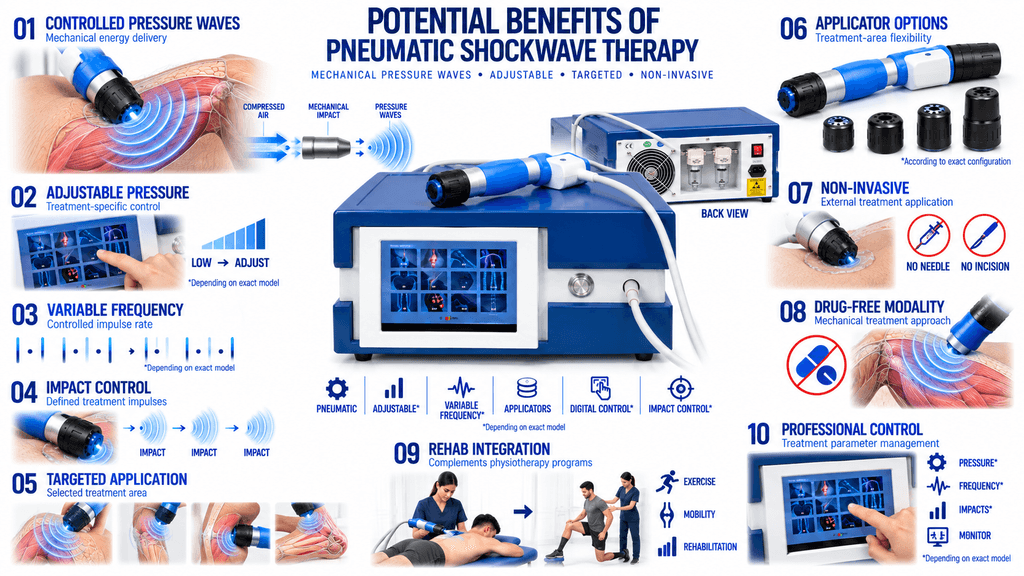
A professional Pneumatic Shockwave Therapy Machine can provide:
- Controlled mechanical pressure-wave delivery
- Adjustable pressure intensity
- Adjustable treatment frequency
- Defined pulse or impact counts
- Targeted applicator-based treatment
- Multiple applicator options on supported models
- Non-invasive treatment application
- Integration with physiotherapy and rehabilitation programs
- A drug-free treatment modality
- Convenient digital parameter management on supported models
Shockwave therapy should be considered as part of an appropriate clinical treatment plan rather than as a guaranteed cure or replacement for diagnosis and active rehabilitation.
Pneumatic Shockwave Therapy Machine for Physiotherapy Clinics
A shockwave system can add a specialized mechanical therapy modality to a professional physiotherapy setup.
Clinics may incorporate shockwave therapy alongside:
- Therapeutic exercise
- Stretching
- Strengthening
- Mobility training
- Manual therapy
- Functional rehabilitation
- Sports rehabilitation
- Postural training
- Other appropriate physiotherapy modalities
The combination of passive and active rehabilitation can allow therapists to develop treatment programs based on individual clinical requirements.
When selecting a Pneumatic Shockwave Therapy Machine, clinics should review pressure range, frequency range, impact count, applicator options, user interface, handpiece design, replacement components, warranty, and technical support.
Radial Shockwave vs Other Shockwave Systems
Shockwave technology is available in different configurations, and terminology can vary between manufacturers.
| Feature | Pneumatic Radial Shockwave |
|---|---|
| Energy Generation | Pneumatic / compressed-air mechanism |
| Wave Type | Radial pressure waves |
| Applicator | Handpiece with transmitter |
| Pressure Control | Model-dependent |
| Frequency | Model-dependent |
| Impact Count | Model-dependent |
| Applicators | One or multiple, depending on model |
| Main Use | Physiotherapy and rehabilitation |
| Operator | Trained professional |
It is important not to assume that every machine marketed as a “shockwave” system has the same technology or clinical characteristics.
How to Use a Pneumatic Shockwave Therapy Machine
The machine should be operated only by a trained professional who understands shockwave therapy, treatment parameters, contraindications, and the manufacturer’s instructions.
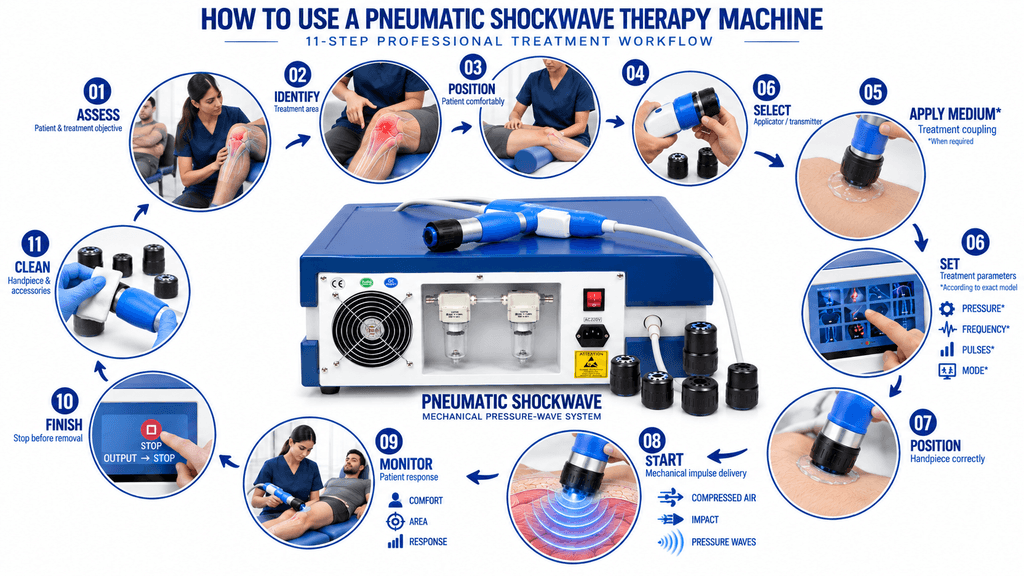
Step 1: Assess the Patient
Review the patient’s condition, treatment history, relevant contraindications, and treatment objective.
Step 2: Identify the Treatment Area
Determine the appropriate anatomical area according to the clinical assessment.
Step 3: Position the Patient
Place the patient in a comfortable and clinically appropriate position.
Step 4: Select the Applicator
Choose the appropriate transmitter or applicator according to the treatment area and machine instructions.
Step 5: Apply Suitable Coupling Medium
Use the manufacturer-recommended coupling medium if required for the specific system.
Step 6: Set Treatment Parameters
Select the appropriate pressure, frequency, pulse count, and treatment mode according to the clinical protocol.
Step 7: Position the Handpiece
Place the applicator over the selected treatment area using the recommended technique.
Step 8: Start Treatment
Activate the machine and deliver the mechanical impulses according to the selected settings.
Step 9: Monitor Patient Response
Observe patient comfort and treatment response throughout the session.
Step 10: Finish the Session
Stop the treatment before removing the applicator from the treatment area.
Step 11: Clean the Equipment
Clean the handpiece and applicable accessories according to the manufacturer’s maintenance instructions.
Safety Precautions
Shockwave therapy requires appropriate patient assessment and professional operation.
- Treatment should be performed by trained healthcare professionals.
- Follow the manufacturer’s contraindications.
- Review the patient’s relevant medical history before treatment.
- Begin with appropriate treatment parameters according to the clinical protocol.
- Monitor patient tolerance throughout treatment.
- Use only compatible applicators and accessories.
- Inspect the handpiece, cables, and applicators before use.
- Do not use damaged equipment.
- Follow the manufacturer’s maintenance instructions.
- Avoid treating areas where shockwave therapy is contraindicated.
- Use additional caution where there are relevant bleeding risks or other medical considerations.
- Follow professional guidance for patients taking anticoagulant medication or with bleeding disorders.
- Do not modify the pneumatic system or handpiece.
- Keep the machine and accessories maintained according to the manufacturer’s instructions.
The exact contraindications and precautions vary according to the device and patient circumstances.
Technical Specifications
Specifications vary significantly between pneumatic shockwave models. Current product examples show systems with different pressure and frequency ranges, so the exact product datasheet should be checked before publishing fixed specifications.
| Specification | Details |
|---|---|
| Product Name | Pneumatic Shockwave Therapy Machine |
| Therapy Type | Radial Shockwave / Pressure Wave Therapy |
| Technology | Pneumatic Shockwave |
| Shock Type | Radial |
| Pressure Range | Model-Dependent |
| Frequency Range | Model-Dependent |
| Impact / Pulse Count | Model-Dependent |
| Applicator Heads | Model-Dependent |
| Display | Digital / Touchscreen, Model-Dependent |
| Treatment Modes | Model-Dependent |
| Power Supply | Model-Dependent |
| Handpiece | Pneumatic Shockwave Applicator |
| Intended Application | Physiotherapy & Rehabilitation |
| Intended Operator | Trained Healthcare Professional |
For reference, currently listed pneumatic systems include examples with 0.5–8 bar and 1–22 Hz, while another listed system specifies 1–22 Hz and up to 10 bar. These figures should not be treated as universal specifications for every Pneumatic Shockwave Therapy Machine.
Things to Consider Before Buying
Pressure Range
Check the machine’s minimum and maximum working pressure and ensure the range matches your intended clinical applications.
Frequency Range
Review the available frequency settings and whether they provide the treatment flexibility required by your clinic.
Applicator Heads
Check how many applicators are supplied and their available sizes.
Impact Count
Confirm the available pulse or impact-count range if your treatment protocols require defined session counts.
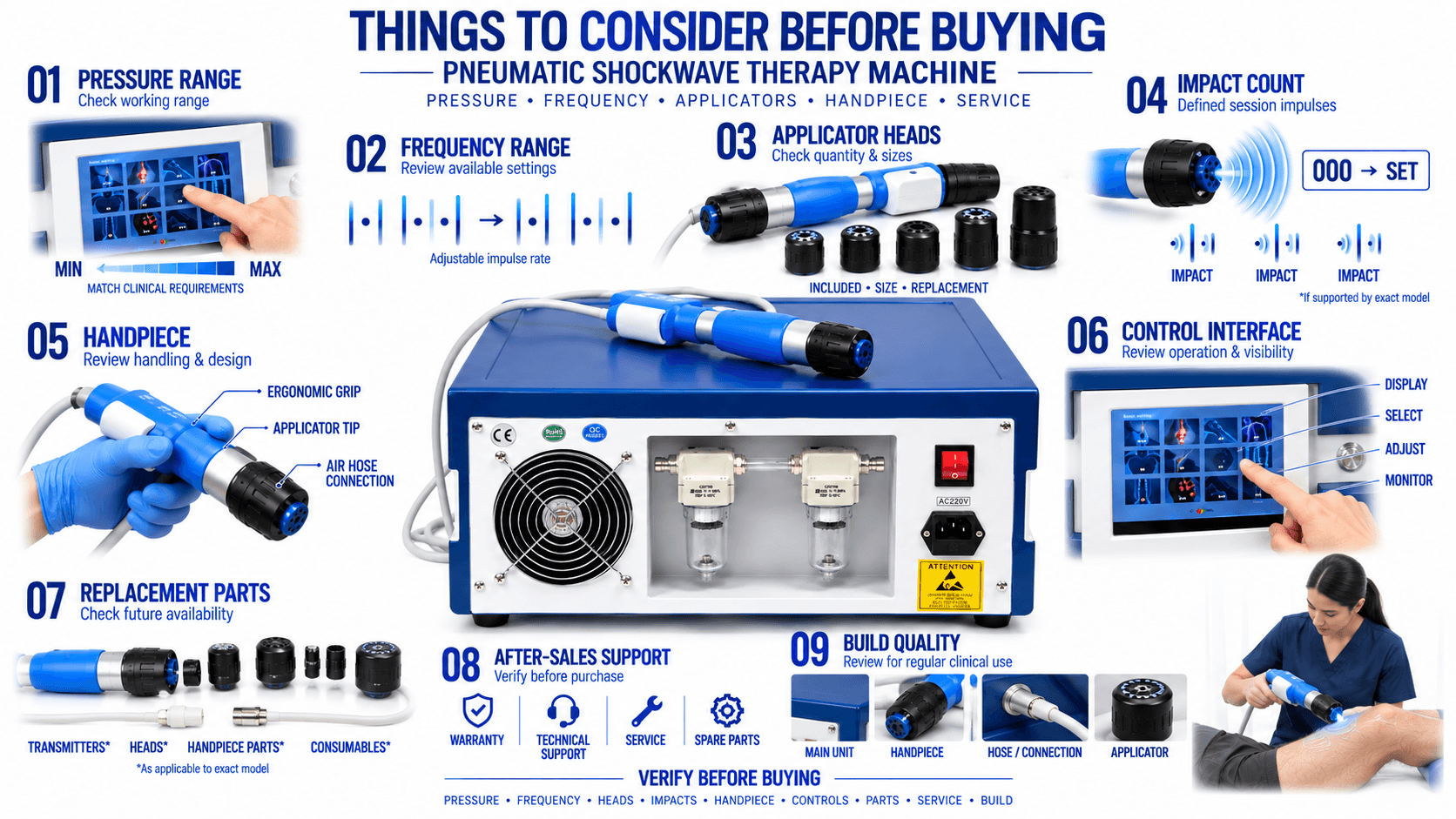
Handpiece Design
An ergonomic handpiece can make repeated clinical operation more practical.
Display and Controls
A touchscreen or digital interface can make parameter selection and monitoring easier.
Replacement Parts
Ask about replacement transmitters, applicator heads, handpiece components, and other consumables.
Warranty and Service
Confirm warranty coverage, technical support, servicing, and replacement-part availability before purchase.
Build Quality
For clinics with frequent daily use, consider the durability of the main unit, handpiece, applicators, and internal pneumatic components.
Who Should Operate a Pneumatic Shockwave Therapy Machine?
The Pneumatic Shockwave Therapy Machine should be operated by appropriately trained physiotherapists or other qualified healthcare professionals.
The operator should understand:
- Shockwave therapy principles
- Radial pressure-wave technology
- Treatment parameters
- Applicator selection
- Patient assessment
- Contraindications
- Treatment positioning
- Patient monitoring
- Equipment safety
- Manufacturer-specific instructions
Appropriate training helps ensure that the equipment is incorporated responsibly into professional treatment programs.
Why Choose PHYSIOMODALITIES™?
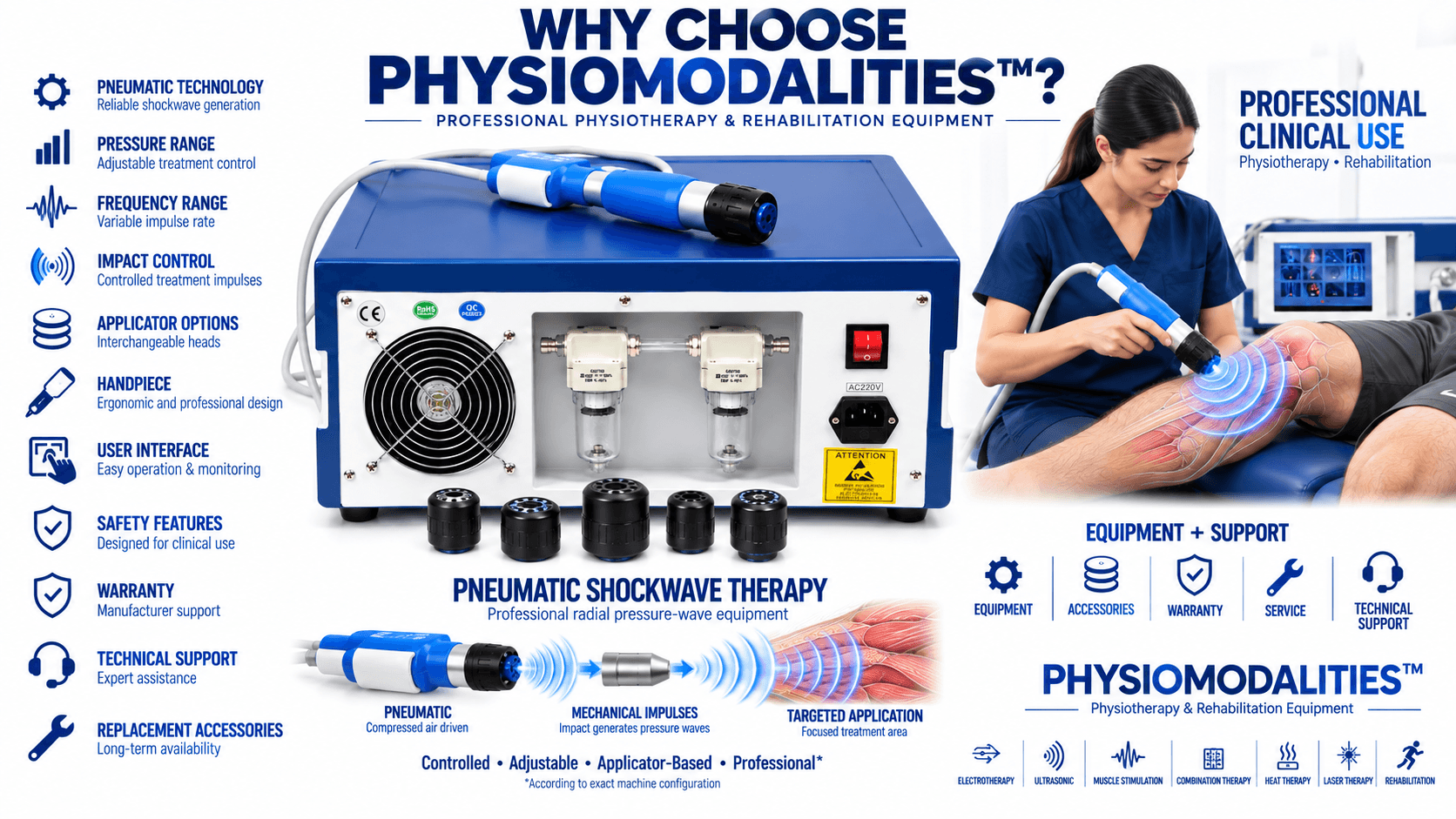
PHYSIOMODALITIES™ provides professional physiotherapy and rehabilitation equipment for clinical treatment environments.
When selecting a Pneumatic Shockwave Therapy Machine, clinics should evaluate more than the basic machine price.
Important factors include:
- Pneumatic technology
- Pressure range
- Frequency range
- Impact count
- Applicator options
- Handpiece quality
- User interface
- Safety features
- Warranty
- Technical support
- Replacement accessories
PHYSIOMODALITIES™ also provides equipment across different physiotherapy categories, including electrotherapy, Ultrasonic Therapy, muscle stimulation, combination therapy, heat therapy, laser therapy, Tecar therapy, and rehabilitation equipment.
Conclusion
The Pneumatic Shockwave Therapy Machine is a professional radial pressure-wave device designed to deliver controlled mechanical impulses for selected physiotherapy and rehabilitation applications.
Its pneumatic mechanism, adjustable treatment parameters, and applicator-based delivery can make it a useful modality within professional musculoskeletal and sports rehabilitation programs.
Before purchasing, clinics should verify the exact pressure range, frequency range, impact count, applicator configuration, handpiece specifications, warranty, and service support of the selected model. Proper professional assessment, training, and adherence to manufacturer instructions are essential for safe clinical operation.
Frequently Asked Questions
1. What is a Pneumatic Shockwave Therapy Machine?
It is a physiotherapy device that uses pneumatic energy to generate controlled radial pressure waves for selected rehabilitation and musculoskeletal treatment applications.
2. How does pneumatic shockwave therapy work?
Compressed air drives a projectile inside the handpiece, creating mechanical pressure waves when the projectile strikes the transmitter.
3. What conditions can shockwave therapy be used for?
It may be incorporated into professional rehabilitation programs for selected tendon, fascia, muscle, and other musculoskeletal conditions, depending on clinical assessment.
4. Can a Pneumatic Shockwave Therapy Machine be used for sports rehabilitation?
Yes. It may be incorporated into sports rehabilitation programs alongside exercise therapy, mobility work, strengthening, and other appropriate physiotherapy interventions.
5. What should I check before buying a Pneumatic Shockwave Therapy Machine?
Check the pressure range, frequency range, impact count, applicator heads, handpiece, display, warranty, technical support, and replacement-parts availability.